Blogs
AI Agent Orchestration for Forward Deployed Engineers
AI Agent Orchestration for Forward Deployed Engineers
By
R&D, FDE Academy
July 10, 2026

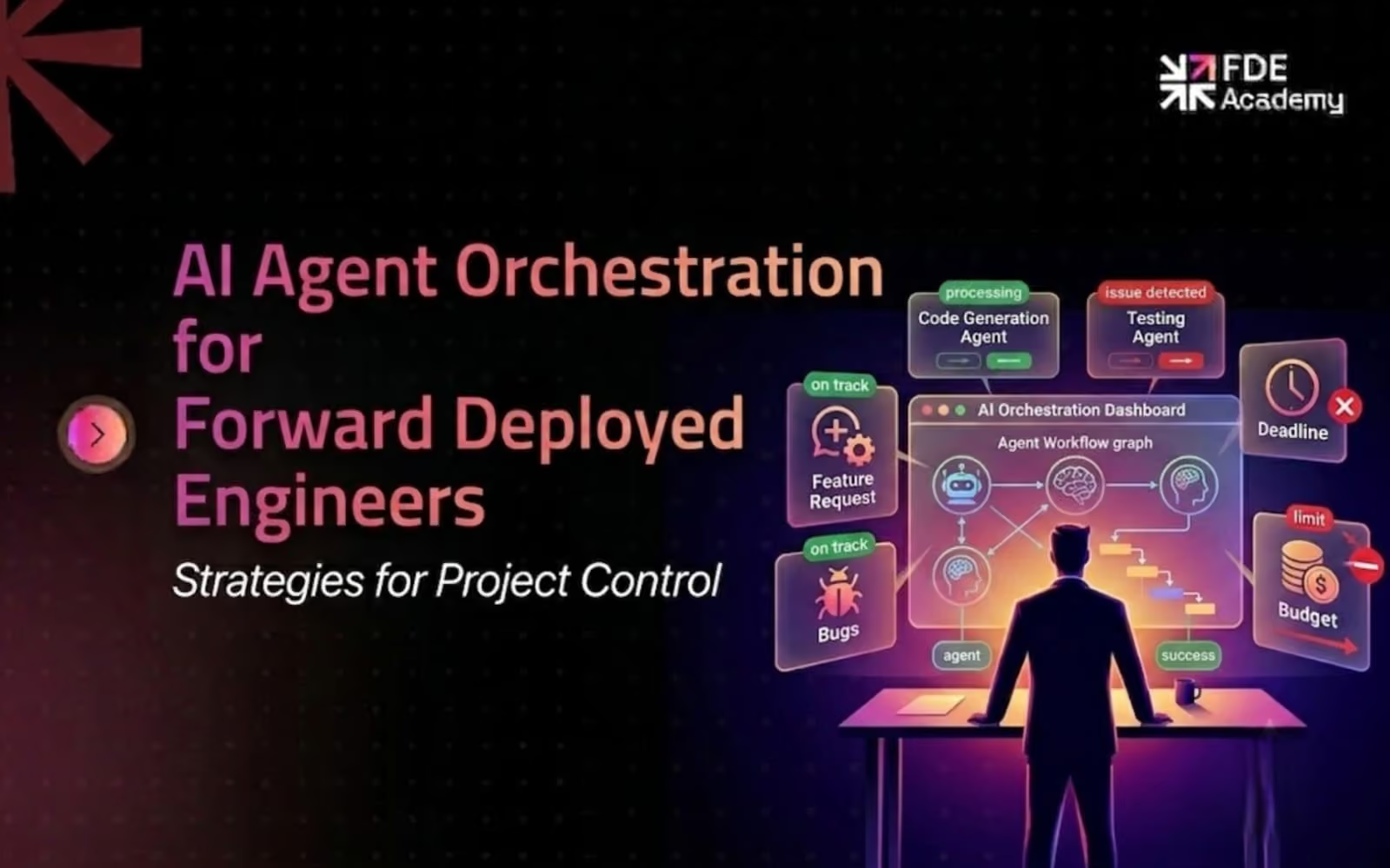
If you're a Forward Deployed Engineer (FDE) shipping AI agents into a real customer's stack, the framework you pick matters far less than the workflow you design.
AI agent orchestration is the layer that determines which agent or tool acts next, how information moves between steps, and what happens when a step fails. In production, weak orchestration can turn a promising agentic AI prototype into an unreliable system.
This guide covers the three orchestration patterns that show up repeatedly in real FDE deployments, how to choose between LangGraph, CrewAI, and Semantic Kernel for a given engagement, and the specific mistakes that turn a working demo into a production incident once real customer data and real failure rates enter the picture. If you're evaluating this alongside a specific role, our OpenAI Forward Deployed Engineer guide covers where orchestration fits into the broader technical bar frontier labs actually screen for.
A single LLM call answering a single question isn't orchestration, it's just inference. Orchestration starts the moment a task requires more than one reasoning step with a decision point in between: retrieve data, decide whether it's sufficient, call a tool, evaluate the tool's output, decide whether to retry or hand off to a human. The orchestration layer manages the sequence, tracks state across steps, and determines what happens next based on the workflow's current state.
For FDEs specifically, orchestration design is inseparable from the customer's actual workflow. A generic RAG chatbot needs minimal orchestration, retrieve, generate, done. A real enterprise deployment, routing 100,000 monthly support tickets across multiple languages, or reconciling three million transactions across bank statements, requires orchestration that can branch, retry, escalate to a human, and maintain state across steps that might span minutes or hours.
Getting this layer right is frequently the difference between a system that works in a demo and one that survives a customer's actual data volume and edge cases. It's also why agent orchestration shows up consistently as a required skill across Forward Deployed Engineer vs Applied AI Engineer postings and is a common topic in Forward Deployed Engineer interviews, it's one of the few technical areas that reliably separates candidates who've shipped real systems from those who've only prototyped with a framework's quickstart example.
The simplest pattern: agent A's output becomes agent B's input, in a fixed, predetermined order. A document processing pipeline that extracts text, then classifies the document type, then routes it to a type-specific handler is sequential orchestration.
This pattern is easy to reason about, easy to debug (you can trace exactly where a failure happened by looking at which step in the sequence produced bad output), and easy to test in isolation, since each step has clear inputs and outputs.
Sequential orchestration is the right default whenever the workflow genuinely has a fixed order and no need for dynamic branching. Reaching for a more complex pattern when sequential would work is one of the most common over-engineering mistakes in early FDE deployments.
A supervisor agent receives a task, decides which specialized sub-agent (or sub-agents) should handle it, and synthesizes their outputs into a final response. This pattern fits workflows where the right next step genuinely depends on the specifics of the input, a customer support router that decides whether a ticket needs a billing specialist agent, a technical support agent, or an escalation to a human, rather than always following the same fixed sequence.
The tradeoff: supervisor patterns are harder to debug than sequential ones, since the supervisor's routing decision is itself a point of potential failure, and tracing why a request went to the wrong sub-agent requires inspecting the supervisor's own reasoning, not just the sub-agent's output. This pattern earns its complexity when routing logic genuinely needs to be dynamic and learned rather than rule-based; if you can express the routing logic as a simple if-else tree, a supervisor agent is usually unnecessary overhead.
Agents pass control to each other directly, without a central supervisor coordinating the handoff, each agent decides when it's done with its part and which agent (or human) should take over next. This pattern fits workflows that genuinely resemble a real organizational process, a claims-processing workflow where an intake agent hands off to a verification agent, which hands off to either an approval agent or a human reviewer depending on risk score.
Hand-off orchestration scales better than a single supervisor as the number of possible next-steps grows, since you're not funneling every routing decision through one central bottleneck, but it requires more careful state management, since context needs to travel cleanly across every hand-off without any agent losing track of what's already been established earlier in the chain.
LangGraph models orchestration as an explicit state graph, nodes are steps, edges define transitions, and state is a shared object that updates as execution moves through the graph.
This makes LangGraph the strongest choice when a deployment needs precise, inspectable control over exactly how state moves between steps, particularly for supervisor and hand-off patterns with genuinely complex branching logic. The tradeoff is a steeper learning curve and more upfront design work compared to the alternatives below.
CrewAI is built around the metaphor of a team of agents with defined roles collaborating on a shared goal, and it's noticeably faster to prototype with for straightforward sequential or simple supervisor patterns, since the framework handles a lot of the coordination boilerplate for you.
This makes it a strong choice for earlier-stage deployments or proof-of-concept work where speed to a working version matters more than fine-grained control over every state transition, though it's typically less flexible than LangGraph for genuinely complex, deeply branching hand-off patterns.
Semantic Kernel integrates most naturally into Microsoft-stack environments (Azure OpenAI, .NET, or enterprise customers already standardized on Microsoft tooling), and its plugin-based architecture fits particularly well when a deployment needs to integrate cleanly with existing enterprise systems that are also Microsoft-centric.
For FDEs deploying into large enterprises with an existing Azure footprint, this integration fit frequently outweighs any framework-level feature difference against LangGraph or CrewAI.
The practical decision for most FDE engagements: default to whichever framework the rest of your team already has production experience with, since orchestration bugs are expensive to debug regardless of framework, and familiarity reduces the odds of a subtle state-management mistake more than any specific framework's feature set does.
Reach for LangGraph specifically when the customer's workflow has genuinely complex branching that needs precise state control; reach for CrewAI when speed to a working prototype matters most; reach for Semantic Kernel when the customer's existing stack makes it the natural integration fit.
AI Agent Orchestration for Forward Deployed Engineers cannot rely on the assumptions found in generic orchestration tutorials, which typically assume clean, controlled environments. Real customer deployments are far messier and require orchestration decisions that account for business constraints, legacy systems, and constantly changing requirements. Three differences matter specifically:
Data is messier than the framework's examples assume: A supervisor agent routing logic that works cleanly on well-formatted test data frequently breaks on a customer's actual inputs, inconsistent formatting, missing fields, documents in a second language nobody mentioned during discovery. Orchestration logic needs explicit handling for the malformed and unexpected case, not just the happy path a framework's quickstart guide demonstrates.
Failure has to degrade gracefully, not just retry: In a demo, a failed agent call can just retry until it works. In production, a failed step in a claims-processing hand-off chain needs a defined fallback: escalate to a human, return a partial result with a clear flag, or roll back cleanly, not silently retry indefinitely while a customer's real transaction sits in limbo.
State needs to survive across sessions, not just a single request: Many enterprise workflows span minutes to hours, a claims review might wait on a human approval step before continuing. Orchestration state needs to persist reliably across that gap, which is a meaningfully different engineering problem than the single-request, single-response pattern most orchestration tutorials demonstrate.
Reaching for multi-agent when single-agent-with-tools would work: The most common over-engineering mistake. If a single well-designed agent with the right tool access can handle a workflow, adding a supervisor and multiple sub-agents adds complexity and failure surface without adding capability.
No observability into which agent made which decision: When a hand-off chain produces a wrong final answer, being able to trace exactly which agent's output introduced the error is essential for debugging, and it's frequently missing from early-stage deployments built for speed rather than production reliability.
Treating orchestration framework choice as permanent: Committing deeply to one framework's specific abstractions early, before the customer's real workflow complexity is fully understood, tends to require painful rework once real requirements diverge from initial assumptions. Keeping the core business logic reasonably decoupled from the specific orchestration framework's API pays off when (not if) the framework choice needs to change.
Underestimating context window and cost accumulation in long hand-off chains: Each hand-off in a chain that passes full context forward can compound token usage quickly, both a cost problem and, past a certain length, a genuine model-performance problem as context grows unwieldy. Deliberately summarizing or pruning context at hand-off boundaries, rather than passing everything forward by default, is a frequently-skipped step that becomes expensive at scale.
AI Agent Orchestration for Forward Deployed Engineers is less about which framework you choose and more about matching the orchestration pattern to the actual shape of the customer's workflow- using sequential orchestration when the order is genuinely fixed, supervisor models when routing decisions need to be dynamic, and hand-off patterns when the process mirrors a real organizational chain of responsibility.
The success of agent systems in enterprise deployments depends far more on aligning orchestration with business processes than on selecting a specific agent framework or tooling stack.
The frameworks (LangGraph, CrewAI, Semantic Kernel) are implementation details that matter less than getting this fundamental match right, and than building in graceful failure handling and observability before a customer's real data volume exposes the gaps a clean demo never revealed.
The layer that manages how multiple AI agent steps connect: which agent runs when, how state and context pass between them, and what happens when one step's output needs to inform the next. For FDEs, this design is shaped directly by a specific customer's real workflow, not a generic pattern applied uniformly.
Default to a single, well-designed agent with the right tool access unless the workflow genuinely requires different specialized reasoning at different stages, or dynamic routing based on input characteristics that a single agent's prompt can't cleanly handle. Multi-agent orchestration adds complexity and failure surface that should be earned by genuine workflow need, not added by default.
LangGraph fits deployments needing precise, inspectable control over complex branching logic. CrewAI fits faster prototyping of straightforward sequential or simple supervisor patterns. Semantic Kernel fits enterprise customers already standardized on Microsoft's stack. Team familiarity with a given framework often matters more than feature differences between them.
A supervisor pattern has one central agent deciding which sub-agent handles each task and synthesizing results. Hand-off orchestration lets agents pass control to each other directly without a central coordinator, which scales better as the number of possible next-steps grows but requires more careful state management across each transition.
Real customer data is messier than framework examples assume, failures need graceful, defined fallbacks rather than simple retries, and state frequently needs to persist across long gaps (like waiting on human approval) rather than existing only within a single request-response cycle.
Reaching for a multi-agent, supervisor-based architecture when a single well-designed agent with proper tool access would handle the workflow just as well, with less complexity and fewer failure points to debug later.
The world is hiring - and this Academy prepares you for it.