Blogs
AI Change Management: Getting Users to Adopt Deployed AI
AI Change Management: Getting Users to Adopt Deployed AI
By
R&D, FDE Academy
October 8, 2026

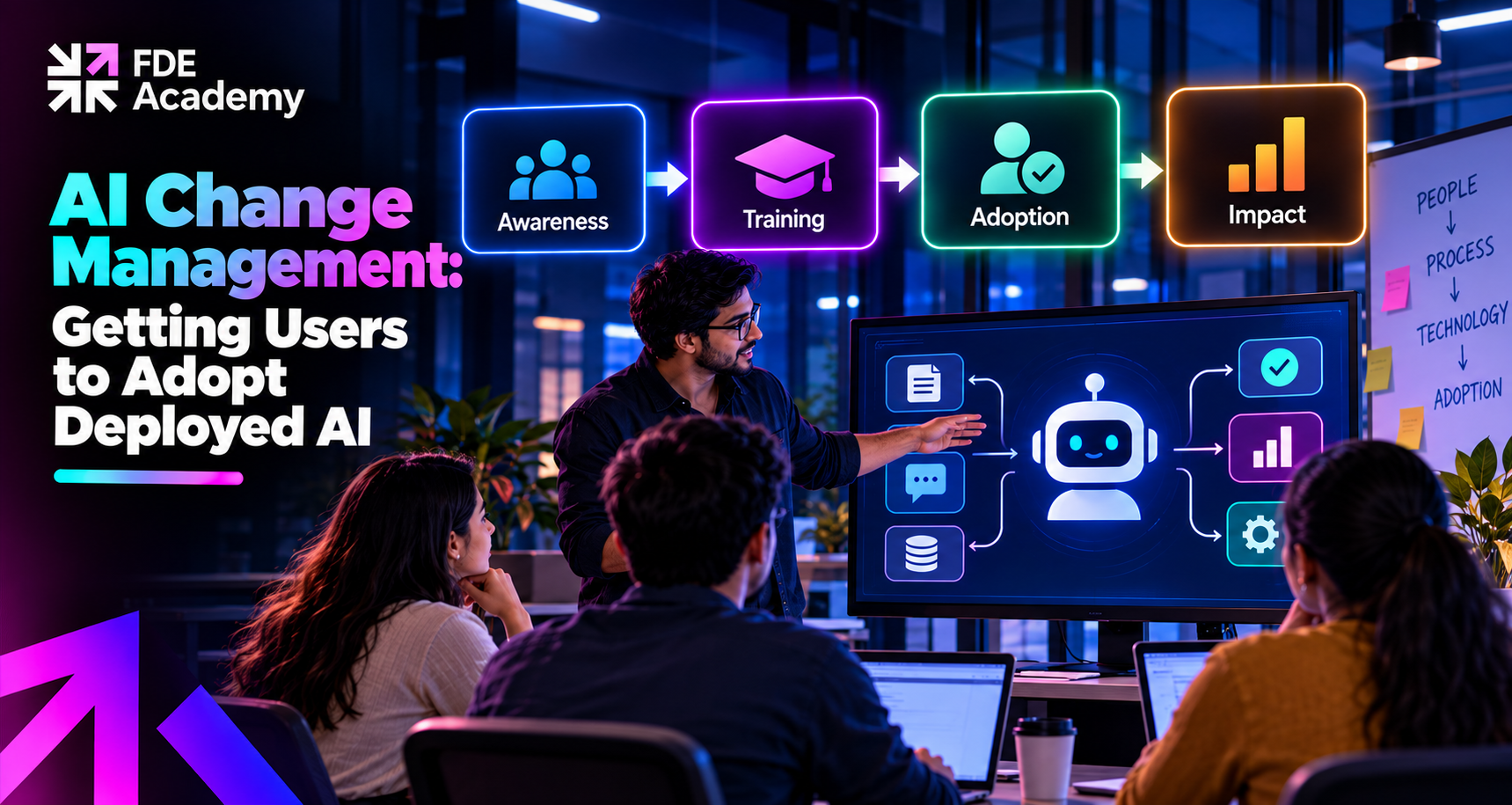
Most teams track whether an AI system is live. Fewer track whether anyone uses it. The difference between "deployed" and "adopted" is where a lot of enterprise value quietly disappears. A dashboard nobody opens, a copilot used twice, or an agent that employees bypass in favour of a consumer chatbot all count as deployed.
We covered the causes in why enterprise AI adoption fails: solving the wrong problem, losing trust after an early mistake, adding workflow friction, and having no owner after launch. This article is the practical follow-up. It sets out how to manage the human side so the system earns its place. The wider picture of why projects stall is in why AI projects fail and how FDEs fix it.
AI change management is the structured practice of preparing, equipping, and supporting people to adopt AI systems in their daily work, so that a technical deployment becomes a lasting change in behaviour. It covers communication, sponsorship, training, workflow redesign, feedback, and measurement.
It differs from classic change management in a few ways. AI outputs are probabilistic, so trust has to be earned and recalibrated. Tools evolve quickly, so training cannot be a one-off. Employees often have access to consumer AI already, so your sanctioned tool is competing with free alternatives. And fear of job loss is often more explicit than with past software.
Resistance is usually rational. Common sources include:
Prosci's ADKAR model describes five things an individual needs for a change to stick: Awareness, Desire, Knowledge, Ability, and Reinforcement. It maps well to AI adoption and gives FDEs a checklist.
Lead with the business problem the AI solves, not the technology. Explain what the system will and won't do, and what stays human. Repeat the message, because one announcement is rarely enough.
Broadcast messages usually explain the company's benefit. People ask about theirs: less tedious work, faster answers, fewer errors. Give role-specific answers and let early users share their own wins, which carry more weight than management claims.
Generic webinars fade quickly. Training works better when it is built around tasks people already do, such as preparing a weekly report or responding to a customer, and leaves behind reusable assets like prompt packs, templates, and checklists. Follow-up matters: office hours, refreshers, and practice challenges help skills stick.
Knowing how to use a tool is different from being able to use it on a busy Tuesday. Embed the AI into the systems people already work in, remove avoidable friction first, and pair new users with experienced peers.
Adoption decays without attention. Track usage, recognise people who use the tool well, collect feedback, and refresh use cases as the tool changes.
A Forward Deployed Engineer is close to the users, which is exactly where adoption is won or lost. Several practices follow from that.
Start with real workflows. Spend time watching how work actually happens, including the undocumented steps and workarounds. Design the AI to fit that reality instead of expecting people to change their habits to suit the tool. This is part of what makes the FDE project lifecycle different from a standard IT rollout.
Involve users early. People who help shape a tool are more likely to use it. Run pilots with a small group, take their feedback seriously, and show what changed as a result.
Ship a small win first. A narrow use case that works reliably builds trust faster than a broad one that sometimes fails.
Design for trust. Show sources, signal uncertainty, let people correct outputs, and keep humans in control of consequential actions. These patterns come from LLM guardrails and human-in-the-loop design. Clear policies on approved tools and data handling, covered in AI governance for forward deployed engineers, also reassure people that using the system is safe.
Plan the handover. Name a post-launch owner who is accountable for usage, not just uptime. Without one, adoption tends to drift once the deployment team moves on.
Two roles do much of the work.
Executive sponsors provide visible backing. The most effective ones use the tool themselves and talk about it, rather than signing a memo and disappearing. Prosci's research links stronger leadership support to smoother AI rollouts.
Peer champions are respected colleagues who help others in daily work. Good champions are chosen for credibility, curiosity, and willingness to share their failures, not just technical skill. They collect real examples, run informal sessions, answer practical questions, and flag access or policy problems back to the project team. In smaller organisations, one sponsor and two or three champions can be enough.
If the only metric is "licences deployed" or "go-live date," you will not know whether the project worked. Better measures cover several layers.
Capture baselines for targeted workflows before the pilot begins. Otherwise you cannot show improvement later, and ROI conversations become opinion contests. This links directly to how FDEs improve AI ROI, because adoption is the step that converts a deployed system into measurable value, and to how FDEs improve customer retention, since customers who see sustained usage tend to renew.
A simple structure many teams use is a 90-day rollout:
Treat this as a starting template, not a rule. Timelines depend on the organisation's size and risk tolerance.
Imagine a company deploys an AI copilot that drafts replies for its customer support team. Two months after launch, only a fraction of agents use it, and several admit they still paste tickets into a public chatbot.
An FDE who treats this as a change problem starts by shadowing agents for a few days. The finding: the copilot lives in a separate tab, so using it costs agents extra clicks on every ticket, and its first drafts ignore the company's refund policy, which one agent saw go wrong in week one and told the whole team about.
The fixes follow from the diagnosis. The copilot moves inside the ticketing tool. The policy gap is closed with a retrieval fix and a visible "sources used" panel. Two respected senior agents become champions and run a weekly thirty-minute session using real tickets. The team lead, who had been absent from the rollout, starts using the tool in front of the team. Usage, edit rate on drafts, and handling time are tracked against a pre-launch baseline, and a named owner reviews them every two weeks. Nothing about the model changed. What changed was how well the tool fit the people using it.
AI change management is increasingly part of what separates a good FDE from a purely technical one. It combines user research, communication, training design, and metrics. If you want to build these habits, the practices in habits of successful forward deployed engineers are a good place to start, along with the broader view of how FDEs help enterprises deploy AI.
TL;DR: AI change management is the discipline of getting people to actually use an AI system once it is live. A deployment can pass every technical test and still fail if users ignore it, distrust it, or route around it. The fix is rarely more announcements. It is understanding real workflows, answering "what's in it for me" for each role, training people on their own tasks, using visible sponsors and peer champions, measuring behaviour rather than licences, and keeping an owner accountable after launch. For Forward Deployed Engineers, this work starts in discovery and continues long after go-live
AI change management is the structured practice of preparing, equipping, and supporting people to adopt AI systems in their daily work. It covers communication, sponsorship, training, workflow redesign, feedback, and measurement, so that a technical deployment becomes lasting use.
Common reasons include unclear benefit to their own role, skill and confidence gaps, workflow friction, fear about job security, loss of trust after early mistakes, and the availability of consumer tools that feel easier. Low usage is often a design and support problem rather than a training problem alone.
Start with real workflows, involve users early, give role-specific answers about benefits, train people on their own tasks, use executive sponsors and peer champions, reduce friction, and assign a post-launch owner who tracks usage and feedback.
An AI champion is a respected colleague who helps peers use AI in daily work. They share examples, answer practical questions, run informal sessions, and feed problems back to the project team. Credibility and willingness to share failures matter more than technical expertise.
Go beyond licences deployed. Track active and repeat usage, depth of use, outcome impact such as cycle time or error rates, user sentiment, and leading signals such as shadow AI use. Capture baselines before rollout so you can show change.
FDEs work close to users, so they can observe real workflows, design the system to fit them, run pilots, gather feedback quickly, and iterate. They also help set up training, champions, and post-launch ownership.
The world is hiring - and this Academy prepares you for it.