Blogs
AI Consultant vs Forward Deployed Engineer
AI Consultant vs Forward Deployed Engineer
By
R&D, FDE Academy
August 10, 2026

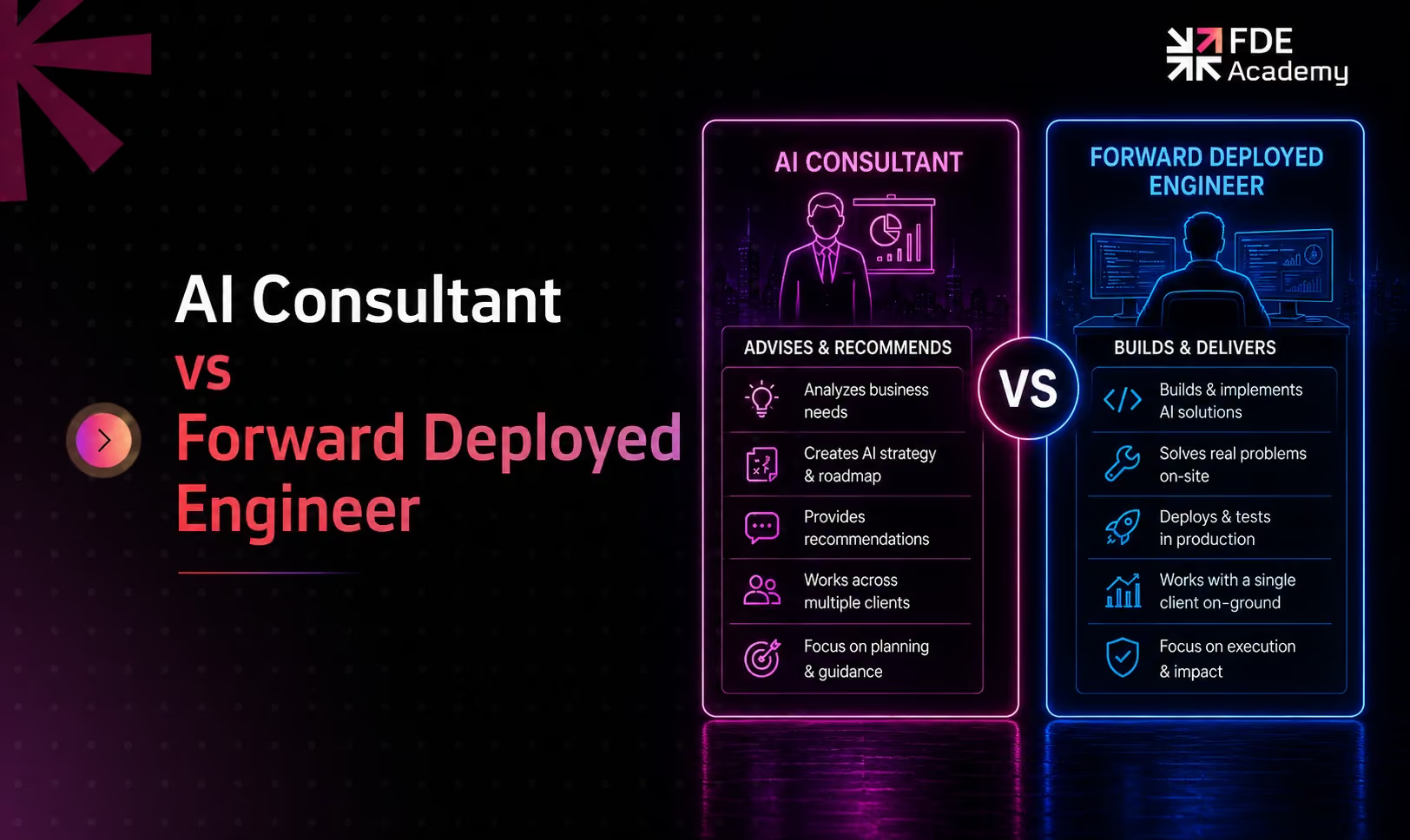
An AI Consultant advises a company on AI strategy: readiness assessment, vendor recommendations, feasibility studies, typically across many clients in relatively short engagements, and typically without writing the production code that implements any of it.
A Forward Deployed Engineer builds and ships the actual system, embedded with one customer at a time, staying accountable through production stabilization. Both roles sit at the intersection of AI and business strategy, but they own fundamentally different halves of the work: one recommends, the other builds.
This distinction matters more now than it did a few years ago, when "AI consultant" often covered both advisory and hands-on work loosely under one title.
As AI adoption has matured, the two functions have separated more clearly: strategy work increasingly stays with traditional consulting firms and specialized advisory boutiques, while hands-on deployment work has consolidated into the dedicated FDE title at companies serious about actually shipping AI systems, not just recommending them.
AI Consultants, typically employed by large consulting firms (McKinsey, Deloitte, Accenture, BCG) or specialized AI advisory boutiques, help companies figure out their AI strategy before, or instead of, actually building anything.
The work centers on assessment: evaluating whether a company is ready for AI adoption, recommending which vendors or approaches fit a specific business problem, running feasibility studies, and producing strategic recommendations, typically presented as a report or deck rather than a working system.
The engagement model reflects this scope: AI Consultants typically work across multiple clients simultaneously or in short, sequential engagements measured in weeks, billing hours or a fixed project fee for the advisory work itself, with implementation, if it happens at all, handed to a separate team or vendor.
A typical AI Consultant engagement follows a recognizable arc: a discovery phase interviewing stakeholders across a client's organization, a current-state assessment identifying gaps and opportunities, a market scan comparing available vendors and approaches, and a final recommendation, often including a phased roadmap, presented to leadership.
The consultant's job is largely finished once that recommendation is delivered and accepted; whoever implements it, an internal team, a vendor, sometimes an FDE, is a separate question the consultant typically isn't accountable for answering.
A Forward Deployed Engineer builds and owns the actual AI system inside one customer's environment: discovery, integration, evaluation, production deployment, and staying engaged through stabilization.
Unlike an AI Consultant's advisory output, an FDE's deliverable is a working system, not a recommendation about what a working system should look like.
FDEs typically work with one customer at a time for an extended engagement, weeks to months, embedded closely enough to write production code against that customer's actual data and systems, not a hypothetical implementation plan.
Our guide comparing FDE vs Solutions Engineer, Sales Engineer, and Customer Success Engineer covers the broader consulting-adjacent title landscape, including Technical Consultant, this piece focuses specifically on the AI strategy advisory end of that spectrum.
An FDE's engagement arc looks structurally different from a consultant's: discovery still happens, but it feeds directly into a technical scoping decision the FDE will personally execute, not a recommendation handed to someone else.
The middle of the engagement is spent building, debugging, and iterating against real production constraints, and the engagement doesn't end at a decision point, it ends once the system is genuinely stable and the customer's own team can operate it independently. Accountability for whether the recommendation actually worked sits with the same person who made it.
AI Consultant compensation varies enormously by firm tier. At top-tier strategy consulting firms, senior AI consultants can earn $150,000 to $250,000+ in base salary, with total compensation reaching higher at partner or principal levels, though these figures reflect consulting-industry compensation structures generally, not AI-specific premiums.
Boutique AI advisory roles typically pay less than the major firms, often in the $120,000 to $180,000 base range.
Forward Deployed Engineer compensation, particularly at frontier AI labs, runs comparably high or higher for equivalent seniority: OpenAI and Anthropic FDE roles pay $350,000 to $550,000 in total compensation at mid-to-senior levels. See our Forward Deployed Engineer salary guide for the full breakdown by level and market.
The compensation gap reflects genuine scarcity in the combined skill set FDE work requires, production engineering depth plus customer-facing judgment, a rarer combination than strategic advisory skill alone.
Career progression also differs structurally between the two paths. Consulting compensation growth is heavily tied to firm tenure and promotion cycles, moving from associate to manager to partner on a relatively predictable, multi-year timeline set largely by the firm.
FDE compensation growth is more directly tied to demonstrated deployment track record and company tier, an engineer with a strong portfolio of shipped, successful deployments can move to a higher-paying company faster than the fixed promotion cadence a consulting firm typically imposes.
Hire an AI Consultant when a company genuinely doesn't yet know what it should build, needs an outside, structured assessment of AI readiness, or is comparing vendors before committing to any specific technical approach. This work matters most early, before a technical direction has been chosen.
Hire a Forward Deployed Engineer once a company has decided what to build and needs someone to actually build and ship it inside a specific, real environment. FDE work matters most after the strategic question has been answered and the harder problem, making it actually work, begins.
Many companies genuinely need both, at different points, and the mistake worth avoiding is treating one as a substitute for the other. Engaging an AI Consultant to produce a comprehensive strategy deck and then handing it to an internal team with no dedicated deployment ownership frequently produces the exact stalled-pilot outcome consulting engagements are meant to prevent, the strategy was sound, but nobody owned turning it into a working system.
Similarly, bringing in an FDE before any strategic direction exists risks technically excellent execution of the wrong plan. The sequence matters: consulting-driven strategy first, FDE-driven execution second, with a clean handoff between them rather than either role trying to cover both halves alone.
Yes, and the transition is increasingly common as AI consulting engagements themselves shift toward requiring more hands-on implementation credibility. AI Consultants already carry genuinely valuable skills, structured problem framing, stakeholder communication, business context fluency, but need to close a real gap: production coding depth, since consulting work rarely requires writing code that ships to real users, and comfort owning a system's outcome rather than handing off a recommendation and moving to the next client.
The fastest way to close this gap: build and deploy a real, working system, not another strategy deck, that touches real data and includes genuine production concerns (error handling, evaluation, monitoring).
That single artifact demonstrates the builder capability an FDE role actually tests for, something a consulting track record, however strong, doesn't demonstrate on its own.
Interviewers evaluating a consultant-background candidate for an FDE role typically probe specifically for this gap: expect direct questions about the last time you personally wrote and shipped production code, not architected or recommended, actually wrote and shipped, and be ready with a concrete, specific answer rather than a description of a project you oversaw.
Candidates who can point to genuine hands-on building, even a smaller side project outside their formal consulting role, interview meaningfully better than those whose entire track record is advisory, regardless of how sophisticated that advisory work was.
AI Consultants focus on AI strategy, assessments, vendor selection, and recommendations, while Forward Deployed Engineers focus on building, deploying, and stabilizing AI systems in real customer environments. Consultants typically work across multiple clients and deliver strategic advice, whereas FDEs work closely with one customer and remain accountable for the system's production outcome.
Neither role replaces the other. Companies often benefit from AI Consultant-led strategy followed by FDE-led implementation. AI Consultants can also transition into FDE roles by developing strong production coding, deployment, and hands-on engineering experience.
An AI Consultant advises on AI strategy and typically doesn't write production code. A Forward Deployed Engineer builds and ships the actual system, embedded with one customer through production stabilization.
At comparable seniority, FDE roles at frontier AI labs typically pay more, $350,000 to $550,000 total compensation versus $150,000 to $250,000+ base for senior AI consultants at top firms, reflecting the scarcer combination of production engineering and customer-facing skill FDE work requires.
Rarely as a core part of the role. Some AI Consultants have technical backgrounds and may build prototypes or proofs of concept, but the primary deliverable is strategic advice, not a shipped production system.
When the company doesn't yet know what to build, needs an AI readiness assessment, or is comparing vendors and approaches before committing to a technical direction. This work happens before implementation, not instead of it.
Yes, a common and increasingly credible transition. The main gap to close is production coding depth and comfort owning a system's real-world outcome, since consulting work rarely requires shipping code to real users.
Not exactly, though they overlap. Our guide comparing FDE vs Solutions Engineer, Sales Engineer, and Customer Success Engineer covers Technical Consultant specifically as one of several adjacent titles; AI Consultant, as covered here, sits further toward the advisory/strategy end than most Technical Consultant roles.
The world is hiring - and this Academy prepares you for it.