Blogs
AI Governance for Forward Deployed Engineers
AI Governance for Forward Deployed Engineers
By
R&D, FDE Academy
August 7, 2026

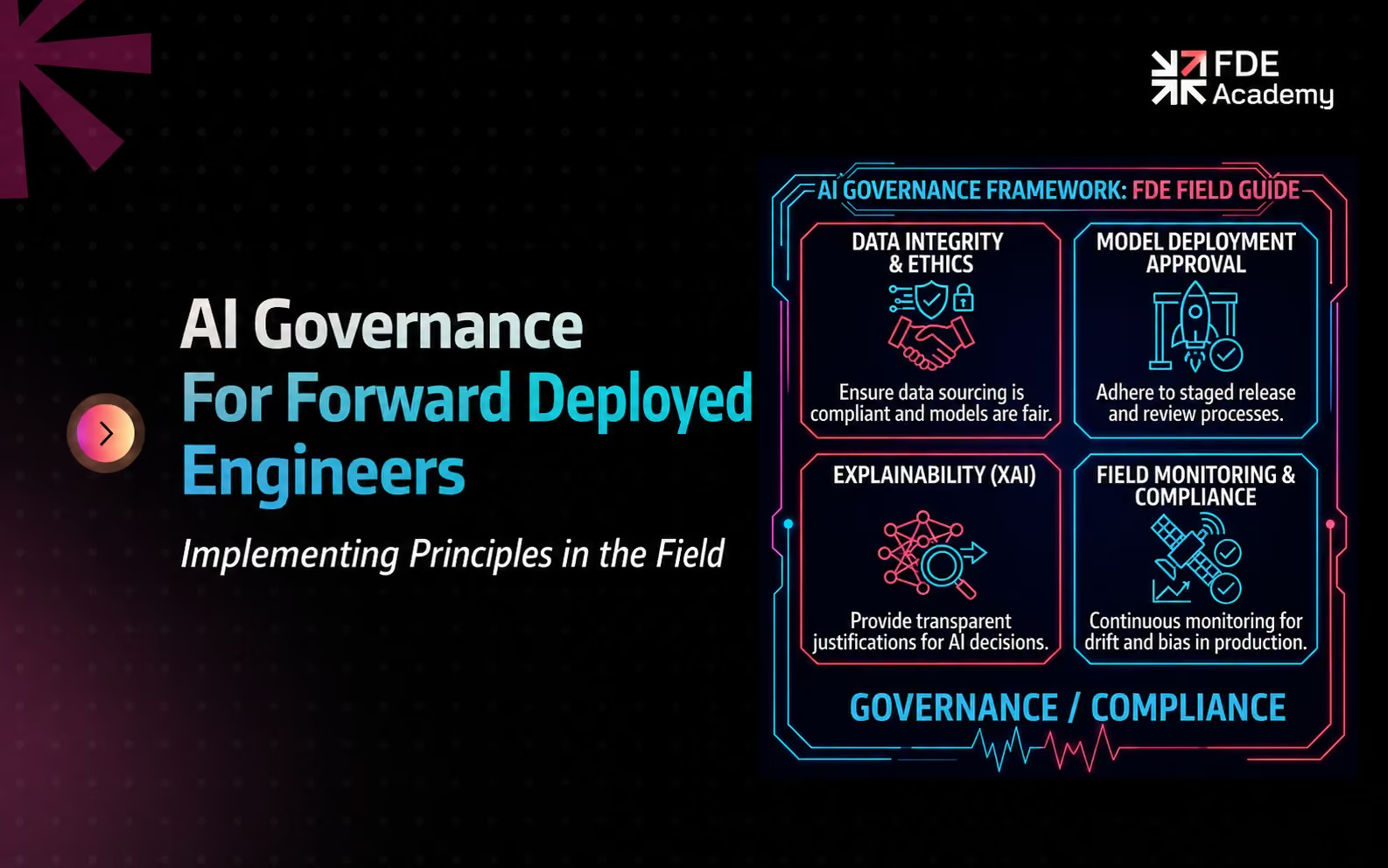
AI governance conversations usually happen in legal and compliance departments, but the actual work of implementing governance, building the audit trails, scoping the access controls, documenting the evaluation criteria, falls to whoever is writing the code.
For a Forward Deployed Engineer, that's you. This guide covers what AI governance actually means operationally, not as legal theory, but as the specific things an FDE builds, documents, and coordinates on during a real deployment.
A customer's legal and compliance team can write a policy stating that AI decisions must be explainable and auditable. They cannot make that true in the running system, that requires specific technical choices: logging what data a model saw, documenting why a particular output was generated, and building the evaluation infrastructure that proves a system behaves within agreed boundaries.
An FDE sits at exactly the point where policy has to become implementation, which means governance isn't a compliance checkbox handled elsewhere, it's a design constraint that shapes the actual system being built.
This distinction matters because FDEs who treat governance as someone else's problem consistently build systems that pass an initial demo but fail a compliance review months later, when a customer's audit team asks for evidence the FDE never thought to capture.
Building governance into the deployment from the start is dramatically cheaper than retrofitting it once a regulator or internal audit asks a question the system wasn't designed to answer.
The stakes here have risen specifically as enterprise AI adoption has matured. Early pilots, run in controlled environments with synthetic or limited data, rarely triggered a formal governance review.
Production systems handling real customer data, real decisions, and real regulatory exposure are a different category entirely, and the gap between pilot-era governance habits and production-grade requirements is exactly where many otherwise-successful deployments stall during their compliance review.
Data access and residency. Which data the deployed system can see, where that data physically lives, and whether it can leave a specific boundary (a customer's VPC, a specific geographic region) are governance decisions with direct architectural consequences. An FDE implements these as concrete infrastructure choices, not abstract policy statements.
Getting this wrong isn't a minor documentation gap, a system that inadvertently sends data outside an agreed boundary is a genuine incident, not a paperwork problem to clean up later.
Audit trails and logging. Being able to reconstruct what a system did, what input it received, what it output, and why, after the fact is a governance requirement that has to be built into the system's architecture from day one.
Retrofitting comprehensive logging into a system that wasn't designed for it is genuinely difficult and often incomplete, since decisions about what to capture need to be made before the relevant data ever flows through the system, not after someone realizes it's missing.
Evaluation as compliance evidence. A well-built evaluation harness, the graded test cases defining correct versus incorrect outputs that strong FDEs already built as core practice, doubles as governance documentation.
It's concrete evidence a system behaves within defined boundaries, exactly what a compliance review is looking for. An FDE who's already disciplined about evaluation is, often without realizing it, already doing most of the work a governance review will eventually ask for.
Access control and permissions. Who and what can invoke the AI system, and what actions it's permitted to take autonomously versus what requires human approval, are governance decisions an FDE implements directly in the system's permission model.
This becomes particularly consequential for agentic systems, where the question isn't just who can query a model, but what actions an autonomous agent can take without a human confirming first.
The cheapest time to address governance requirements is during initial discovery, before any code is written, not after a customer's compliance team raises concerns during a pre-launch review. Strong FDEs ask governance-adjacent questions as a standard part of discovery: what data classification applies here, does this decision need a human in the loop, what does this customer's industry typically require for audit evidence.
Our Forward Deployed Engineer playbook covers discovery practice in full, and governance scoping is a natural extension of the same discipline: surfacing constraints before they become expensive surprises.
This is also where evaluation-first thinking pays a second dividend. A habit of successful FDEs is building the evaluation set before calling a build finished, and that same evaluation set, extended slightly, becomes the artifact that answers a compliance team's most common question: how do you know this system behaves correctly, and what happens when it doesn't.
Compliance and legal teams are not obstacles to route around, they're a stakeholder group with real leverage over whether a deployment ships at all. The most effective FDEs treat early, direct engagement with a customer's compliance function as part of discovery, not a final gate to clear right before launch.
Bringing a compliance reviewer a clear explanation of what data the system touches, what decisions it makes autonomously versus with human review, and what evidence exists to verify its behavior, in advance of them asking, consistently moves reviews faster than waiting for a formal request and scrambling to produce answers under deadline pressure.
This also connects directly to scope management. A compliance requirement that surfaces mid-engagement functions exactly like any other scope change: the strongest response separates the underlying requirement (which gets addressed) from the specific technical implementation (which gets scoped deliberately), rather than either ignoring it or agreeing to an open-ended commitment without understanding the real cost.
A useful practical habit: treat the first conversation with a customer's compliance or security team the same way you'd treat discovery with the business stakeholder, an opportunity to surface constraints early rather than a hurdle to clear quickly.
Asking directly what their team looks for in a review, what's tripped up previous vendors, and what documentation format they actually use internally, produces far more useful information than waiting to be told after a build is already underway.
Compliance teams that feel consulted early tend to become allies who help a deployment move faster; compliance teams that feel bypassed until the end tend to become the bottleneck that stalls a launch date everyone else has already committed to.
Governance expectations scale sharply by industry. Financial services and healthcare deployments typically require far more rigorous audit trails, explicit human-in-the-loop requirements for high-stakes decisions, and formal model risk documentation than a general enterprise SaaS deployment would. Government and defense engagements, common at companies like Palantir, add security clearance and air-gapped environment requirements on top of standard governance concerns.
An FDE moving between industries needs to recalibrate governance expectations each time, the practices that satisfied a retail customer's compliance team will likely fall short for a banking customer's, and building that recalibration habit early avoids a painful, expensive correction later in a career spent across varied deployments.
This variation is also worth factoring into how an engineer thinks about specialization. FDEs who spend years working exclusively within one regulated vertical, healthcare specifically, for instance, develop a depth of governance fluency in that domain's specific requirements (HIPAA, clinical decision-support documentation standards) that's genuinely difficult to replicate quickly when moving to a new industry.
This is part of why some FDEs choose to specialize by industry rather than staying fully generalist, the governance learning curve for a new regulated vertical is real, and repeated exposure within one domain compounds into a credible, hireable specialization over time.
Key takeaway: AI governance isn't just about following regulations, it's about designing AI systems that are secure, auditable, explainable, and ready for real-world enterprise deployment. Strong FDEs treat governance as a core engineering practice, not a last-minute compliance task.
Both, but the implementation specifically falls to engineering. Legal and compliance teams set policy; the FDE builds the actual system that makes that policy technically real, audit trails, access controls, evaluation evidence, which is why governance functions as a design constraint on the deployment itself.
Treating governance as a final compliance gate rather than a discovery-phase consideration. Retrofitting audit trails, logging, or evaluation evidence into a system that wasn't designed for them is significantly harder and less complete than building them in from the start.
A well-built evaluation set, defining correct versus incorrect outputs with graded test cases, is concrete evidence a system behaves within agreed boundaries, exactly what a compliance review looks for. FDEs who already build strong evaluation practice get governance documentation largely for free.
Significantly. Financial services and healthcare typically require far more rigorous audit trails and human-in-the-loop requirements than general enterprise SaaS. Government and defense engagements add security clearance and air-gapped environment requirements on top.
No. Compliance teams have real leverage over whether a deployment ships. Proactive engagement during discovery, bringing clear answers before they're asked, consistently moves reviews faster than treating compliance as a final gate to clear under deadline pressure.
The world is hiring - and this Academy prepares you for it.