Blogs
AI Platform Engineer: Role, Skills & How It Differs from an FDE
AI Platform Engineer: Role, Skills & How It Differs from an FDE
By
R&D, FDE Academy
August 31, 2026

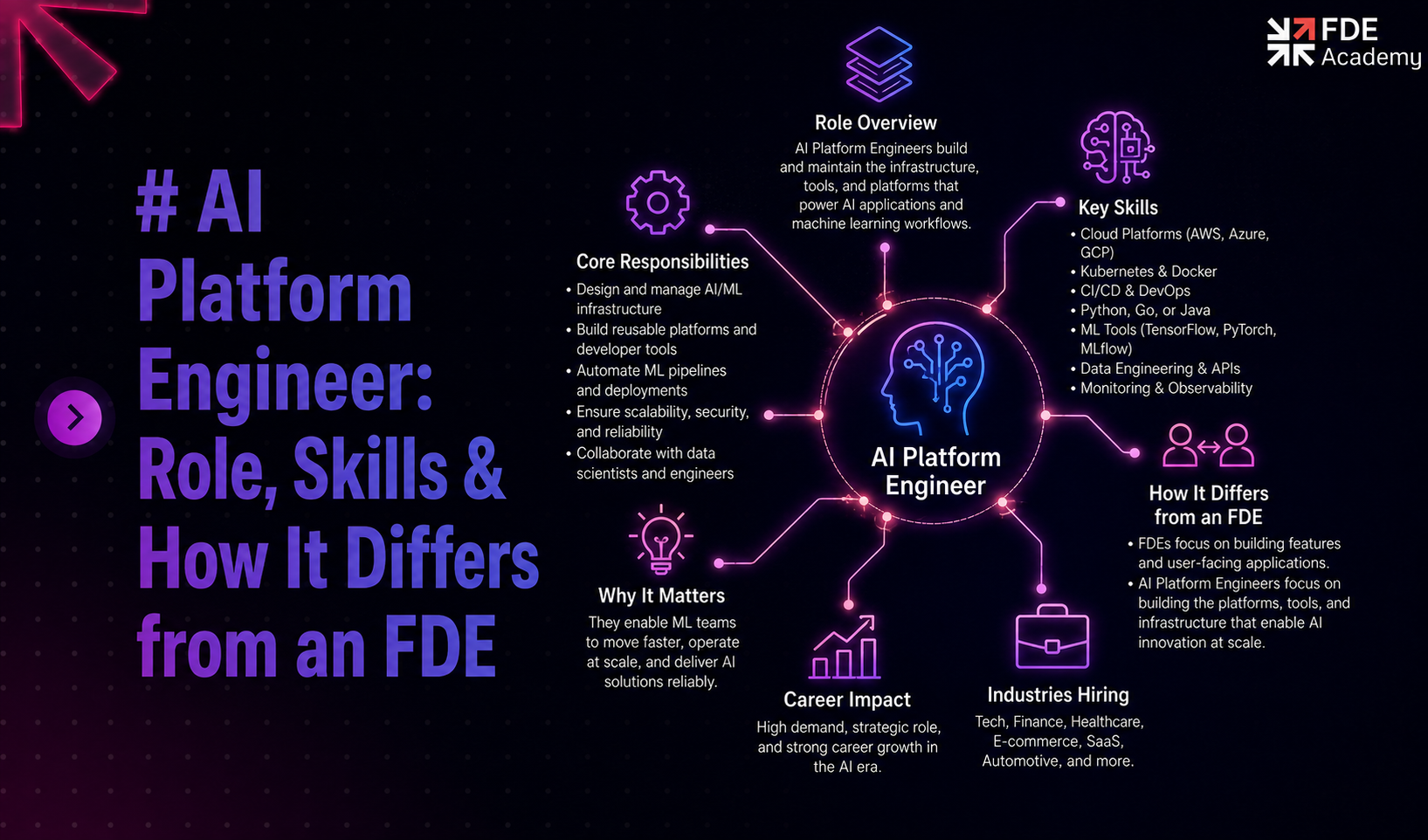
An AI Platform Engineer builds and maintains the internal infrastructure, GPU orchestration, model serving systems, MLOps pipelines, self-service tooling, that lets other engineering teams inside their own company build and deploy AI systems efficiently. It's an internal, infrastructure-facing role serving many teams at once. A Forward Deployed Engineer does something structurally different: building and owning a production AI system inside one specific customer's environment. Both are genuinely technical, AI-adjacent careers, but they solve different problems for different audiences.
AI Platform Engineering extends the broader discipline of platform engineering, treating internal infrastructure as a product that other engineering teams consume, specifically to AI and machine learning workloads. The core work centers on building and operating the systems other teams depend on to train, deploy, and serve AI models reliably: GPU cluster orchestration, model serving infrastructure, feature stores, experiment tracking, CI/CD pipelines adapted for ML workflows, and observability tooling specific to model performance and drift.
The audience for this work is internal. An AI Platform Engineer's "customer" is another engineering team at the same company, a data science team that needs a reliable way to deploy a new model, an application team that needs low-latency access to inference endpoints, an MLOps team that needs standardized tooling across dozens of models running in production simultaneously. Success is measured by how efficiently, reliably, and safely internal teams can build on top of the platform, not by whether any single external customer's deployment succeeds.
This role emerged for a fairly specific reason: as more companies moved from a handful of experimental AI models to dozens or hundreds of models running in production simultaneously, ad hoc, per-team infrastructure stopped scaling. Every data science or application team independently building its own deployment pipeline, its own monitoring, and its own GPU provisioning approach produced enormous duplicated effort and inconsistent reliability across the organization. AI Platform Engineers exist specifically to consolidate that fragmented effort into shared, well-designed infrastructure that every team can build on rather than reinvent.
A useful way to think about the difference in scale this creates: a Forward Deployed Engineer solving a data-messiness problem for one customer builds a solution specific to that customer's data. An AI Platform Engineer solving the same category of problem builds a general, reusable data validation and preprocessing layer that every internal team touching that kind of data can use, a fundamentally different design goal even when the underlying technical challenge looks similar on the surface.
The distinction mirrors the same one that separates an AI Product Engineer from an FDE: both Platform Engineers and Product Engineers build for a shared, internal or company-owned surface, while FDEs build bespoke, customer-specific solutions one engagement at a time. What differs between Platform and Product Engineering specifically is the audience within the company, Product Engineers build for end users of the company's product; Platform Engineers build for other engineers inside the company.
Both roles demand genuine, non-trivial technical depth, but the specific skills that matter diverge meaningfully.
AI Platform Engineers need:
Forward Deployed Engineers need:
The overlap sits in foundational systems engineering, both roles need to understand how production systems actually behave under real load and failure conditions. The divergence sits in audience and context: internal, company-controlled infrastructure serving many teams versus external, customer-controlled environments serving one relationship at a time.
Compensation for both roles reflects genuine technical scarcity, though the specific bands differ by company tier and role maturity. AI Platform Engineering, as an extension of the broader, well-established platform engineering discipline, typically commands strong compensation at companies running AI infrastructure at real scale, comparable to senior infrastructure and site reliability engineering roles at the same company.
Forward Deployed Engineer compensation runs notably high at frontier AI labs specifically: $250,000 to $450,000 total compensation at the broader market level, and $350,000 to $550,000 or more at companies like OpenAI and Anthropic. See our Forward Deployed Engineer salary guide for the complete breakdown by company and level. The premium reflects FDE work's direct, visible connection to customer retention and revenue, an outcome leadership can see clearly, compared to platform work whose value, while real, is often less directly attributable to a specific revenue outcome.
This doesn't mean Platform Engineering compensation is weak, at companies where AI infrastructure genuinely underpins the business, senior platform engineers command compensation on par with senior product engineering roles, and the discipline overall has grown significantly in both headcount and pay as more companies scale their internal AI infrastructure seriously. The gap specifically versus FDE compensation at frontier labs reflects those particular companies' unusual willingness to pay a premium for a role directly tied to proving out their core product's value with paying enterprise customers, a dynamic that doesn't apply the same way to internal infrastructure work, however valuable that work genuinely is.
If you're energized by building reliable, well-designed infrastructure that many teams depend on, and you'd rather solve a problem once at scale than solve a new, ambiguous version of it for every new customer, AI Platform Engineering is likely the better fit. It rewards deep systems thinking, a genuine product mindset applied internally, and satisfaction from invisible, foundational work that other engineers rely on without necessarily noticing.
If you're energized by direct customer relationships, genuine ambiguity, and the specific challenge of making a system work inside an environment you don't fully control, FDE work is the better fit. It rewards discovery instinct, comfort being wrong and recalibrating quickly in front of a customer, and a preference for variety, a new environment and a new problem with each engagement, over the deep, singular focus platform work rewards.
Neither path is more technical than the other, they're technical in different directions: platform work goes deep on infrastructure design and reliability at scale; FDE work goes deep on adapting quickly to unfamiliar systems and building trust under ambiguity.
Yes, and it's a reasonably natural transition in both directions. An AI Platform Engineer moving toward FDE work already has strong infrastructure fundamentals, the gap to close is customer-facing discovery skill and comfort with genuine ambiguity rather than the more controlled, internally-defined problems platform work typically presents. An FDE moving toward Platform Engineering already understands production AI systems deeply, the gap to close is systems design at internal scale, serving many teams' varied needs simultaneously rather than one customer's specific requirements at a time.
Our Forward Deployed Engineer eligibility checklist covers what companies actually screen for in an FDE transition specifically, useful whether you're coming from a platform engineering background or elsewhere.
They build and maintain internal infrastructure, GPU orchestration, model serving, MLOps tooling, that other engineering teams at the same company use to build and deploy AI systems. The work is internal-facing, serving multiple teams rather than a single external customer.
An AI Platform Engineer builds shared infrastructure for internal teams at their own company. A Forward Deployed Engineer builds a bespoke, production system inside one specific external customer's environment. Different audience, different scope, different success metric.
FDE compensation at frontier AI labs specifically tends to run higher, $350,000-$550,000+ total comp at companies like OpenAI and Anthropic, reflecting the role's direct, visible link to customer retention. AI Platform Engineering compensation is strong but generally comparable to senior infrastructure roles rather than carrying the same frontier-lab premium.
Yes. Infrastructure fundamentals transfer well; the main gap to close is customer-facing discovery skill and comfort with the kind of open-ended ambiguity that internal platform work, with its more clearly scoped internal requirements, doesn't typically demand.
Deep infrastructure and systems engineering (Kubernetes, cloud platforms), MLOps-specific tooling fluency, GPU resource management, and an internal product mindset treating other engineers as the platform's real "customer."
Yes, it's a genuinely growing, well-compensated discipline as more companies build serious internal AI infrastructure at scale. It suits engineers who prefer deep, foundational systems work over the customer-facing variety and ambiguity that defines FDE work.
The world is hiring - and this Academy prepares you for it.