Blogs
Air-Gapped AI Deployment: A Guide for FDEs
Air-Gapped AI Deployment: A Guide for FDEs
By
R&D, FDE Academy
October 3, 2026

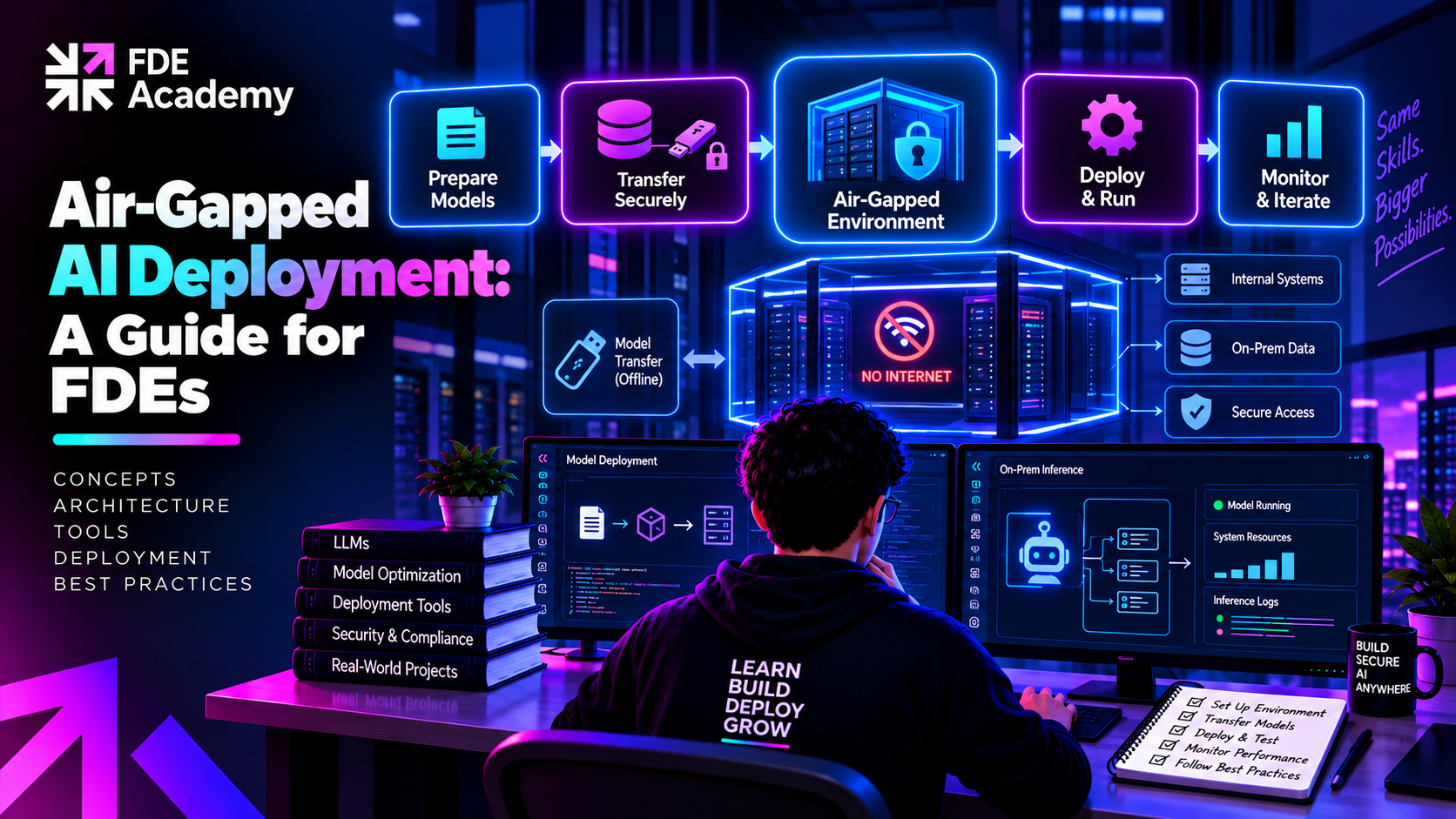
Most enterprise AI deployment work even inside a customer's VPC still assumes some connectivity: a model API call to a hosted provider, telemetry streaming to a monitoring service, package managers pulling from the public internet, authentication checked against an identity provider that lives outside the customer's four walls. Air-gapped deployment removes all of that at once.
This isn't a stricter version of the same job. It's a different set of engineering constraints that touches model selection, infrastructure, data pipelines, update management, and governance simultaneously. Defense, intelligence, critical infrastructure, and some financial and healthcare environments all have networks that are deliberately isolated sometimes fully disconnected, sometimes connected only through tightly controlled one-way data transfer. An FDE deploying AI into one of these environments is solving a fundamentally harder version of the same problem: get a working, governed AI system live, without the conveniences a connected deployment takes for granted.
This is also increasingly a distinct hiring signal. FDEs who can demonstrate they understand disconnected deployment constraints are valuable specifically because so few engineers have done it most AI tooling, documentation, and best practices assume internet access by default.
An air-gapped environment has no physical or logical network path to the public internet or to any network outside its security boundary. This is different from and stricter than a private cloud VPC, a customer's on-prem data center with a firewall, or a "dark site" that has occasional, controlled connectivity.
Three tiers are worth distinguishing, because they change what's achievable:
An FDE needs to know precisely which tier they're working in before anything else, because the engineering answer is different for each. A sovereign deployment might still use managed cloud infrastructure, just region-locked. A fully air-gapped deployment rules that out entirely.
Across defense, government, and highly regulated enterprise deployments, the requirements converge on a consistent set of non-negotiables.
The model has to be one you can download, inspect, and run entirely inside the boundary no API calls to a hosted provider, ever. This immediately rules out closed, API-only models (GPT-4-class hosted models, Claude via API, and similar) unless the vendor offers a licensed, self-hostable deployment specifically built for disconnected use. In practice, this pushes teams toward open-weight models (Llama, Mistral, Qwen, and similar families) or a vendor's packaged on-prem appliance.
Model selection becomes a function of what fits on the available hardware and what license permits classified or government use not which model performs best on a public leaderboard.
GPUs, storage, and networking all have to physically sit inside the boundary on customer-owned hardware, in an on-prem data center, or on tactical edge hardware for field deployments. There's no elastic scaling, no spinning up a bigger instance overnight. Hardware sizing has to be planned up front, which means the FDE needs a realistic estimate of model size, expected concurrency, and acceptable latency before procurement even starts because a hardware request in these environments can take months to fulfill.
Every data source the system draws from internal wikis, document repositories, structured databases has to be indexed and hosted inside the boundary. There's no calling out to a hosted vector database or embedding API. This usually means standing up a self-hosted vector store and running embedding models locally, which adds its own compute overhead to the sizing problem above.
Content filtering, safety classifiers, and evaluation suites that normally call out to a hosted moderation API have to run locally too. This is an easy requirement to miss early in a project teams plan for the model and the retrieval pipeline, then discover late that their safety stack assumes internet access.
Every prompt, every generated output, the exact model version used, and the reasoning or retrieval sources behind each response need to be logged and stored inside the boundary, in a format that can be reviewed without any data leaving the environment. In classified settings, this audit trail isn't a nice-to-have for debugging it's often a compliance requirement tied to the system's authorization to operate.
Models, dependencies, and data don't update silently. Every version change a new model checkpoint, an updated package, a refreshed knowledge base has to move through a formal transfer and review process, typically via approved physical media or a scheduled connectivity window. This means an FDE has to design for infrequent, batched updates from day one, rather than the continuous deployment patterns common in connected environments.
In a connected deployment, some infrastructure decisions can be revisited later swap a model, add a service, adjust scaling. In an air-gapped environment, many of those decisions are effectively locked in once hardware is procured and the environment is accredited. Discovery has to surface hardware constraints, data classification levels, and network topology in detail before any build work starts, because getting it wrong is expensive to fix later.
FDEs typically can't iterate directly inside the air-gapped boundary every change requires a transfer process. The practical pattern is to build and validate in a connected environment that mirrors the target hardware and software stack as closely as possible, then package a tested, versioned bundle for transfer into the secure environment. This makes environment parity between the staging setup and the real target a critical, easy-to-underestimate piece of the work.
Every library, model file, and container image the system needs has to be bundled, scanned, and transferred there's no pip install reaching out to a public package index inside the boundary. Teams typically maintain an internal, mirrored package repository and a strict manifest of everything the system depends on, reviewed before each transfer.
In connected deployments, compliance can sometimes be bolted on after the fact. In air-gapped and classified environments, the audit trail, access controls, and evaluation framework are part of the system's authorization to operate meaning they have to be built in from the start, not layered on. This is the same principle covered in AI governance for forward deployed engineers, applied to its most demanding case.
A simplified version of how this plays out on a real engagement:
Not every popular AI tool or framework translates cleanly into an air-gapped setting, and part of the FDE's job is filtering for what will actually work before committing to a stack.
Model families: Open-weight models with permissive or government-friendly licensing Llama, Mistral, and Qwen variants are the most commonly deployed give teams a model they can download once, run entirely offline, and version-lock indefinitely. The deciding factor is rarely which model scores highest on a public benchmark; it's which one fits the available GPU memory at an acceptable latency, and which license terms actually permit the deployment context.
Serving infrastructure: Inference servers like vLLM or TGI are popular precisely because they're self-hostable without any dependency on an external control plane, unlike managed inference services that assume a live connection back to the provider.
Vector stores and retrieval: Self-hosted options (a local Postgres with a vector extension, or a self-managed vector database) replace hosted retrieval services, and the embedding model used to index documents has to run locally too it's easy to pick a retrieval architecture that works end-to-end except for one hosted embedding API call that quietly breaks the whole premise.
Observability: Standard SaaS monitoring and logging tools are usually out by definition. Teams typically fall back to self-hosted logging stacks (something like a local ELK stack or equivalent) that can be exported and reviewed without ever touching an external endpoint.
None of this is exotic technology the components all exist and are mature. The actual skill is knowing, before a project starts, which combination of tools can be assembled into a fully self-contained stack without a single silent dependency on the outside world
TL;DR: Air-gapped AI deployment means running models, retrieval pipelines, and evaluation entirely inside a boundary with zero outbound network calls no cloud inference, no telemetry, no live updates. For Forward Deployed Engineers, this shifts almost every normal assumption: model choice is constrained to self-hostable weights, updates become a manual and audited process, infrastructure has to be owned or physically controlled, and every output needs a traceable, local audit trail. This guide walks through what actually changes technically and operationally when an FDE moves from a connected enterprise deployment to a disconnected, classified, or sovereign one and what it takes to do it well.
It means the system runs inside a network with no connection physical or logical to the public internet or any outside network. Every component, from the model to the evaluation layer, has to run entirely within that boundary.
Not directly through their standard hosted APIs, since those require an internet connection. Some vendors offer separately licensed, self-hostable versions of their models for government or classified use, but most air-gapped deployments use open-weight models that can be downloaded and run entirely on local infrastructure.
Yes, but through a formal, documented process rather than automatic updates. New model versions, packages, or data are reviewed, packaged, and transferred into the environment on a scheduled or as-needed basis, typically via approved physical media.
Defense and intelligence agencies, government contractors, critical infrastructure operators, and some financial institutions and healthcare systems with strict data-residency or classification requirements.
On-premise generally means the infrastructure is owned and hosted by the customer, but it may still have internet access for updates, authentication, or monitoring. Air-gapped removes that connectivity entirely on-premise is a hosting choice, air-gapped is a network isolation requirement.
Yes it's a specialized skill set with a small pool of engineers who have real experience in it, which makes it a differentiator for FDE roles at defense contractors, government-focused AI vendors, and highly regulated enterprises.
The world is hiring - and this Academy prepares you for it.