Blogs
Common Myths About Forward Deployed Engineers
Common Myths About Forward Deployed Engineers
By
R&D, FDE Academy
August 7, 2026

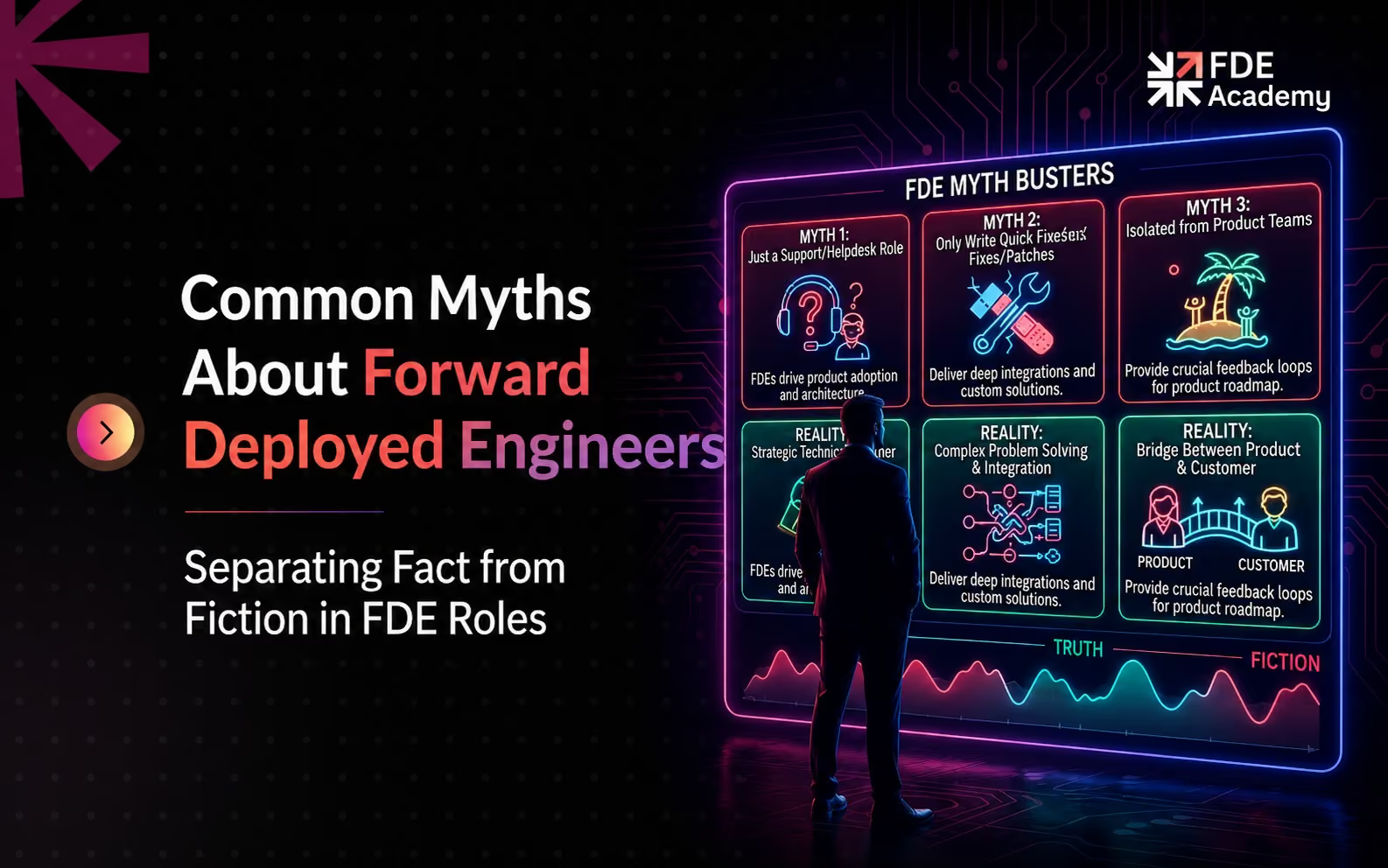
Few roles in tech have generated as much conflicting online discussion as fast as Forward Deployed Engineer has, and a lot of that discussion repeats the same handful of myths rather than examining the actual evidence.
Some of these myths come from genuine confusion about a still-maturing title, others from engineers on forums pattern-matching to a role they've never actually worked in, and a few carry a grain of historical truth that's since been overtaken by how the role has actually evolved across the industry.
This guide addresses eight of the most persistent, with the actual evidence behind each, rather than repeating the secondhand version that tends to circulate on forums and comment threads.
Four of these myths already have full, dedicated treatments elsewhere on this site, covered here briefly with a link to the complete version. The other four are addressed in full here, since no dedicated page for them exists yet.
Myth: FDEs are customer-facing consultants who talk about technical solutions but don't actually build them.
Reality: FDEs write and ship production-grade code as a core, daily part of the job, not an occasional task layered onto a consulting role.
The confusion usually comes from the customer-facing dimension of the role getting mistaken for the whole job, when it's actually one part of a role that also includes system integration, evaluation design, and production ownership.
The myth tends to persist specifically among engineers who've never worked adjacent to an FDE team, since the customer-facing meetings are the visible part from the outside, while the hours spent writing and debugging production code happen inside a customer's environment where product engineering peers rarely see it directly.
Our full breakdown, do Forward Deployed Engineers actually code, covers exactly what languages, systems, and production work FDEs are responsible for.
Myth: As AI models improve, the need for engineers to deploy them will shrink and eventually disappear.
Reality: FDEs are the ones responsible for making AI models actually work reliably inside a specific customer's messy environment, exactly the kind of judgment-heavy work that's hardest to automate.
If anything, better models increase demand for FDEs by making enterprise AI adoption more common, which increases the volume of deployment work needed.
The fear behind this myth usually conflates two very different things, a model getting better at generating code, and a model getting better at navigating a specific customer's undocumented legacy system, ambiguous requirements, and internal politics, capabilities that haven't moved in tandem so far. Our piece on AI replacing Forward Deployed Engineers covers this in full.
Myth: FDE roles can be done entirely remotely, the same as most modern software engineering jobs.
Reality: Discovery conversations, stakeholder trust-building, and on-site debugging during critical phases frequently require physical presence.
Some FDE work can be remote, but treating it as equivalent to a standard remote engineering role misunderstands the customer-embedded nature of the job, especially early in a customer relationship or during a high-stakes go-live. Our full guide on whether Forward Deployed Engineers actually work remotely covers exactly when remote work is realistic and when it isn't.
Myth: FDEs are on planes constantly with zero say over their own schedule.
Reality: Travel intensity varies significantly by company, customer, and deployment phase, and experienced FDEs generally have more say in cadence than the myth suggests.
Travel is real, but "nonstop with no control" overstates it, particularly once an FDE has established themselves. Our piece on why Forward Deployed Engineers travel breaks down the real pattern rather than the exaggerated version that circulates online.
Myth: "Forward Deployed Engineer" is marketing language for what's really a sales or billable-hours consulting job.
Reality: FDEs are measured on deployment outcomes and technical delivery, not sales quotas or billable hours, a genuinely different incentive structure entirely.
This myth has some historical basis, the term itself has occasionally been mocked as job-title inflation, but it misreads what actually distinguishes the role.
The origin, from Palantir CTO Shyam Sankar's own account, was specifically about closing the gap between engineers and customer reality, modeled on how French restaurant wait staff are trained as part of the kitchen, not as a sales layer bolted onto engineering.
The practical test that separates a genuine FDE role from a relabeled sales or consulting position: ask what happens after the deal closes. In a sales-adjacent role, the customer relationship typically hands off to someone else once the contract is signed.
In genuine FDE work, the deal closing is closer to the starting line, the FDE owns discovery, build, and production stabilization that follows, often for months. A posting using the FDE title with no post-sale production ownership described anywhere in the responsibilities is a stronger signal of title inflation than the title itself.
Myth: FDEs are viewed as a lesser, less technical role compared to product engineers at the same company.
Reality: FDE compensation at frontier AI labs frequently exceeds standard product engineering compensation, reflecting how seriously these organizations actually value the role.
This myth shows up frequently in online forum discussions, engineers asking whether FDE work is viewed the same way as product engineering internally. The honest answer is nuanced rather than a flat no: whatever perception lingers externally, internal compensation and organizational investment tell a different story.
Where the myth has some truth is in visibility, FDE work happens inside customer environments rather than in a shared internal codebase, so it's naturally less visible to peers than product engineering work, which can create a perception gap even when the underlying work and compensation don't support it.
This visibility gap tends to shrink as a company's FDE function matures. At companies where FDE work is new or small, product engineers sometimes genuinely don't understand what the role involves, since they've never seen the work directly.
At companies with an established, well-integrated FDE function, the field feedback loop back into product and research teams makes the role's impact visible internally in a way that offsets the lack of shared-codebase visibility, engineers see FDE-sourced insights shaping the roadmap directly, which builds a different kind of internal credibility than code review activity alone would.
Myth: Without prior Palantir experience or a degree from a top program, breaking into FDE roles is nearly impossible.
Reality: Demonstrated production ownership and customer-facing exposure matter more consistently, backgrounds from backend, data, and solutions engineering all transition successfully.
A degree from a top program or prior Palantir experience helps, but neither is a hard requirement at most companies hiring for this role today. Our Forward Deployed Engineer eligibility checklist covers the actual, verifiable requirements rather than the pedigree myth.
This myth persists partly because Palantir genuinely did originate the role and has produced a large, visible alumni network now spread across the industry, which creates an availability bias:
Palantir-origin FDEs are simply more numerous and more visible in the current talent pool, not because the path is closed to everyone else. Companies like OpenAI, Anthropic, Databricks, and Salesforce are actively hiring FDEs from a much broader range of backgrounds precisely because the pool of Palantir alumni alone can't meet current demand, a strong practical signal that the pedigree requirement is far softer than the myth suggests.
Myth: Forward Deployed Engineering and DevOps are essentially the same job with a different name.
Reality: DevOps engineers typically own infrastructure for one company's own internal systems; FDEs own deployment inside a specific external customer's environment.
This comparison captures a surface-level similarity, both roles involve deployment and production ownership, while missing a real distinction in scope, even when some of the underlying technical skills overlap.
The clearest practical difference shows up in who the "customer" actually is. A DevOps engineer's customer is effectively internal, other engineering teams relying on stable infrastructure, measured through uptime and deployment velocity metrics that stay constant regardless of which internal team is affected.
An FDE's customer changes with every engagement, along with that customer's specific data, compliance requirements, and stakeholder relationships, which means the discovery, communication, and relationship-management skills central to FDE work simply aren't part of most DevOps job descriptions at all.
An engineer strong in DevOps has a real technical head start toward FDE work, but the roles test for meaningfully different things beyond that shared technical foundation.
Yes, extensively. Production-grade coding is a core, daily part of the role, not an occasional task. The myth that FDEs are "just consultants" typically comes from the customer-facing dimension of the job being mistaken for the entire job.
Unlikely, and possibly the opposite. FDEs are responsible for making AI models work reliably inside specific, messy customer environments, exactly the kind of context-dependent judgment work that's hardest to automate. Better models tend to increase deployment demand rather than eliminate it.
No. The role's origin was specifically about closing the gap between engineers and customer reality, and FDEs are measured on deployment outcomes and technical delivery, not sales quotas or billable hours, a genuinely different incentive structure than either sales or consulting.
Generally yes in terms of compensation and organizational value, frontier labs often pay FDEs more than equivalent product engineering roles. The perception gap that exists is more about visibility, FDE work happens inside customer environments rather than a shared internal codebase, than about actual internal regard.
No, though both can help. Demonstrated production ownership and customer-facing exposure matter more consistently across companies hiring for this role, and successful FDEs come from a range of backgrounds including backend, data, and solutions engineering.
The world is hiring - and this Academy prepares you for it.