Blogs
Data Cleaning for AI Projects: Methods FDEs Use on Messy Customer Data
Data Cleaning for AI Projects: Methods FDEs Use on Messy Customer Data
By
R&D, FDE Academy
October 15, 2026

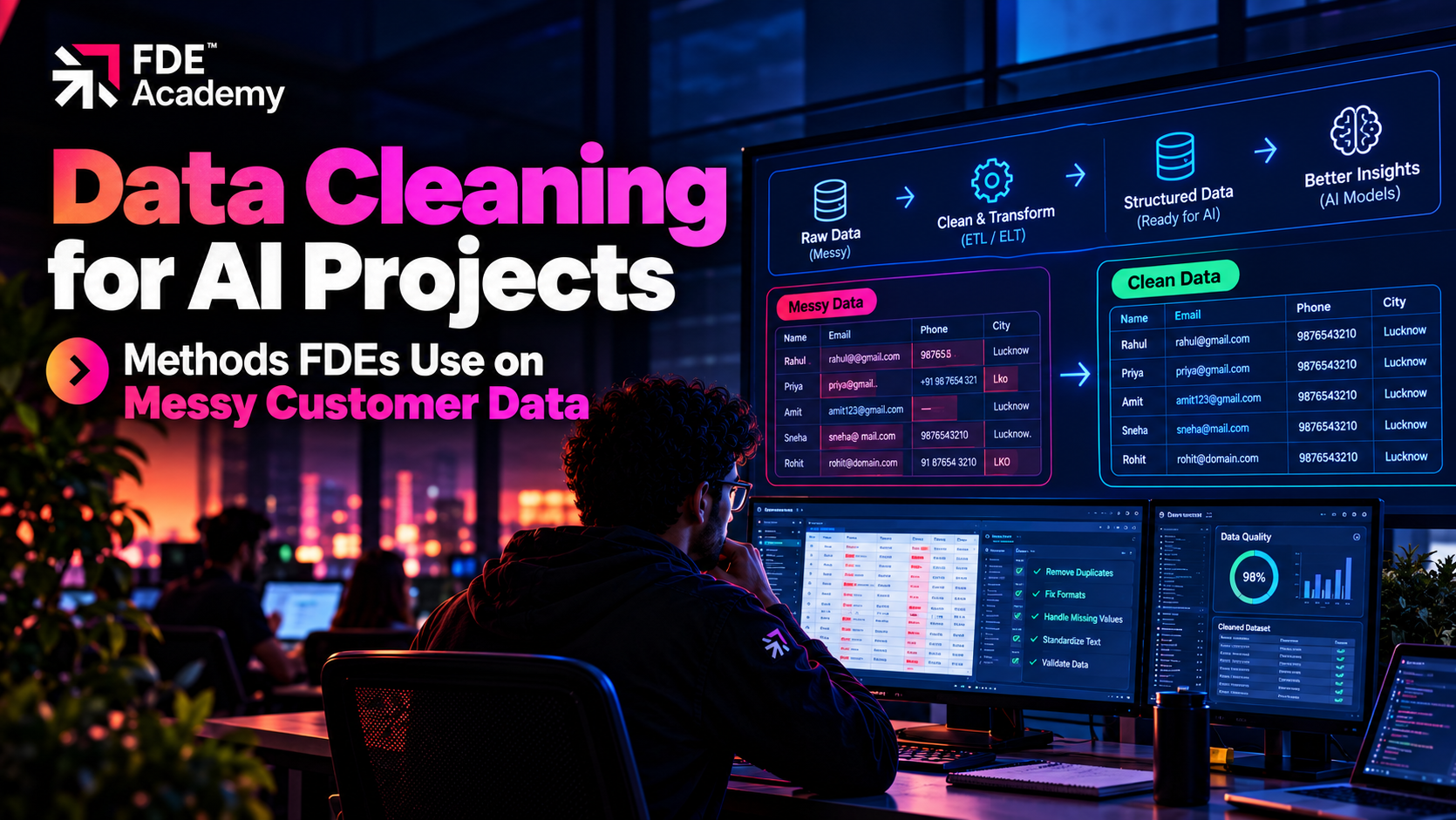
Data cleaning for AI projects is the process of detecting and correcting errors, inconsistencies and gaps in data so that models and AI features built on it behave correctly. It covers fixing formats, standardising values, handling missing entries, removing or merging duplicates, treating outliers and correcting wrong labels.
A systematic literature review by Côté and colleagues (Polytechnique Montréal), covering papers from 2016 to 2022, groups the field into six activities: feature cleaning, label cleaning, entity matching, outlier detection, imputation and holistic cleaning. That is a useful map, and the methods below follow it.
Usually, but not automatically. The CleanML study (Li et al.) tested how cleaning five error types, namely missing values, outliers, duplicates, inconsistencies and mislabels, affects machine learning classification. Its findings were mixed: the impact varied by dataset and was not always positive, and it differed by error type. For example, imputing missing values usually helped, while removing duplicates more often had an insignificant or even negative effect.
The practical lesson is to treat each cleaning step as a hypothesis. Clean, measure on a held-out set, and keep the change only if it helps or if it is needed for correctness. "Cleaner" is not the same as "better for this model".
Customer data comes from many hands and many systems: sales reps typing into a CRM, web forms, payment systems, support tools and spreadsheets. In an Indian context, common patterns include phone numbers with or without +91 and leading zeros, names transliterated several ways, day-month-year dates mixed with year-month-day, free-text addresses, and mobile numbers shared across family members.
The order matters. Fixing duplicates before standardising formats, for example, means your matching rules will miss obvious pairs.
Measure what you have: row counts, null rates per column, distinct values, ranges, formats, and the most common values. Compare against what the business says the data should be. Profiling often reveals the real problems, such as a column that is 70 percent empty or a status code with twelve undocumented values. This belongs in the discovery stage of the FDE project lifecycle.
No tool tells you that "status 4" means "closed by phone". Sit with the person who uses the system. Record definitions, known quirks and which source is authoritative for which field. This step avoids more errors than any code.
Convert text to proper dates, numbers and booleans, and standardise encodings and units. The classic trap is ambiguous dates. "03/04/2025" is 3 April in a day-first system and 4 March in a month-first system. Confirm the convention with the source owner instead of guessing, and parse each known format explicitly.
python
import pandas as pd
Notice that the unparsed flag keeps failures visible instead of silently dropping them. A blanket dayfirst=True setting can misread ISO-formatted dates, which is exactly the kind of quiet error that corrupts a model.
Trim whitespace, normalise case, map synonyms to one canonical value, and strip formatting from identifiers such as phone numbers, keeping only digits and validating length. Maintain mapping tables for categories (for example, city names) that people can review and extend. Keep the original column next to the cleaned one so you can trace and undo changes.
First ask why the value is missing. A blank might mean "not applicable", "not collected", "refused" or "system error", and each has a different meaning. Then choose:
Always add a flag column showing which values were imputed. Also check sentinel values such as 0, 9999 or "N/A" that stand in for "unknown".
Exact duplicates are easy. The harder problem is the same real-world customer appearing as different records. Entity resolution links them using several signals: normalised name, phone, email, address and date of birth. Typical approach:
Wrongly joining two customers is usually worse than leaving a duplicate, so keep merges reversible and logged. Send uncertain pairs to human review, using the approach in LLM guardrails and human-in-the-loop design. Duplicates also cause leakage: if the same customer lands in both training and test sets, your evaluation will look better than reality.
Look for impossible values (negative ages, future birth dates) and extreme but possible ones (a very large order). Do not delete outliers automatically; some are your most valuable cases. Investigate, then correct, cap, flag or keep.
Labels deserve equal attention. Northcutt, Jiang and Chuang's work on confident learning argues that label quality is often overlooked compared with model predictions, and offers a method for finding likely label errors in a dataset. In customer data, wrong labels often come from process quirks, such as a "churn" flag set by a billing batch job rather than by customer behaviour. Review a sample of labels with someone who knows how they were created.
Cleaning is not a one-off script. Write automated checks that run on every data refresh: required fields present, values in expected ranges, no sudden change in null rates or row counts, no new unseen categories, and no schema changes upstream. Agree these as a contract with the data owner, an idea we cover in the broader context of enterprise pipelines. Fail loudly and alert someone, because silent drift is what breaks models months after launch.
Keep a cleaning log: each rule, why it exists, who approved it and what it changed. This helps with audit, debugging and handover, and supports privacy and accountability duties. Customer data often contains personal information, so involve the customer's data protection owner early and check applicable law, such as India's Digital Personal Data Protection Act, with their legal team. Our guide to AI governance for forward deployed engineers covers this in more detail.
A lending company wants a model to predict which customers are likely to miss a payment. The FDE receives an extract of 200,000 customer records from three systems.
Profiling shows that the income column is mostly empty for one source, phone numbers come in four formats, and about a tenth of customers appear twice with slightly different names. The data owner explains that the value 0 in the "late payments" column means "not yet recorded", not "none".
The FDE converts dates with explicit formats, standardises phone numbers, replaces the 0 sentinel with a missing flag, and links duplicates using phone plus name similarity. Several hundred uncertain pairs go to a credit analyst. Splitting data by customer ID after resolution avoids leakage. A label check finds that "defaulted" was set by a batch job that also flagged accounts closed early, so the team redefines the label with the business. Automated checks are added to the daily load.
The model accuracy gain is modest. The bigger win is that the business now trusts the numbers. This scenario is illustrative, not a real case.
If you come from a data background, our article on moving from data engineer to forward deployed engineer shows how these skills transfer, and FDE vs data scientist explains where the roles differ. For the full skills picture, read what technical skills an FDE needs, and for how this fits a delivery, see how FDEs help enterprises deploy AI. If you are weighing approaches, fine-tuning vs RAG shows how cleaning needs change by method. When data readiness is the real blocker, why AI projects fail explains the pattern.
Data cleaning for AI projects is the work of turning raw, inconsistent records into data a model can learn from and a business can trust. Forward deployed engineers (FDEs) do it in a fixed order: profile the data first, fix types and formats, standardise values, handle missing data, resolve duplicates and entities, check outliers and labels, then add automated validation that keeps running after launch. The goal is not perfect data. It is data that is good enough for the specific decision the AI will support, with every cleaning rule written down and every uncertain case reviewed by someone who knows the business.
It is the process of detecting and correcting errors, inconsistencies and gaps in data so that models and AI features built on it behave correctly. It covers format fixes, standardisation, missing values, duplicates, outliers and label errors.
Profile it. Measure row counts, null rates, distinct values, ranges and formats, then ask the data owner what each column means. Profiling shows which problems matter before you write any cleaning code.
First find out why the value is missing, then decide whether to leave it missing with a flag, impute it, drop the row or column, or recover it from the source. Always flag imputed values and watch for placeholders such as 0 or 9999 that mean "unknown".
Standardise the fields first, then group likely matches, score pairs on signals such as name, phone, email and address, auto-merge high-confidence pairs, send uncertain ones to a person, and keep merges reversible and logged.
No. The CleanML study found that the effect varies by dataset and error type, with imputing missing values usually helping and removing duplicates often having little or negative effect. Test each step against a held-out set and keep what helps.
They profile the data, learn what it means from the people who use it, clean in a fixed order, involve business experts for uncertain cases, document every rule and add automated validation so the data stays clean after launch.
The world is hiring - and this Academy prepares you for it.