Blogs
Data Engineer to Forward Deployed Engineer: Skills, Gaps, and Transition Guide
Data Engineer to Forward Deployed Engineer: Skills, Gaps, and Transition Guide
By
R&D, FDE Academy
April 13, 2026


Key fact: Databricks, Deloitte, and Salesforce explicitly list data engineering as a qualifying background in their FDE job descriptions. You are already in the target profile.
A Forward Deployed Engineer (FDE) is a software engineer who works directly with customers to deploy, integrate, and scale complex systems like AI platforms in real-world environments.
Unlike traditional software engineers, FDEs operate inside client systems, solving production issues, integrating multiple technologies, and ensuring systems actually work in practice.
A Data Engineer is a software engineer who builds and maintains data pipelines, infrastructure, and systems that collect, transform, and make data usable for analytics, applications, and machine learning.
Data engineers focus on reliability, scalability, and data quality, ensuring that downstream systems receive clean and consistent data.
The diagram below shows how data engineering skills overlap with Forward Deployed Engineer responsibilities, and where the roles differ.
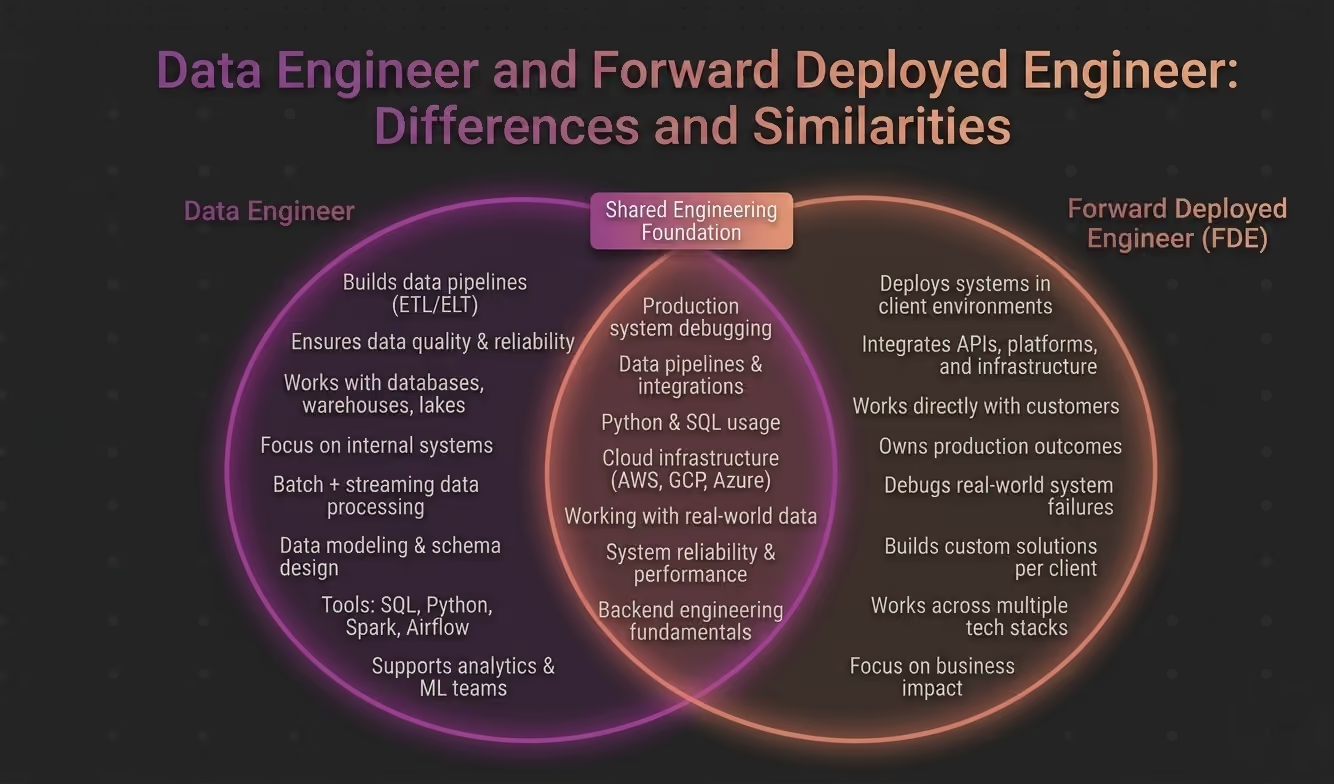
This overlap is why data engineers are one of the strongest candidates for FDE roles.
Most engineers approaching Forward Deployed Engineer roles ask the same question: do I have the right background?
For data engineers, the answer is more direct than for almost any other engineering background. Yes.
The skills at the core of data engineering, building reliable pipelines, debugging production systems, handling messy real-world data, designing for quality at scale, are the exact skills that make the forward deployed engineer role possible. Not adjacent to it. Central to it.
The Forward Deployed Engineer role exists because AI and data products fail in production. Not because the technology is bad, but because real enterprise environments are messy in ways that controlled product development never anticipates.
Data engineers live in that messiness every day.
Building pipelines that must survive unreliable upstream sources. Debugging integration failures across systems that were never designed to talk to each other. Handling schema changes, data quality degradation, and sync failures while something is live. These are not edge cases in data engineering. They are the daily job.
They are also exactly what Forward Deployed Engineers are hired to solve inside client environments.
"Design, build, and productionize first-of-their-kind data and AI solutions... own the architecture, lead design decisions, and implement end-to-end systems spanning data engineering, AI, and application development." - Databricks FDE Job Description
The overlap is not coincidental. It is structural. Data engineering is the technical core of what FDE work demands. The additional layers FDEs need are broader integration experience, client communication, and AI systems knowledge. But the foundational muscle is the same.
Here’s how data engineering skills map directly to Forward Deployed Engineer requirements:
The first six data engineer skills are not background advantages. They are direct requirements that appear explicitly in FDE job descriptions.
Deloitte's Forward Deployed Engineer practice requires "3+ years of experience in software engineering, data engineering, data science, or analytics engineering" as a qualifying background. Data engineering is listed as one of the primary target profiles, not a workaround.
While data engineers have a strong foundation, three key gaps separate them from FDE roles.
Data engineers typically work internally. FDEs work directly with clients.
This means explaining technical failures to non-technical stakeholders, managing expectations during failures, and leading conversations under pressure.
Data engineers connect data systems. FDEs connect everything.
CRM platforms, ERP systems, APIs, legacy systems, authentication layers, and AI models.
The debugging mindset transfers. The system variety needs expansion.
This is the most time-sensitive gap.
FDE roles now require:
The concepts build on data engineering. The context is new.
This is not theoretical. The following companies explicitly value data engineering experience in their FDE hiring, confirmed by job descriptions published in 2025 and 2026.
The most common mistake data engineers make when applying for FDE roles is presenting themselves as data engineers who want a new job. The correct framing is that you are a production-focused engineer who has spent your career solving the exact problems FDE work is built around, and you are now applying that foundation to a broader customer-facing scope.
This affects how you describe your experience. Three examples of the same work, reframed:
The content is identical. The framing shifts from what you built to the deployment context, the real-world constraints, and the outcome. That is the signal FDE hiring teams are looking for.
A standard data engineering portfolio shows technical output. An FDE-ready portfolio also shows how you think and communicate under real constraints. The most differentiating additions are:
The last two items are the most differentiating. Most data engineering portfolios show only technical output. An FDE portfolio also shows communication and deployment thinking.
This plan assumes you are currently working as a data engineer and preparing for an FDE transition alongside your existing role. Adjust the AI systems phase based on how much exposure you already have.
For engineers who want structured, real-world preparation instead of figuring this out alone, platforms like FDE Academy focus specifically on deployment, integration, and client-facing engineering skills that traditional roles don’t teach.
This is worth answering directly before you commit time to the transition.
Data engineering and Forward Deployed Engineering reward different things. Data engineering rewards deep platform specialization, building reliable internal infrastructure, and long-horizon technical work. FDE work rewards visible real-world impact, direct client contact, working across industries and deployment contexts, and operating effectively under ambiguity.
The data engineer who thrives in FDE roles tends to be someone who finds the internal, pipeline-focused work increasingly removed from the actual impact of their work. Someone who wants to see a client's system change because of what they built, within days rather than quarters. Someone energized by context-switching and ambiguity rather than drained by it.
The data engineer who stays happy in data engineering tends to prefer deep specialization over breadth, internal systems over client contact, and predictable sprint-based work over real-time triage and escalation.
Neither is better. They describe different engineering temperaments. The transition is worth making if the first description sounds like energy. It is not worth making if it sounds like obligation.
Yes. Data engineers are one of the most natural fits for Forward Deployed Engineer roles because their core skills, building production pipelines, debugging integration failures, and handling real-world data quality issues, directly match what FDE work demands inside client environments. Companies like Databricks and Deloitte explicitly list data engineering as a qualifying background in their FDE job descriptions. The main gaps to fill are client communication and AI systems knowledge, neither of which requires starting from zero.
Production pipeline engineering, data quality monitoring, Python, SQL, cloud platform experience, and debugging production systems are the most directly valued. These appear as explicit requirements in FDE job descriptions at Databricks, Salesforce, and leading AI companies. Schema design, Airflow experience, and data modeling are useful but transfer partially rather than directly.
Three areas need deliberate development: client-facing communication, integration breadth beyond data systems, and AI and agentic systems knowledge. The most time-sensitive is AI, specifically RAG architecture, vector databases, and LLM evaluation frameworks, which are now baseline requirements at AI-first FDE employers. Client communication and broader integration experience can be developed through targeted project work and practice.
Databricks, Salesforce, Deloitte, OpenAI, and Palantir all explicitly value data engineering backgrounds in FDE hiring. Databricks is the most direct, listing data engineering as a primary qualifying background in their FDE job descriptions. AI startups also actively hire data engineers into FDE roles because pipeline and data infrastructure work is central to AI deployment.
Most data engineers with solid production pipeline experience can transition in 60 to 90 days of focused preparation. The technical foundation is already there. The preparation time goes toward building AI systems knowledge, developing client communication skills, and practicing FDE-specific interview formats. Data engineers who have worked on ML pipelines or had client-facing experience can move faster.
Neither role is better. They suit different engineering temperaments. FDE work rewards direct client impact, broad industry exposure, and operating under ambiguity. Data engineering rewards deep platform specialization, internal system reliability, and long-horizon technical work.
The world is hiring - and this Academy prepares you for it.