Blogs
A Day in the Life of a Forward Deployed Engineer: What the Work Actually Looks Like
A Day in the Life of a Forward Deployed Engineer: What the Work Actually Looks Like
By
R&D, FDE Academy
April 10, 2026

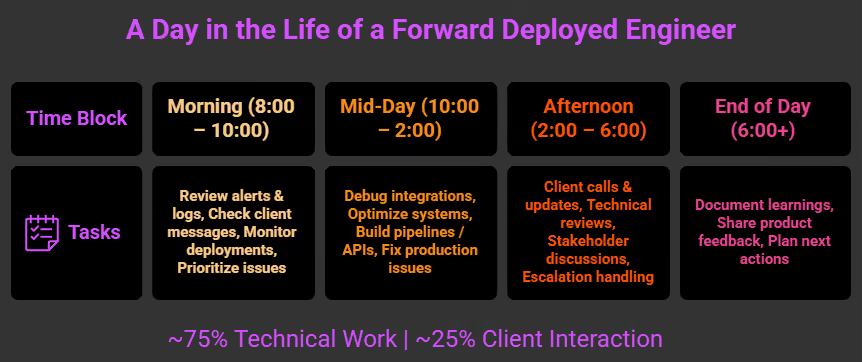
Key fact: A Forward Deployed Engineer spends roughly 75% of their time on technical engineering work and 25% on client-facing consulting and relationship management. That ratio shifts significantly depending on the client, the deployment stage, and the day.
Most descriptions of the Forward Deployed Engineer role focus on what the role is.
This article focuses on what it feels like to live it.
There is a meaningful gap between understanding FDE responsibilities on paper and understanding what an actual day demands from you mentally, technically, and interpersonally.
The content here is built from documented first-person accounts from FDEs working at companies including Baseten, Salesforce, and Palantir, as well as patterns confirmed across industry reporting. No generic filler. No theoretical framing. Just what the work actually looks like.
A Forward Deployed Engineer (FDE) works directly with customers to deploy, customize, and optimize technical solutions in real-world environments. Unlike traditional software engineers who primarily build internal products, FDEs solve engineering challenges inside a client's infrastructure while acting as the bridge between engineering, product, and the customer.
A typical Forward Deployed Engineer may:
The exact responsibilities vary by company and project, but the common thread is simple: FDEs combine hands-on engineering with customer-facing problem solving. Because every client has different systems, business goals, and technical constraints, no two deployments or workdays are exactly the same.
This is not a cliche disclaimer. It is the defining feature of the Forward Deployed Engineer role.
A software engineer working on a product team has predictable inputs: a sprint, a ticket queue, a roadmap. The work changes over weeks.
A Forward Deployed Engineer's inputs change hourly. An overnight alert from a client system. A scope change from a stakeholder. A production issue that surfaces mid-call. A deployment that worked in staging and does not work in the client's environment.
The unpredictability is not a bug in the role. It is the reason the role exists.
"There's a ton of context-switching in this role that you've got to be ready for. It's not a typical software job where you can hunker down and focus on one project." - Forward Deployed Engineer, Baseten
Understanding this upfront matters. It is the single biggest adjustment engineers make when transitioning into FDE work.
Based on documented accounts from working FDEs, the time split across a typical week looks roughly like this:
Three important caveats on this breakdown:
A Forward Deployed Engineer does not open an IDE first thing in the morning.
They open their client context.
The first 30 to 60 minutes of an FDE morning typically involves:
By 10am, a Forward Deployed Engineer has typically already made several judgment calls.
What is urgent versus what can wait. What requires client input before work begins. What can be handled without escalation.
This triage muscle is one of the skills that separates strong FDEs from capable engineers who struggle in the role.
This is where most of the day lives.
For a Forward Deployed Engineer, the technical work is not abstract. It is happening inside a specific client's environment, on their infrastructure, with their data.
This is where most Forward Deployed Engineer daily responsibilities are carried out, from integrating enterprise systems to troubleshooting production issues and optimizing AI-powered applications inside complex customer environments.
What this looks like in practice:
The distinguishing feature is not the difficulty of the code. It is the context.
Every technical problem a Forward Deployed Engineer solves is embedded in a real business environment with real constraints: compliance requirements, legacy systems, data quality issues, security policies, and stakeholder expectations that were never fully documented.
"On any given day, you might be writing agent instructions, experimenting with prompts, working through a tricky integration, or collaborating with the product team to shape features based on what we're learning in the field." - Sarah Khalid, Forward Deployed Engineer Director, Salesforce
Client-facing work is concentrated in the afternoon in most FDE schedules.
This is not a hard rule. A production incident can pull a Forward Deployed Engineer into a client call at any time.
But afternoons are typically when scheduled interactions happen:
The escalation calls deserve specific attention.
A Forward Deployed Engineer is often the person on the line when a client's live system is failing. That conversation requires a different set of skills than writing code.
You need to acknowledge the client's situation quickly, ask the right two or three diagnostic questions without making promises, and project calm authority under real pressure.
Engineers who have never been in that position often underestimate how demanding it is. Engineers who have done it once usually describe it as one of the most skill-building experiences of their career.
This part of the FDE role is underappreciated from the outside.
Forward Deployed Engineers are not just deployment resources. They are the company's highest-fidelity source of product intelligence.
At the end of a day in the field, a strong FDE does the following:
Salesforce's FDE team explicitly describes this as one of the most valuable parts of the role. As one FDE Director noted, FDEs "feed all those insights from the frontline back to the product team" so the product itself gets better. In that way, a Forward Deployed Engineer influences the product roadmap in ways a traditional engineer working internally rarely can.
This feedback loop is also what makes FDE experience so transferable to product management and leadership roles later in a career.
Beyond the daily structure, several factors make the Forward Deployed Engineer experience consistently varied in a way most engineering roles are not.
A healthcare client and a financial services client may both need AI agent deployments. The technical work looks completely different.
Healthcare means HIPAA, airgapped environments, clinical workflow constraints, and extremely cautious change management cycles.
Financial services means real-time compliance checks, audit trail requirements, data residency rules, and security reviews that can stall a deployment for weeks.
A Forward Deployed Engineer working across multiple clients simultaneously is essentially learning new industries continuously.
A Forward Deployed Engineer's responsibilities evolve throughout the deployment lifecycle. The focus shifts from understanding customer requirements during discovery to building, deploying, optimizing, and supporting solutions as they move into production.
Forward Deployed Engineers at many companies spend a meaningful portion of their time physically embedded at client sites.
Palantir historically expects around 25% of FDE time on-site with clients. At Salesforce, entire pod teams sometimes travel to the client and embed themselves in the company's day-to-day operations for weeks at a time.
On-site weeks change the rhythm completely. You are working in the client's office, attending their meetings, eating lunch with their team, and getting an unfiltered view of how their organization actually operates.
This exposure accelerates understanding in ways that no number of remote calls replicates. It is also exhausting, and not right for every engineer.
Engineers who move into Forward Deployed Engineer roles consistently report the same surprise: the skills they expected to use are not always the ones that determine success.
The technical skill floor is high. You need to be a strong engineer.
But the engineers who thrive in Forward Deployed Engineer roles are those who treat the non-technical dimensions of the work with the same rigor they apply to code.
This question matters more than whether you are technically qualified.
You can develop the technical skills for the role. You can learn the frameworks and the integration patterns. What is harder to develop is the underlying disposition the daily reality demands.
Neither list is a judgment. They describe different kinds of engineering temperaments. The Forward Deployed Engineer role is genuinely demanding in ways that are orthogonal to technical ability.
Engineers who want to understand whether they are well-suited for the Forward Deployed Engineer path before committing can explore the structured learning environment at FDE Academy, which is designed specifically to develop the combination of technical and deployment skills the role requires.
A Forward Deployed Engineer spends roughly 75% of their day on technical engineering work inside real client environments, not product development.
Mornings start with context: reading alerts, triaging client messages, and aligning on priorities before writing a single line of code.
The technical work is production-level and environment-specific. It is harder than it sounds because you are always working in a system you did not build.
Afternoons involve client interaction, status updates, escalation calls, and real-time problem solving under pressure.
End of day includes documentation and feeding product intelligence back to the engineering and product teams.
No two days are the same because no two clients, industries, or deployment stages are the same.
The skills that determine FDE success are not always the ones engineers expect. Judgment under ambiguity matters as much as technical depth.
A Forward Deployed Engineer starts the day by reviewing system alerts, client messages, and deployment status before moving into technical work like debugging integrations, optimizing systems, and writing production code. Afternoons usually involve client calls, stakeholder updates, and real-time problem solving.
A Forward Deployed Engineer typically spends around 70–75% of their time on technical work, including coding, debugging, and system integration. The remaining time is split between solution design, consulting, and client communication, depending on the deployment stage.
Yes, many Forward Deployed Engineer roles involve travel, especially during active deployments. Some companies expect around 20–25% on-site work, where engineers embed with client teams to better understand systems and solve problems faster.
Unlike software engineers who work on structured sprints, Forward Deployed Engineers start each day by responding to real-world issues from client environments. Their work involves debugging live systems, handling unpredictable problems, and delivering impact in days rather than long release cycles.
The most challenging part of being a Forward Deployed Engineer is constant context switching across clients, systems, and priorities. Engineers also carry high accountability, as they are directly responsible for fixing issues in live production environments.
Yes, the Forward Deployed Engineer role is considered a strong career accelerator. It builds technical depth, business understanding, and real-world problem-solving skills, opening paths into senior engineering, product leadership, and startup roles.
The world is hiring - and this Academy prepares you for it.