Blogs
Fine-Tuning vs RAG: How an FDE Decides
Fine-Tuning vs RAG: How an FDE Decides
By
R&D, FDE Academy
October 6, 2026

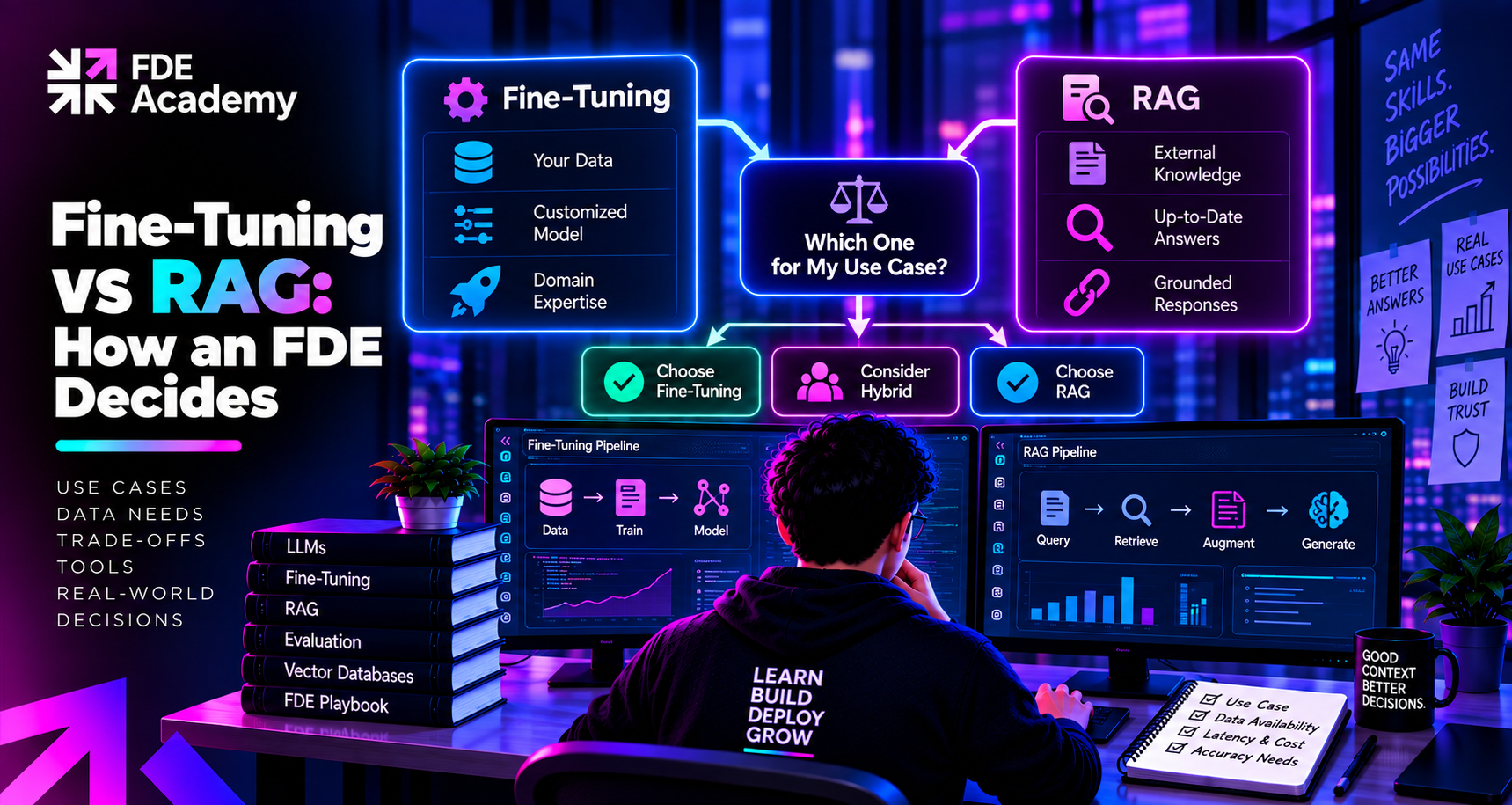
Online, fine-tuning vs RAG is often treated as a contest. In a customer deployment it is closer to a diagnosis. A Forward Deployed Engineer sits with the customer, sees the actual documents, the actual failure cases, and the actual constraints on data and budget, and picks the approach that fits. The right answer is rarely "whichever is more advanced."
That is why this decision sits in discovery, not at the end of a build. It shapes data pipelines, infrastructure, evaluation, and cost, so changing your mind late is expensive. It belongs alongside the other early decisions described in the FDE project lifecycle. And because enterprise AI projects often stall on avoidable choices, it connects directly to why enterprise AI adoption fails.
Retrieval-augmented generation (RAG) is an architecture where the system retrieves relevant documents from an external source at query time and passes them to the model as context, so the answer is grounded in that material. The model's weights don't change. Update the documents, and the next answer reflects the update.
A typical pipeline chunks and embeds documents, stores them in a vector database, retrieves the best matches for a query, often reranks them, and asks the model to answer using what was retrieved. We covered the retrieval layer in how FDEs build enterprise AI platforms; here the question is when to use it versus the alternative.
Fine-tuning is further training of a pre-trained model on a curated set of examples so that it behaves differently: following a format, adopting a tone, using domain vocabulary, or performing a narrow task more reliably. Parameter-efficient methods such as LoRA update only a small set of added weights, which makes tuning cheaper and lighter than full retraining.
One rule of thumb appears in most practitioner guides: facts and freshness belong to RAG; capability and style belong to fine-tuning. Fine-tuning is poor at teaching a model new facts, because knowledge baked into weights goes stale the moment the source changes and carries no provenance. RAG is poor at changing how a model reasons or writes, because retrieved text only informs a single response.
Here is the sequence a Forward Deployed Engineer typically walks through.
Before choosing anything, find out what is going wrong with the baseline. Run the task with a good prompt on a strong model and collect failures. Then sort them:
This diagnosis step is the one most often skipped, and it decides almost everything else.
Prompting is the cheapest option and should be exhausted first. Clear instructions, a few examples in the prompt, and a defined output format solve many "behaviour" problems without any training. The relationship between this work and the FDE role is explored in forward deployed engineer vs prompt engineer. Only when prompting hits a ceiling do you need heavier tools.
Practitioner guides converge on a short set of questions:
Even with a clear technical answer, constraints can change the decision:
Cost and time vary widely by project, so avoid quoting generic figures to a customer. What holds consistently is the shape: RAG tends to reach a working result sooner, fine-tuning needs more preparation, and combining them takes the most effort. This is the sort of trade-off that feeds into how FDEs improve AI ROI.
Situation
Likely choice
Answers depend on internal docs that change monthly
RAG
Users need citations or an audit trail
RAG
Model must always output a strict JSON or report format and prompting fails
Fine-tuning
Consistent brand voice or domain jargon needed at scale
Fine-tuning
Narrow, high-volume task where cost per call matters
Fine-tune a smaller model
Needs both fresh facts and a fixed output style
RAG + fine-tuning
Model lacks reasoning ability for the task
Stronger model or task redesign
Several 2026 decision guides recommend the same sequence, and it matches how most FDE engagements unfold:
The logic is cost and reversibility. RAG and prompting are fast to change and easy to roll back. Fine-tuning is a larger commitment, so you want evidence that it is needed before making it.
Production systems often use both, with each approach doing what it is good at. Common patterns include:
If you are building agent systems on top of these patterns, the orchestration questions are covered in AI agent orchestration for FDEs.
Imagine an insurer wants an assistant that answers staff questions about claim policies and drafts replies in a fixed template. The FDE first runs a strong prompted model and reviews the failures. Two patterns emerge: the model invents policy clauses it has never seen, and its drafts drift from the template.
The first problem is knowledge: the policies change quarterly and staff need to see the clause behind each answer, so retrieval with citations is the right fix. The second is behaviour: if a tighter prompt and a few in-context examples fix the template drift, no training is needed. If drift persists after a few hundred reviewed drafts have been collected, that data becomes the training set for a small fine-tune. The final system is RAG for facts, with a tuned model only if the template problem demands it. The decision followed the diagnosis, not a preference for either technique.
The best preparation is to build the same small project both ways. Take a document set, build a RAG pipeline, measure answer quality on a test set, then try fine-tuning a small open model for a specific formatting task and compare. Note where each helped and where it didn't. Being able to explain, with evidence, why you picked one approach is the skill interviewers and customers are looking for, and it draws on the wider set of skills an FDE needs and on familiarity with the FDE tech stack.
RAG retrieves relevant documents at query time and gives them to the model as context, so answers reflect current, citable information. Fine-tuning retrains the model on examples to change its behaviour, such as format, tone, or a narrow skill. RAG changes what the model knows when it answers; fine-tuning changes how it behaves.
Use RAG when your information changes often, when answers must be traceable to sources, or when you need the model to use proprietary documents. It's also usually the faster starting point and easier to update.
Fine-tuning is better when the problem is behaviour rather than knowledge: enforcing a strict output format, a consistent tone, domain-specific language, or making a smaller, cheaper model perform one narrow task well.
Not reliably. Fine-tuning is better at changing style and skills than at storing facts. Knowledge placed in weights goes stale, can't be cited, and may be recalled inaccurately, so facts that change are better served by RAG.
Yes, and many production systems do. A common pattern uses RAG to supply current facts and a fine-tuned model to deliver them in the right format and voice.
Start with prompting, add RAG if the model lacks the needed information, and consider fine-tuning only for behaviours that remain unsolved. This order is cheaper, faster to iterate, and easier to reverse.
The world is hiring - and this Academy prepares you for it.