What FDEs Become Next: Senior Roles, Leadership Tracks, and Founding Paths After Forward Deployed Engineering
What FDEs Become Next: Senior Roles, Leadership Tracks, and Founding Paths After Forward Deployed Engineering
Most engineers ask what the FDE role involves. Fewer ask where it leads. That is a mistake. The Forward Deployed Engineer role produces one of the most transferable skill combinations in modern tech: production engineering depth, direct enterprise client experience, multi-industry exposure, and product intelligence gathered from the frontline. This article covers the internal leadership tracks, the roles FDEs move into externally, and the founding paths that the role opens up, with documented examples from Palantir alumni and the broader FDE ecosystem.
What it covers: Where Forward Deployed Engineers actually go next, documented through career trajectory data from Palantir alumni analysis and published progression structures at major FDE employers
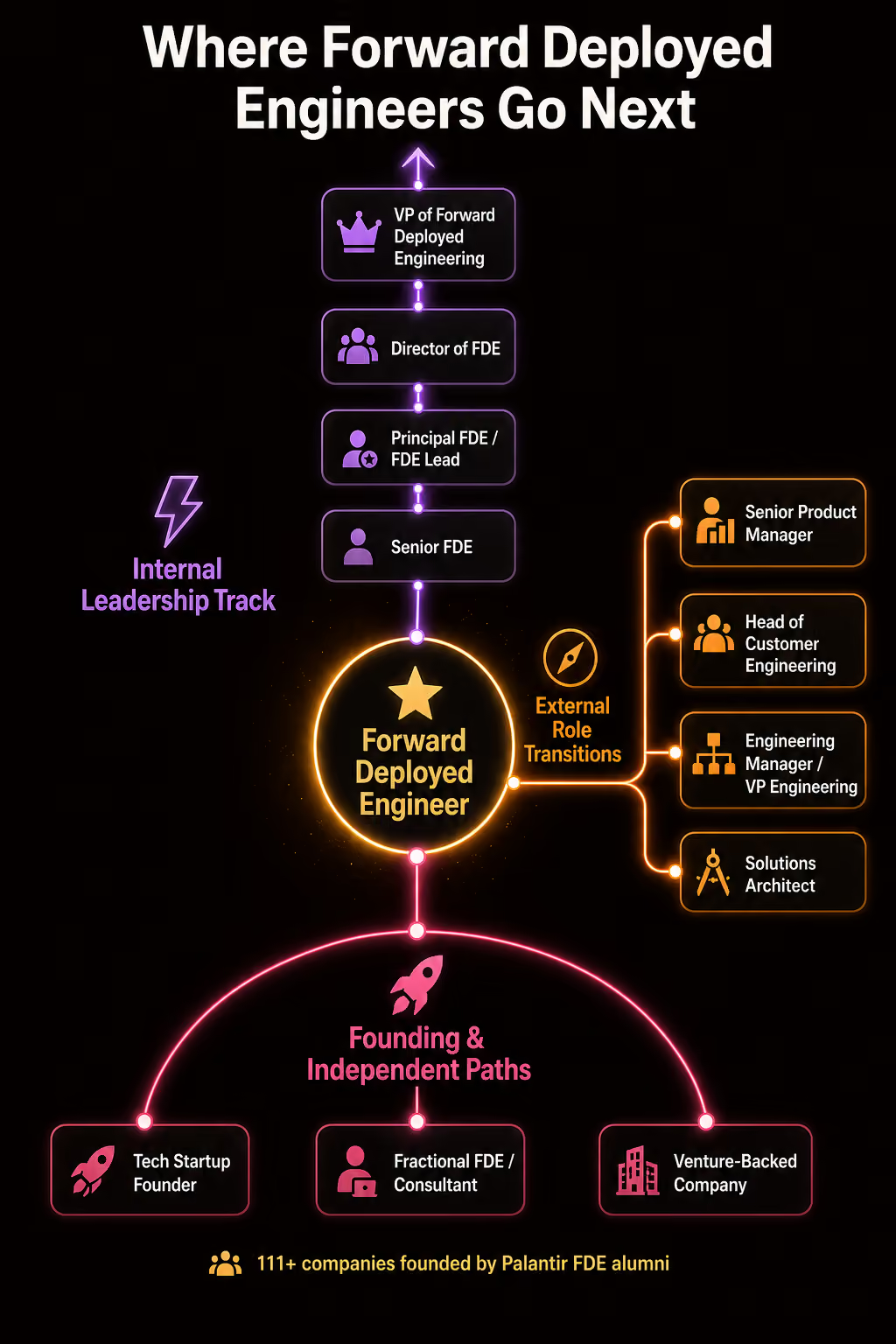
Internal ladder: FDE → Senior FDE → Principal FDE → Director → VP of Forward Deployed Engineering
Most common external moves: Product management, Head of Customer Engineering, engineering leadership, technical consulting
Founding rate: Palantir alumni, majority of whom held FDE-style roles, have collectively founded 111+ companies that raised $11.6 billion in capital
Why FDEs found companies at high rates: The role builds the exact skills founding requires: diagnosing real problems before building, executing under ambiguity, and developing deep industry expertise through direct client exposure
10-year comparison vs SWE: FDE path is broader, not faster. More senior options open up including product leadership and founding paths that are less accessible from pure product engineering tracks.
The question most engineers ask about the Forward Deployed Engineer role is what the work involves.
The more important question is where the role leads.
This matters because the FDE role is still relatively new and does not have the decades of established career ladder documentation that software engineering or product management have. Engineers evaluating it as a long-term career decision sometimes worry it is a specialty track with a narrow ceiling.
The evidence says the opposite.
The Forward Deployed Engineer role builds a combination of skills that is genuinely rare: production engineering depth, direct enterprise client experience across multiple industries, product intelligence gathered from the actual point of failure, and end-to-end ownership of high-stakes outcomes. That combination does not narrow your options. It expands them significantly.
This article documents where FDEs actually go, based on career trajectory data from Palantir alumni analysis, practitioner accounts, and the published progression structures at major FDE employers.
Where Forward Deployed Engineers Go Next: Career Trajectory Map
Why Forward Deployed Engineer Experience Is Unusually Transferable
Before covering specific paths, it is worth understanding why FDE experience transfers so broadly. Most engineering roles build depth in one area. FDE work builds depth in multiple areas simultaneously.
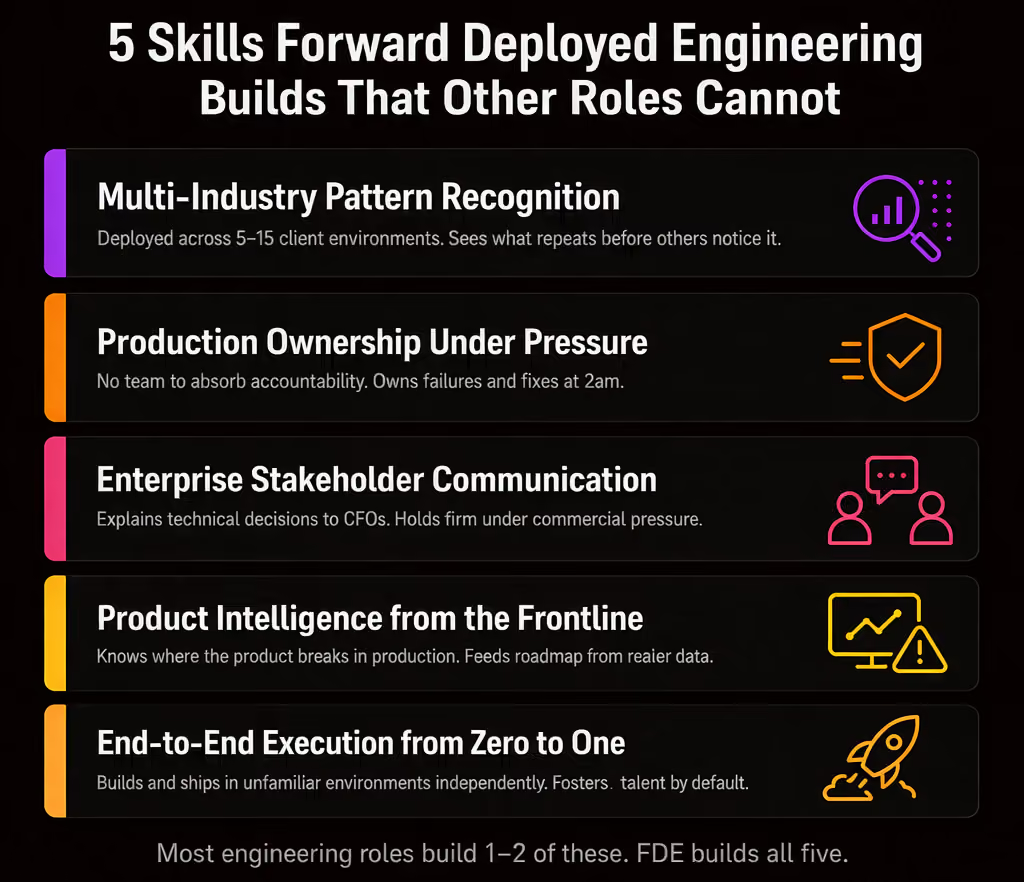
After two to five years in a Forward Deployed Engineer role, an engineer has typically:
Shipped production systems in five to fifteen different client environments across multiple industries
Diagnosed and fixed production failures under live client pressure, without a team to absorb accountability
Built and maintained client relationships at engineering, management, and executive levels
Converted direct client experience into product feedback that shaped what the company built next
Made high-stakes technical architecture decisions independently with incomplete information
Operated with the autonomy of a startup CTO inside an enterprise product company
No single other engineering role produces all six of those outcomes. Most produce one or two.
Forward Deployed Engineering builds a skill combination most engineering roles cannot replicate
The result is an engineer who has developed what is essentially a founder skillset inside a structured employment context. That is precisely why the FDE-to-founder pipeline is so active, and why FDE experience reads well across senior engineering, product, and leadership hiring.
"FDE responsibilities look similar to those of a startup CTO: you'll work in small teams and own end-to-end execution of high-stakes projects." - Palantir's own description of the Forward Deployed Engineer role
The Internal Forward Deployed Engineer Seniority Ladder
At most companies with established FDE teams, there is a defined internal progression that rewards technical depth, account complexity, and team leadership.
Forward Deployed Engineer to Senior Forward Deployed Engineer
The move from FDE to Senior FDE is the most common first step. Senior FDEs handle higher complexity accounts, often involving more stakeholders, more legacy systems, or more regulated environments. They begin to contribute to how the FDE team operates, including onboarding new FDEs and developing reusable integration patterns that benefit other accounts.
Salesforce's Ready in Six onboarding programme, for example, is partly run by Senior FDEs who have been through the programme themselves and now teach the frameworks they developed in the field.
Principal Forward Deployed Engineer and FDE Lead
Principal FDEs and FDE leads carry the highest-complexity engagements at a company. They often own a vertical, such as healthcare, financial services, or government, and develop the specialist expertise that makes the FDE team effective in that domain. They also have a direct line into product: at Ramp, for example, FDE leads drive the product roadmap decisions that determine when something should be built as a custom solution versus when it should become a core product feature.
Director and VP of Forward Deployed Engineering
This is the internal leadership path that major FDE employers are now building as their FDE teams scale. Salesforce committed to building a team of 1,000 FDEs, which requires a full management structure: directors who run regional or vertical FDE teams, VPs who own the function strategically, and in some cases a Chief Deployment Officer or equivalent. These roles are just now becoming established as the function matures.
What is notable about this track is that the Director and VP level roles demand exactly what FDE work develops: the ability to translate customer complexity into product and business decisions, at scale, across an entire team rather than a single engagement.
External Roles Forward Deployed Engineers Move Into
Many FDEs do not stay on the internal ladder. The skills the role builds are valued across a wide range of external roles, and the FDE title itself has become a strong signal in technical hiring.
Product Management
The FDE-to-PM transition is one of the most common paths and arguably the most natural fit.
Product managers are supposed to deeply understand what customers actually need, not just what they ask for. Most PMs at product companies have customer exposure filtered through user research, sales calls, or support escalations. FDEs have unfiltered, direct, high-stakes client experience. They know where the product breaks in production. They know which enterprise pain points repeat across accounts. They have been the person who had to explain a product gap to a frustrated CTO at 11pm.
That experience is worth years of traditional PM career development compressed into a shorter time. Companies that understand this hire FDEs directly into senior PM roles, skipping the junior to mid progression entirely.
Head of Customer Engineering and Solutions Architecture
These roles are a natural evolution of what FDEs already do, but at a team level rather than an individual level. A Head of Customer Engineering owns the function that deploys the product into enterprise environments. A Solutions Architect owns the technical design of how the product integrates into a client's stack.
Both roles draw heavily on the judgment, communication skills, and pattern recognition that FDE work develops. FDEs who want to stay close to the technical work but take on more scope often move here rather than into pure product management.
FDEs who want to stay in engineering and move into management have an unusual advantage over internal candidates from product engineering. They have already operated with the autonomy and accountability of a senior leader. They have already managed client relationships, navigated technical conflicts, and owned outcomes without a safety net.
The gap FDEs typically need to fill for EM roles is people management: performance conversations, career development, team structure. The judgment and execution skills are already there. The transition is often faster than for engineers moving from internal product roles.
Technical Consulting and Independent Practice
Some FDEs leave company employment to operate as independent deployment consultants or fractional FDEs. The demand for senior FDE-level expertise on a project basis is growing as more companies need AI deployment capability but cannot justify a full-time FDE team.
This path rewards the breadth of industry exposure that FDE work provides. An FDE who has worked across healthcare, financial services, and logistics has the context to consult across those sectors independently.
The Founding Path: Why FDE Experience Produces Founders at an Unusual Rate
This is the most striking pattern in FDE career trajectories, and it is documented well enough to discuss with specificity.
Palantir alumni, the majority of whom held FDE or FDE-adjacent roles, have collectively founded over 111 companies that had raised $11.6 billion in capital by 2024. That figure is documented by Concept VC, which analyzed the Palantir alumni network in depth.
"A very common role was Forward Deployed Engineer. A large number of founders held FDE or deployment strategist titles, which suggests Palantir deliberately put top talent in roles requiring technical skill, adaptability, and leadership. This experience of solving real-world problems on-site gave them a strong understanding of industry pain points and a bias toward execution." - Concept VC analysis of Palantir alumni
Specific examples from documented career histories:
Nabeel Qureshi spent nearly eight years at Palantir as a Forward Deployed Engineer, working on projects ranging from Covid-19 response infrastructure to AI applications in drug discovery to aircraft manufacturing optimization at Airbus. He subsequently became a founding employee and VP of Business Development at GoCardless, a European fintech that reached unicorn status.
Trae Stephens, Brian Schimpf, and Matt Grimm all held senior roles at Palantir that combined FDE-style customer deployment work with broader platform responsibilities. They co-founded Anduril Industries, which by 2025 had reached a valuation of approximately $28 billion and secured major contracts with the Department of Defense.
Coby Blumenfeld worked on healthcare deployments at Palantir and subsequently founded Chapter, a Medicare advisor platform, applying direct domain expertise from his FDE work in the healthcare sector.
The pattern is consistent. FDE work gives engineers direct exposure to real business problems at the point where they are most acute. It builds a mental database of industry pain points that most engineers accumulate only through years of peripheral exposure. And it builds the execution instinct, the ability to move from problem to deployed solution quickly in an unfamiliar environment, that founding a company demands.
Why FDEs Make Strong Founders
The parallels between FDE work and early-stage founding are direct, not coincidental:
FDEs diagnose problems before they build solutions. Founders who skip this step build for the wrong problem.
FDEs work with incomplete information under time pressure. Early-stage founding is the same condition at higher stakes.
FDEs own outcomes end to end without a team to absorb accountability. Founding requires this mindset.
FDEs build deep expertise in a specific industry through deployment work, which often becomes the founding domain.
FDEs understand what enterprise customers actually need versus what they say they need, which is the product-market fit instinct.
To give a concrete sense of how FDE trajectories compare to traditional engineering paths over time, the table below maps approximate five-year and ten-year outcomes across three paths.
Path
5-Year Position
10-Year Position
Traditional Software Engineering
Senior Engineer or Staff Engineer on a product team
Principal Engineer, EM, or Director of Engineering (internal track)
Forward Deployed Engineering FDE
Senior or Principal FDE with multi-industry deployment experience
VP Engineering, Head of Customer Engineering, PM Lead, or Founder
Solutions Engineering
Senior SE or SE Manager
Director of Solutions Engineering or VP Customer Success
The FDE track is not faster. It is broader. At the five-year mark the FDE has accumulated industry exposure and client-facing execution experience that their SWE peer has not. At the ten-year mark that breadth translates into a wider range of senior options, including paths that are not typically available from pure product engineering tracks.
The tradeoff is that the internal FDE ladder is less defined than the SWE ladder at most companies. FDE is a newer function and the seniority structures are still being built. Engineers who need clearly defined promotion criteria and predictable advancement timelines may find the SWE ladder more legible, at least for now.
What This Means for Engineers Evaluating the Forward Deployed Engineer Role
The career-ceiling concern that some engineers bring to the FDE role is not baseless. It reflects the fact that the role is new, internal ladders are still being established, and there are fewer decades of career trajectory data than exist for SWE or PM roles.
But the actual evidence points in the other direction. The FDE role produces engineers who are better positioned for senior technical leadership than most product engineering tracks, more credible as product managers than most engineers who make that transition, and more prepared for founding than almost any other corporate engineering role.
The engineers who have the best long-term outcomes from FDE roles are those who treat each deployment as an investment in domain knowledge and execution skill, not just a job to be completed. The frontline experience the role provides is the asset. What you do with it determines where you end up.
For engineers who want to build the technical and deployment foundation that these trajectories require, FDE Academy provides a structured path into the Forward Deployed Engineer role with the skills, interview preparation, and portfolio work that the best FDE employers are looking for.
Frequently Asked Questions
What career paths are available after a Forward Deployed Engineer role?
Forward Deployed Engineers commonly move into product management, engineering leadership, head of customer engineering, solutions architecture, technical consulting, or founding their own companies. The role builds a rare combination of production engineering depth, enterprise client experience, and product intelligence that translates well across all of these paths. Some FDEs stay on the internal seniority ladder and progress to Principal FDE, Director, or VP of Forward Deployed Engineering as the function scales.
Is the Forward Deployed Engineer role a good long-term career investment?
Yes. FDE experience is broadly transferable in ways that most engineering roles are not. The combination of production deployment experience, direct enterprise client relationships, and product feedback from the frontline positions FDEs well for senior technical leadership, product management, and founding roles. Palantir alumni, the majority of whom held FDE-style roles, have founded over 111 companies that raised $11.6 billion collectively.
Can a Forward Deployed Engineer move into product management?
Yes, and it is one of the most common FDE transitions. FDEs have unfiltered, high-stakes client experience that most PMs accumulate only gradually through research and filtered customer feedback. Companies that understand this hire FDEs directly into senior PM roles because the customer understanding and product intelligence are already developed.
Do Forward Deployed Engineers become founders?
Yes, at a notably high rate. FDE work builds the exact skillset founding requires: diagnosing real problems before building, executing under ambiguity with incomplete information, and developing deep industry expertise through direct client exposure. The Palantir alumni network, where FDE work was pioneered, has produced over 111 founded companies including Anduril Industries, now valued at tens of billions of dollars.
What is the seniority progression for a Forward Deployed Engineer?
The typical internal progression is FDE to Senior FDE to Principal FDE to FDE Lead or Director of Forward Deployed Engineering. At companies with large FDE teams like Salesforce, the structure extends to VP of Forward Deployed Engineering. Senior FDEs handle higher-complexity accounts and contribute to team onboarding and reusable frameworks. Principal FDEs often own a specific vertical or domain and have a direct line into the product roadmap.
How does the Forward Deployed Engineer career path compare to software engineering long-term?
At the five-year mark the FDE has accumulated multi-industry deployment experience and enterprise client skills that a product SWE typically has not. At ten years the FDE has a broader set of senior options including product leadership and founding paths that are less accessible from pure product engineering tracks. The tradeoff is that FDE internal seniority structures are less defined than SWE ladders, since FDE is a newer function and the career frameworks are still being established at most companies.
Become one of India’s first Forward-Deployed Engineers.
The world is hiring - and this Academy prepares you for it.