Blogs
What Are the Responsibilities of a Forward Deployed Engineer?

What Are the Responsibilities of a Forward Deployed Engineer?

A stage-by-stage breakdown of what a Forward Deployed Engineer is actually responsible for, from discovery through post-launch ownership.

By
July 25, 2026
What Are the Responsibilities of a Forward Deployed Engineer?

Summarize this article using AI

A Forward Deployed Engineer is responsible for discovery, technical scoping, production-grade implementation, deployment, and ongoing ownership of an AI or software system inside a specific customer's environment plus feeding what they learn back to the product and research teams. Unlike most engineering roles, an FDE's responsibilities don't end at go-live. Ownership continues through monitoring, iteration, and adoption until the system is stable and trusted.

That ongoing-ownership piece is the single biggest thing that separates FDE responsibilities from adjacent titles. A Solutions Architect designs and hands off. A Sales Engineer demos and moves to the next deal. An FDE stays accountable for the outcome.

This guide breaks those responsibilities down stage by stage, so you can see exactly what the role owns at each point in an engagement, not just a general description of the title.

The Core Responsibility: Owning Outcomes, Not Just Delivery

Before breaking responsibilities into stages, it's worth naming the thread that runs through all of them. An FDE isn't responsible for producing an artifact, a design document, a working demo, a signed-off deliverable. They're responsible for whether the system actually works, in production, for a specific customer.

Palantir, the company that originated the role, has described FDE responsibilities as looking similar to a startup CTO's: working in small teams and owning end-to-end execution of high-stakes projects. That framing holds up well across the companies now running FDE teams, from OpenAI to AWS-credentialed partners to AI-native startups.

FDE Responsibilities by Engagement Stage

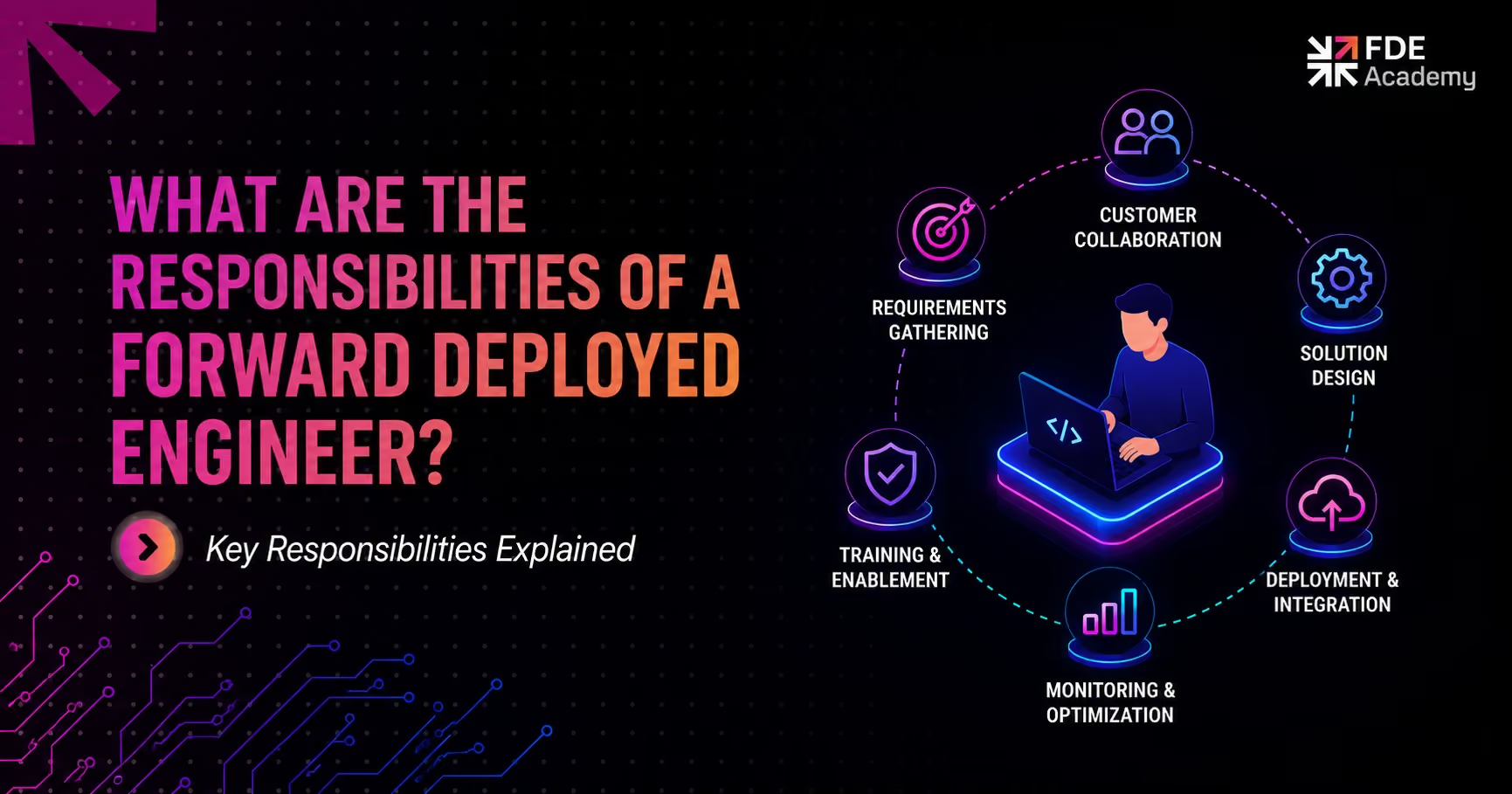
Responsibilities shift as an engagement moves from first contact with a customer to a stable, adopted production system. The table below breaks down what an FDE typically owns at each stage.

Deployment Stages & Core Responsibilities
Stage Core responsibilities
Discovery & Scoping Map the customer's real data, systems, and constraints; identify the actual business problem; define measurable success criteria
Build & Integration Write production-grade code; integrate with existing customer systems and data sources; build the technical solution against real constraints
Deployment Ship the system into the customer's live environment; configure security, access, and compliance requirements specific to that customer
Production Ownership Monitor performance; fix issues as they arise, including being on-call for production incidents; catch drift and edge cases
Feedback & Iteration Report field learnings back to product and research teams; influence the broader product roadmap based on what one customer's deployment revealed

Each row deserves a closer look at what actually happens inside it, and why it's structured the way it is.

Discovery and Scoping Responsibilities

Engagements don't start with a spec sheet. An FDE is responsible for mapping a customer's actual data usually fragmented across legacy systems, identifying the real constraint (compliance, latency, data residency), and defining what success looks like in concrete, measurable terms.

Specifically, this stage typically includes:

  • Auditing what data actually exists, where it lives, and how clean or fragmented it really is
  • Identifying the true constraint driving the engagement often compliance, latency, or legacy-system limitations rather than whatever was named in the initial ask
  • Defining success in numbers a customer can verify later, not vague language like "improve efficiency"
  • Flagging early whether the engagement is technically feasible within the customer's real environment, before committing engineering time to a full build

This stage carries more weight than it might seem to from the outside. Customers frequently know they want "AI" or a specific outcome without knowing what that means in practice, and getting the scoping wrong here compounds into every later stage.

Who FDEs Work With: Cross-Functional Responsibilities

Responsibility for an engagement rarely sits with the FDE in isolation. Part of the role's day-to-day work is coordinating across several other functions, each with a different stake in the outcome:

  • Customer engineering and IT teams coordinating access, infrastructure, and integration points inside the customer's own environment
  • Product and research teams internally translating field learnings into roadmap input, and pulling in specialized expertise when an engagement surfaces a gap the current product can't handle
  • Sales and account teams staying aligned on what was actually promised in the deal, since an FDE is often the first to discover a gap between what was sold and what's technically realistic
  • Compliance and security teams, on both the customer and vendor side making sure a deployment satisfies both organizations' governance requirements before and after go-live

Managing all of these relationships simultaneously, without a dedicated project manager smoothing every handoff, is itself a responsibility most engineering roles never have to carry.

Build and Integration Responsibilities

This is the responsibility that most clearly separates FDEs from consultants: they write and ship the actual production code, not a recommendation or a slide deck. That typically includes:

  • Building data pipelines and integrations against the customer's real (often messy) systems
  • Implementing the core technical solution which for current AI-focused engagements often means retrieval pipelines, agentic workflows, or custom model integration
  • Writing evaluation and testing logic before anything reaches a real user

For a deeper technical breakdown of what this stage actually involves architecturally, how Forward Deployed Engineers build enterprise AI platforms covers the build-stage responsibilities in much greater depth than this overview does.

Deployment and Production Responsibilities

Getting a system running in a customer's actual environment carries its own distinct set of responsibilities separate from building it in the first place:

  • Configuring access control, audit logging, and compliance settings to match the customer's specific requirements
  • Coordinating go-live with the customer's own teams and timelines, not just an internal release schedule
  • Making sure the system degrades gracefully rather than failing hard if something goes wrong on day one

Production Ownership Responsibilities

FDE responsibilities don't stop at go-live; this is the stage that most clearly distinguishes the role from a typical delivery or consulting engagement. Ongoing responsibilities include:

  • Monitoring production behavior and catching performance drift the pre-launch evaluation missed
  • Being the person accountable if the system breaks including out-of-hours incident response for high-stakes deployments
  • Driving actual adoption, not just technical uptime a system nobody uses isn't a success regardless of how well it runs

Feedback and Iteration Responsibilities

The final responsibility is easy to overlook but structurally central to why the FDE model exists at all: feeding field learnings back into the broader product. Job descriptions at companies serious about this model explicitly include language like "share field learnings that shape the product roadmap" this isn't an incidental extra duty, it's a core part of the role.

That feedback loop is what keeps the FDE model from collapsing into pure custom-services work. Learnings from one customer's deployment are meant to generalize and improve the product for the next one.

Client-Facing Responsibilities

Alongside the technical build work, FDEs carry a distinct set of client-facing responsibilities that a typical backend or platform engineer never has to manage:

  • Directly collaborating with business users to understand workflows, frustrations, and goals not just requirements documents
  • Navigating stakeholders with competing incentives, from skeptical end users to compliance teams to impatient executives
  • Translating ambiguous business language into concrete technical specifications, often without a product manager as an intermediary
  • Building enough trust with the customer's own teams that they'll actually adopt the system once it ships

This client-facing layer runs in parallel with the technical responsibilities above, not sequentially most FDEs are managing both simultaneously throughout an engagement, which is a large part of why the role demands an unusually broad skill combination. The full breakdown of that skill combination lives in Forward Deployed Engineer skills.

How Responsibilities Shift With Seniority

Responsibility scope expands predictably as an FDE gains experience, even though the five stages above stay broadly the same at every level.

Deployment Stages & Core Responsibilities
Stage Core responsibilities
Discovery & Scoping Map the customer's real data, systems, and constraints; identify the actual business problem; define measurable success criteria
Build & Integration Write production-grade code; integrate with existing customer systems and data sources; build the technical solution against real constraints
Deployment Ship the system into the customer's live environment; configure security, access, and compliance requirements specific to that customer
Production Ownership Monitor performance; fix issues as they arise, including being on-call for production incidents; catch drift and edge cases
Feedback & Iteration Report field learnings back to product and research teams; influence the broader product roadmap based on what one customer's deployment revealed

What FDE Responsibilities Are Not

Because "Forward Deployed Engineer" gets confused with several adjacent titles, it's worth being explicit about what falls outside the role's responsibilities:

  • Not pure pre-sales demos. That's Sales Engineering, a role whose responsibilities typically end once a deal closes, where an FDE's real responsibilities are just beginning.
  • Not design-and-handoff. That's closer to Solutions Architecture designing an approach and handing it to someone else to build and own.
  • Not advisory recommendations billed by the hour. That's traditional consulting assessments and roadmaps rather than shipped, owned production code.

For the full comparison across all of these adjacent titles, see Forward Deployed Engineer for the complete definitional breakdown, and do Forward Deployed Engineers code for a direct answer to one of the most common follow-up questions about this responsibility set.

How FDE Responsibilities Actually Get Measured

Unlike roles measured against activity metrics, tickets closed, features shipped, deals influenced, FDE responsibilities are almost always measured against a business outcome the customer actually cares about.

A few patterns show up consistently across how companies evaluate FDE performance:

  • Adoption, not just deployment - A system that's technically live but barely used doesn't count as a completed responsibility usage and reliance are the real signal.
  • Time to measurable value - How quickly the engagement moved from discovery to a customer seeing a concrete business result, not just a working demo.
  • Downstream product impact - Whether the field learnings an FDE surfaced actually influenced later product decisions, which is how the feedback responsibility gets validated rather than just claimed.

That measurement framework is worth understanding early, since it shapes how the responsibilities above actually get prioritized day to day. An FDE juggling all five stages at once will naturally lean into whichever one most directly affects the outcome they're being evaluated against.

TL;DR

  • Core responsibility: own outcomes end-to-end, not just delivery discovery through post-launch stabilization
  • Five responsibility stages: discovery/scoping β†’ build/integration β†’ deployment β†’ production ownership β†’ feedback to product
  • Client-facing duties: direct collaboration with business users, stakeholders, and domain experts not just engineering teams
  • Technical duties: production-grade coding, system integration, data pipeline work not slide decks or demos
  • What responsibilities are NOT included: pure pre-sales demos (Sales Engineering) or design-and-handoff (Solutions Architecture) those are adjacent, not the same role
  • The differentiator: responsibilities continue after go-live, which is unusual compared to most engineering and consulting roles

Frequently Asked Questions

  • What are the main responsibilities of a Forward Deployed Engineer?

    Discovery and technical scoping, building and integrating production-grade code, deploying the system into a customer's live environment, ongoing production ownership including incident response, and feeding field learnings back to product and research teams.

  • Do Forward Deployed Engineer responsibilities end after the system goes live?

    No. Ongoing production ownership monitoring, catching drift, and remaining accountable if the system fails is one of the most distinguishing responsibilities of the role compared to typical delivery or consulting engagements, which usually end at handoff.

  • Are client-facing duties part of an FDE's core responsibilities?

    Yes. Direct collaboration with business users, stakeholder navigation, and translating ambiguous requirements into technical specifications all run in parallel with the technical build responsibilities throughout an engagement.

  • How do FDE responsibilities change with seniority?

    Junior FDEs typically execute within a defined scope under guidance. Senior and staff-level FDEs own full engagements end-to-end and take on higher-complexity accounts, while team leads shift toward owning team performance and org-wide playbooks rather than individual deployments.

  • Is feeding feedback to the product team really a core FDE responsibility?

    Yes, at companies with mature FDE programs. This feedback loop is structurally central to the model it's what turns one customer's deployment learnings into improvements that benefit the broader product, rather than one-off custom work

  • Background image glowing