Blogs
Forward Deployed Engineer vs Machine Learning Engineer
Forward Deployed Engineer vs Machine Learning Engineer
By
R&D, FDE Academy
July 18, 2026

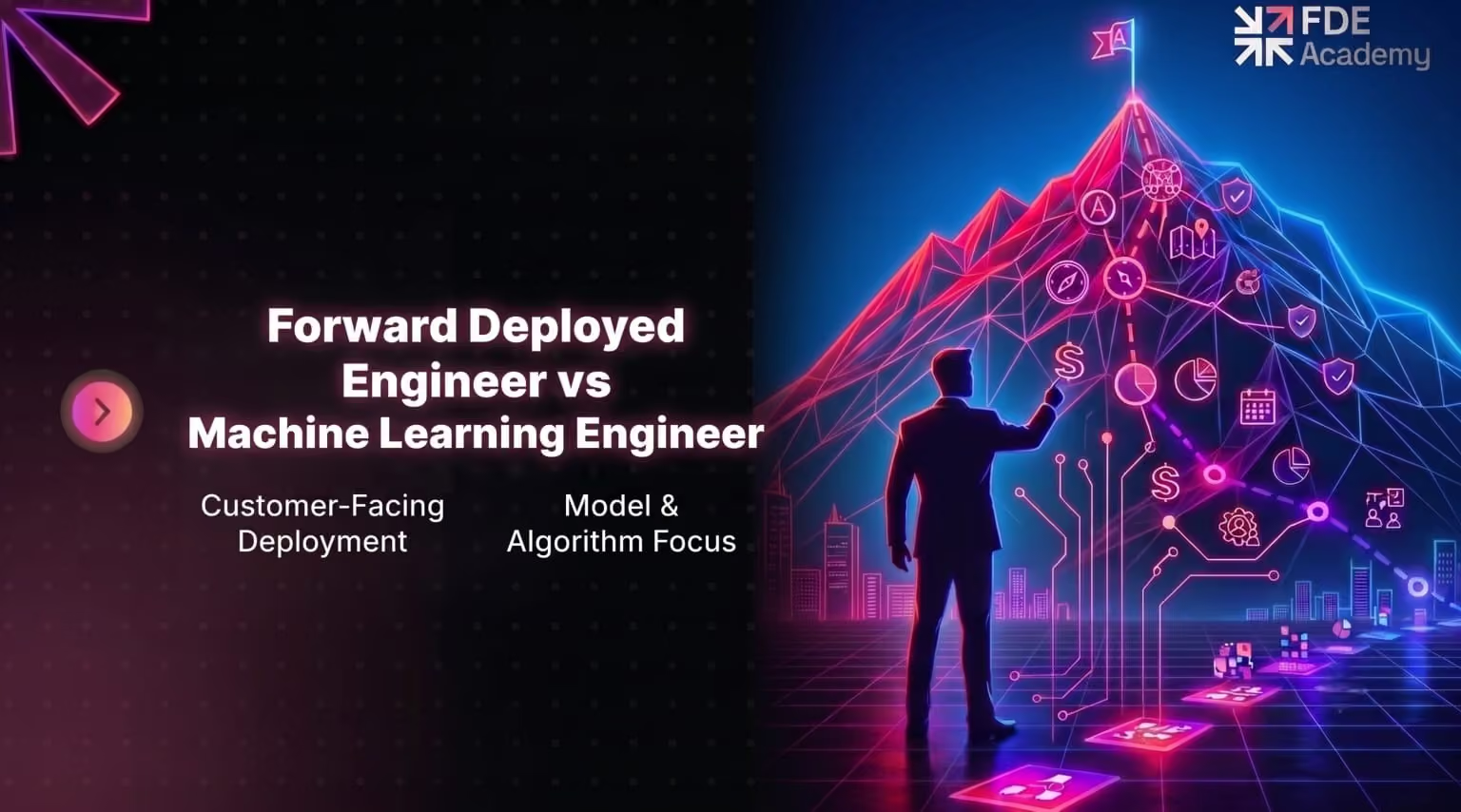
A Machine Learning Engineer builds, trains, and optimizes models, the work happens largely before a model ever reaches a real customer. A Forward Deployed Engineer takes a model that already exists and makes it work inside one specific customer's messy, real environment. The work happens after the model is built, embedded with the people who'll actually use it. Both roles touch AI systems daily, but they own opposite ends of the same pipeline: one perfects the model in the abstract, the other proves it works in reality.
This Forward Deployed Engineer vs Machine Learning Engineer guide breaks down what each role actually does day to day, how skills and success metrics diverge, what each pays, and how to tell which path fits you if you're deciding between them.
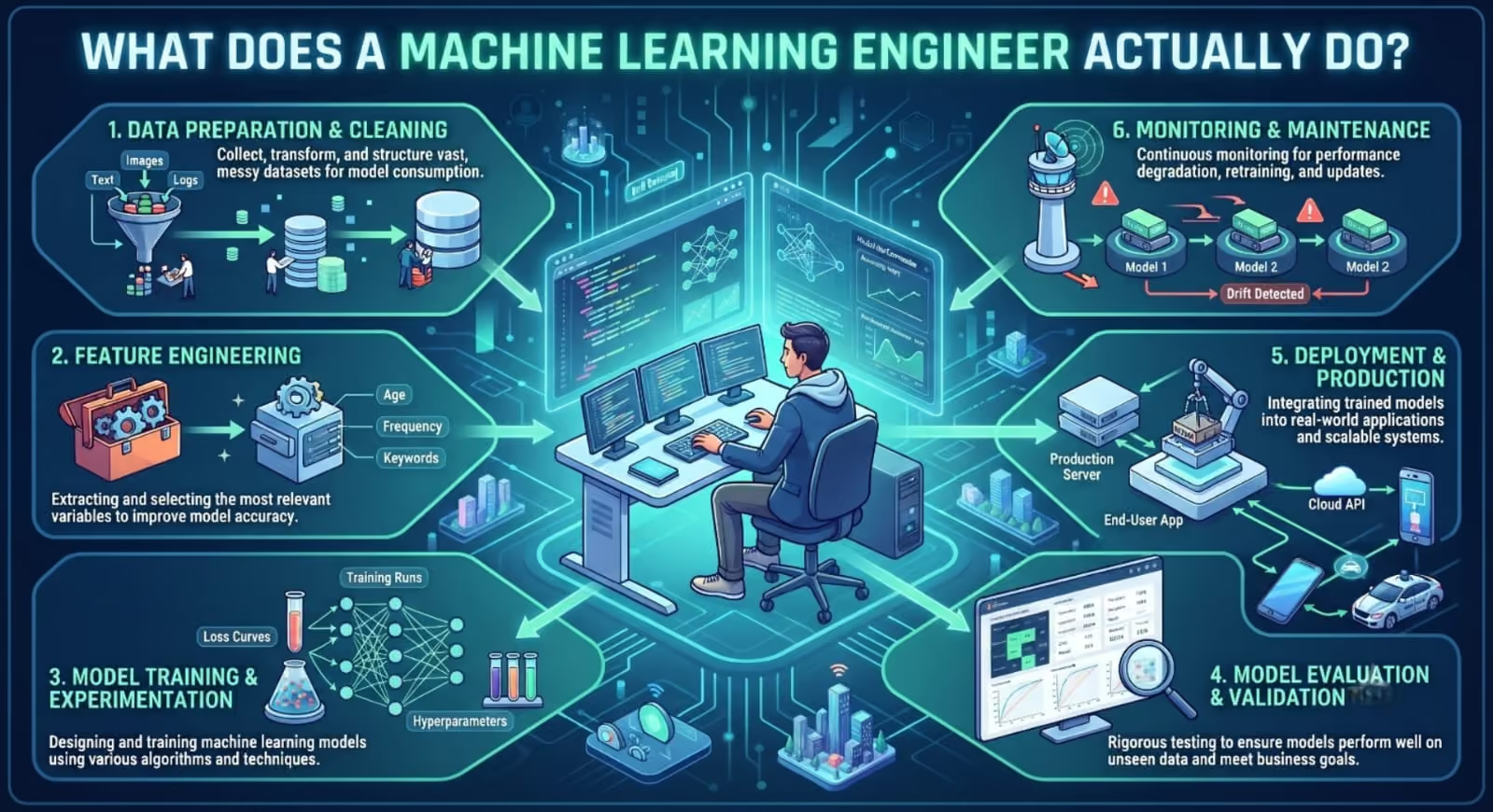
A Machine Learning Engineer designs, builds, trains, and optimizes machine learning models, then works to get those models into a scalable, reliable serving infrastructure. The day-to-day centers on data: feature engineering, model architecture selection, training runs, hyperparameter tuning, and evaluating model performance against benchmark metrics like accuracy, precision, recall, or task-specific scoring.
ML Engineers typically work within a company's internal product or research organization, building a capability meant to serve many users or many downstream applications at once, not one specific customer's environment.
Success is measured in model performance: did accuracy improve, did latency drop, does the model generalize well to new data. The core skill is technical depth in ML fundamentals: statistics, linear algebra, deep learning architectures, and frameworks like PyTorch or TensorFlow, combined with growing MLOps skill (model versioning, serving infrastructure, monitoring for drift).
A typical day is structured and internally focused: tracking down a data leakage issue in a validation set, writing a transform script ahead of a training run, benchmarking a model's memory footprint on a GPU cluster.
The communication circle is heavily technical, other data scientists, infrastructure engineers, technical product managers, built for sustained, deep problem-solving on one system over time.
The role has matured significantly over the past several years, splitting in practice into research-leaning ML Engineers (closer to applied research, working on novel architectures or fine-tuning approaches) and platform-leaning ML Engineers (focused on the infrastructure that reliably serves models at scale).
Both variants share the same core distinction from FDE work: the primary customer is internal, another team, a product surface, a research goal, rather than one specific external organization with its own constraints and politics.
A Forward Deployed Engineer embeds directly with a specific customer to take an existing AI capability and make it work inside that customer's actual environment, legacy systems, messy data, and real organizational constraints included. The work centers on discovery, integration, and production ownership: understanding what the customer actually needs, scoping a buildable solution, integrating with their existing infrastructure, and staying accountable once the system is live.
A typical day looks nothing like the structured MLE routine above: a morning session with a client's security lead explaining data isolation protocols, an afternoon spent writing a pipeline to clean an undocumented decade-old database, and an evening prototyping a UI to show an executive sponsor what's possible. Constant context-switching is the norm, not the exception. Our day in the life of a Forward Deployed Engineer covers this in full detail.
FDEs typically work customer by customer, sometimes across many different industries within a single year. Success is measured in adoption and business outcome: did the deployment ship, is the customer's team actually using it, did it solve the real problem, not a model performance metric in isolation.
The core skill is production engineering combined with customer-facing judgment: full-stack coding ability, system integration, and the discovery and stakeholder-communication skills that let an FDE translate a vague business ask into a shippable technical plan.
An ML Engineer's work lives largely upstream: data pipelines, training infrastructure, model architecture. An FDE's work lives downstream: taking a model that's already capable and proving it works against one customer's real data, integrations, and constraints.
This is the cleanest way to separate the two roles when a job posting's title alone doesn't make it obvious, ask whether the role is expected to improve a model's underlying performance, or to prove an existing model works inside a specific, messy customer environment.
ML Engineers collaborate primarily with other ML engineers, data scientists, and research teams, internal, technical stakeholders working toward a shared model or product goal. FDEs work primarily with customer stakeholders, engineers, domain experts, compliance teams, executives, who are frequently non-technical and need the FDE to translate technical tradeoffs into business language they can act on.
An ML Engineer's success is measured against model-centric benchmarks: did accuracy, F1 score, latency, or throughput improve. An FDE's success is measured against deployment and business outcomes: did the system ship to production, is it being used, did it move the specific metric the customer cared about. A technically excellent model that never gets adopted is a failure by FDE standards; a deployment that works reliably but uses a less sophisticated model is often a success by FDE standards, as long as it solves the customer's actual problem.
ML Engineers need deep technical fluency in statistics, model architectures, and training infrastructure. FDEs need production-grade full-stack coding, system integration experience (APIs, legacy systems, authentication), and discovery and stakeholder-communication skills that ML Engineer roles rarely test for. Both roles increasingly overlap in one area: evaluation design, since FDEs deploying AI systems need to validate model behavior against real customer data, a skill that borrows directly from ML Engineering practice even though the FDE isn't training the model itself.
Both roles share a common engineering foundation, Python, Git, containerization, and basic cloud fluency, but diverge sharply once you look past that baseline. The split reflects the same upstream/downstream distinction covered above: an MLE's tools optimize a model in a controlled environment, and FDE's tools integrate that model into somebody else's chaos.
For the full breakdown of FDE-specific tooling organized by workflow stage rather than by comparison to ML Engineering, see our tools used by Forward Deployed Engineers guide, which covers agent orchestration, evaluation frameworks, and deployment tooling in more depth than fits here.
Compensation for both roles depends heavily on the company tier rather than just the job title on your offer letter. In the broader tech market including established software firms and mid-sized startups Machine Learning Engineer (MLE) compensation modestly outpaces Forward Deployed Engineers (FDEs).
General market MLEs command $120,000 to $260,000 in base pay with senior total compensation reaching $350,000 to $500,000+, while a typical FDE salary yields $115,000 to $250,000 in base pay and $250,000 to $450,000 in total compensation due to the title being newer and less standardized.
At elite frontier AI labs like OpenAI and Anthropic, these figures shift significantly higher and the historical pay gap largely disappears. FDE roles at these labs command $350,000 to $550,000 in total compensation at mid-to-senior levels because they are benchmarked directly against high-paying research engineer tracks.
Senior MLE compensation at this same frontier tier reaches comparable or higher totals, particularly for specialized engineers with foundation-model training experience whose pay converges with pure research tracks.
Ultimately, the market is shifting its value metrics from code isolation to production reality. While the general market has historically rewarded the scarcity of model-building skills, frontier labs have realized that a brilliant model no one can successfully deploy generates far less revenue than a good model that reliably ships. Which compensation band applies to you will depend far more on the tier of the hiring company than on the specific title itself.
Yes, and it's one of the more common and natural FDE entry paths. ML Engineers already carry strong Python fluency, comfort with model behavior and evaluation, and technical credibility that customers and hiring managers respect. The skill gap to close is primarily on the deployment and customer-facing side: production system integration (APIs, legacy systems, authentication), discovery and requirements-gathering skill, and comfort operating in ambiguous, non-technical stakeholder conversations, none of which a typical ML Engineering role tests for directly.
The most effective way to close that gap: take on any available customer-facing or cross-functional work in your current ML Engineering role, even informally, and build a portfolio project that goes beyond training a model, deploy it somewhere real, integrate it with a mock external system, and document the production concerns (monitoring, error handling, evaluation) that a pure research or training-focused project wouldn't require. Our Forward Deployed Engineer skill roadmap covers this transition path in more detail.
Interviewers evaluating an ML Engineer for an FDE role typically probe specifically for this gap: expect decomposition-style questions that test whether you can scope an ambiguous customer problem, not just optimize a well-defined model metric.
Candidates who can point to even one instance of taking a model from a notebook to something a non-technical stakeholder actually used tend to interview far better than candidates whose experience stops at model performance, regardless of how technically strong that model work was.
Choose Machine Learning Engineer if you're energized by the model itself, architecture decisions, training dynamics, squeezing out the next percentage point of accuracy, and you'd rather go deep on one technical problem than context-switch across many customer environments. This path also offers a more direct route into ML research roles later, since the skill overlap is substantial.
Choose Forward Deployed Engineer if you want to see your technical work solve a specific, real problem for a specific customer, and you're energized by variety, ambiguity, and direct customer impact more than by squeezing incremental performance out of a model.
This path rewards breadth and judgment as much as technical depth, and it routes more naturally toward deployment leadership, product roles, or founding a company later, since it builds end-to-end product intuition that pure model-building work doesn't.
A useful gut check: if you're more excited by the question "how do I make this model 3% more accurate" than by "how do I get this system actually adopted by people who don't care about the model, they care whether their job gets easier," you're likely leaning ML Engineer. If it's the reverse, you're likely learning FDE.
Machine Learning Engineer and Forward Deployed Engineer solve different halves of the same problem: one makes the model good, the other makes the model useful to a real customer who doesn't care how it works, only that it does.
Neither role is more valuable than the other, and the compensation data increasingly reflects that both are treated as elite, scarce technical skill sets by the companies competing hardest for AI talent. The right choice comes down to whether you're more energized by the model or by the mess of making it work in someone else's world.
A Machine Learning Engineer builds and optimizes models, work that happens largely before a model reaches customers. A Forward Deployed Engineer takes an existing model and makes it work inside a specific customer's real environment, work that happens after the model is built. One perfects the model; the other proves it works in reality.
At frontier AI labs, compensation for both roles is high and increasingly convergent. OpenAI and Anthropic FDE roles pay $350,000 to $550,000 total compensation at mid-to-senior levels, comparable to senior ML Engineer compensation at the same companies. The specific number depends more on company and level than on which title is on the offer.
Yes, this is one of the more common and natural FDE entry paths. ML Engineers already have strong Python skills and model evaluation experience. The gap to close is production system integration and customer-facing discovery skills, which most ML Engineering roles don't test for directly.
Some, but not at the depth an ML Engineer needs. FDEs need applied fluency, evaluation design, prompt engineering, RAG architecture, enough to validate and integrate an existing model, but they're not typically training models from scratch or making architecture-level decisions the way an ML Engineer does.
No, they're distinct, complementary roles rather than one being a subset of the other. FDE work spans discovery, integration, and production ownership across the customer's entire system, of which the AI model is often just one component, not the sole focus the way it is for an ML Engineer.
No, and this is a common confusion. A Solutions Architect typically works pre-sales or in a consultative capacity, designing system blueprints and rarely touching production code. An FDE is a full-time developer who writes the actual integrations, debugs runtime failures on-site, and stays embedded until the system is fully operational. See our Forward Deployed Engineer vs Solutions Architect guide for the complete comparison.
The world is hiring - and this Academy prepares you for it.