Blogs
How Forward Deployed Engineers Help B2B AI Startups Scale Enterprise AI
How Forward Deployed Engineers Help B2B AI Startups Scale Enterprise AI
By
R&D, FDE Academy
July 28, 2026

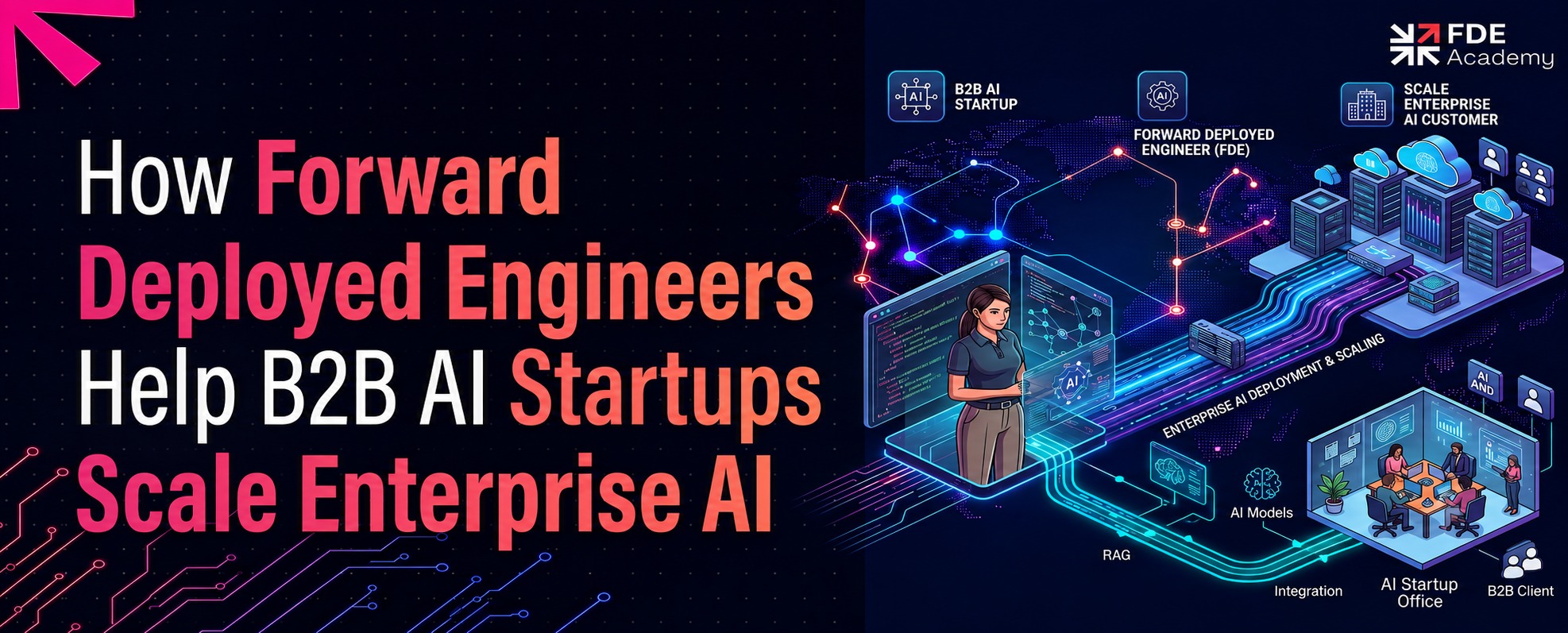
Most B2B AI startups don't lose enterprise deals on the demo. They lose them in the six to twelve weeks after the demo, when a working prototype has to survive a customer's real data, real authentication system, and real compliance review and nobody on the founding team is assigned to make that happen.
A Forward Deployed Engineer (FDE) is the role built specifically to own that gap: an engineer who embeds inside the customer's environment, adapts the product to their actual constraints, and stays accountable until the deployment is generating value, not just running in a sandbox.
This article covers what that looks like in practice: why the gap exists, what an FDE actually does inside an enterprise deal, the signals that tell you your startup needs this function now rather than later, and how founders are building or buying it in 2026.
Scaling enterprise AI isn't the same problem as scaling a SaaS product. A typical SaaS company scales by making the same onboarding flow work for the 500th customer as it did for the 5th. An AI startup selling into the enterprise usually can't do that, because every enterprise customer's AI deployment touches something the vendor doesn't control: their legacy databases, their identity provider, their data residency rules, their internal review process.
That's why the industry-wide pilot failure rate is so stark. MIT's Project NANDA study, The GenAI Divide: State of AI in Business 2025, found that 95% of enterprise generative AI pilots showed no measurable profit-and-loss impact; only 5% made it to a stage where they were extracting real value.
The same research found something specific and useful for founders: vendor-led implementations succeeded roughly twice as often as internal builds. In other words, the deployments that worked usually had someone from the vendor's side embedded in making them work.
For a B2B AI startup, "scaling enterprise AI" means closing that gap repeatedly and predictably turning what looks like a one-off, hand-built integration for customer #1 into a repeatable motion by customer #10, without rebuilding the product from scratch every time.
Ask most AI startup founders why a promising pilot stalled, and the answer isn't "the model wasn't good enough." It's usually one of:
Industry practitioners call this the integration wall: getting a demo working in a sandbox is roughly 20% of the job of getting an AI system live in production. The other 80% is enterprise SSO, legacy ETL pipelines, regulatory constraints, and the internal politics of getting production credentials from a customer's security team.
No amount of additional model quality fixes that 80% it needs an engineer who can sit inside the account and do the unglamorous work of making the system fit.
An FDE's job on a specific account typically runs through a few consistent phases, detailed further in the Forward Deployed Engineer Playbook:
That last point is what separates an FDE from a solutions engineer or a professional services consultant. A Solutions Engineer supports the sales cycle up to signature and then largely hands off. An FDE's job doesn't end at signature; it starts there.
Not every B2B AI startup needs a dedicated Forward Deployed Engineering function on day one. The signals that it's time tend to cluster together:
The first enterprise deployment for any AI startup is usually bespoke hand-built, under-documented, and hard to repeat. An FDE's job on that first account is partly to solve the customer's problem and partly to document what was learned well enough that the second and third deployments take weeks, not months. This is the mechanism that actually produces scale: not doing the same custom work faster, but making each deployment teach the next one something reusable.
Enterprise buyers increasingly evaluate AI vendors on how fast they can go from signed contract to working system, not just on the model's capability. Perspective AI's research on AI buyer behavior found that 67% of AI buyers cited vendor responsiveness during deployment as the single largest factor in whether they renewed. A founder or a product engineer splitting attention across the roadmap and a live deployment can't match that responsiveness. A dedicated FDE, embedded in the account, can.
A pilot that never reaches full adoption is a renewal that's already at risk before the contract is even up. Because an FDE stays accountable past go-live instrumenting the system so failures surface before the customer notices, and iterating against real usage the deployment is far less likely to quietly stall out unused. The rough math cited across the FDE hiring market in 2026: one FDE's fully-loaded cost pays for itself against roughly two saved enterprise renewals at typical mid-market ACVs, which is why the function increasingly shows up as a retention lever, not just a delivery one.
This is the part of the model Palantir originated and most AI-native companies have rebuilt for the LLM era: a Forward Deployed Engineer sitting inside a customer's environment sees exactly where the product breaks against reality, and that field-level signal flows back into what gets built next. FDE Academy's deep dive into how Palantir invented the model covers the original "gravel road to paved highway" feedback loop; this pattern is built on the same structure that now shows up inside AI-native startups' product cycles.
Founders often reach for a role they already understand before hiring an actual FDE. Here's where those roles fall short of the job:
Compensation for Forward Deployed Engineers varies significantly by company stage, region, and seniority; the full breakdown lives in the Forward Deployed Engineer salary guide. The decision that matters more than the exact number is the ROI threshold: at typical mid-market enterprise ACVs, one FDE's cost is generally recovered against a small number of saved renewals or accelerated deployments, which is why the function tends to pay for itself quickly once a startup has enough enterprise pilots in the pipeline to justify it.
Where founders get this wrong most often is wiring the FDE role into the sales team as a renamed Solutions Engineer. That produces a demo-focused consulting motion, not the production-ownership model that actually drives scale. The role only pays off when it's structured to own outcomes after signature, not just support the signature itself.
The pattern isn't theoretical it's showing up across the AI industry at increasing scale in 2026:
You don't need to hire a 200-person org like Scale AI's on day one. Most B2B AI startups build this function in stages:
For the practical side of building this what to screen for, engagement models, and realistic hiring timelines see how to hire Forward Deployed Engineers.
FDE Academy's hire, train, deploy program is built specifically to help startups add this capacity without a months-long from-scratch search, whether that means placing a pre-vetted FDE or training an existing engineer of yours into the role.
Because enterprise AI deployments touch each customer's unique data, systems, and compliance requirements in a way self-serve SaaS products don't. Without someone dedicated to closing that gap account by account, pilots stall between demo and production which is exactly the pattern MIT's research found happening at scale across the industry.
A Solutions Engineer supports the sales cycle up through signature and typically hands off after the deal closes. A Forward Deployed Engineer's job starts at signature building, deploying, and staying accountable for the system inside the customer's environment until it's actually delivering value.
Most founders reach for this once they have three or more signed enterprise pilots, at least one stalled between demo and production, and an average contract value above roughly $25K–$50K, where dedicating an engineer to deployment starts to make financial sense.
For the first account or two, often yes. It stops scaling once founding engineers are repeating the same custom integration work for every new customer instead of shipping it once as a reusable feature; that's the signal it's time to hire dedicated FDE capacity.
The world is hiring - and this Academy prepares you for it.