Blogs
Can You Build a Global Career as a Forward Deployed Engineer?
Can You Build a Global Career as a Forward Deployed Engineer?
By
R&D, FDE Academy
August 8, 2026

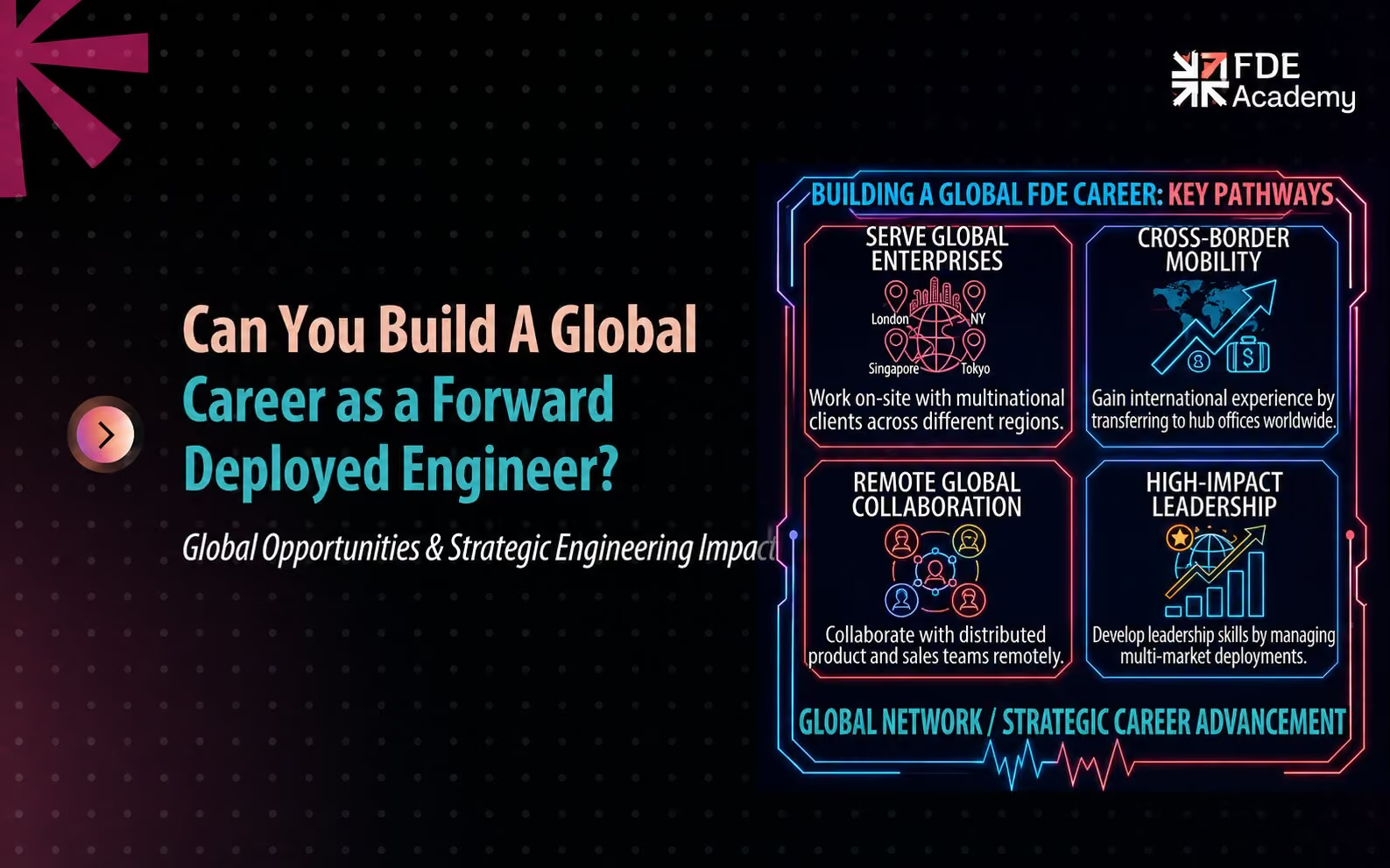
Yes, and Forward Deployed Engineering is structurally more global than most engineering careers, not despite the customer-embedded model, but because of it. Companies running dedicated FDE organizations hire across a dozen or more cities simultaneously, because the role exists specifically to be close to customers, and customers are everywhere. This guide covers what genuinely transfers when an FDE moves between countries, what resets and has to be rebuilt, and how a realistic international career arc actually unfolds over time.
Most internal product engineering roles are anchored to wherever a company's core engineering hub sits, one or two cities, at most, where the majority of headcount lives. FDE roles work differently by design: the job exists to embed with customers, and enterprise customers are distributed globally, which means the hiring footprint follows them.
OpenAI's own Forward Deployed Engineer postings, for example, span New York City, San Francisco, Dublin, London, Seattle, Madrid, Munich, Paris, Seoul, Singapore, Stockholm, and Tokyo, among other locations, a genuinely global hiring footprint that most internal engineering roles at the same company don't share.
Direct international hiring: Companies increasingly hire FDEs directly into international hubs, not as a relocation from an existing US role, but as a local hire supporting a regional customer base.
This is the most straightforward path if you're already based outside the US, applying to roles explicitly posted in your region. It also tends to be the least bureaucratically complicated path, since the company is hiring into an established local entity from the start rather than navigating a relocation process for an existing employee.
Internal transfer after building a track record: FDEs who've established themselves domestically sometimes move internally to a different regional office, particularly at companies with mature, multi-hub FDE organizations.
This path generally requires demonstrated success first, companies are far more willing to support an internal transfer for someone with a proven deployment record than to sponsor international relocation for an unproven new hire.
The practical upside of this route is retained institutional credibility: a manager who already trusts your judgment based on a real track record is a much easier internal advocate for a transfer than a hiring manager evaluating a cold external application.
Remote-global roles supporting international customers: Some FDE roles are structured as remote-first, supporting customers in a specific region without requiring the engineer to physically relocate there.
Our guide on Forward Deployed Engineer jobs in India covers this pattern directly, remote roles at global AI companies supporting customers elsewhere, a genuine and growing category rather than a rare exception.
This path is particularly valuable for engineers who want international deployment experience on their resume without the logistical complexity of an actual physical move, though it typically comes with real limits: certain customer relationships, especially in regulated or high-security contexts, still require physical presence that remote work genuinely cannot substitute for.
The core technical and judgment skills that define strong FDE work, discovery discipline, evaluation-first thinking, production ownership, scope management, transfer completely regardless of geography.
A deployment methodology that works well with a customer in Singapore works essentially the same way with a customer in Germany, since the underlying skill is about navigating ambiguity and stakeholder relationships, not anything specific to one market.
Compensation also transfers reasonably well in structure, if not in exact number: our Forward Deployed Engineer salary guide covers how comp scales across the US, India, and other major markets, and the same general drivers, company tier, specialization, deployment complexity, hold consistently across regions even as the specific bands shift.
Technical stack fluency also transfers largely intact. A production-grade grasp of cloud infrastructure, integration patterns, and evaluation design doesn't need to be relearned for a new market, the specific customer systems will differ, but the underlying engineering discipline that lets you learn a new system quickly is exactly the portable skill this career already trains for repeatedly, engagement after engagement, even within a single country.
Regulatory and compliance context is genuinely region-specific and doesn't transfer by default. Data residency rules, industry-specific compliance frameworks, and government contracting requirements vary significantly by country, and an FDE moving into a new region needs to rebuild this specific knowledge rather than assuming prior experience covers it.
Local business culture and communication norms also require real recalibration, the discovery and stakeholder-management instincts that work well with US enterprise customers don't map identically onto every market, and engineers who assume they do tend to misread situations early in a new region.
Existing customer relationships and institutional knowledge, the accumulated context that makes a domestic FDE valuable to their current customers, don't transfer at all, a move to a new region genuinely means starting that specific relationship capital from zero, even with a strong overall track record.
International FDE moves generally follow standard tech-industry visa and relocation patterns rather than anything role-specific: employer sponsorship for a work visa in the destination country, typically contingent on the company having an established legal entity and hiring infrastructure there already.
Companies with mature, multi-hub FDE organizations, the frontier AI labs and larger enterprise platforms specifically, are more likely to have this infrastructure in place than earlier-stage startups, which is a practical reason international relocation is generally easier to arrange at a more established company than a smaller one, independent of role seniority.
Government-focused FDE tracks add a further constraint worth knowing about directly: roles embedding with government or defense customers frequently require citizenship or security clearance eligibility in the country where the work happens, which can rule out an international transfer into that specific track even for an otherwise strong internal candidate.
Timelines are also worth setting realistic expectations around. Visa sponsorship and processing for a genuine international move typically takes several months at minimum, and can extend considerably longer depending on the destination country's specific immigration system and current processing backlogs.
Engineers targeting a specific international move are generally better served treating it as a medium-term goal to plan toward deliberately, building the domestic track record and having the visa conversation early, rather than something to negotiate reactively once an opportunity happens to appear.
A common, realistic arc looks like this: two to three years building a track record domestically, developing the discovery, evaluation, and production-ownership habits that define strong FDE work in a market you already understand well.
From there, either an internal transfer to a company's international hub, a direct move to a company with a stronger footprint in a target region, or a shift into remote-global work supporting international customers without physically relocating.
Each of these paths compounds differently: internal transfer preserves institutional credibility within one company; moving companies resets that credibility but can accelerate geographic goals faster; remote-global work avoids relocation logistics entirely while still building genuinely international deployment experience.
Beyond the first international move, the arc tends to broaden rather than repeat. An FDE who's successfully navigated one cross-border transition, learned to rebuild regulatory knowledge, adapted communication style, started customer relationships from zero, carries that adaptability into future moves with meaningfully less friction than the first time.
This is part of why FDE experience compounds well into senior deployment leadership or founder paths later: the same skill set that makes an international move successful, rapid context-building in an unfamiliar environment, is precisely the skill leadership roles managing distributed, global teams require.
Yes, Forward Deployed Engineers can build a global career. In fact, FDE is naturally suited to international work because the role is built around working closely with enterprise customers, and those customers are spread across different countries and regions.
There are three main paths to international FDE work: direct international hiring, internal transfers, and remote-global roles. Core FDE skills such as discovery, evaluation, production ownership, cloud engineering, and scope management transfer across countries, while local regulations, business culture, compliance requirements, and customer relationships usually need to be rebuilt.
International moves also depend on visa sponsorship, company presence in the destination country, and sometimes citizenship or security-clearance requirements, particularly for government and defense-focused roles.
Bottom line: Build a strong FDE track record first, then use internal transfers, international applications, or remote-global opportunities to expand your career internationally.
Yes. FDE roles are structurally more globally distributed than most engineering roles, since the job exists specifically to embed with customers, and enterprise customers are distributed worldwide. Companies like OpenAI hire FDEs across a dozen or more cities simultaneously.
Discovery discipline, evaluation-first thinking, production ownership, and scope management transfer completely, since these are about navigating ambiguity and stakeholder relationships rather than anything specific to one market.
Regulatory and compliance knowledge, local business culture and communication norms, and existing customer relationships and institutional knowledge all need to be rebuilt from scratch in a new region, regardless of overall track record.
Generally yes, following standard tech-industry visa patterns. Companies with established multi-hub FDE organizations and legal entities in the destination country are typically better positioned to sponsor international moves than smaller, earlier-stage companies.
Yes, and it's a growing category. Some FDE roles are structured to support customers in a specific region remotely, without requiring physical relocation, a genuine path to international deployment experience that doesn't depend on visa sponsorship.
Not as easily. These tracks frequently require citizenship or security clearance eligibility specific to the country where the work happens, which can limit international transfer options even for a strong internal candidate.
The world is hiring - and this Academy prepares you for it.