Blogs
Habits of Successful Forward Deployed Engineers
Habits of Successful Forward Deployed Engineers
By
R&D, FDE Academy
August 4, 2026

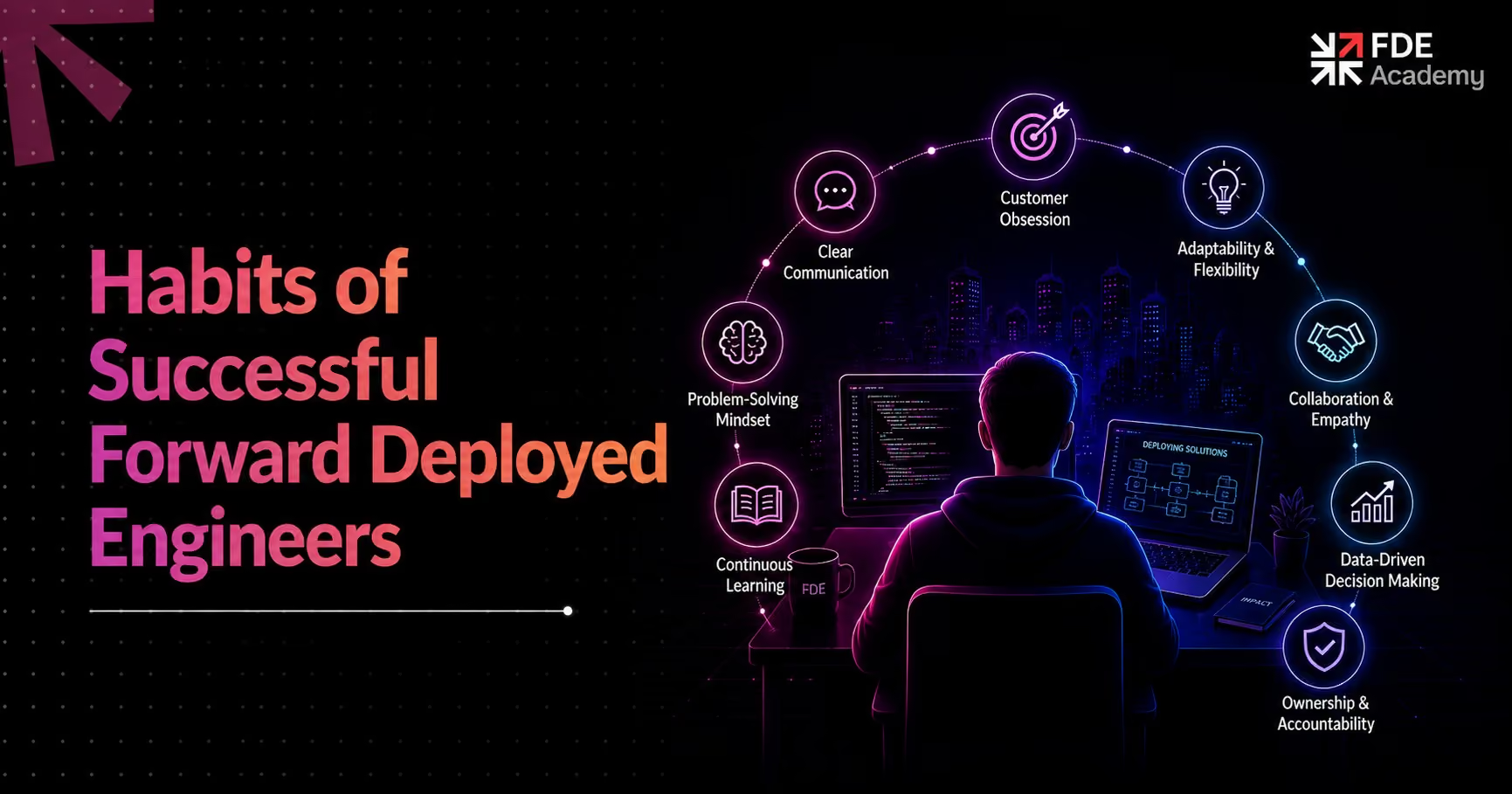
The gap between an average Forward Deployed Engineer and a genuinely successful one isn't usually raw technical talent, it's a small set of repeatable habits applied consistently across every deployment. These habits show up before the code, during the build, and long after go-live, and they're learnable, not innate.
This guide covers six specific habits that separate FDEs who compound their impact deployment after deployment from FDEs who reset to zero every time.
This isn't a list of mistakes to avoid, our 10 mistakes new Forward Deployed Engineers make covers that ground already. This is the positive case: what experienced, successful Forward Deployed Engineers actually do differently, day to day, across their careers.
Successful FDEs treat discovery as the highest-leverage hour of any engagement, not a formality to rush through before the "real work" starts. They ask the second and third clarifying question after the first answer sounds reasonable, since the first answer is frequently the customer's assumption, not the actual constraint. They leave discovery conversations with a specific, falsifiable definition of success, not a vague mission statement, and they resist the urge to propose a technical approach until that definition exists.
The habit isn't asking more questions for its own sake, it's a genuine discomfort with building against an unclear target. Engineers who skip this step tend to build something technically impressive that solves the wrong problem, then have to rebuild once the real requirement surfaces weeks in. Our Forward Deployed Engineer playbook breaks down exactly what strong discovery looks like phase by phase.
A concrete version of this habit in practice: a customer says they need "faster reporting." A weak discovery process takes that at face value and starts optimizing query performance. A strong one asks who's waiting on the reports, what decision the report drives, and what "faster" actually means in hours saved, and frequently discovers the real bottleneck is a manual data-entry step three systems upstream, not the report itself.
The habit of asking "why do you need this" at least once more than feels natural, until the answer stops being a restatement of the original request.
Successful FDEs write down what "correct" looks like before they consider a build finished, not after a customer flags something wrong in production. This means defining graded test cases, what's clearly right, what's clearly wrong, and where the genuinely ambiguous middle ground sits, as a deliberate step in the build, not an afterthought bolted on when someone asks for it.
This habit compounds specifically in AI-heavy deployments, where model outputs are non-deterministic and there's no fixed expected value to assert against. FDEs who treat evaluation as core to the build, not a QA function that happens elsewhere, consistently ship more reliable systems and catch failure modes before a customer does instead of after.
Successful FDEs write a short note the moment a meaningful decision gets made, a scope change, a technical tradeoff, a workaround for a customer constraint, rather than trying to reconstruct the reasoning later from memory or a Slack scroll.
This habit is cheap at the moment and expensive to skip: a three-line summary written immediately takes two minutes; the same information reconstructed a month later, if it's even possible to reconstruct accurately, takes much longer and is often wrong.
This habit also does something subtler: writing the decision down forces a moment of actual thought before committing to it. Engineers who skip this step tend to agree to scope changes reflexively under pressure, then discover later they can't clearly explain why a specific tradeoff was made when a customer or teammate asks.
The format matters less than the consistency. A three-line message in the customer's Slack channel, a comment on a shared ticket, or a quick entry in a running engagement log all work, as long as it captures three things: what was asked, what was decided, and what it costs (in timeline, complexity, or scope) to say yes.
Successful FDEs treat this as a two-minute tax on every meaningful decision, not optional overhead reserved for the big ones, since it's often the small, seemingly minor decisions that turn out to matter most when a customer asks "why does it work this way" months later.
Successful FDEs treat the first two to three weeks after a deployment goes live as the highest-attention period of the entire engagement, not the finish line.
They watch dashboards proactively rather than waiting for an alert, they check in with the customer's team even when nothing has technically broken, and they resist the pull toward the next engagement until the current one is genuinely stable.
This habit exists because real usage patterns reveal edge cases no evaluation set anticipated, and because a customer's trust in the system is disproportionately shaped by what happens in these first few weeks.
An FDE who disappears the moment code ships consistently has worse long-term outcomes, more churned pilots, more support escalations, than one who treats stabilization as part of the job, not an optional extra.
Successful FDEs ask, at the end of every engagement, what part of this could apply to the next customer. They extract the general pattern from the specific solution: not "I built a custom integration for this CRM," but "I built a reusable pattern for connecting to CRMs with inconsistent field naming," and they document it somewhere the next FDE, or the product team, can actually find and use.
This is the habit that compounds fastest over a career. FDEs who treat every deployment as a one-off custom build start from zero every time. FDEs who deliberately extract reusable patterns get measurably faster with each subsequent engagement, and they build the kind of visible, cross-customer impact that shows up directly in promotion and leadership conversations.
In practice, this often means writing two versions of the same work: the customer-specific implementation, and a short internal note describing the general shape underneath it, what category of problem it solved, what made it reusable, and what would need to change for a different customer's version of the same problem.
This second artifact is easy to skip under deadline pressure, since it delivers no immediate value to the customer in front of you. It's exactly the habit that separates FDEs whose influence stays contained to one account from FDEs whose work quietly becomes the default pattern the whole team reaches for.
Successful FDEs rarely refuse a customer's request outright. Instead, they separate the business ask from the specific implementation commitment, saying yes to the underlying need while quietly scoping the actual technical approach to fit the real timeline and architecture.
A customer asking for something that would take a full rebuild in two days doesn't hear "no", they hear a phased plan that delivers real value in two days and the rest over the following weeks.
This habit is as much about relationship management as it is technical judgment. FDEs who say a hard "no" too often damage trust and get worked around. FDEs who say "yes" to everything without renegotiating scope accumulate technical debt and burn out. The habit of quietly reshaping scope, without ever making the customer feel refused, is one of the clearest signals of a senior FDE versus a junior one.
Every habit on this list shares a common thread: they all trade a small amount of upfront friction for a much larger amount of downstream cost avoidance. Extra discovery questions feel slow in the moment and save weeks later. Writing the evaluation set first feels like it delays "real" progress and prevents a production incident.
Documenting a decision immediately feels like unnecessary overhead and saves hours of reconstruction later.
None of these habits are complicated. What makes them habits, rather than just good advice, is doing them consistently even when the friction feels avoidable in the moment, especially when it feels avoidable, since that's exactly when skipping them costs the most.
This is also why these habits are hard to fake under pressure and easy to spot in an interview. A candidate who's genuinely built these habits will default to them instinctively when handed an ambiguous decomposition problem, asking clarifying questions before proposing a solution, thinking about how to validate the approach, mentioning tradeoffs unprompted, rather than reciting them as things they know they're "supposed to" do.
The habits aren't a checklist to perform, they're a way of actually thinking about deployment work that shows up whether or not anyone's watching for it.
None of these six habits require exceptional talent, they require discipline applied consistently under exactly the conditions that make them tempting to skip: time pressure, an eager customer, a deadline that feels tight enough to justify cutting a corner.
The FDEs who build a genuine track record of success aren't the ones who never feel that pressure, they're the ones who've built the habit of doing the unglamorous, friction-adding thing anyway, because they've seen what skipping it costs later. For a closer look at where these habits actually show up hour by hour, see our day in the life of a Forward Deployed Engineer.
Not raw technical talent, but a set of consistent, repeatable habits: thorough discovery before building, defining evaluation criteria before calling work done, real-time documentation of decisions, staying engaged through production stabilization, extracting reusable patterns from every deployment, and reshaping scope quietly rather than refusing customer requests outright.
Because building against an unclear or assumed requirement is the single most common cause of rework in FDE deployments. Strong discovery surfaces the real problem before any code is written, preventing the far more expensive cost of rebuilding once the actual requirement becomes clear weeks into a project.
Yes, particularly for AI-heavy deployments where model outputs are non-deterministic. Defining what correct and incorrect outputs look like before finishing a build is treated as a core part of the build itself, not a separate QA step that happens afterward.
Successful FDEs treat the first two to three weeks after go-live as the highest-attention period of the engagement, actively monitoring and staying available rather than immediately moving to the next project. This window is when real usage patterns reveal issues an evaluation set couldn't anticipate.
It means extracting the general, transferable version of a specific solution, documenting not just what was built for one customer, but the underlying pattern that could apply to future customers with similar problems. This is what lets an FDE's impact compound across deployments rather than resetting to zero each time.
The world is hiring - and this Academy prepares you for it.