Blogs
How Forward Deployed Engineers Build Enterprise AI Platforms
How Forward Deployed Engineers Build Enterprise AI Platforms
By
R&D, FDE Academy
July 24, 2026

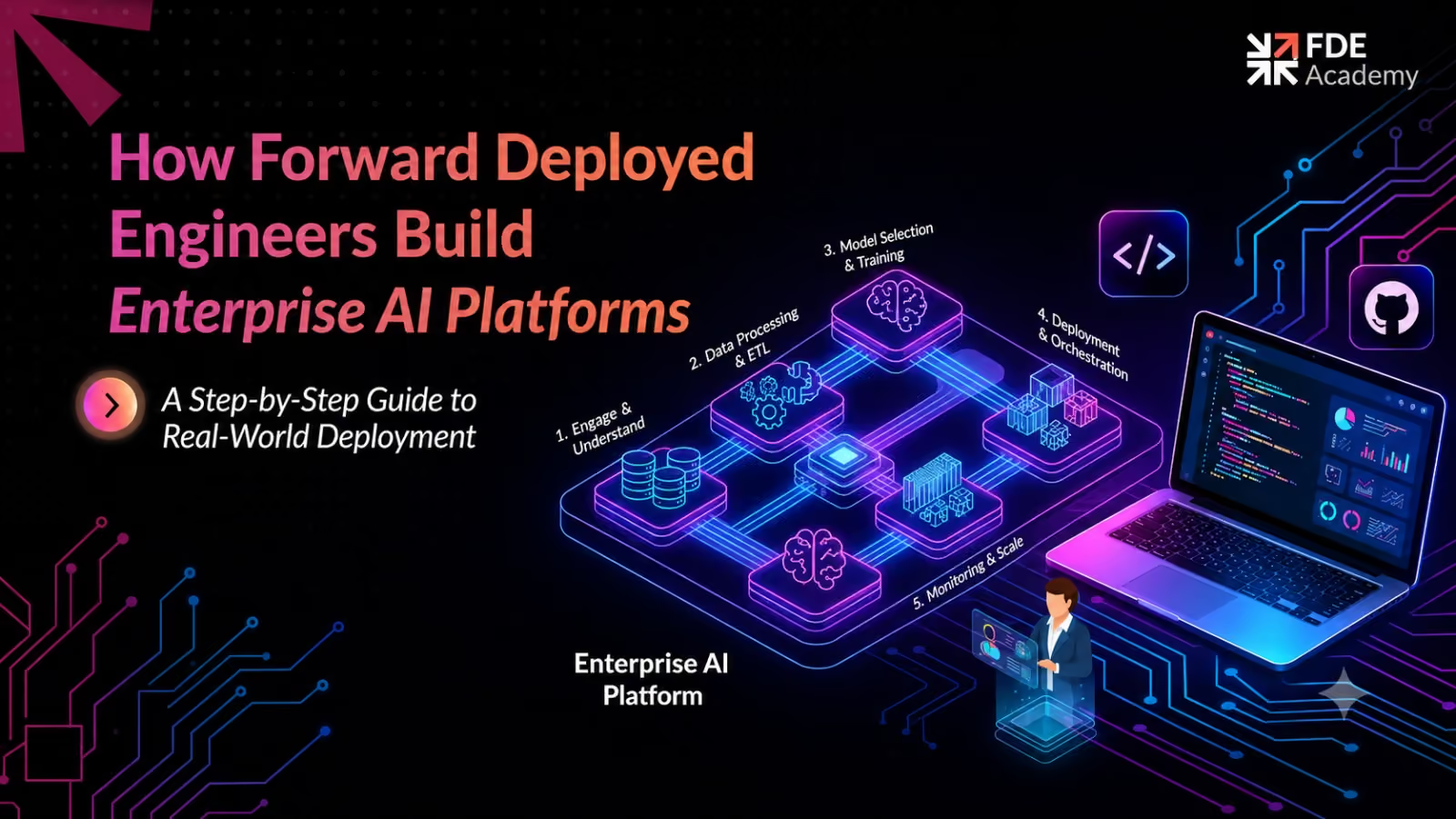
Forward Deployed Engineers build enterprise AI platforms by embedding inside a customer's actual environment and working through four layers: data integration, retrieval, orchestration, and evaluation in a discovery-to-production cycle that never fully ends. Unlike a product team shipping one system for many customers, an FDE builds against one customer's real data, real legacy systems, and real constraints from day one, and stays accountable for the system after it ships.
This article breaks down that build process at the architecture level: what each layer actually does, how the discovery-to-production cycle runs in practice, and the integration patterns that show up in almost every FDE engagement.
A product engineer builds one system that many customers use the same way. An FDE builds one system for one customer, shaped entirely around that customer's data, workflows, and constraints then repeats a version of that process for the next customer.
That difference shows up immediately in how the work starts. There's no shared user base to design for, no assumptions that hold across every deployment. Every architecture decision has to survive contact with one specific organization's messy reality: its legacy systems, its compliance rules, its internal politics about who owns what data.
This is also why the job is closer to systems engineering than to typical SaaS feature work. An FDE isn't customizing a UI or configuring a settings panel. They're deciding how a retrieval layer should be structured for a specific document corpus, how an agentic workflow should hand off between steps, and where a human needs to stay in the loop before the system is trusted to act alone.
Strip away the specifics of any individual engagement, and most FDE-built AI platforms share the same underlying architecture, just tuned differently for each customer.
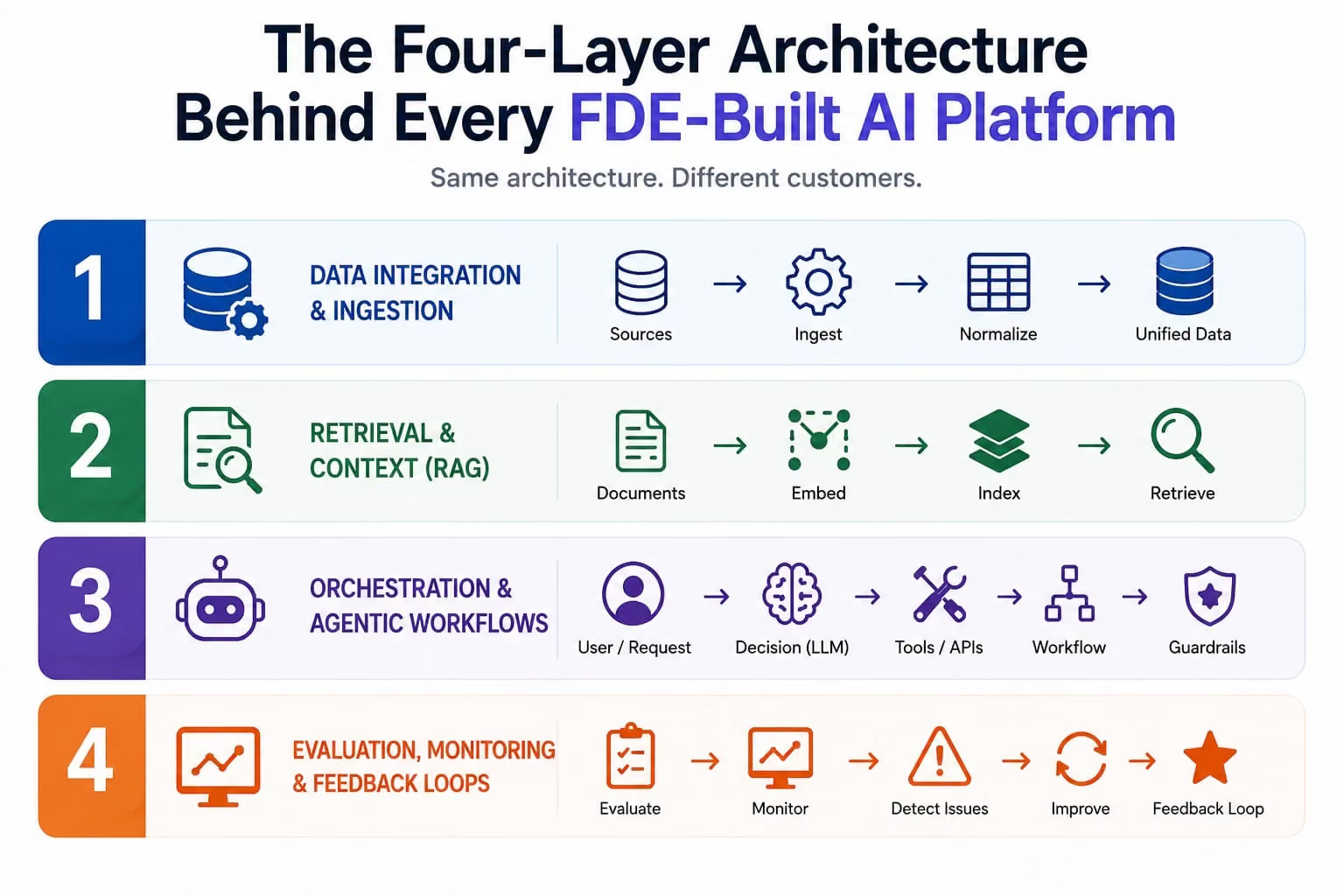
Nothing else works until this layer does. FDEs typically spend real, uncomfortable time here connecting to legacy databases, wiring up ETL pipelines, and normalizing data that was never structured with AI in mind.
This is usually where the biggest technical risk in an engagement actually lives, not in the model choice. A customer's data is almost always more fragmented, inconsistent, and poorly documented than it looked during discovery.
Once data is accessible, it has to become a usable context for the model. This is where retrieval-augmented generation (RAG) pipelines come in chunking, embedding, and indexing a customer's proprietary documents so the model can pull in accurate, current information instead of relying on what it was trained on.
The quality of this layer determines whether the platform actually knows anything true about the customer's business, or just sounds like it does.
This is the layer that decides what the system actually does, which tools to call, in what order, and when to hand a decision to a human instead of acting autonomously. Agentic workflows live here, along with the guardrails that keep them from taking actions the customer hasn't actually authorized.
Good orchestration design usually means narrower autonomy than a demo would suggest. Production systems tend to earn broader autonomy over time, not start with it.
The layer most demos skip entirely, and the one that determines whether a system survives contact with production. This is where FDEs build the test suites that catch hallucinations and edge cases, and the monitoring that flags drift once the system is live.
Without this layer, a system that worked well in a pilot degrades silently in production and nobody notices until a customer does.
Architecture describes the what. The build process describes the how and it runs as a cycle, not a straight line.
Engagements start with discovery, not a spec sheet. An FDE maps the customer's actual data, usually fragmented across legacy systems, identifies the real constraint (compliance, latency, data residency), and defines what success looks like in measurable terms.
This step matters more than it sounds like it should. Customers frequently arrive knowing they want "AI" without knowing what that means in practice, and why AI projects fail and how Forward Deployed Engineers fix it traces most enterprise AI failures back to exactly this gap: a system built against an idealized version of the business instead of the real one.
Before committing to a full build, FDEs typically validate the riskiest architectural assumption first, usually whether the data integration layer can actually deliver clean, current data at the volume and latency the use case needs.
A prototype here isn't a demo meant to impress stakeholders. It's a technical bet, deliberately narrow in scope, designed to fail fast if the architecture is wrong before real engineering time goes into it.
Enterprise deployment introduces requirements a prototype never had to satisfy:
This stage is often where timelines stretch, and it's a large part of why the FDE model exists at all; a generic AI product was never going to satisfy one specific enterprise's governance stack out of the box.
FDEs don't disappear after go-live. They monitor production behavior, catch drift the pre-launch evaluation missed, and feed what they learn back into how the system and often the broader product evolves.
That feedback loop is arguably the most differentiating part of the model. A traditional delivery team hands off and moves to the next project. An FDE stays close enough to the running system that its failures become their problem to fix, not a ticket in someone else's queue.
Knowing the architecture is one thing. Knowing where it tends to fail in practice is what separates a working platform from one that looks good in a demo.
Retrieval quality collapses on messy source documents - A RAG pipeline built and tested against clean, well-formatted sample documents often falls apart against the customer's actual archive scanned PDFs, inconsistent formatting, contradictory versions of the same policy. This is usually the single most common cause of a platform that "worked in the pilot" and then quietly degrades once it's pointed at real production data.
Agentic autonomy gets scoped too broadly, too early - It's tempting to let an agent chain several actions together autonomously because the demo looks impressive that way. In production, narrower autonomy with clear human checkpoints tends to earn trust faster and trust, not raw capability, is usually the actual bottleneck to adoption.
Evaluation gets treated as a launch gate instead of an ongoing discipline - Many teams build an evaluation suite once, pass it, and ship. Production data drifts from whatever the evaluation set assumed, and without ongoing monitoring, that drift goes unnoticed until a customer flags a bad output.
Governance gets bolted on at the end instead of designed in from discovery - Access control, audit logging, and compliance requirements are much cheaper to build into the architecture from the start than to retrofit after a prototype has already proven the concept. Retrofitting governance is one of the most common reasons engagements run over their original timeline.
A handful of integration patterns show up across nearly every enterprise engagement, regardless of industry:
None of these patterns are unique to AI platforms specifically. What's different is how often an FDE has to combine several of them inside a single engagement, under real time pressure, against a system nobody fully documented.
Traditional enterprise delivery usually separates design from build from operation; a solutions architect designs, an implementation team builds, and a separate operations team runs the result. Each handoff is a place where context can get lost.
The FDE model collapses those stages into one accountable engineer or small team. The person who mapped the customer's real constraints during discovery is the same person who wrote the production code, and the same person who gets paged if it breaks at 2 a.m.
That collapse is deliberate, not accidental. It's what AI Forward Deployed Engineering as an operating model is actually optimizing for fewer handoffs, less context loss, and a single point of accountability for whether the platform actually works.
Executing this cycle well requires a specific, unusually broad skill combination production-grade coding, system architecture judgment, and enough AI fluency to make real tradeoffs between retrieval design, orchestration complexity, and evaluation rigor.
None of these skills are exotic in isolation. Plenty of engineers can write production code, and plenty can reason about system architecture. What's rare is the combination, plus the customer-facing judgment to know which architectural tradeoff actually matters to a specific business outcome rather than which one is most technically elegant.
That combination is exactly what the Forward Deployed Engineer skills breakdown covers in full, and it's the specific gap FDE Academy's program is built to close for engineers making this transition.
Most FDE-built AI platforms share four layers: data integration and ingestion, retrieval (RAG), orchestration and agentic workflows, and evaluation/monitoring each tuned to the specific customer's systems and constraints rather than built as a one-size-fits-all product.
Data integration is usually the biggest risk, not model selection. Customer data is almost always more fragmented and inconsistent than it appears during discovery, and the retrieval and orchestration layers can't perform well on top of a weak data foundation.
It collapses design, build, and operation into one accountable engineer or small team instead of separate handoffs between architects, implementers, and operations staff and that same engineer typically remains responsible for the system after it goes live.
No. LLMs and agentic workflows are central to most current engagements, but the surrounding architecture data pipelines, integration layers, evaluation systems, and governance controls draws on the same system-design skills that any complex enterprise integration requires.
Timelines vary widely by engagement complexity, but the cycle itself discovery, prototype and validation, production hardening, and iteration repeats continuously rather than ending at go-live, since FDEs stay engaged to monitor and refine the system in production.
The world is hiring - and this Academy prepares you for it.