Blogs
How to Build a Forward Deployed Engineer Portfolio
How to Build a Forward Deployed Engineer Portfolio
By
R&D FDE academy
September 19, 2026

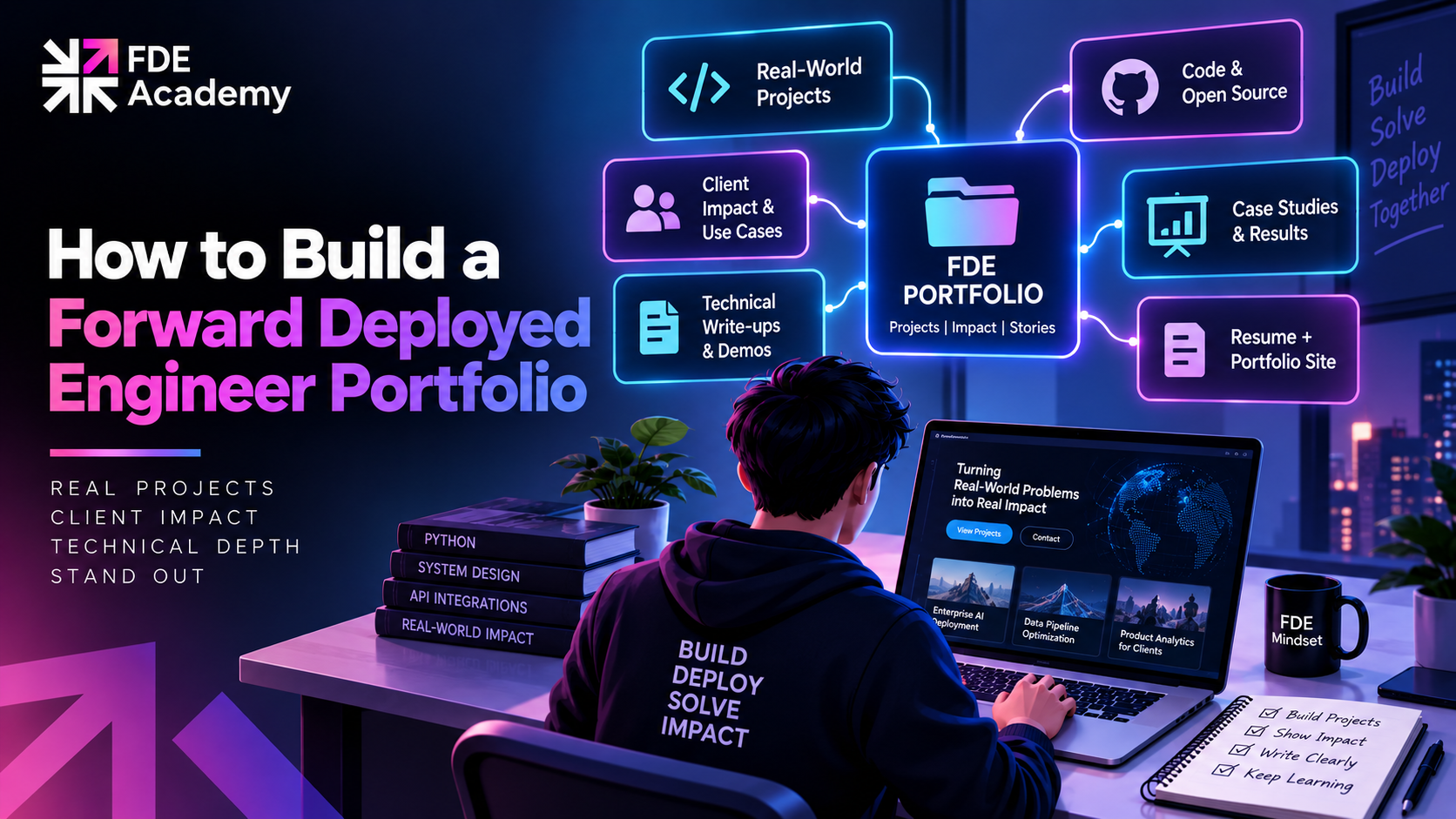
A strong Forward Deployed Engineer portfolio isn't eight polished demos, it's one real, deployed project with a written case study explaining what broke, how you investigated it, and what you changed. That single distinction, quality and depth over volume, is the most consistently repeated piece of advice across FDE hiring feedback, and it's worth building your entire preparation strategy around it rather than treating portfolio-building as a checklist of projects to accumulate.
Our piece on FDE certification makes this point directly: if your real goal is getting hired, time is almost always better spent building one real, deployable project than studying for another exam. No badge substitutes for a shipped deployment you can walk through in detail, and the signals that actually matter for this role, production experience, portfolio depth, customer-facing judgment, get tested directly during interviews, not through resume credentials.
This is specific to how FDE hiring actually works. The role is fundamentally about deployment, integration, and judgment under real-world messiness, and a portfolio that demonstrates those exact qualities is a far stronger signal than a resume line listing frameworks you've used. Hiring managers reading FDE applications consistently report that portfolio projects showing production deployments with real integration work outweigh academic or tutorial-style projects, and that pattern shows up repeatedly enough across interview feedback to treat as close to a hard rule.
Think about it from the interviewer's side. A resume tells them what you claim to know. A portfolio project, walked through in detail during an interview, tells them how you actually think under real constraints, how you handle ambiguity, how you communicate a tradeoff, how you respond when something you built breaks in a way you didn't anticipate. That second kind of evidence is simply more predictive of how someone will perform in an actual FDE engagement, which is exactly why experienced hiring managers weight it so heavily over credentials or a polished resume alone.
A strong portfolio project follows the same basic shape as real FDE work: pick a realistic enterprise scenario, scope an MVP rather than the full vision, build against messy real or realistic data, deploy it somewhere real, and write up what broke and what you'd do differently.
Each piece of that shape matters specifically:
A realistic scenario, not a toy problem. Connecting two systems that weren't designed to connect, building an API integration with genuine failure handling, or automating a workflow that involves real, messy data teaches you, and demonstrates to a hiring manager, far more than a clean, self-contained coding exercise.
A scoped MVP, not the full vision. Real FDE engagements start with a narrow, well-scoped version that proves the concept, not an attempt to build everything at once. A portfolio project that shows disciplined scoping signals the same judgment a hiring manager wants to see in a real engagement.
Real or realistically messy data. A project built against clean, well-formatted sample data doesn't demonstrate the specific skill FDE work actually requires: handling the inconsistent formatting, missing fields, and edge cases real production data always contains.
Genuine deployment, not localhost. A system that other people can actually access and use, and that breaks under conditions you didn't anticipate, teaches and demonstrates far more than a demo that only ever ran on your own machine.
This is worth calling out as its own dedicated section, because it's genuinely the single most effective, and most underused, portfolio item available: a written case study of a real debugging scenario. Not code, a document that walks through what broke, how you investigated it, what you found, and what you changed.
This format is unusually powerful because it demonstrates two things simultaneously that are otherwise hard to show in a single artifact: real technical depth (you actually understood and fixed a genuine problem) and FDE-style communication (you can explain a technical situation clearly to someone who wasn't there when it happened). Most candidates submit code and hope it speaks for itself. A well-written debugging case study speaks directly to exactly what an interviewer is trying to assess, and very few candidates think to include one.
A strong case study covers: what the system was supposed to do, what actually went wrong (with enough specificity that someone unfamiliar with the project could follow it), how you diagnosed the root cause, what you changed, and what you'd do differently if you encountered a similar situation again. This last part matters more than it might seem, it shows reflective judgment, not just problem-solving in the moment.
Length and polish matter less here than clarity and honesty. A one- or two-page write-up that clearly walks through a genuine, specific debugging story beats a longer document padded with generic process description. Avoid the temptation to make the problem sound more dramatic than it was, or to skip past the parts where your first attempted fix didn't actually work, that kind of honest detail is precisely what makes this format credible and interesting to read, rather than a sanitized success story that could describe almost anyone's project.
If you don't yet have a real debugging story to draw from, that's worth treating as a signal in itself: it likely means your current portfolio project hasn't been pushed hard enough against real conditions yet. Deploying something to genuine, if modest, real-world use, rather than stopping once it works in a controlled test, is usually what surfaces the kind of problem worth writing this case study about in the first place.
Not every project idea demonstrates the same thing, and some genuinely under-the-radar project types signal FDE readiness more effectively than more obvious, polished-looking ones.
Integration projects nobody else wants. API work connecting a system to a third-party service, a data pipeline pulling from a messy external source, an authentication layer bridging two systems with different security models. These are unglamorous and genuinely difficult to scope well, which is exactly why they're such strong signals, they're precisely what FDE-relevant experience actually looks like.
A project connecting multiple third-party APIs with real failure handling. This directly tests the technical areas FDE interviews commonly probe: REST versus GraphQL tradeoffs, webhook reliability, retry and idempotency patterns, OAuth flows, and data synchronization strategies. Building something that genuinely handles failure, not just the happy path, demonstrates production thinking directly.
An AI or agentic pipeline with non-technical documentation. If you're coming from a data engineering or adjacent background specifically, our piece on transitioning from data engineering to FDE recommends pairing an AI pipeline project with at least one piece of non-technical documentation, since customer-facing communication is exactly the skill that background typically needs to demonstrate alongside existing technical strength.
Real deployment infrastructure work, even at small scale, monitoring, authentication, multiple connected systems rather than an isolated, self-contained application, demonstrates the systems thinking FDE work requires far more effectively than an impressive-looking but architecturally simple project.
A few patterns show up consistently as weak portfolio signals, worth avoiding deliberately rather than discovering through rejection.
Fewer than most candidates assume. The portfolio question is genuinely about quality over quantity: one strong deployed project with a case study is more effective than eight polished demos. If you're choosing between spending your remaining preparation time polishing a fourth project or writing a genuinely thorough case study for your strongest existing one, the case study is almost always the better investment.
Our interview questions guide covers how portfolio depth connects directly to interview performance: engineers with a strong backend or DevOps background typically need four to eight weeks of focused preparation to build a relevant portfolio and practice FDE-specific interview formats, and that timeline assumes building genuine depth on a small number of strong projects, not breadth across many shallow ones.
A realistic enterprise scenario, a deliberately scoped MVP rather than the full vision, work against real or realistically messy data, genuine deployment beyond localhost, and honest documentation of what broke and what you'd change, following the same shape real FDE work actually takes.
A written case study of a real debugging scenario, walking through what broke, how you investigated it, what you found, and what you changed. It demonstrates technical depth and FDE-style communication simultaneously, and very few candidates think to include one.
Fewer than most candidates assume. One strong, deployed project with a thorough case study consistently outperforms multiple polished but shallow demos. Depth matters more than breadth.
No, generally. Our FDE certification guide covers this directly: no badge substitutes for a real, shipped deployment you can walk through in detail during an interview. If you have limited time, a portfolio project is almost always the better investment.
Tutorial-based projects followed step by step, anything that's never been deployed beyond your local machine, undocumented projects with no evidence of real use, and long technology lists with no real project demonstrating them.
Engineers with a relevant backend or DevOps background typically need four to eight weeks of focused effort. Those transitioning from less deployment-oriented roles may need longer, and the timeline depends more on deliberate practice than total hours spent.
The world is hiring - and this Academy prepares you for it.