Blogs
LLM Guardrails and Human-in-the-Loop Design: A Practical Guide for FDEs
LLM Guardrails and Human-in-the-Loop Design: A Practical Guide for FDEs
By
R&D, FDE Academy
October 5, 2026

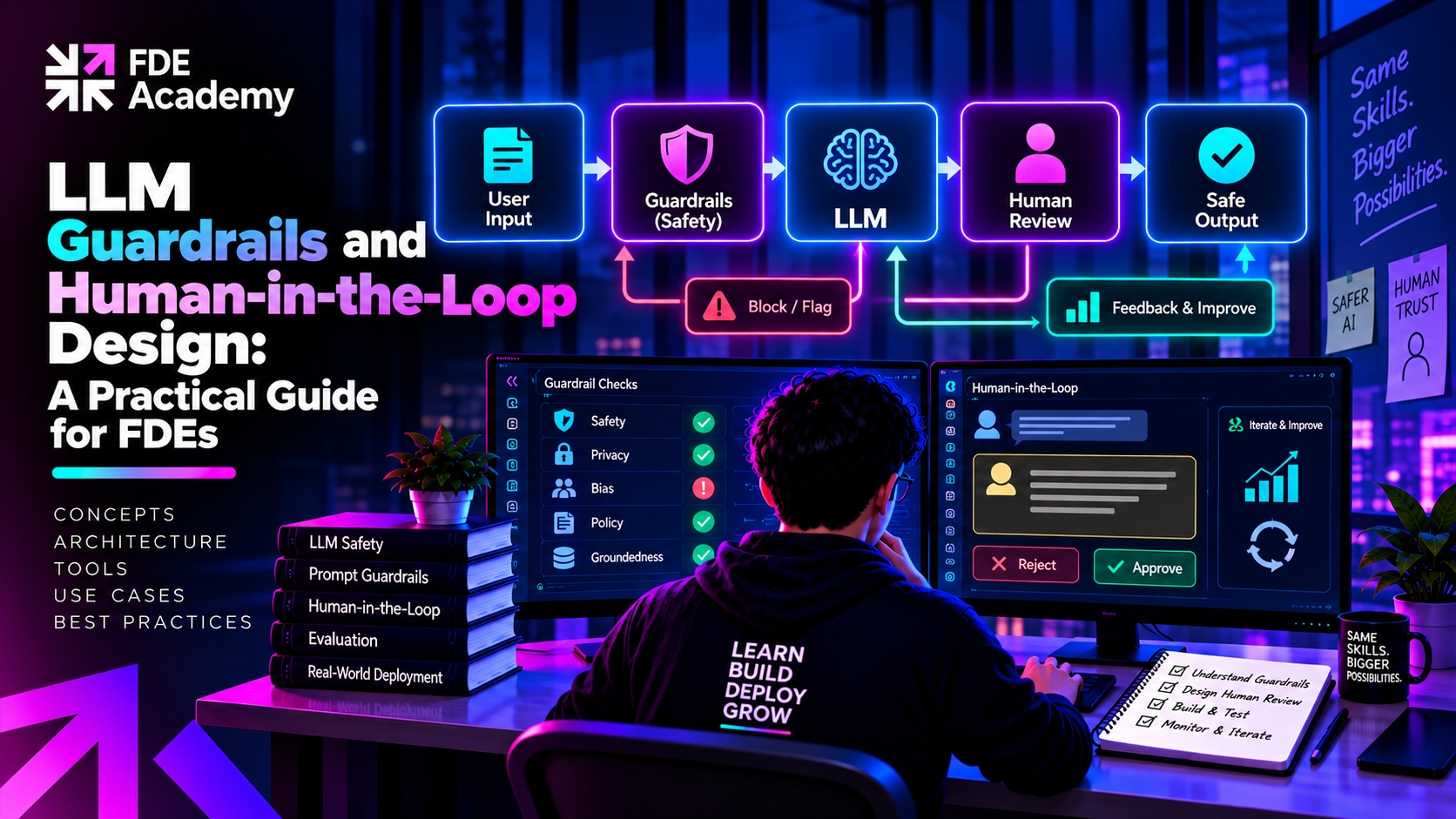
A model that works in a demo fails in production in ways that are rarely about model quality. It gets a malformed input, a customer pastes in an instruction meant to hijack it, or an agent with write access does something technically valid and practically disastrous. Nobody at the customer cares that the failure rate is 2%; they care that one failure refunded the wrong account. As agentic AI changes the FDE role, more systems can act on their own, and the cost of a bad action rises with it.
That is why LLM guardrails and human-in-the-loop design sit squarely in the Forward Deployed Engineer's scope. The FDE is the person embedded with the customer who knows which actions are expensive to get wrong, who actually approves things in that organization, and how much friction their reviewers will tolerate. A platform team can ship a generic guardrail library. Only someone close to the workflow can decide where the human goes. It is the engineering side of the policy work described in AI governance for forward deployed engineers, and it's one of the clearest places where why AI projects fail turns on design decisions rather than model choice.
Guardrails are controls that sit around the model rather than inside it. They don't make the model smarter; they limit the blast radius when it is wrong. In practice they fall into four layers.
These run before the model sees anything. They validate format and length, strip or flag sensitive data (PII, credentials), and screen for prompt injection, where text in a user message or retrieved document tries to override the system's instructions. Input checks are cheap and deterministic, so push as much as possible here.
These run on what the model produced before anyone acts on it. Typical checks include schema validation (is this valid JSON with the required fields?), grounding checks (does the answer cite retrieved sources?), policy filters, and checks for leaked data. A failed output check should trigger a defined behavior: retry, fall back, or escalate.
For agents, this is the layer that matters most. Action guardrails restrict which tools the agent can call, with what parameters, and under what limits (maximum refund amount, allowed recipients, read-only versus write). The principle is least privilege: the agent gets the narrowest access that lets it do the job. This is where tool integration, such as the patterns in MCP for forward deployed engineers, meets control design.
These cover the system around the model: rate limits, spend caps, kill switches, versioned prompts, and evaluation suites that run before every change. They are less visible but they are what let you roll back quickly when something does go wrong.
No single layer is enough. Output filters miss novel failures, input filters miss indirect injection, and action limits can't judge intent. Defense in depth is the goal, and human review is the final layer in that stack rather than a replacement for the others.
The first design question is not "how confident is the model?" It's "what happens if this action is wrong?"
A useful framework is to sort every action the system can take into risk tiers by consequence:
This approach, described in a 2026 analysis of HITL escalation design, has a practical advantage: the tiers are decided by a person with domain knowledge during discovery, not guessed by the model at runtime. It also makes the conversation with the customer concrete. Instead of debating "how much autonomy," you walk through the action list and assign each one a tier. That conversation belongs in discovery, which is why it fits naturally into the FDE project lifecycle.
The tempting alternative is to let the model say how sure it is and escalate when it's below a threshold. This is attractive and fragile.
Language models are often poorly calibrated: the confidence they express doesn't match how often they're right. The same analysis cited above reports that a claimed 90% confidence in RLHF-tuned models tends to correspond to roughly 75% actual accuracy, and that the error compounds across a chain of agents. If each of three chained steps is overconfident by about 15 points, end-to-end reliability can fall to somewhere around 42% even though every step reported 90%. Treat the specific figures as illustrative of the failure pattern rather than universal constants, since calibration varies by model and task. The direction of the problem is the point.
The takeaway isn't to discard confidence signals. They are useful for routing low-stakes cases to asynchronous review. But for anything consequential, a confidence score is a weak gate. Consequence-based tiers are a stronger one, because they don't depend on the model being honest about its own uncertainty.
Beyond risk tier and confidence, a robust system escalates on several independent signals:
Using several triggers matters because each one has blind spots. An anomaly detector can miss a well-formed but wrong request; a risk tier can't spot an unusual-looking input on a low-tier action. Layering them covers more ground.
The naive pattern is synchronous: the agent pauses, a person clicks approve, the agent continues. This breaks in real systems. Gateways time out, OAuth tokens expire, and the state the agent was working with (pagination cursors, cached lookups) goes stale while the request waits for a human who is in a meeting.
The pattern that works is asynchronous: serialize the agent's state, queue the approval request, and resume from a checkpoint once a decision arrives, using idempotency keys so a retried step doesn't execute twice. Platforms are converging on this. Cloudflare's agent documentation, for example, describes durable approval gates that can wait for days or longer without keeping an agent process running, along with timeouts that trigger escalation if nobody responds. Many production workflows can tolerate a minute or more of latency, which makes async-first the realistic default rather than a compromise.
An approval is only as good as the information in front of the reviewer. A request that says "Approve action?" with a raw JSON payload invites a blind click. A good approval request includes:
Pending requests should live in persistent state so they survive disconnections and restarts, and every decision should be written to an immutable audit record: who approved, when, and on what information. In regulated environments that audit trail is part of the compliance evidence, not a debugging convenience.
Over-gating is a failure mode of its own. If reviewers see a constant stream of low-value approvals, they learn to approve reflexively. That turns the human checkpoint into a click-through, and a prompt injection that gets past the model can then ride through the human too.
The fix is restraint. Reserve synchronous interruptions for Tier 4 actions. Handle Tier 3 with sampling or rule-based routing. Let Tiers 1 and 2 run, with logging. Track approval rates and time-to-decision: if reviewers approve 99.9% of requests in under two seconds, the gate isn't doing its job and you either need to remove it or make it more informative. The goal is a human signal that stays meaningful because it's rare.
This checklist applies to any production deployment, from a single assistant to multi-agent systems built with the patterns in AI agent orchestration. For the wider delivery process, see how FDEs help enterprises deploy AI.
TL;DR: LLM guardrails are automated checks that constrain what a model sees, says, and does. Human-in-the-loop (HITL) design decides which actions still need a person. The two work as one system: guardrails catch what can be caught cheaply and automatically, and humans handle what is consequential, ambiguous, or irreversible. The most reliable way to design it is to classify actions by consequence (not model confidence), keep approvals asynchronous, and reserve human interruptions for the cases that matter so reviewers don't rubber-stamp. This guide covers the layers, the escalation triggers, the approval patterns that survive production, and the mistakes Forward Deployed Engineers make most often.
LLM guardrails are automated controls around a language model that limit what it can receive, produce, and do. They include input validation, output checks, restrictions on tool use, and process safeguards like rate limits and kill switches.
It's the practice of deciding which actions an AI system may take on its own and which require a person to approve, review, or take over. Good HITL design is based on the consequence of actions, with clear escalation triggers and a reviewer experience that supports real decisions.
Escalate when an action is irreversible or high-risk, when the input looks anomalous or like an injection attempt, when the user shows frustration or repeated failure, when a deadline is close, or when confidence falls below a tuned floor. Consequence-based triggers should carry more weight than confidence alone.
Not on their own. Models are frequently miscalibrated, and errors compound across multi-step chains. Use confidence to route low-stakes items to review, but gate high-stakes actions by risk tier.
Asynchronous is the more dependable default in production. Synchronous waits run into timeouts, expiring tokens, and stale state. Async designs serialize state, queue the request, and resume after approval using idempotency keys.
Yes. When reviewers face constant low-value approvals they start approving reflexively, which weakens the control. Keeping interruptions rare and informative preserves the value of the human check.
The world is hiring - and this Academy prepares you for it.