Blogs
Master Data Management: How FDEs Unify Customer and Product Data
Master Data Management: How FDEs Unify Customer and Product Data
By
R&D, FDE Academy
October 17, 2026

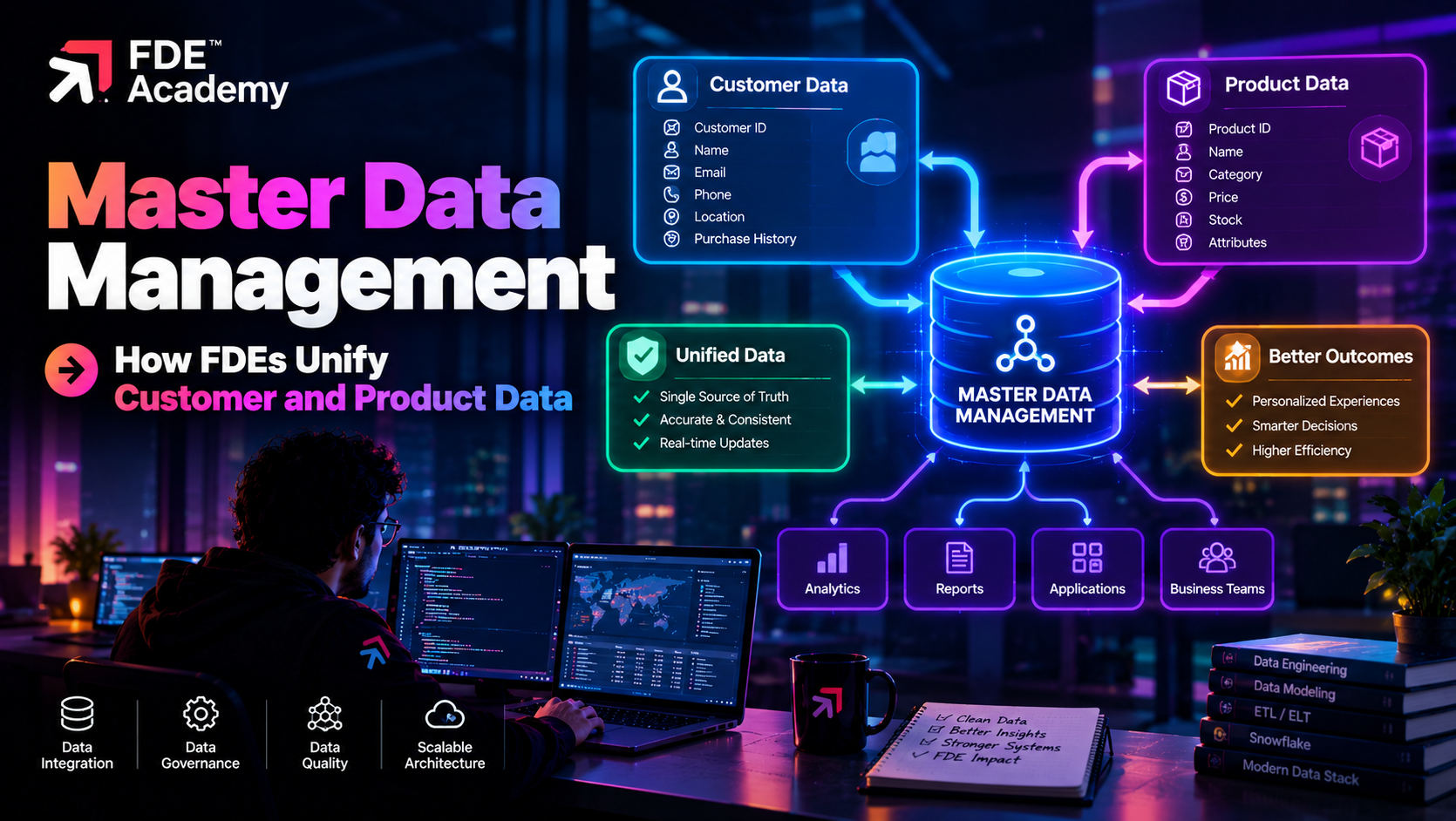
Master data management is a technology-enabled business discipline in which business and IT work together to ensure the uniformity, accuracy, stewardship, governance, semantic consistency and accountability of an enterprise's official shared master data. That is Gartner's definition, paraphrased closely.
Gartner describes master data itself as the smallest set of consistent, standardised identifiers and extended attributes that describe an organisation's core entities, used across many business processes. Customers, suppliers, sites, hierarchies and the chart of accounts are typical examples.
The key idea is the contrast with transactional data. An order is a transaction: it happens once and is recorded. The customer who placed it and the product they bought are master data: they persist, and many systems refer to them. MDM keeps those shared references consistent.
AI features depend on entities. A recommendation system needs to know which purchases belong to one customer. A support assistant must retrieve the right account. A demand forecast needs one product history, not three. When the same entity appears as several records, the results degrade quietly:
This is a recurring pattern behind why AI projects fail: the model is fine, but the data it relies on disagrees with itself. FDEs are often the first people to see this, because they work directly with the customer's systems.
The two most common domains behave differently.
Customer data is mostly a matching problem. Product data is mostly a standardisation problem, with a matching problem on top when you merge catalogues from suppliers or acquisitions.
There is no single mandated method, but most successful projects follow this order.
Start with one entity, usually customers or products, tied to a business outcome. Name a business owner who can settle disputes about what counts as a customer. Without an owner, every disagreement stalls the project.
List every system that creates or changes the entity, what identifiers each uses, and which one is trusted for which fields. Build a crosswalk, a table that links each system's local ID to the shared one. If you are still getting data out of those systems, see our guide to AI data pipelines for messy enterprise data.
Matching works only on comparable values. Normalise names, phone formats, addresses and units first. This overlaps with data cleaning for AI projects, which covers profiling, missing values and format fixes in detail.
Decide which records describe the same real-world entity. See the next section.
Merge matched records into one, using survivorship rules to choose each field's value. See below.
Deliver the golden record to the systems and AI features that need it, and put people in charge of exceptions. Matching is never finished, because new records arrive daily.
Record matching, also called entity resolution, comes in three broad flavours.
Strong results on benchmarks do not remove the need for judgement on your own data. Whatever the method, FDEs keep three habits:
A golden record is the single, trusted version of an entity created by combining matched records. Survivorship rules decide which source value wins for each field. Examples:
Write the rules down and get the business owner to sign them off. Keep lineage, meaning which source supplied each field, so any value can be traced back. This also supports the accountability expected in AI governance for forward deployed engineers.
How the golden record is stored and shared varies. Vendor material from Profisee describes four common styles, which are widely used in the industry:
Profisee's own advice for organisations new to MDM is to begin with consolidation, and it notes that real deployments are often hybrids. That is a vendor view, but it matches common FDE practice: start with the style that does not touch operational systems, prove value, then move toward more control if the business needs it.
This is a hypothetical example to show the method; the retailer and its figures are invented.
A mid-sized retailer wants a personalised shopping assistant. Customer data lives in an e-commerce platform, a loyalty app and store point-of-sale. Products come from an ERP and two supplier feeds.
Scope. The FDE proposes customers first, because the assistant needs a single purchase history. A head of customer experience becomes the owner.
Crosswalk. Each system's customer ID is mapped to a new shared ID. Phone number and email are the strongest shared signals.
Matching. Phone numbers and names are standardised. Pairs sharing a phone and a similar name merge automatically. Pairs with a similar name and address but no shared phone go to a review queue of the loyalty team.
Survivorship. Address comes from the app (customer-edited), name from the loyalty sign-up, marketing consent from the strictest source.
Style. Consolidation: the hub publishes a golden customer table to the assistant and analytics, and the operational systems are left alone for now.
Products. In phase two, the team standardises units and categories across the ERP and supplier feeds, flags probable duplicates, and a merchandiser approves merges.
Result. The assistant sees one history per customer. A weekly report shows pending reviews and merges that were reversed, so the team can tune thresholds.
These ideas overlap, which causes confusion.
MDM sits between data engineering and business consulting. Useful skills include SQL, Python for matching and profiling, data modeling, stakeholder facilitation and clear documentation. See the FDE project lifecycle for where this fits in discovery and build, how FDEs build enterprise AI platforms for the wider system, and data engineer to forward deployed engineer if you are making that move. For the full picture of the role, read how FDEs help enterprises deploy AI.
Master data management is the practice of keeping one agreed, governed version of an organisation's core entities, such as customers and products, so every system and team uses the same facts. It combines matching technology with ownership and rules.
A golden record is the single trusted version of an entity, such as one customer, created by matching records from several systems and choosing each field's value using survivorship rules. It should keep lineage back to its sources.
Transactional data records events, such as an order or a payment. Master data describes the persistent entities those events refer to, such as the customer, product or supplier, and is shared across many systems.
The four common styles are registry, consolidation, coexistence and centralised. They differ in where the golden record lives and whether source systems are updated. Many organisations start with consolidation and later use a hybrid.
AI features depend on correct entities. MDM gives models and assistants one history per customer and one record per product, which reduces duplicates, wrong retrievals and misleading evaluation results.
Standardise the fields, then compare signals such as name, phone, email and address. Merge high-confidence pairs automatically, send uncertain pairs to human reviewers, and keep every merge logged and reversible.
The world is hiring - and this Academy prepares you for it.