Blogs
10 Mistakes New Forward Deployed Engineers Make
10 Mistakes New Forward Deployed Engineers Make
By
R&D, FDE Academy
July 24, 2026

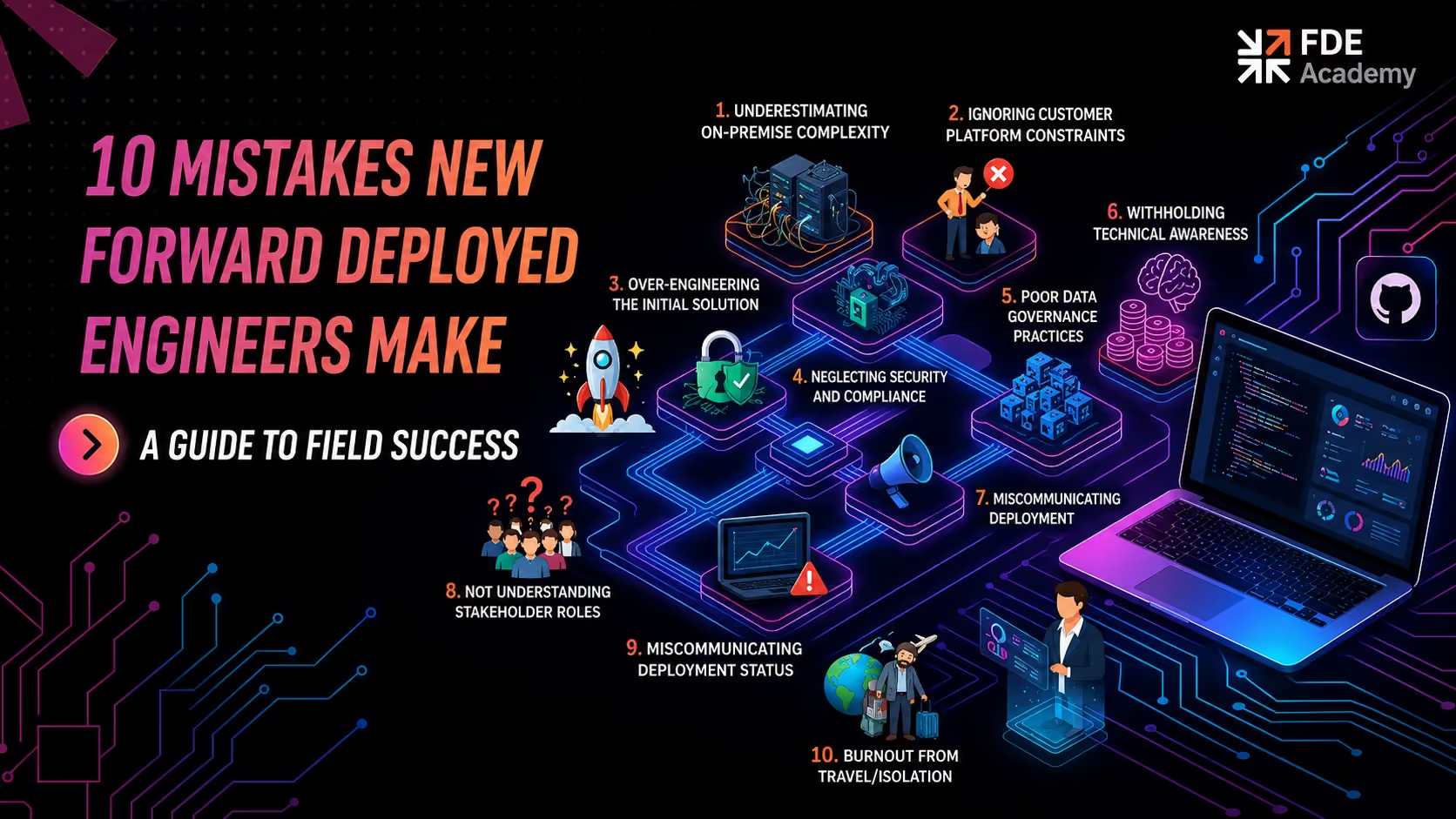
The Forward Deployed Engineer (FDE) role is having a massive moment right now job postings skyrocketed by over 800% in a single year, with tech giants like OpenAI, Palantir, and Databricks racing to build out entire FDE divisions. Operating at the high-stakes intersection of deep coding, sales strategy, and client diplomacy, FDEs don't just sit behind a screen writing back-end features; they drop directly into client territory to translate messy business problems into custom, production-ready code.
But because this hybrid role breaks almost every rule of traditional software engineering, new engineers often face a brutal learning curve where navigating client politics and setting boundaries matters just as much as writing clean syntax, and making early missteps can mean the difference between a thriving partnership and complete burnout.
A Forward Deployed Engineer (FDE) a role pioneered by Palantir and now widely adopted across AI and enterprise tech leaders like OpenAI, Anthropic, and Databricks is a specialized software engineer who embeds directly within a customer's environment to write and deploy tailored, production-ready code.
Unlike traditional core product engineers who build generalized features for a broad user base, an FDE operates at the intersection of engineering, sales, and customer success, spending roughly half their time shipping fast-paced technical solutions and the other half managing client relationships, scoping business needs, and translating complex technical outputs for non-technical stakeholders.
Most engineers are trained to optimize for one thing: clean, scalable, well-tested code shipped on a sprint cycle, with requirements handed down by a product manager who has already done the work of talking to users. FDEs are optimizing for something messier: a live, embedded relationship with a paying customer who has a business problem, a deadline, and often very little patience for engineering process or textbook best practices.
On top of that, a new FDE is usually thrown into ambiguity almost immediately: an open-ended prompt from a client, minimal internal documentation on how similar problems were solved before, and pressure from both their own company and the customer to show value fast. That mismatch in mental models sprint-driven engineering versus open-ended, relationship-driven delivery is the root cause behind almost every mistake on this list. Understanding it early is often the single biggest predictor of whether a new FDE thrives or struggles in year one.
New FDEs often walk in expecting sprints, backlog grooming, tidy tickets, and quiet, uninterrupted focus time. In reality, the job is closer to consulting: ambiguous requirements, shifting priorities, and a client who cares about outcomes, not process. A feature that's technically impressive but doesn't move the client's business metric is, from the customer's point of view, a failure no matter how well-tested the code is.
The fix is a mindset shift, not a skills gap. Success as an FDE is measured by whether the customer's actual problem gets solved, on a timeline that matters to their business, not by how elegant your architecture is or how closely you followed a standard engineering process. The best new FDEs learn to ask "what does winning look like for this customer this month?" before they ask "what should I build first?"
Eager new FDEs frequently commit to deadlines or features in a client meeting without checking feasibility with their own team first. It feels good the moment the client is happy, the meeting ends on a high note but it erodes trust the moment the first deadline slips, and slips are common when a promise was made without engineering input.
Experienced FDEs learn to say "let me confirm that and get back to you" far more often than junior engineers are comfortable doing. It can feel like a weak answer in a room full of stakeholders, but it's almost always the more trustworthy one. Clients remember who kept their word far longer than they remember who sounded confident in the room.
It's tempting to jump straight into building the moment you spot the technical gap that instinct is exactly what got most FDEs hired in the first place. But shipping a solution that doesn't match how the client's team actually works their existing tools, approval chains, data structures, or even internal jargon means rework, or worse, a technically correct solution that nobody on the client side actually adopts.
Spending the first week (or even just the first few days) mapping the client's real workflow, not the idealized one described in the sales deck, saves weeks of wasted engineering later. This usually means sitting in on the client's actual meetings, watching how their team currently solves the problem manually, and asking "why" more than "what" before writing a single line of production code.
New FDEs often see themselves as purely technical and mentally check out of the commercial side of the account. But FDEs frequently work in close partnership with sales and customer success to help close deals, activate new customers, and expand existing accounts. Not understanding why a deal was structured a certain way, what the account team already promised the client, or what the renewal timeline looks like leads directly to friction and misaligned priorities down the line.
A new FDE who treats the sales and customer success teams as "not my job" often ends up blindsided building the wrong thing at the wrong time, or discovering too late that a commitment was already made on their behalf. The strongest FDEs treat the account team as a core part of their working unit, not a separate department.
One of the most valuable things an FDE does is feed real customer pain points back to the core product team, so one-off fixes eventually become generalized product features rather than one-off patches that have to be rebuilt for the next client. New FDEs, buried in delivery pressure, often skip this step entirely, solving the same custom problem repeatedly for different clients instead of flagging the pattern and pushing for a scalable fix.
This is a major failure mode that companies building FDE teams specifically watch for, because it's the difference between an FDE function that eventually shrinks the amount of custom work needed and one that just keeps growing more expensive over time. If you notice you're solving a nearly identical problem for a third or fourth client, that's a strong signal it belongs in the core product, not in another custom build.
Because FDE work often happens fast and under real time pressure, documentation is usually the first thing to get skipped. It feels reasonable in the moment the client needs the fix today, not a wiki page. But when a customer's environment changes hands to another FDE, to customer success, or to the core engineering team undocumented, tribal-knowledge solutions become a serious liability, both for the business and for your own reputation as someone who ships things others can maintain.
Writing clear runbooks, architecture notes, and "why we built it this way" context as you go, rather than promising to backfill it later, is non-negotiable. In practice, "later" rarely comes, and the next person to touch that client's environment, sometimes you, six months on pays the cost.
Being liked and trusted by a client's engineering lead, procurement team, and day-to-day end users simultaneously is a distinct skill from writing good code and it's arguably the harder half of the job. New FDEs sometimes assume technical competence alone will earn trust, since that's what earned them credibility on previous engineering teams.
In reality, clear, honest, frequent communication especially when something is going wrong is what earns long-term credibility with a client. A client who hears about a delay or a bug directly from you, early and plainly, will almost always trust you more afterward than one who finds out from someone else, or finds out late. Silence, even well-intentioned silence while you try to fix something quietly, tends to read as evasiveness.
Clients will ask for "just one more thing" constantly, and new FDEs eager to be helpful, and often eager to prove their value early, frequently say yes without pushing back or checking capacity. This feels like good service at the moment, but it leads to scope creep, missed deadlines on the original commitment, and a codebase full of disconnected one-off patches that nobody fully understands six months later.
Learning to scope a request, prioritize it against what's already committed, and politely push back or negotiate a trade-off is one of the highest-leverage skills an FDE can build. "Yes, and here's what that means for the current timeline" is almost always a stronger answer than an unconditional yes.
FDEs often work directly inside a client's live production environment, sometimes with sensitive, regulated, or business-critical data. New FDEs, focused on shipping fast and impressing a new client, can overlook data-handling agreements, access controls, or compliance requirements that were negotiated long before they joined the account, a mistake that can create serious legal and trust problems for both companies involved.
This is especially critical in fintech, healthcare, government-adjacent, and other regulated deployments, where a single overlooked access permission or an unapproved data export can jeopardize the entire relationship. New FDEs should treat "what am I allowed to touch, see, and move here?" as a first-week question, not an afterthought.
The role is often high-travel, high-intensity, and involves being "on" for a client at odd hours across time zones, especially during a critical implementation window. New FDEs frequently overcommit early to prove themselves answering messages at midnight, taking every trip offered, saying yes to every escalation and then burn out within the first year, sometimes leaving the role entirely just as they were becoming genuinely good at it.
Building sustainable boundaries early, and communicating them clearly to both your employer and your client, is essential for a long FDE career rather than a short, intense one. The engineers who last in this role tend to be the ones who learned to protect their time deliberately, not the ones who simply had more stamina.
None of the mistakes above are fatal on their own. Almost every experienced FDE has made several of them. What makes them worth avoiding is compounding cost: an over-promised timeline plus undocumented handoffs plus unchecked scope creep doesn't just create three separate problems; it creates a client relationship that's hard to recover once trust erodes. Companies that build FDE teams well tend to treat the first 90 days as a deliberate onboarding period focused on judgment and communication, not just technical ramp-up, precisely because these patterns are so predictable and so avoidable with the right early guidance.
The upside is just as real. FDEs who avoid these traps tend to become the engineers a company trusts with its highest-value, highest-ambiguity accounts and that trust is usually what fuels the next step in an FDE's career, whether that's a senior FDE title, a move into solutions architecture, or a path into product or engineering leadership.
The forward deployed engineer role rewards adaptability more than raw technical skill. Most of the mistakes above aren't about writing bad code, they're about misjudging what the job actually optimizes for: trust, communication, and solving the right problem, not just a problem. New FDEs who internalize this early tend to ramp up faster, build stronger client relationships, and avoid the burnout that pushes many people out of the role within their first year.
Treating the role like traditional software engineering focusing purely on code quality while ignoring client communication, scope management, and business context is the most common and costly early mistake.
Not formal sales training, but FDEs do need strong stakeholder communication and the ability to collaborate closely with sales and customer success teams, since much of the role involves managing client relationships alongside technical delivery.
A solutions engineer typically supports the pre-sales process with demos and proofs of concept. A forward deployed engineer usually owns delivery after the deal closes, writing and shipping production code inside the customer's actual environment.
By setting clear boundaries around travel and availability early, documenting work to avoid becoming a single point of failure, and communicating capacity limits honestly to both their employer and the client.
For engineers who enjoy ambiguity, client interaction, and fast-paced problem solving, it can be a strong path. FDE roles are in high demand, often well compensated, and can lead to solutions architecture, product management, or engineering leadership roles.
The world is hiring - and this Academy prepares you for it.