Blogs
Palantir AIP Explained: What It Is and How FDEs Use It
Palantir AIP Explained: What It Is and How FDEs Use It
By
R&D, FDE Academy
October 14, 2026

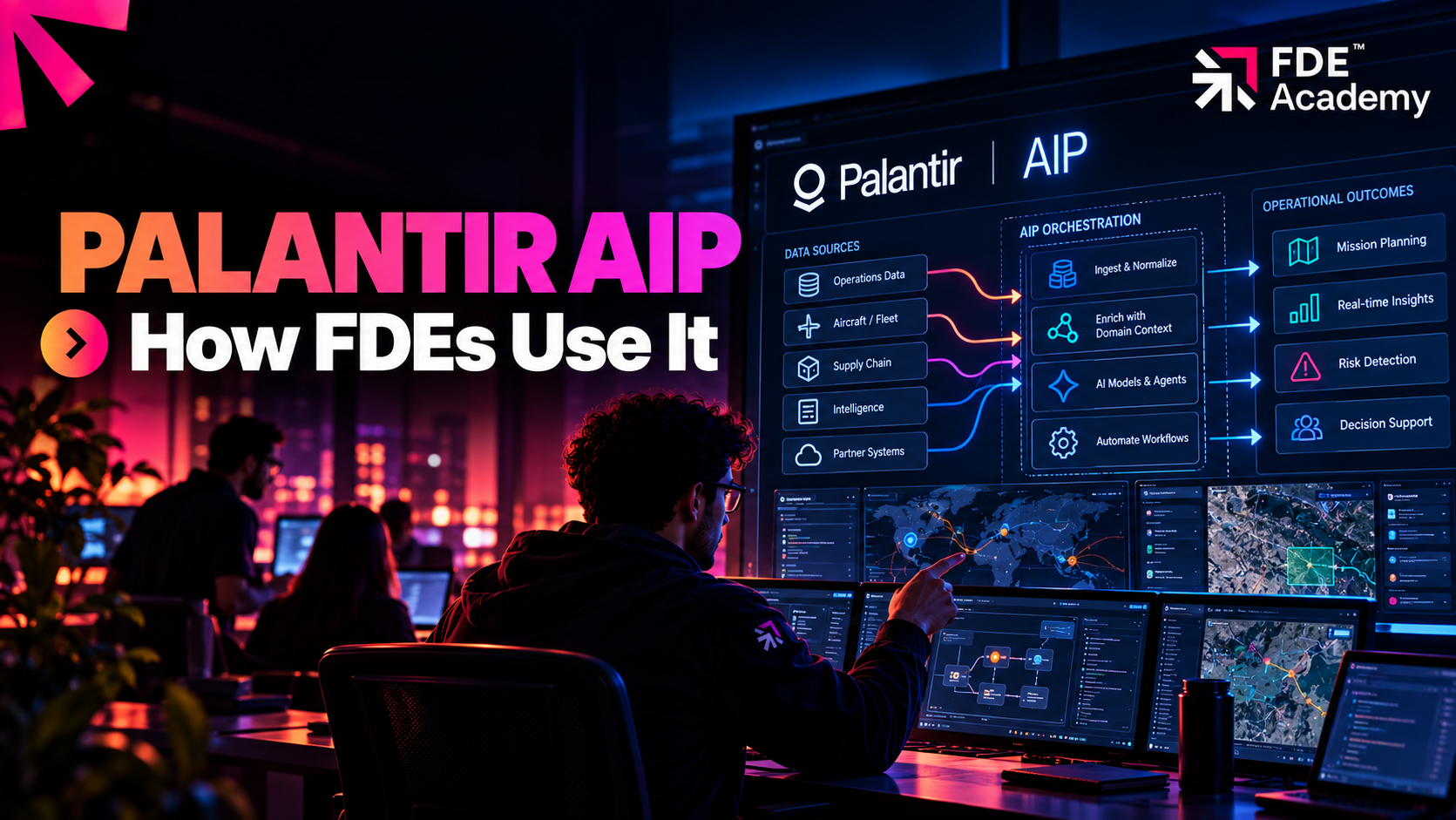
Palantir AIP is Palantir's Artificial Intelligence Platform, a set of tools for building and running AI-powered workflows, agents and applications on top of an organisation's data and operational systems. Palantir's documentation describes it as connecting AI with an organisation's data and operations to drive automation across operational processes, for users ranging from developers to frontline staff.
Two ideas matter most. First, AIP is not a model. It supports a range of large language models and lets teams choose the one that suits each use case. Second, AIP's builder tools operate on top of the Ontology, which is what separates it from a plain chatbot wrapper. The documentation also states that AIP feature availability is subject to change and may differ between customers, so treat any feature list, including this one, as a snapshot.
AIP is easier to understand once you see its neighbours. For the wider platform story, see our guide to what Palantir Foundry is.
The key relationship: Foundry brings the data in, the Ontology gives it meaning, and AIP lets language models use that meaning safely.
A language model on its own knows nothing about your warehouse, your customers or your maintenance schedules. The usual fix is retrieval: pull relevant text and feed it to the model, as we cover in fine-tuning vs RAG.
The Ontology offers a different route. It represents business entities as typed objects, such as a purchase order, a machine or a patient, linked to each other, with defined actions that change them. One Towards AI analysis calls the pattern "Ontology-Augmented Generation", meaning the model retrieves typed objects and calls deterministic tools before it writes anything, rather than relying on loosely matched text chunks. That is one author's label, not an official Palantir term, but the idea is useful: the model works with structured, permissioned facts, and the actions it can take are defined in advance.
Palantir's AIP documentation lists several builder tools. The names change over time, so verify current ones in the docs.
Where the documentation page lists a tool only by name, this article does the same instead of guessing at what it does.
AIP Logic is the easiest component to picture, so it is a good example. According to Palantir's documentation, builders take inputs such as Ontology objects or text, process them with an LLM, and return outputs or make Ontology edits. Its examples include extracting information from unstructured inputs, resolving scheduling conflicts and responding to supply chain disruptions.
A typical function has a "Use LLM" block that contains a prompt, a tool that can query an object type, access to specific object properties, and a typed output. Typed outputs matter because they keep the model's answer in a shape the rest of the system can validate.
Three design features stand out:
Palantir's documentation says AIP provides access controls, encryption and auditing, with governance tools for accountability and lineage. In AIP Logic, platform security limits what the model can read to what the user is allowed to see.
One caution worth repeating: the Logic documentation notes that these read-time controls do not cover the model's output or any edits it makes, and recommends pairing them with markings or classification-based access control. For an FDE, that is a design instruction. Check permissions on the way in and on the way out, and treat staged edits for sensitive actions as a default. Our guide to AI governance for forward deployed engineers goes deeper.
Palantir popularised the forward deployed model, and its FDEs ("Deltas") are mainly technical builders embedded with the customer, as described in our article on Palantir deployment strategists vs FDEs. For the history, see how Palantir invented the FDE model.
On an AIP project, the work follows the same loop as any FDE project lifecycle:
The shape of the work is the same on other platforms; the difference is that AIP supplies the Ontology, action framework and evaluation tooling out of the box. Our article on how FDEs build enterprise AI platforms covers the alternative of assembling your own.
A manufacturer wants faster responses when a supplier delays a shipment.
The FDE spends the first week with planners and learns they spend hours checking which production orders a delayed part affects. In the Ontology, parts, suppliers, purchase orders and production orders are linked objects. The FDE builds a Logic function that takes a delay notice as input, finds the affected orders through the links, drafts a ranked impact summary and proposes rescheduling actions.
The edits are staged. A planner sees the proposal, checks it and approves or rejects each action. The FDE builds a set of test cases from past disruptions, uses evaluations to compare prompt versions, and finds the function mishandles notices that name parts by an old code. Fixing the mapping data helps more than rewriting the prompt. After a pilot with one planning team, the logs show how often planners edit the proposals, which guides the next round.
The lesson is that the model call was a small part. The Ontology, permissions, review step and test set carried the project. This scenario is illustrative, not a real customer case.
Balanced coverage matters here, because AIP is often discussed in extremes.
No. The role is defined by embedded problem-solving, not by one vendor's product. Skills that transfer across platforms include data modelling, integration, LLM evaluation, permissions design and customer communication. Knowing AIP is a plus for Palantir-style roles, but most FDE jobs outside Palantir use a mix of cloud services, open-source frameworks and custom code. See how to become a forward deployed engineer and, for how agents work beyond one platform, AI agent orchestration for forward deployed engineers. For pay context, our Palantir FDE salary guide covers what is known.
TL;DR: Palantir AIP, short for Artificial Intelligence Platform, is Palantir's layer for connecting large language models to an organisation's data and operations. Instead of letting a model answer from raw text, AIP ties it to the company's Ontology, a structured model of its real objects, relationships and actions, and wraps the result in permissions, testing and audit tools. Forward deployed engineers (FDEs) use it to build AI workflows and agents that read live business data, propose or take governed actions, and run inside real operations. It is powerful but not magic: results depend on data quality, careful design and human oversight, and it comes with platform lock-in trade-offs.
Palantir AIP, or Artificial Intelligence Platform, is Palantir's set of tools for connecting large language models to an organisation's data and operations. It lets teams build AI-powered functions, agents and applications grounded in the Ontology, with permissions, testing and audit controls.
Foundry is Palantir's data operations platform, used to integrate data and build pipelines and applications. AIP is the AI layer that works on top of that foundation and the Ontology, connecting language models to governed data and actions.
AIP Logic is a no-code environment in AIP for building, testing and releasing functions powered by language models. It takes inputs such as Ontology objects or text, processes them with an LLM and returns outputs or Ontology edits, which can be staged for human review.
They model a customer's domain in the Ontology, connect data, build Logic functions or agents, set permissions and review steps, test with evaluations, and deploy in stages with customer teams. The work follows the standard FDE loop of discovery, build, validate, ship and iterate.
Parts of it, such as AIP Logic, are described as no-code, but production deployments still need careful prompt and tool design, permissions planning, data work and extensive testing. Treat "no-code" as lower coding effort, not no engineering.
No. Most FDE roles value transferable skills such as data modelling, integration, LLM evaluation and communication. AIP knowledge helps for Palantir-style roles, but it is one platform among several.
The world is hiring - and this Academy prepares you for it.