Blogs
Snowflake vs Databricks: Which Platform Fits Which Customer (A Practical Guide for FDEs)
Snowflake vs Databricks: Which Platform Fits Which Customer (A Practical Guide for FDEs)
By
R&D, FDE Academy
October 31, 2026

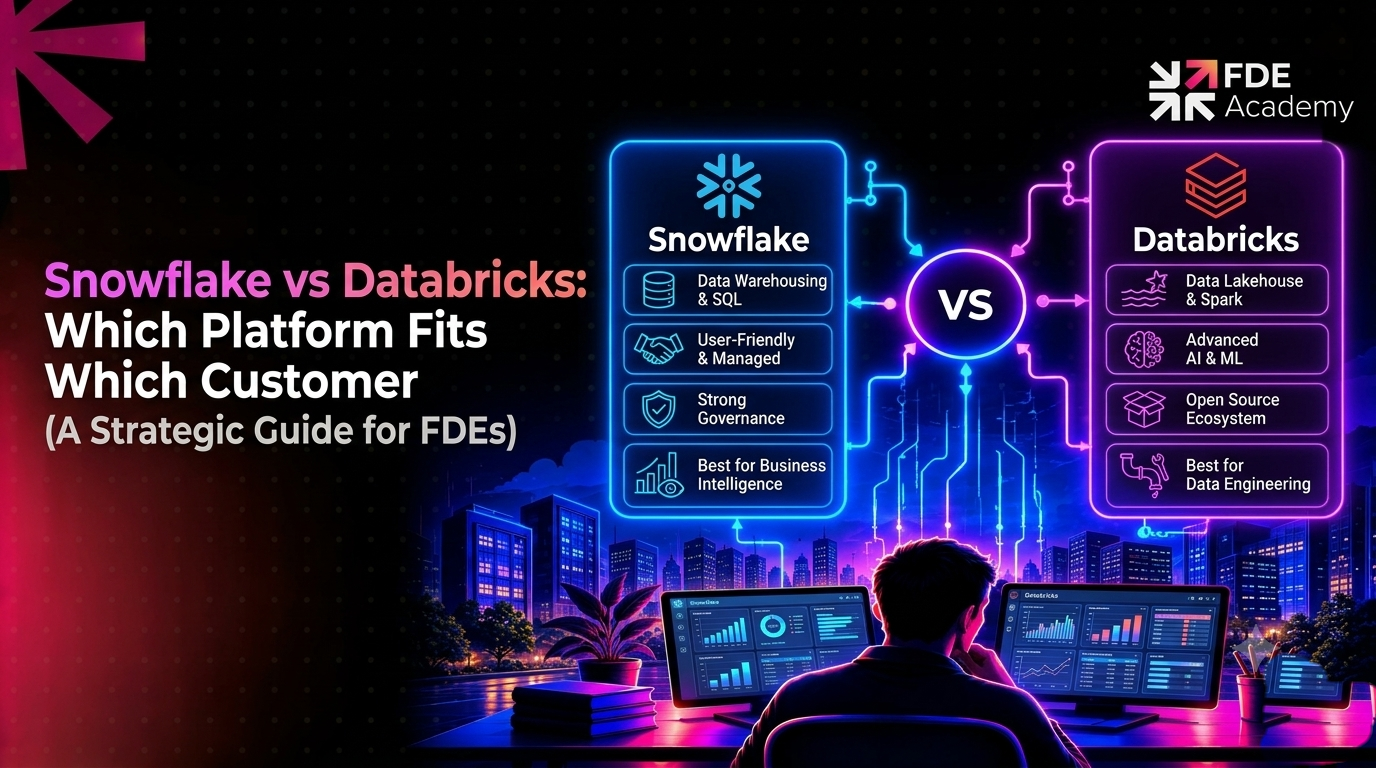
Snowflake's documentation describes it as "an advanced data platform that is provided to you as a self-managed service," running on public cloud infrastructure. You cannot run it locally or on a private cloud. Its architecture is "a hybrid of traditional shared-disk and shared-nothing database architectures," in three layers:
Snowflake handles structured, semi-structured and unstructured data, and offers Snowflake Cortex, which provides AI features built on large language models from several providers, plus Snowflake ML for building models.
Databricks' documentation defines a lakehouse as "a data management system that combines the benefits of data lakes and data warehouses," and says Databricks is built on Apache Spark. The components it names:
Its AI and machine learning page, which is the vendor's own description, lists model serving as REST endpoints with automatic scaling and GPU support, an AI Gateway for governing access to served models, MLflow for tracking experiments and managing the model lifecycle, and a Feature Store. If your customer is on Azure, our guide to Azure Databricks covers setup and use.
Treat the last row as a tendency, not a rule. Each platform now does much of what the other is known for.
Open table formats are the clearest example. A November 2025 article from a Capital One engineer (the author notes the views are his own) reports that Snowflake treats Iceberg as a first-class table format, that Unity Catalog governs Iceberg tables alongside Delta, and that Delta Lake UniForm lets one Delta table expose Iceberg-compatible metadata so several engines can read the same files. The same article gives important caveats: read interoperability is the current focus, shared write semantics were described as "on their way," metadata sync is asynchronous, and choosing a catalog still ties governance to a vendor's implementation.
For an FDE, the lesson is practical. Open formats reduce lock-in at the storage layer, but governance, performance tuning and operations still differ. Do not promise a customer that data "works equally well in both" without testing it.
Here is a common task: get each customer's latest order. First as SQL, which is the natural language of Snowflake and works in Databricks SQL too. I tested this with DuckDB 2.0.0, which supports the QUALIFY clause; confirm it in the customer's engine:
sql
SELECT customer, order_id, order_date, amount
FROM orders
QUALIFY ROW_NUMBER() OVER (PARTITION BY customer ORDER BY order_date DESC) = 1;
And as PySpark, the natural style on Databricks, tested with PySpark 4.3.0 locally:
python
w = Window.partitionBy("customer").orderBy(F.col("order_date").desc())
latest = (df.withColumn("rn", F.row_number().over(w))
.filter("rn = 1").drop("rn"))
On five sample rows both returned the same three results: Asha's order 2 (700), Ben's order 4 (900) and Chitra's order 5 (900). The point is that routine transformations are not the differentiator. Skills, workflow and governance are. Review the modelling guidance in data modeling and star schema either way, because poor models hurt on both platforms.
Snowflake's connectors include Apache Kafka and Apache Spark, and it supports Snowpark for code in several languages. Databricks, being built on Spark, is a natural home for large-scale transformation and custom pipelines. In practice many customers use an orchestration and ingestion tool on top of either. See Azure Data Factory for batch ingestion on Azure, Azure Stream Analytics for streaming, and AI data pipelines for messy enterprise data for pipeline design. Unifying records across systems is a separate problem; see master data management.
Both vendors now sell AI features inside the platform. Snowflake Cortex offers LLM-based functions for unstructured data, and Snowflake ML supports building models. Databricks describes model serving, an AI Gateway, MLflow and a Feature Store. These are vendor descriptions, and capabilities change quickly.
Questions that matter more than feature lists:
Our guide to how FDEs build enterprise AI platforms covers the wider architecture, and AI governance for forward deployed engineers covers controls that apply on either platform.
Pricing changes often, so this guide compares models, not prices.
Snowflake bills compute in credits. Its documentation says warehouses "are only billed for credit usage while running," billed per second with a 60-second minimum, and each size step approximately doubles compute power and credits per hour. Serverless features and the cloud services layer are billed separately under their own rules.
Databricks meters usage in Databricks Units (DBUs) by workload type. Its classic compute also incurs charges from the underlying cloud provider; verify the current arrangement for your customer's cloud and compute type.
What this means in practice:
Then ask: What skills does the team have? What does governance require? Where do compliance rules constrain location? Who will operate it after you leave? Our FDE tech stack guide shows how this decision fits the wider toolkit.
This fits naturally into the discovery stage of the FDE project lifecycle.
This is a hypothetical example to show the approach; the company and details are invented.
A retailer wants demand forecasting and a weekly sales dashboard. Its analysts write SQL daily; it has two data engineers and no ML engineers.
Discovery. The FDE finds sales data already lands in cloud storage, finance wants tight access control, and the team has never run Spark.
Proof of concept. The FDE tests the dashboard queries and one forecasting workload on both platforms using a month of real data, tracking cost, runtime and the engineers' effort.
Finding. Both handle the SQL load. The forecasting workload is easier for the analysts in the SQL-first environment, but the data engineers prefer notebooks for feature work.
Decision. The retailer chooses the platform its analysts can operate, with a plan to revisit if ML needs grow. Open table formats keep the door open. The key point: the decision followed skills and workload, not vendor positioning.
Snowflake and Databricks both run SQL, Python and AI workloads on the cloud, and they have converged over the years. Snowflake started as a managed data warehouse and is strongest where customers want governed SQL analytics with little infrastructure to manage. Databricks started from Apache Spark and is strongest where engineering and machine learning teams want code-first control. An FDE should match the platform to the customer's skills, workloads and existing estate, then test with a short proof of concept.
Snowflake began as a managed cloud data warehouse and is SQL-first, while Databricks is built on Apache Spark and the lakehouse and is code-first. Both now offer SQL, Python, AI features and open table formats.
Neither is universally better. Databricks documents model serving, MLflow and a Feature Store, and Snowflake offers Cortex and Snowflake ML. The better choice depends on where your data lives, who builds the models and what governance applies.
Both support open table formats such as Apache Iceberg, and Delta Lake UniForm exposes Delta tables to Iceberg readers. Read interoperability is further along than shared writes, so test your exact scenario.
Snowflake bills compute in credits, per second with a 60-second minimum for running warehouses. Databricks meters usage in DBUs by workload type, and classic compute also carries cloud infrastructure charges. Verify current terms with each vendor.
Snowflake is SQL-first and often a natural fit for analyst-led teams, but Databricks SQL also targets warehousing workloads. Run your real dashboards on both before deciding.
Start with the customer's existing platform, team skills, workloads and governance needs. Then run a short, time-boxed proof of concept on real data and decide from measured cost, effort and fit.
The world is hiring - and this Academy prepares you for it.