Blogs
Solutions Engineer to Forward Deployed Engineer: Skills, Gaps, and 60-Day Transition
Solutions Engineer to Forward Deployed Engineer: Skills, Gaps, and 60-Day Transition
By
R&D, FDE Academy
April 14, 2026

Key fact: Solutions engineers are one of the most common transition paths into FDE roles. The shift is from demos to production ownership.
There is a specific frustration that experienced solutionsengineers describe when they reach a certain point in their careers.
You scope the problem with the client. You design thesolution. You build a proof of concept that works. You present it, answer thehard questions, and help close the deal. Then you hand it off.
And then you move on to the next prospect.
What happens after that handoff is largely invisible to you.Whether the deployment actually worked. Whether the integration held up inproduction. Whether the client got the outcome you promised them.
The Forward Deployed Engineer role was built to close exactlythat gap. It is the same client-facing technical work, but without the handoff. You own the outcome.
A Solutions Engineer (SE) is a technical professional who works with clients during the pre-sales phase to demonstrate product capabilities, design solutions, and prove feasibility through demos and proof-of-concepts.
A Forward Deployed Engineer (FDE) is a software engineer who works directly inside client environments to deploy, integrate, and scale systems in production, ensuring they work reliably under real-world conditions.
This distinction is worth being precise about because the two roles overlap significantly in the early stages of a client engagement, and the difference becomes critical after the deal closes.
A solutions engineer's primary zone of activity is pre-sale. You demonstrate what the product can do, prove technical feasibility, handle the questions the sales team cannot answer, and build proof-of-concept implementations that show the client the art of the possible. When the contract is signed, your work is largely done.
A Forward Deployed Engineer's primary zone of activity is post-sale. You take the promise that was made during the sales process and make it real inside the client's actual environment, with their actual data, their actual infrastructure, and their actual operational constraints. You stay until it works. You own the outcome.
"Solutions Engineers sell the vision. Forward Deployed Engineers make the vision real. SEs handle pre-sales: scoping, demos, and proof of possibility. Once the deal closes, FDEs take those promises and deliver them in production environments." - Rocketlane FDE Guide, 2026
The two roles share client communication, technical scoping, and product knowledge. They diverge completely on code depth, deployment ownership, and accountability for production outcomes.
%20vs%20solution%20engineer.avif)
Solutions engineers are not starting from a disadvantage. The skills that are hardest to teach in FDE hiring are the skills solutions engineers already have.
Solutions engineers handle executive-level questions live during demos, manage scope discussions in real time, and deliver technical explanations to audiences with no engineering background. This is not a skill FDE hiring teams can develop in engineers who have never done it. It takes years of repetition. You already have it.
Understanding what the client actually needs as opposed to what they asked for, is a core FDE competency. Solutions engineers develop this instinct through repeated discovery calls and pre-sales scoping work. The FDE applies the same instinct to deployment constraints rather than sales requirements.
Solutions engineers know the product inside out. They know its capabilities, its limits, where it integrates cleanly, and where it creates friction. That product knowledge transfers directly into FDE work, where understanding what the platform can and cannot do shapes every integration and customization decision.
Pre-sales work is inherently ambiguous. Client requirements change, timelines compress, and scope expands during the sales cycle. Solutions engineers learn to operate effectively under these conditions. FDE work involves the same ambiguity, except it is now happening in a live production environment rather than a sales process.
Solutions engineers routinely work across engineering leads, IT decision makers, and C-suite executives in the same engagement. FDEs do exactly this but with the added complexity of being inside the client's environment daily, navigating their internal politics, their change management processes, and their security teams.
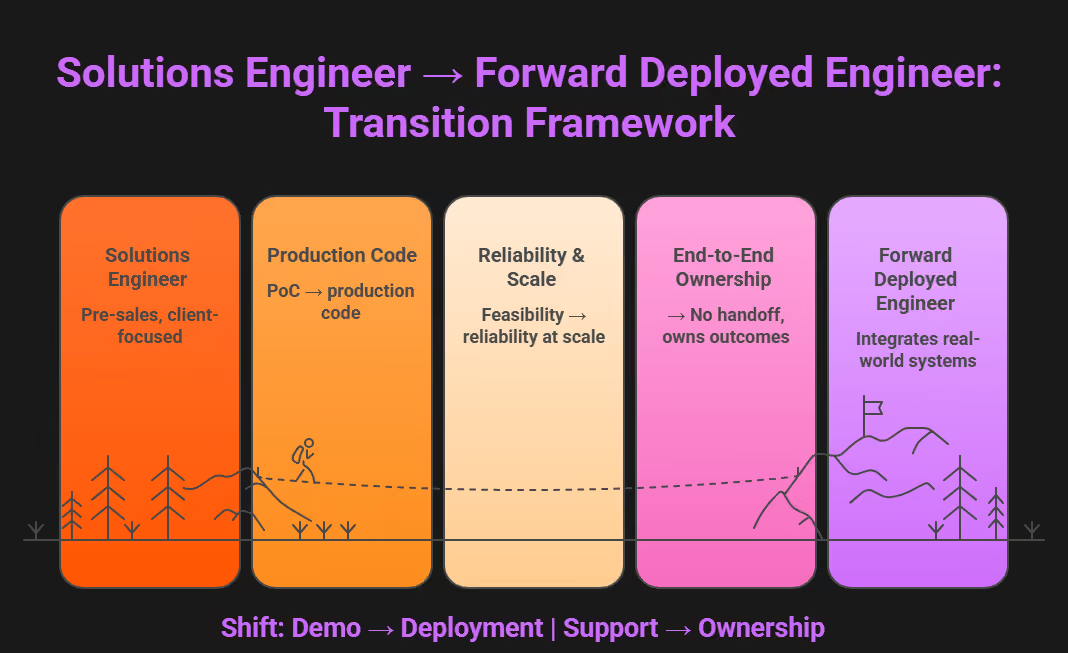
PoC code proves a point.
Production code must survive reality.
You need to:
How to fix it:
Take an existing PoC and rebuild it to production standards.
SE mindset: “It works for the demo”
FDE mindset: “It works when I’m not there”
You own:
This changes how you:
FDEs work in messy environments:
You must learn:
Understanding how FDE hiring teams interpret SE experience helps you position it correctly.
The risk is that SE experience reads as sales-adjacent rather than engineering-adjacent. Some FDE hiring managers will immediately recognize the overlap and value the client skills. Others will want evidence of production code depth before they take the application seriously.
The way to bridge this is in how you describe your experience, not just what experience you have.
The content is the same. The framing removes the sales context and surfaces the technical ownership, which is what FDE hiring teams are looking for.
Not all FDE roles are equal fits for solutions engineers. The roles where your background translates most directly are:
As documented in analysis of 1,000 Forward Deployed Engineer job postings, solutions engineers already have the customer-facing skills and the transition to FDE means going deeper technically: writing production code instead of demos, and owning deployments instead of handing off after the sale.
Solutions engineers have a shorter path to FDE readiness than most other backgrounds because the client skills are already developed. The 60 days here focus entirely on closing the technical gaps.
Solutions engineers who want to compress this timeline with structured guidance and scenario practice, FDE Academy offers a program built specifically around the deployment skills, production code standards, and interview preparation that bridge the gap between solutions engineering and Forward Deployed Engineering.
This is worth being direct about because the FDE role is not the right move for every solutions engineer.
The FDE role makes sense if you find yourself frustrated by the handoff. If you want to know whether the deployment actually worked. If the pre-sales work feels complete but disconnected from real impact. If you are energized by the idea of owning an outcome rather than enabling one. If you want to write code that matters to a specific client rather than building demos that exist to win deals.
The FDE role may not be the right move if you are energized by the variety of pre-sales work and the constant exposure to new prospects. If you prefer breadth of client exposure over depth of engagement. If the accountability of production ownership sounds draining rather than motivating. If you like the clean handoff and the ability to move to the next opportunity.
Solutions engineers who thrive in FDE roles are typically those who have found themselves staying involved after the handoff informally, following up with the implementation team, debugging issues that technically belong to someone else, and caring more about the deployment outcome than their quota requires them to.
If that description sounds familiar, the FDE role is probably where you should have been for a while.
Yes. Solutions engineers are one of the most common transition paths into Forward Deployed Engineering because they already have the hardest FDE skill: working directly with clients under technical pressure. The main gaps to close are production code depth and deployment ownership accountability. Most solutions engineers with strong coding ability can make the transition within 60 days of focused preparation.
A solutions engineer works primarily pre-sale, building demos and proving technical feasibility to win deals. A Forward Deployed Engineer works post-sale, building production systems and owning the deployment outcome inside the client's actual environment. Solutions engineers hand off after the deal closes. Forward Deployed Engineers stay until the deployment works.
The three main areas are: production code standards (writing tested, documented, maintainable code rather than demo code), integration depth (building real API integrations with error handling and retry logic in messy enterprise environments), and AI systems knowledge including RAG architecture and LLM evaluation frameworks. Client communication and stakeholder management already transfer directly.
Yes, significantly. Solutions engineers write demo code and proof-of-concept implementations to support the sales cycle. Forward Deployed Engineers write production-grade code that runs in the client's live environment indefinitely. The bar for code quality, reliability, and documentation is much higher in FDE work.
Remove sales-context language and surface technical ownership instead. Describe PoC implementations in terms of the integration challenge solved and the architecture decisions made, not the deal they supported. Highlight any experience where you stayed involved after the handoff, resolved live technical escalations, or where your PoC became the foundation of the production architecture. FDE hiring teams are looking for deployment thinking, not sales support.
Most solutions engineers with solid coding ability can transition in 45 to 60 days of focused preparation. The client skills are already developed. The preparation time focuses on building production code depth and practicing FDE-specific interview formats. Solutions engineers who have built real production systems outside of their SE role, through side projects or earlier engineering work, can move faster.
The world is hiring - and this Academy prepares you for it.