Blogs
The Forward Deployed Engineer Roadmap: A Month-by-Month Plan
The Forward Deployed Engineer Roadmap: A Month-by-Month Plan
By
R&D, FDE Academy
July 21, 2026

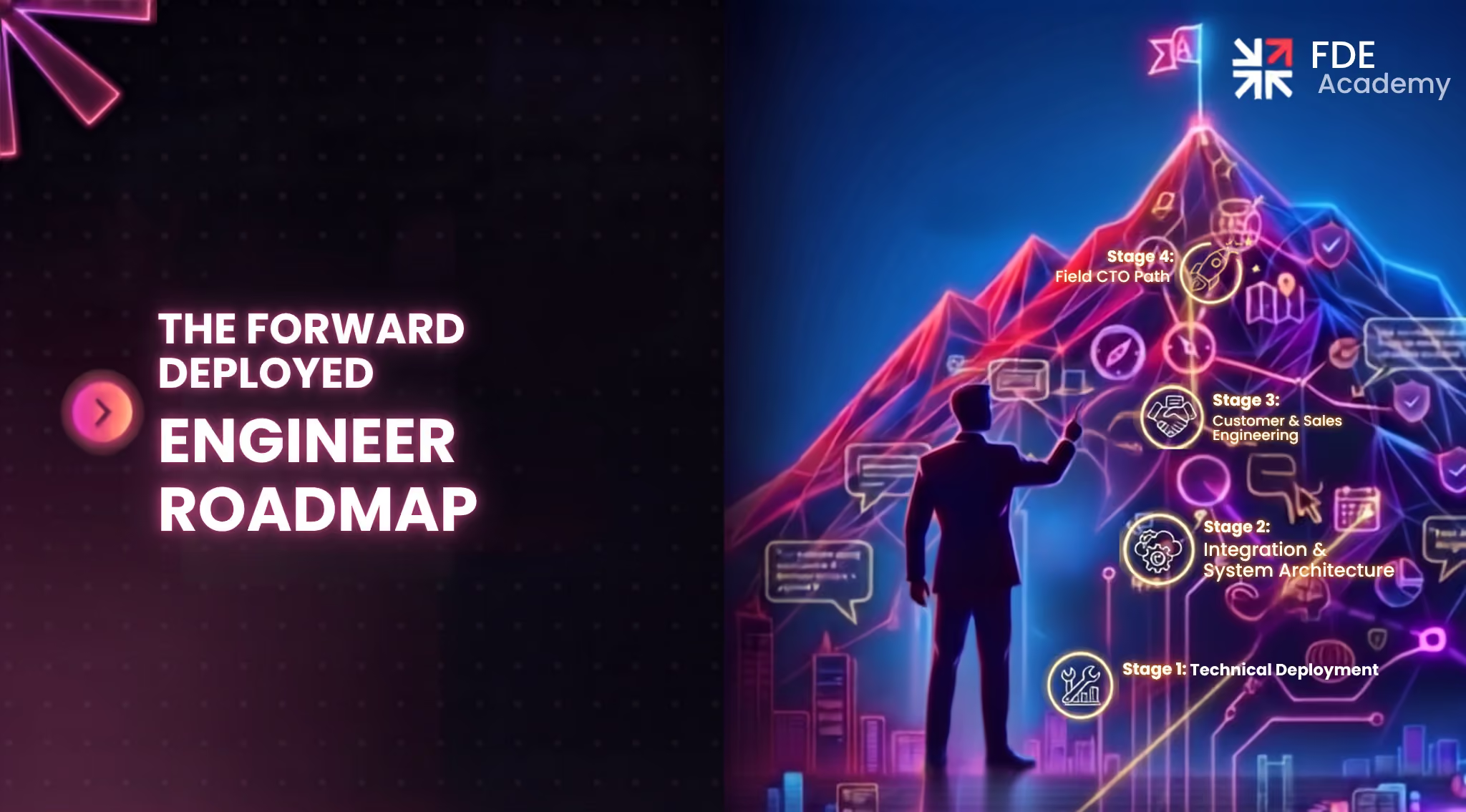
A Forward Deployed Engineer roadmap is a structured, production-first path that bridges software engineering, applied AI deployment, enterprise systems integration, and customer-facing delivery. While traditional software engineers build features for internal codebases from clean product roadmaps, an FDE is embedded directly with customers to turn messy, ambiguous business problems into working production software.
This 2026 guide maps out the core competencies, technology stack, portfolio project blueprints, and a 12-month gated timeline to take you from foundational engineering to landing an FDE role.
A complete Forward Deployed Engineer (FDE) roadmap progresses from core software engineering to shipping against messy enterprise data, mastering applied AI systems, and demonstrating field readiness through real-world case studies:
A Forward Deployed Engineer needs to be comfortable working across different areas of technology. The role combines parts of software engineering, solutions architecture, and customer-facing work. You don’t need to be an expert in everything from day one, but you should build a strong foundation across these six areas:
The flowchart below represents the complete Forward Deployed Engineer roadmap compressed into one view. The key thing to notice isn't just the boxes, but the decision points and loop-back arrows. Each phase of this FDE roadmap ends with a milestone check, not simply a calendar date: did you actually develop the required skills and clear the milestone, or not? If not, the roadmap loops back into the same phase instead of moving forward based only on time.
Reading this left to right, top to bottom: each rectangle is a phase of work, each diamond is a gate, and each loop-back arrow is a deliberate refusal to move forward on a fixed schedule alone. If you hit month three and haven't genuinely deployed a production-quality service yourself, the honest move is to stay in Months 1-3 a little longer, not to carry a shaky foundation into Months 4-6 and watch it show up as gaps later.
The same logic applies at every gate: the diamond, not the calendar, is what actually controls when you advance.
This also explains why the "starting point" adjustments further down compress or extend phases rather than skip them entirely. A software engineer with three years of experience will likely clear the Months 1-3 gate in a few weeks, but they still pass through the gate, they don't bypass the check just because their starting point is stronger.
The structure of the roadmap stays identical regardless of background; only the speed of clearing each gate changes.
Here's the same roadmap as a quick-reference table, useful for coming back to later without re-reading the full detail:
Focus: Production-grade coding depth in one language, plus one cloud platform.
Pick one language (Python is the standard default for AI-adjacent FDE work) and go deep rather than sampling several shallowly. Build real comfort with error handling, testing, and clean code structure, not just syntax. Simultaneously, pick one cloud platform (AWS, Azure, or GCP) and learn core compute, storage, networking, and IAM hands-on, not just conceptually.
A rough week-by-week breakdown within this phase:
A common mistake in this phase: treating fundamentals as a box to check quickly so you can get to the "interesting" AI-specific work sooner. Resist this. Weak fundamentals show up later as bugs you can't diagnose and interview answers that don't hold up under a follow-up question, at a point where fixing the gap costs far more time than building it properly now would have.
Milestone to hit before moving on: You can write a small, production-quality backend service (a simple API with proper error handling and tests) and deploy it yourself on your chosen cloud platform, from scratch, without following a tutorial step by step.
Focus: Your first real, end-to-end deployment project.
This is where fundamentals turn into something you can actually talk about in an interview. Pick a realistic scenario (a RAG pipeline over a messy document set, an integration against a mock CRM with intentionally inconsistent fields, an agent handling ambiguous requests) and build the full pipeline: discovery framing, a scoped MVP, the actual build, and a basic evaluation set that defines what "correct" looks like for your scenario.
Structure this project the way a real engagement would run, not the way a tutorial would:
This last habit, evaluation before "done," is one of the clearest signals separating candidates who've actually done deployment work from candidates who've only built demos.
Milestone to hit before moving on: One deployed, documented project with a written postmortem, what broke, what you changed, what you'd do differently. This single artifact matters more for your eventual applications than anything else in this roadmap.
Focus: Depth in one AI-specific area, plus real practice translating ambiguity into a plan.
Pick one area to go deep in based on where you want to work:
Alongside your specialization, deliberately practice the discovery and requirements-translation skill that decomposition interviews test:
This is a rehearsable skill, and most candidates who struggle in FDE interviews haven't rehearsed it at all before the interview itself.
Build a second, more specialized project in this phase rather than starting fresh. Take your Months 4-6 project and extend it in the direction of your chosen specialization, add a genuine agentic workflow to your RAG pipeline, or add a proper evaluation harness with graded test cases if you haven't already. Extending existing work is more efficient than starting over, and it demonstrates the kind of incremental, production-minded iteration real deployments require.
Milestone to hit before moving on: You can walk through a full decomposition exercise out loud, clarify constraints, scope an MVP, sequence phases, in under 15 minutes without preparation, the same skill tested directly in FDE interviews.
Focus: Turning your work into interview-ready material and starting to apply.
Document your projects the way you'd document real client work, not just a GitHub README. Write a short case study for your best 1-2 projects: the stated problem, what you found once you looked closely, what you scoped, what broke, what you learned.
Interview and application prep for this phase:
Milestone to hit: Applications out, interviews scheduled, and a portfolio that survives detailed follow-up questions, the actual bar FDE interviews test against.
The phases don't need to be exactly three months each, what matters is the order: fundamentals before building, building before specializing, and specializing before you polish a portfolio for applications. Skipping ahead (specializing in agent orchestration before you can write clean, tested production code) tends to produce a demo that impresses in isolation but falls apart under interview follow-up questions.
The value of a roadmap isn't the specific month numbers, it's the discipline of sequencing. Fundamentals first, a real shipped project second, specialization third, and portfolio polish last, in that order, prevents the most common failure mode in self-directed FDE preparation: jumping straight to the exciting parts (agent frameworks, RAG architecture) before the foundation that makes them usable is actually solid.
Follow the sequence, adjust the timeline to your starting point, and the milestones at each phase will tell you honestly whether you're ready to move to the next one.
For someone with a relevant technical background (software engineering, DevOps, or data engineering), 6 to 12 months of focused, hands-on effort is realistic. For someone starting from a non-technical background, 18 to 24 months is more realistic, since foundational skills take longer to establish first.
Focus entirely on fundamentals: deep, production-grade skill in one programming language and hands-on comfort with one cloud platform. Resist the urge to jump into AI-specific tools or frameworks before this foundation is solid.
No, the phases are a guideline, not a fixed schedule. What matters is the sequence: fundamentals before building, building before specialization, specialization before portfolio polish. Compress or extend each phase based on your starting background.
The Months 4-6 milestone: one real, deployed, documented project with a written postmortem. This single artifact does more for actual hiring outcomes than any other single item on this roadmap.
A skills list tells you what you need to know. This roadmap tells you what to actually do, in what order, and on what rough timeline, sequencing the learning so you're building toward a real deployment rather than accumulating disconnected knowledge.
Yes, if you can genuinely demonstrate the Months 1-3 milestone already (production-grade code in one language, deployed on one cloud platform), you can move directly into building your first project. The phases compress based on your real starting point, not a fixed calendar.
The world is hiring - and this Academy prepares you for it.