Blogs
The Rise of Agentic AI and Forward Deployed Engineers
The Rise of Agentic AI and Forward Deployed Engineers
By
R&D, FDE Academy
July 30, 2026

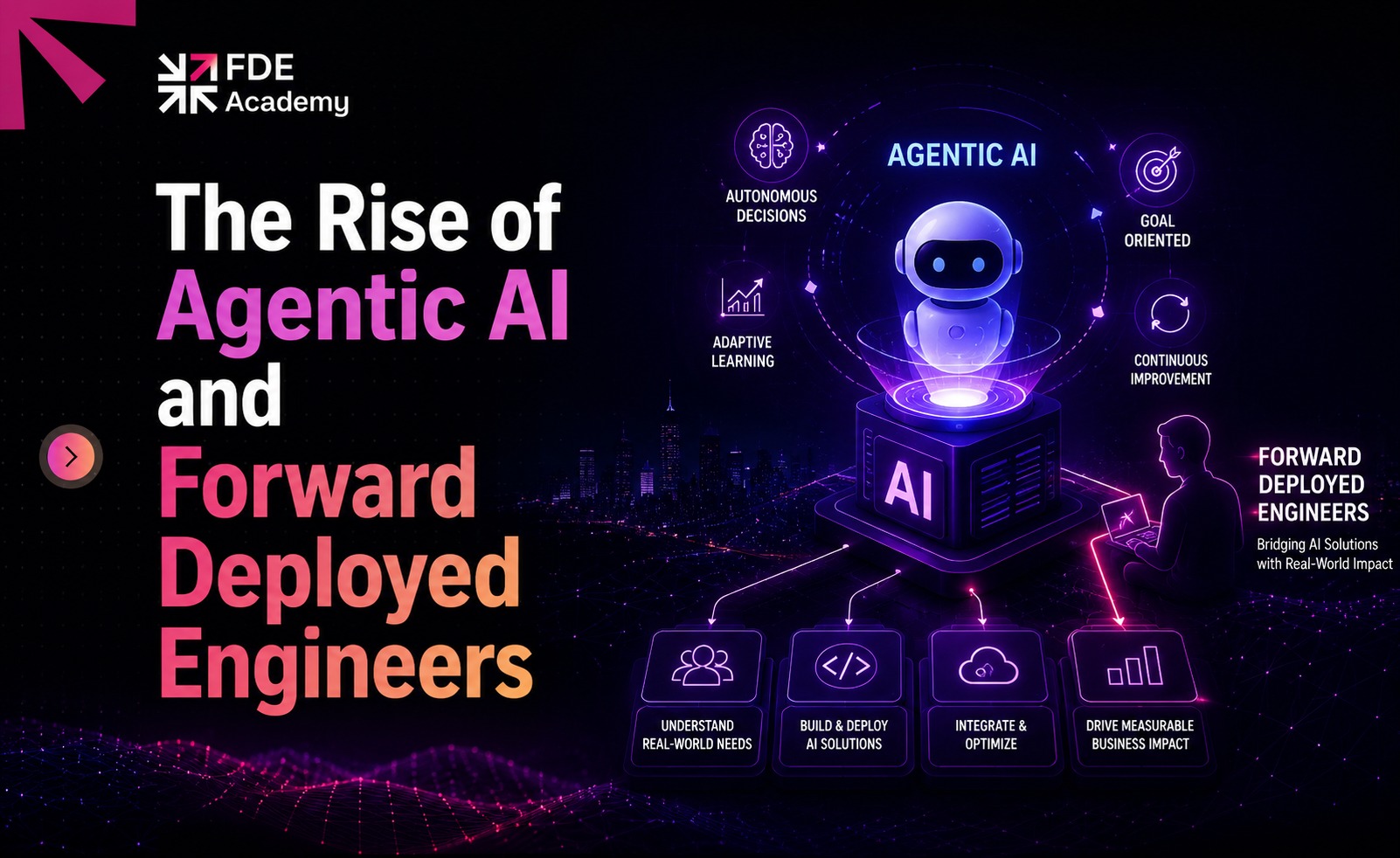
The rise of Agentic AI and Forward Deployed Engineers are the two most consequential parallel trends in enterprise technology right now. Agentic AI is scaling from experiment to infrastructure. Forward Deployed Engineers are scaling from niche Palantir concept to a mainstream enterprise role.
They are co-dependent: agentic AI creates a deployment problem that FDEs are specifically built to solve.
This article traces both trajectories, explains where they intersect, and maps what FDEs actually do when they are deployed to build and run agentic systems inside real enterprise environments.
Agentic AI refers to AI systems that plan and act autonomously across multiple steps and tools, with limited human supervision per task. Unlike a chatbot that responds to a single query, or a copilot that suggests the next line of code, an agentic system can receive a goal, break it into sub-tasks, call external tools or APIs, interpret results, adjust its plan, and execute across a workflow that spans minutes, hours, or longer.
The distinction matters because it changes the deployment problem completely. A chatbot can be deployed and tested in isolation. An agentic system integrates with email clients, CRMs, databases, ticketing systems, and internal APIs simultaneously.
It makes decisions that have downstream consequences. And it does all of this with reduced human oversight per action, which means the cost of a failure is higher and harder to catch early.
This is not a theoretical concern. Gartner predicts that more than 40% of agentic AI projects will be cancelled by the end of 2027, with the primary drivers being unclear business value, escalating costs, and inadequate risk controls.
The deployments that fail are not failing because the models are weak. They are failing because the systems surrounding the models are not built to handle production conditions.
The adoption data for agentic AI in 2026 is striking, but the production data is what explains why FDEs exist.
Gartner found that 40% of enterprise applications will include task-specific AI agents by the end of 2026, up from less than 5% in 2025. Digital Applied's analysis of 120+ enterprise data points found that 79% of enterprises have adopted AI agents in some form.
The production number tells a different story. Only 11% of those organisations run agents in production. That is a 68-percentage-point gap between adoption and production deployment.
An IDC/AWS survey of more than 900 organisations found that 88% of AI proofs-of-concept never reach widescale deployment. And only 3% of companies are successfully scaling agentic AI across multiple departments, per the same study.
The reasons are consistent across research:
The difficulty of deploying agentic AI is categorically different from deploying earlier AI systems. A language model answering questions is a stateless, single-call system. An agentic system is a stateful, multi-step, multi-tool system operating in the messy interior of a real enterprise environment.
An organisation that successfully deployed a customer service chatbot in 2024 cannot reuse that deployment model for an agentic AI system in 2026. The architecture, the governance layer, the integration requirements, and the failure-mode management are all categorically different.
This is the core reason the 79% vs 11% gap exists, and it is the core reason FDE demand has grown in direct proportion to agentic AI adoption.
When an FDE is brought in to deploy agentic AI inside a customer's environment, the work is substantively different from earlier generations of AI deployment. It is not about configuring a chatbot or connecting a model to a knowledge base.
It is about designing and shipping a system that makes multi-step autonomous decisions inside a real enterprise environment, safely and reliably.
The orchestration layer is the central engineering challenge in agentic deployment. It defines which agent handles which sub-task, how information passes between agents, where the system branches based on outcomes, and how it routes to a human when it encounters a decision it cannot resolve autonomously.
As fde.academy's guide on AI agent orchestration for Forward Deployed Engineers notes: a generic RAG chatbot needs minimal orchestration. A real enterprise deployment, routing 100,000 monthly support tickets across multiple languages, or reconciling millions of transactions across bank statements, requires orchestration that can branch, retry, escalate, and maintain state across steps that span minutes or hours.
Agentic AI systems cannot run without structured human checkpoints in production. Not because the models are unreliable, but because enterprise decisions require accountability, and accountability requires a human who can be responsible for outcomes.
FDEs design human-in-the-loop (HITL) architectures that define precisely where agents pause for human review, what the escalation trigger is, what information the human needs to make a fast decision, and how the agent resumes after approval.
Getting HITL design right is one of the highest-leverage FDE contributions to agentic deployments, because it determines both the system's reliability and its compliance posture.
FDE job postings consistently list orchestration frameworks as required technical skills. The patterns FDEs build most frequently in 2026 include:
LangGraph and CrewAI are the two most widely used orchestration frameworks for these patterns in enterprise FDE work. LangGraph handles complex stateful workflows with conditional branching.
CrewAI handles role-based collaborative agent teams with defined responsibilities. The choice of framework depends on the customer's workflow complexity and existing tech stack.
The industry-level investment pattern confirms that agentic AI and FDE deployment capacity are being built in the same motion.
In May 2026, ServiceNow and Accenture announced a joint Forward Deployed Engineering program specifically designed to take agentic AI from enterprise pilot to production at scale. The program embeds FDE teams from both organisations inside mutual customer environments, building agentic workflows natively on the Service.
Now AI Platform and delivering production value before any broader enterprise rollout begins. The explicit framing from both companies is that FDE deployment is how agentic AI becomes a production asset rather than a permanent pilot.
OpenAI's Deployment Company, backed by $4 billion and staffed with approximately 150 acquired FDEs from Tomoro, is structured around the same premise: model quality is not the constraint on enterprise AI ROI. Deployment expertise is.
Google Cloud has expanded its FDE hiring specifically for generative and agentic AI deployments, with job descriptions that frame the role as embedded builders who address integration, data readiness, and orchestration constraints in customer environments.
FDE job postings for agentic AI roles cluster around a specific set of frameworks and infrastructure tools. The table below maps the stack based on FDE Academy's analysis of current FDE job listings:
Proficiency across this stack is what the FDE skills guide describes as the "agentic engineering" competency that separates FDE-level practitioners from engineers who can build demos but cannot ship production agentic systems.
The deployment gap is not a temporary condition that better models or better tools will automatically close. It is a structural gap created by the complexity of connecting agentic systems to real enterprise environments. That complexity requires human expertise to navigate.
FDE job postings grew 729% year-over-year, from 643 openings in April 2025 to 5,330 in April 2026, per Indeed data. The LinkedIn study cited in Computerworld put the position growth at 42-fold between 2023 and 2025.
Agentic AI adoption is accelerating that demand further because every new agentic deployment requires the same integration, orchestration, and governance work that FDEs are trained to deliver.
For engineers evaluating career trajectories, the 79 vs 11 gap is a career signal. There are far more enterprises with agentic AI ambitions than there are engineers who can close the distance between ambition and production. That imbalance will not resolve quickly.
Two years ago, the core FDE technical challenge was Retrieval-Augmented Generation: connecting a language model to a customer's internal documents and making it queryable in production. RAG pipelines are still central to FDE work in 2026, but they are now typically the retrieval layer within a larger agentic system rather than the end product.
The shift from RAG to agentic represents a genuine increase in technical scope. A RAG pipeline retrieves, generates, and returns. An agentic system retrieves, decides, acts on external systems, evaluates its own output, retries on failure, escalates when needed, and maintains state across all of it. The engineering surface is substantially larger.
This evolution is tracked in detail by the AI Forward Deployed Engineering operating model, which maps how FDE work has shifted from static integration to dynamic, multi-step agentic deployment over the past 18 months.
For engineers building toward this career path, how to become a forward deployed engineer maps the specific technical competencies that agentic FDE work demands, including the orchestration frameworks, RAG architecture skills, and HITL design knowledge that current postings consistently require.
Agentic AI and Forward Deployed Engineers are rising together because they are co-dependent. Agentic AI adoption is at 79% of enterprises, but production deployment is at just 11%, a 68-percentage-point gap. Gartner predicts 40%+ of agentic AI projects will be cancelled by the end of 2027.
FDEs exist to close that gap by designing multi-agent orchestration, human-in-the-loop checkpoints, and enterprise integrations that make agentic systems survive real production conditions. ServiceNow and Accenture launched a joint FDE program in May 2026 specifically for this purpose. OpenAI, Google Cloud, and others are investing in the same model.
FDE job postings grew 729% year-over-year through April 2026. For engineers, the 79 vs 11 gap is a career signal: demand for agentic deployment expertise is accelerating faster than supply.
Agentic AI creates a deployment problem that FDEs are specifically built to solve. Most enterprises can experiment with AI agents but cannot get them into production. FDEs close that gap by designing orchestration layers, building integrations with enterprise systems, and delivering agentic systems that survive real production conditions.
An IDC/AWS survey of 900+ organisations found that 88% of AI proofs-of-concept never reach widescale deployment. The primary reasons are integration complexity with existing enterprise systems, lack of skilled personnel, inadequate governance and human-in-the-loop design, and the difficulty of managing stateful multi-step workflows under real production load.
LangGraph and CrewAI are the two most widely used orchestration frameworks in enterprise FDE work in 2026. LangGraph handles complex stateful workflows with conditional branching. CrewAI handles role-based collaborative agent teams.
FDE work has expanded from RAG pipeline deployment to full agentic system architecture. FDEs now design multi-agent orchestration layers, human-in-the-loop checkpoints, observability tooling, and multi-system integration for agents that operate autonomously across long-running enterprise workflows.
The world is hiring - and this Academy prepares you for it.