Blogs
What Are the Biggest Risks Forward Deployed Engineers Face?
What Are the Biggest Risks Forward Deployed Engineers Face?
By
R&D, FDE Academy
July 31, 2026

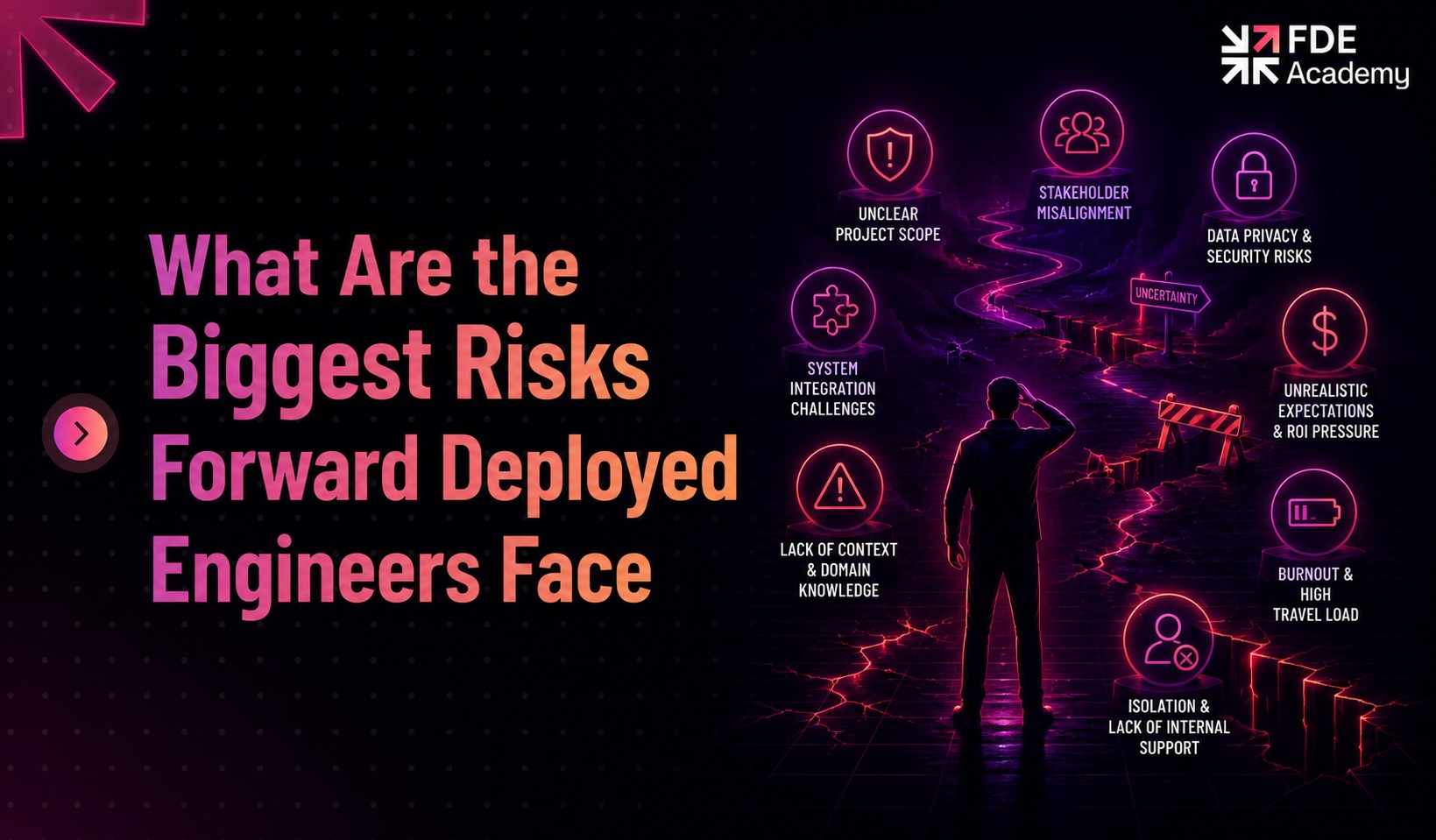
The biggest risks Forward Deployed Engineers face are not the ones that show up in job descriptions. The listings emphasise the opportunity: high compensation, direct business impact, work at the frontier of enterprise AI. What they do not describe in detail is what the role costs in practice: the structural risks that experienced FDEs navigate every engagement and that new entrants often encounter without adequate preparation.
These risks are not reasons to avoid FDE work. The role offers a career ceiling and compensation trajectory that few other engineering paths match. But going in clear-eyed about what can go wrong, and why it tends to go wrong specifically in this role rather than others, is what separates FDEs who build sustainable careers from those who burn out, drift off track, or find their technical skills eroding while they are busy firefighting client escalations.
This article covers the six structural risks, what they look like in practice, and how experienced FDEs manage them. For the operational day-to-day mistakes that new FDEs make, the separate guide on 10 mistakes new Forward Deployed Engineers make covers that layer. This article goes deeper: structural risks that compound over time, not single-engagement errors.
The table below summarises the six structural risks, their category, and the mitigation direction that experienced FDEs apply. Each is covered in detail in the sections that follow.
Burnout is the most discussed FDE risk, and the most underestimated one. The job descriptions acknowledge "frequent travel" and "customer-facing work." What they do not describe is the specific structure that makes FDE burnout different from burnout in other engineering roles.
LeadDev's 2026 coverage of the FDE market quoted practitioners directly on this: "The constant travel makes the role susceptible to burnout a lot earlier than others." One practitioner's assessment was blunt: "It's definitely not for everybody."
The burnout risk in FDE work surfaces through four specific pressure patterns, documented by Underdog.io in their 2026 FDE guide:
FDE work operates in a fundamentally different environment from most engineering work: there is usually no product specification, no clearly defined done state, and no automatic boundary-setter.
The Pragmatic Engineer's 2026 coverage of the FDE role described it precisely: "'Founder's mindset': no one will provide a spec, and scope creep is your problem to deal with. If your project doesn't ship, that's also your problem."
SupplyChainBrain's analysis of FDE risk from the client side identified scope creep as the first structural risk in any FDE engagement: "Scope creep driving up initial cost estimates and chosen individuals transitioning to other engagements." The downstream consequence is an "unwieldy portfolio of custom features that require active governance to track, evaluate and retire", a technical and operational liability that accumulates silently across multiple engagements.
The signs that scope creep is actively occurring are worth recognising early:
The mitigation is explicit scope documentation before each engagement begins, a clear escalation process when scope changes are proposed mid-engagement, and a standing review cadence that keeps scope visible to both the FDE and the client's decision-makers.
This is the risk that experienced FDEs mention most consistently and that new FDEs rarely anticipate. It does not happen suddenly. It accumulates.
An FDE starts their role building things: integrations, pipelines, agentic workflows, evaluation systems. Over time, if the engagement model does not include deliberate rotation, the work shifts. There are more escalations to manage, more client stakeholder meetings to attend, more "can you just quickly" requests that turn into multi-day detours. The ratio of engineering work to account management work drifts, often without anyone explicitly making that decision.
Underdog.io's 2026 FDE guide documented this pattern: "If the role turns into endless integrations and customer firefighting, you can get farther from core product engineering than you intended." The career consequence is real: an FDE who has spent 18 months primarily managing escalations and updating stakeholders rather than building new systems has not kept their technical skills at the level that commands the compensation and opportunities the FDE role offers.
The mitigation is not simply "build more things." It is deliberate career architecture: explicit agreements about what percentage of time stays in engineering work, rotation off accounts that have stabilised into maintenance mode, and proactive investment in the technical skills that are advancing (agentic systems, evaluation frameworks, SovereignAI deployments) rather than the ones the current account happens to need.
FDE work has a compounding value when it goes right: the insights and code from each client engagement feed back into the core product, making future deployments cheaper and more reliable. When this feedback loop is broken, FDE work becomes expensive custom consulting that builds leverage for the client but not for the company or the FDE.
SupplyChainBrain identified this as a structural governance risk: the "unwieldy portfolio of custom features that require active governance to track, evaluate and retire." Perspective AI's 2026 FDE survey found that top-performing FDE functions target a reusable asset ratio of 70% or more, meaning 70% of FDE code in the main product repository by month 12 of an engagement.
When FDE deployments operate below that threshold, the work accumulates as technical debt in client environments rather than product improvements. The FDE's time is spent maintaining bespoke integrations rather than advancing the platform. And because this custom work is opaque to the product team, the insights from the field (the specific failure modes, the workflow gaps, the edge cases that appear in production) never make it into the product roadmap.
The mitigation is structural, not individual. It requires explicit productisation processes: regular reviews of FDE code for abstractability, clear channels for FDE field insights to reach the product team, and compensation structures that reward platform contribution alongside client success.
Enterprise AI deployments are relationship-dependent. An FDE who builds a strong working relationship with a client's VP of Engineering or Chief Data Officer has significant leverage in that account. The risk is what happens when that person leaves.
SupplyChainBrain noted this explicitly as one of the named risks in FDE engagements: "chosen individuals transitioning to other engagements." When the client champion who understood the FDE's work, advocated for the deployment internally, and had the organisational authority to unblock decisions moves to a different role or leaves the company, the FDE is starting over on relationship-building with someone who may not share the same understanding or commitment.
This risk is compounded when the FDE has single-threaded their relationships, with all access and all advocacy concentrated in one person. Multi-threaded stakeholder relationships, where the FDE has working relationships with multiple client stakeholders across technical, operational, and business functions, are the mitigation. It is also why the 47% customer-facing time documented in Perspective AI's survey exists: maintaining broad stakeholder relationships is not overhead, it is risk management.
The FDE technical stack is not stable. Two years ago, the core FDE technical output was RAG pipelines and LLM integrations. Today, that work is typically the retrieval layer inside a larger agentic system. Two years from now, the technical floor will have moved again.
An FDE who has been on the same account for 18 months, optimising a system that the client is satisfied with, may not have noticed that the broader market has moved. The deployment stack has added LangGraph and CrewAI as standard orchestration frameworks. Evaluation engineering is now a required skill in most senior FDE postings. SovereignAI deployments are emerging as a subspecialty that commands premium compensation.
This is not a hypothetical risk. The tech stack in enterprise AI is moving faster than almost any other domain. An FDE who does not deliberately update their skills alongside their client work finds themselves with deep expertise in last year's patterns and gaps in the frameworks that next year's engagements will require.
The six risks do not hit equally across all career stages. The table below maps how the risk profile shifts from a new FDE through to a staff-level FDE managing multiple accounts or a specialist function.
Reading a list of risks can make any role sound unattractive. That is not the argument here.
The FDE role carries these six structural risks because it operates at the hardest intersection in enterprise technology: between a client's organisational complexity and a product's technical architecture, under time pressure, with accountability for outcomes that most engineers never have to own. Those same conditions are exactly why the role commands the compensation it does, creates the career opportunities it creates, and attracts the kind of engineer who wants their work to land in the real world and matter there.
The engineers who manage these risks best are not the ones who ignore them. They are the ones who go in with a clear picture of what the risks are, make deliberate choices about which accounts and which companies to work with, and build professional practices that protect their engineering time, skill development, and client relationships simultaneously.
Understanding what a Forward Deployed Engineer does is the foundation. Building that understanding alongside a realistic picture of these six structural risks is how you make a durable career out of it.
The six biggest risks Forward Deployed Engineers face are burnout from always-on pressure and conflicting incentives, scope creep in engagements without clear specifications, career drift from engineering into firefighting, the productization trap where FDE work never feeds the core product, client key-person dependency when a champion leaves, and skills obsolescence in a stack that moves fast.
Rocketlane's analysis found 40-60% of FDE time is already lost to administrative overhead, accelerating all other risks. The risks hit differently by career stage: new FDEs are most exposed to scope creep and burnout, mid-level FDEs to career drift and the productization trap, and senior FDEs to skills obsolescence in long-running accounts.
None of these risks make the FDE path a poor choice. They make preparation and structural awareness a prerequisite for a sustainable one.
The six structural risks are burnout from always-on availability pressure, scope creep in engagements without clear specifications, career drift from engineering into customer firefighting, the productization trap where FDE code never feeds back into the core product, client key-person dependency, and skills obsolescence in a fast-moving technical stack.
Yes. LeadDev's 2026 coverage of the FDE market cited burnout as a primary sustainability concern, noting that constant travel and high-stakes client pressure make the role susceptible to burnout earlier than most engineering positions. Rocketlane's analysis found that 40-60% of FDE time is lost to administrative tasks rather than engineering work, compounding the pressure.
Experienced FDEs address scope creep through explicit scope documentation before each engagement begins, a clear escalation process when clients propose changes mid-engagement, and a regular scope review cadence that keeps expectations visible on both sides.
Career drift is the gradual shift from building engineering systems to managing client escalations and account relationships. It typically surfaces 12-24 months into an FDE role when the engineering work decreases and the firefighting work increases, often without any deliberate decision being made. Deliberate rotation and skill-building plans are the standard mitigation.
The world is hiring - and this Academy prepares you for it.