Blogs
What Is Palantir Foundry? The Platform Every FDE Should Know
What Is Palantir Foundry? The Platform Every FDE Should Know
By
R&D, FDE Academy
August 21, 2026

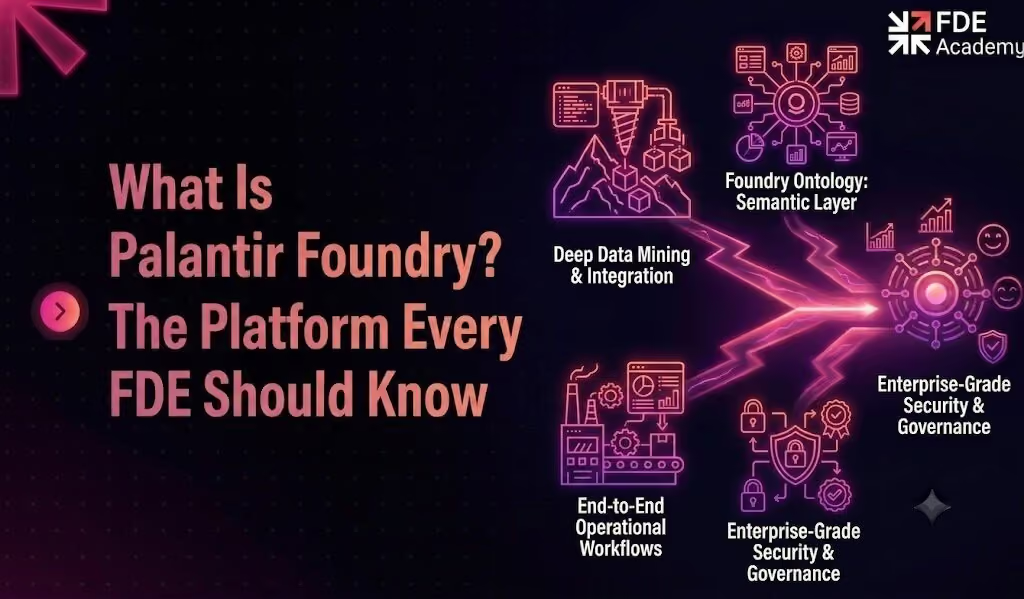
Palantir Foundry is an enterprise data platform that connects an organization's raw data, models it into a shared "ontology" of real-world objects, and turns that model into working software: pipelines, dashboards, and AI-driven applications that operators use to run the business. It's the platform that gave rise to the Forward Deployed Engineer role in the first place, and it's still the tool most FDEs, at Palantir and at the companies that copied the model, spend their days building on.
If you're evaluating an FDE career, you can't skip Foundry. It's not one tool among many on the job; it's usually the primary surface the work happens on.
Palantir didn't invent forward deployed engineering as an abstract idea; the role exists because Foundry (and its predecessor, Gotham) needed engineers embedded with customers to make the platform actually work for their specific data and workflows. Understanding how Palantir invented the Forward Deployed Engineer model explains the "why." This article covers the "what": the actual platform those engineers build on, layer by layer.
Companies that have since adopted the FDE model, including OpenAI, Anthropic, and a wave of AI-native startups, don't necessarily use Foundry itself. But the platform's design pattern, connect data, model it, ship applications against it directly with the customer, is the template the whole category borrowed. Learning Foundry's architecture teaches you how forward deployed engineering works structurally, even if your first FDE role runs on a different stack.
Palantir runs two core platforms, and mixing them up is a common early mistake.
Gotham is Palantir's original platform, built for government, defense, and intelligence customers. It's oriented around investigation and operational decision-making in high-stakes, often classified environments.
Foundry is the commercial-facing platform, launched publicly around 2016. It targets enterprise customers, manufacturing, healthcare, financial services, retail, energy, and logistics, and is built for data integration, operational applications, and now AI deployment at scale.
Most FDE roles advertised outside of government and defense contracting are Foundry roles. When a job posting says "Forward Deployed Engineer (Palantir Foundry)," that's the platform in question.
Foundry isn't a single tool; it's a stack of connected layers, each solving a different part of the "raw data to working application" problem. Understanding these four layers is the fastest way to understand what an FDE actually builds day to day.
Foundry starts by connecting to the systems a business already runs: ERPs, CRMs, data warehouses, file stores, APIs, and streaming sources. This connection layer, sources and syncs, lands raw data inside Foundry with lineage attached from the first sync, so every downstream dataset can be traced back to where it came from.
Pipeline Builder is the visual tool FDEs use to clean, join, and transform that raw data into usable datasets. It functions similarly to tools like Alteryx, but it's built to scale to enterprise data volumes and to feed directly into Foundry's next layer: the ontology. Pipeline Builder also includes AI-assisted transform generation, letting an engineer describe a transformation in natural language and have Foundry draft the pipeline logic.
The ontology is what genuinely separates Foundry from a standard data platform, and it's the concept every FDE candidate should be able to explain clearly in an interview.
An ontology is a structured, semantic model of a business, expressed as objects (a "Customer," a "Claim," a "Machine"), their properties, and the relationships (links) between them. Instead of scattering business logic across dashboards and spreadsheets, Foundry encodes it once, in the ontology, so every application, pipeline, and AI agent built on top of it shares the same definition of what a "Customer" or a "Claim" actually is.
This matters practically: when an FDE models a customer's domain into an ontology, that model becomes the customer's permanent operational data layer, not a one-off report. It's also why ontology modeling is consistently listed as a core FDE responsibility across job postings for Foundry-based roles.
Once data is integrated and modeled, Foundry's application-layer tools turn it into something end users, the actual operators on a factory floor or in a claims department, can use without touching code.
This is the layer where FDE work becomes visible to the customer. A working Workshop application, built on live production data, in the first week of an engagement is the standard FDEs are held to; Palantir's internal phrase for this is "ship on day one."
AIP (Artificial Intelligence Platform) is Foundry's AI layer, connecting large language models to the ontology so AI agents can read real enterprise context, reason over live operations, and take governed actions rather than just generating text in a chat window.
AIP is increasingly the center of new FDE engagements. A typical AIP build wires an LLM-based action, for example, extracting structured fields from thousands of PDF maintenance reports, into an operational workflow, complete with permissions, human-in-the-loop approval, and audit logging. This is a meaningfully different skill from prompting a chatbot: it requires the engineer to ground the AI agent in real ontology objects and constrain what actions it's permitted to take.
Palantir's own tooling has extended this further with AI FDE, an AI-powered agent that operates Foundry through conversational commands, handling ontology edits, pipeline logic, and governance tasks that a human FDE would otherwise do by hand. Its existence doesn't replace the human FDE role; it changes what the role emphasizes, shifting toward supervising and directing AI-assisted builds rather than writing every transform manually.
Job postings for Foundry-based FDE roles consistently describe the same core loop: model a customer's domain into the ontology, build pipelines that feed it, ship a Workshop application operators actually use, and increasingly, layer AIP agents on top of all three. Understanding what a Forward Deployed Engineer actually does day to day makes more sense once you see that this loop, not vague "consulting," is the actual job.
This is also why Foundry knowledge shows up so heavily in interview screens. Candidates are commonly asked to explain ontology modeling from first principles, walk through how Pipeline Builder outputs feed the ontology, or describe how they'd constrain an AIP agent's permissions on a live system. It's a technical bar, not a conceptual one; reading about Foundry gets you the vocabulary, but hands-on practice with the platform (through Palantir's own free courses or third-party training) is what actually prepares you for that bar.
For a fuller picture of the tools and languages that surround Foundry on the job, including the version control, cloud, and scripting skills FDEs pair with it, see Forward Deployed Engineer tech stack. And if you want to see these four layers in a working context rather than as an abstraction, a day in the life of a Forward Deployed Engineer walks through how ontology work, pipeline builds, and Workshop shipping actually fill a real week.
Foundry now runs across manufacturing, healthcare, financial services, energy, and logistics, alongside its original government and defense customer base. Palantir has reported Foundry-driven commercial revenue growing sharply as clients expand their use of the platform across more of their operations, citing measurable gains in throughput and compliance as adoption deepens.
That commercial expansion is a direct driver of FDE hiring. As more industries adopt Foundry, more companies need engineers who can embed on-site, model an unfamiliar business domain into an ontology, and ship a working application against it, fast. It's also the reason the FDE title has spread well beyond Palantir itself: consulting partners and Palantir-adjacent firms hire FDEs specifically to deploy Foundry and AIP for their own client base.
Manufacturing customers, for example, have used Foundry to unify data across procurement, production, and finance, reporting meaningful cost savings as adoption spreads across more of the business. That pattern, a single deployment expanding into an org-wide platform, is exactly why Foundry engagements tend to grow rather than stay fixed in scope, and why FDEs are staffed for the long haul on an account rather than rotated off after a single build.
It's worth being precise about what Foundry does and doesn't test for, because candidates sometimes assume "I know SQL and Python" is sufficient preparation. It's necessary but not sufficient.
General data engineering skills, writing transforms, understanding pipelines, working with structured and unstructured data, transfer directly into Pipeline Builder work. What doesn't transfer automatically is ontology design: the judgment call of deciding which real-world entities deserve to be first-class objects, which relationships matter enough to model as links, and where to draw the line between an object's properties and a separate linked object entirely. That's a modeling skill closer to database schema design or domain-driven design in software engineering, applied under real time pressure with a customer watching.
The other skill that doesn't show up in a typical data engineering resume is the customer-facing half of the job: sitting with an operator, understanding their workflow well enough to model it correctly, and shipping something they'll actually use inside the first week. Foundry gives you the tools to build fast; it doesn't teach you how to ask the right questions to know what to build. That combination, technical depth plus fast, accurate domain modeling under customer pressure, is what interview processes for Foundry-based FDE roles are really screening for.
Palantir Foundry is used to integrate an organization's data from multiple systems, model it into a shared ontology, and build operational applications and AI agents on top of that model. It's used across industries including manufacturing, healthcare, financial services, energy, and logistics, wherever an organization needs its data turned into working, decision-ready software rather than static dashboards.
Gotham is Palantir's platform for government, defense, and intelligence customers, built around investigation and high-stakes operational decisions. Foundry is the commercial platform, built for enterprise data integration, operational applications, and AI deployment. Most Forward Deployed Engineer roles outside government contracting are Foundry roles.
An ontology is a structured model of a business expressed as objects (like "Customer" or "Machine"), their properties, and the relationships between them. It gives every pipeline, application, and AI agent built on Foundry a shared, consistent definition of the business, rather than each tool defining its own version of the truth.
For roles at Palantir itself, or at consulting firms and enterprises that deploy Foundry and AIP, yes, hands-on Foundry knowledge is typically a hard requirement or a strong hiring signal. For FDE roles at companies like OpenAI or Anthropic that don't run on Foundry, the platform-specific tooling differs, but the underlying skill set (ontology-style domain modeling, embedded customer work, shipping fast) transfers directly.
AIP (Artificial Intelligence Platform) is Foundry's AI layer. It connects large language models to the ontology so AI agents can read real enterprise context and take governed, permissioned actions on live systems, rather than only generating text. AIP builds are an increasingly central part of FDE work as of 2026.
The individual tools (Pipeline Builder, Workshop) have a moderate learning curve if you already have data engineering or analytics experience. The genuinely hard part is ontology design: modeling an unfamiliar business domain correctly requires business judgment as much as technical skill, and that's the part interview screens and on-the-job onboarding tend to probe hardest.
The world is hiring - and this Academy prepares you for it.