Blogs
Which SaaS Businesses Benefit From Forward Deployed Engineers?
Which SaaS Businesses Benefit From Forward Deployed Engineers?
By
R&D, FDE Academy
August 18, 2026

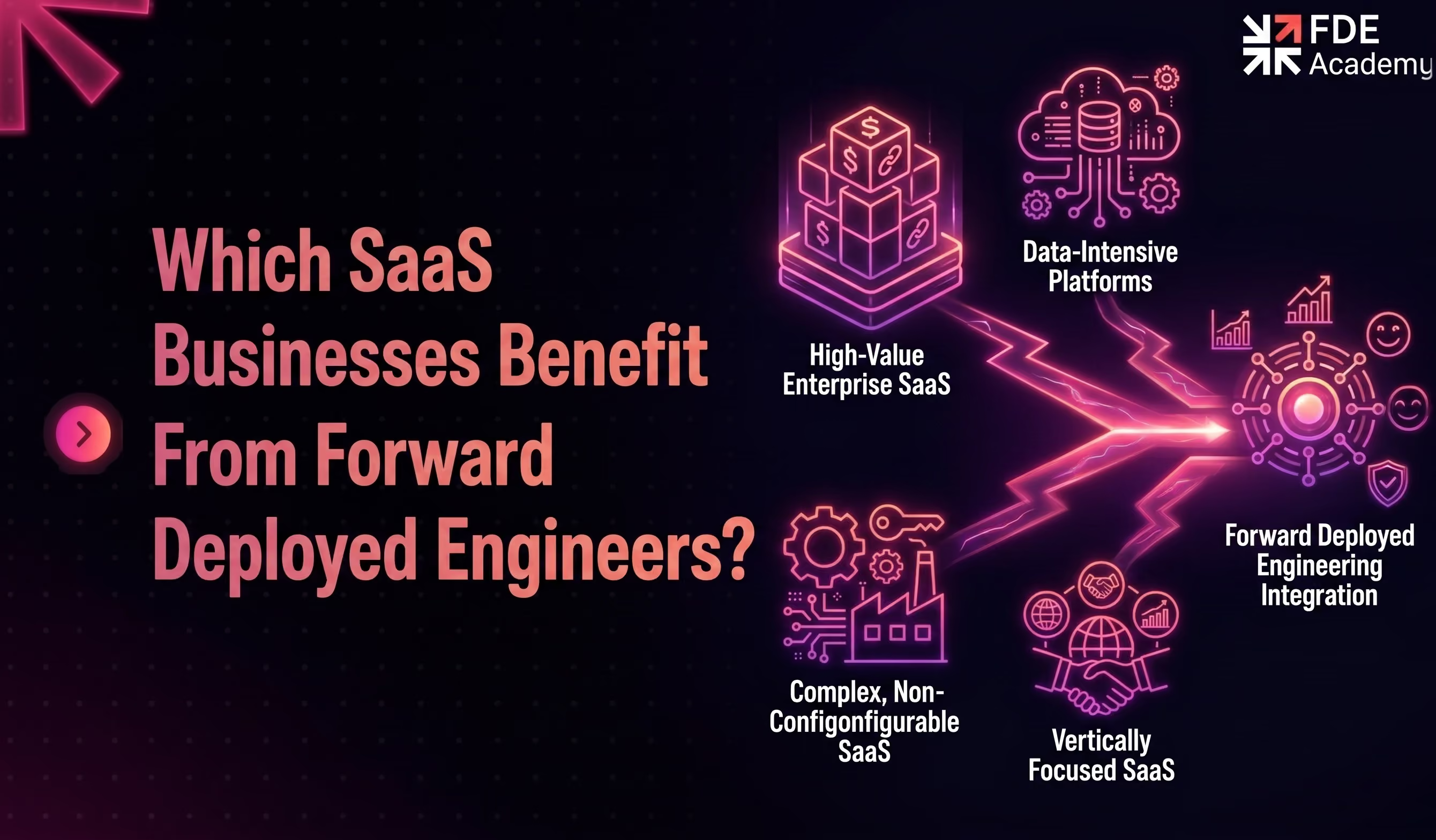
Not every SaaS company benefits from a Forward Deployed Engineer, and pretending otherwise wastes a genuinely expensive hire on a business model that doesn't need it. The businesses that benefit most share one trait: the product isn't fully standardized yet, every customer's deployment still requires real, non-trivial customization.
This guide segments SaaS businesses into three groups, benefits clearly, doesn't need it yet, and sits in a genuine gray zone, so you can figure out which one actually describes your company.
Our piece on how Palantir invented the Forward Deployed Engineer model frames the core distinction well: SaaS wins when the market is ready for a standardized product; FDE work wins when the problem is still being defined.
That's the single question worth asking before hiring an FDE, not "are we a SaaS company" (nearly everyone is, by now), but "is our product genuinely standardized across customers, or does each new customer still require real, non-trivial figuring-out."
A self-serve project management tool where every customer's setup looks basically the same is standardized. An enterprise data platform where every customer's deployment touches a different legacy system, a different compliance regime, and a different internal workflow is still being defined, account by account. The first doesn't need an FDE. The second almost certainly does.
Vertical and complex enterprise SaaS: Products serving healthcare, financial services, insurance, or legal specifically tend to hit deep, genuine per-customer variance, every hospital system, every bank, has different legacy infrastructure, different compliance requirements, and different internal politics around adoption.
An FDE absorbs this variance without pulling the core product team off the roadmap. A clinical data platform selling into three different hospital systems might face three genuinely different EHR integrations, three different data governance committees, and three different definitions of what "done" looks like, exactly the kind of variance a standardized onboarding flow can't absorb on its own.
SaaS selling into regulated or legacy-heavy industries: Even a relatively standardized product becomes non-trivial to deploy once it has to integrate with a customer's decades-old internal systems, satisfy a specific audit requirement, or route around a legacy authentication setup.
This is exactly the kind of work an FDE is built to absorb, and it applies well beyond healthcare and finance specifically, government, energy, and manufacturing customers frequently carry the same legacy-integration burden.
AI-native SaaS layering agents or LLMs onto existing workflows: This is the fastest-growing category right now. A generic AI feature demonstrates well; making it work reliably against one customer's real, messy data with a genuine evaluation framework behind it is a different, harder problem, and it's the same "last-mile" gap covered throughout this site.
A company selling an AI-powered support triage tool might demo beautifully on clean sample tickets, then discover a specific customer's ticket data is riddled with inconsistent formatting, multiple languages, and edge cases the model was never evaluated against, exactly the gap an FDE closes before it becomes a churned account.
High-ACV deals where a failed pilot means real churn: When a single enterprise contract is worth enough that losing it meaningfully hurts revenue, the cost of dedicated deployment attention is easy to justify against the cost of a stalled, abandoned pilot. Our piece on why companies are hiring Forward Deployed Engineers covers this churn-prevention dynamic directly.
Companies whose core sales motion is already top-down and outcome-based, selling to executives on business outcomes rather than to end users on features, tend to have exactly the kind of high-stakes, high-customization deals that make an FDE's embedded, accountable-through-production role worth the investment.
Pure self-serve, product-led growth SaaS: If your entire go-to-market is a free trial, a credit card, and an onboarding flow that works basically identically for customer 5 and customer 5,000, there's no deployment gap for an FDE to close. The product IS the deployment, and an FDE embedded with one customer would produce insight that doesn't generalize to the other 4,999.
Low-ACV, high-volume SMB tools: When individual contracts are small and the customer base is large, the economics don't support dedicated, embedded engineering attention per account, the entire business model depends on a standardized product working at scale, not customization. Spending a senior engineer's time on any single SMB account, however well it goes, doesn't move the business the way the same effort would against one enterprise account worth a hundred times as much.
Simple point solutions with minimal per-customer variance: A tool that does one narrow thing the same way for everyone, a form builder, a basic scheduling tool, doesn't have the kind of deployment complexity that justifies this hire, no matter how technically well-built the product is. The absence of deployment complexity here isn't a weakness in the product, it's often exactly what makes a simple point solution successful and easy to sell.
If your company falls clearly into this category, the better investment is almost always in product-led onboarding, in-app guidance, and self-serve documentation, not a dedicated deployment function. Hiring an FDE here doesn't fail because the person isn't skilled, it fails because there's no genuine deployment variance for the skill to apply to.
Some business models don't sort cleanly into either category, and usage-based, developer-facing, or platform SaaS is the clearest example. On the surface, these products can look standardized (a clean API, self-serve signup), but a lot of real configuration complexity often sits just beneath that surface: data pipeline setup, custom integrations with a customer's specific stack, or configuration that genuinely differs by use case even though the core product doesn't change.
A developer tools company might onboard a small startup in minutes with zero human involvement, and onboard an enterprise customer over six weeks involving custom SSO setup, a dedicated data residency configuration, and a bespoke rate-limiting arrangement negotiated by sales.
Both count as "the same product," but only one of those two onboarding experiences has the deployment complexity an FDE exists to absorb. The mistake to avoid here is judging fit off the self-serve marketing story rather than what actually happens on the enterprise tier specifically.
If your company shows mostly left-column signals, you're likely in benefits-from-FDE territory even if your marketing describes the product as "self-serve."
Not every SaaS business needs a Forward Deployed Engineer. FDEs are most valuable when enterprise customers require complex integrations, custom deployments, or significant workflow customization, particularly in regulated, legacy-heavy, AI-native, or high-ACV businesses.
Self-serve SaaS, low-ACV SMB tools, and standardized point solutions usually don't need FDEs because their onboarding is designed to scale without customization. Usage-based and platform SaaS fall somewhere in between, depending on the complexity of their enterprise deployments.
The simplest test is this: if customers repeatedly need technical customization that your engineering team currently handles manually, an FDE may be a strong fit.
The clearest signal is per-customer deployment variance: if every new customer requires genuinely different setup, integration, or configuration work, rather than the same standardized onboarding flow, an FDE is likely a good fit. If deployment looks basically identical across customers, it probably isn't yet.
Company size matters less than deal size and deployment complexity. A smaller company with a handful of high-ACV enterprise accounts requiring deep customization can benefit as much as a larger one; a large company with a fully standardized, low-touch product may not need this role at all.
No, though AI-native SaaS is currently the fastest-growing category driving demand. The underlying fit criteria (standardized vs. still-being-defined deployment) apply just as much to non-AI enterprise SaaS in regulated or legacy-heavy industries.
Rarely for its core self-serve motion, but sometimes for a specific enterprise tier layered on top. If a self-serve company starts closing large enterprise deals that require real custom integration work, that specific segment of the business may need this function even if the broader product stays self-serve.
The role becomes expensive, underutilized capacity, since there's no genuine per-customer deployment complexity for the FDE to absorb. The better investment in that case is typically product-led onboarding and self-serve tooling rather than embedded engineering headcount.
Customer Success typically manages relationship health and product adoption from outside the technical system. An FDE builds and owns the actual technical deployment, integration code, evaluation infrastructure, production stability, which is a different function CS teams generally aren't equipped to do themselves.
The world is hiring - and this Academy prepares you for it.