Blogs
Why Companies Are Hiring Forward Deployed Engineers in 2026
Why Companies Are Hiring Forward Deployed Engineers in 2026
By
R&D, FDE Academy
March 19, 2026


What happens when powerful software leaves the lab and enters the messy reality of enterprise systems? Very often, that is where the real challenge begins.
Current organizations are developing very strong software systems. Cloud computing, big data platforms, and AI are changing organizational operations. But one of the biggest challenges has become evident throughout industries, which is that software is no longer the most difficult part to build. It is successfully deployed in actual enterprise surroundings.
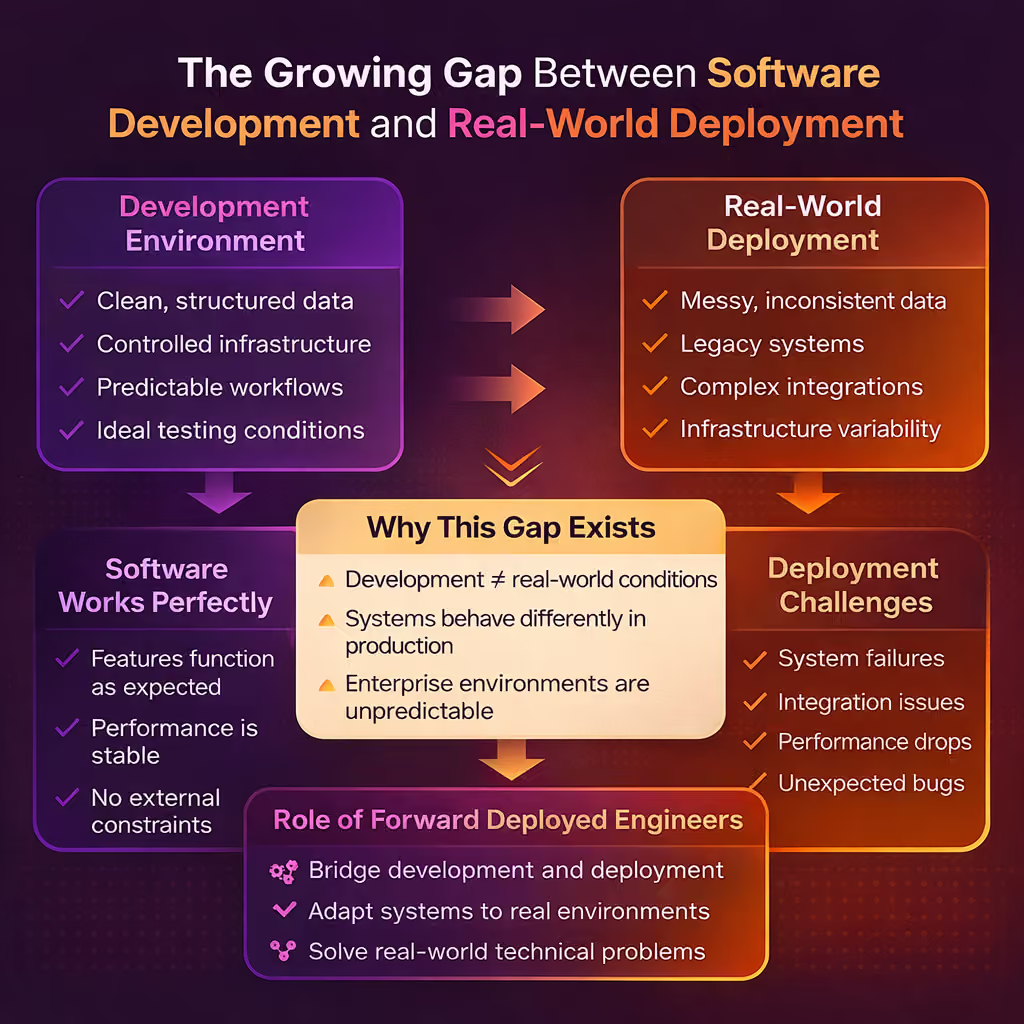
Some products work perfectly well in the development environment but fail once they are deployed to real operational systems. Enterprise environments consist of old infrastructure, disjointed data, regulatory restrictions and also multifaceted integrations that are hard to replicate in the development process.
The result of this widening difference between development and deployment is the major factor that makes companies employ forward deployed engineers nowadays. Companies are discovering that the ability to design and to apply and adapt technology within actual customer contexts is as important as software engineering innovation.
Why are companies hiring forward deployed engineers in 2026?
Because building software is no longer the hardest part, making it work in real-world enterprise environments is.
Consequently, forward deployed engineers have been in a high demand in the technology industry. The trend to hire forward deployed engineers by 2026 indicates that this job is already not an experiment or a niche. Rather, it is being integrated into enterprise technology teams.
To analyze the reasons behind the increase in FDE roles, it is necessary to explore the forces of the industry that are defining the future of software implementation, enterprise AI implementation, and the complexity of the infrastructure.
Majority of enterprise software is not failing due to its development in a wrong manner. However, failures occur when systems are transferred to actual business activities.
This is a gap that is caused by the complexity of enterprise software deployment which consists of various key challenges.
Large organizations are operating on decades-old technology stacks.
Typical features are:
Integration problems are usually evident when a new product is introduced into this environment.
Forward deployed engineers resolve such problems by:
Since most of the enterprises will still be experiencing the existence of legacy technology, this aspect alone is creating a compelling forward deployed engineering market demand.
Environments of development tend to operate on clean and ordered datasets. The real business data seldom works this way.
Typical real world data issues are:
The problems have the potential to greatly influence the performance of software in the production.
Forward deployed engineers manage such issues by:
A significant factor that has contributed to the ever increasing demand of forward deployed engineers is their capability to solve real world data problems.
Each business possesses a different infrastructure environment.
In different organizations, it may be:
Due to this variability, development teams are unable to simulate all deployment scenarios perfectly.
Forward deployed engineers can fill this gap by:
This practical implementation exercise justifies why organizations recruit forward deployed engineers as opposed to using traditional software engineers alone.
There are numerous companies with tight laws and security standards.
Examples include:
These demands add more complexity during deployment.
Forward deployed engineers are useful in helping by:
Some of the traditional functions employed by companies to assist deployments were present prior to the emergence of forward deployed engineering. These roles were however not able to address the deployment challenge completely.
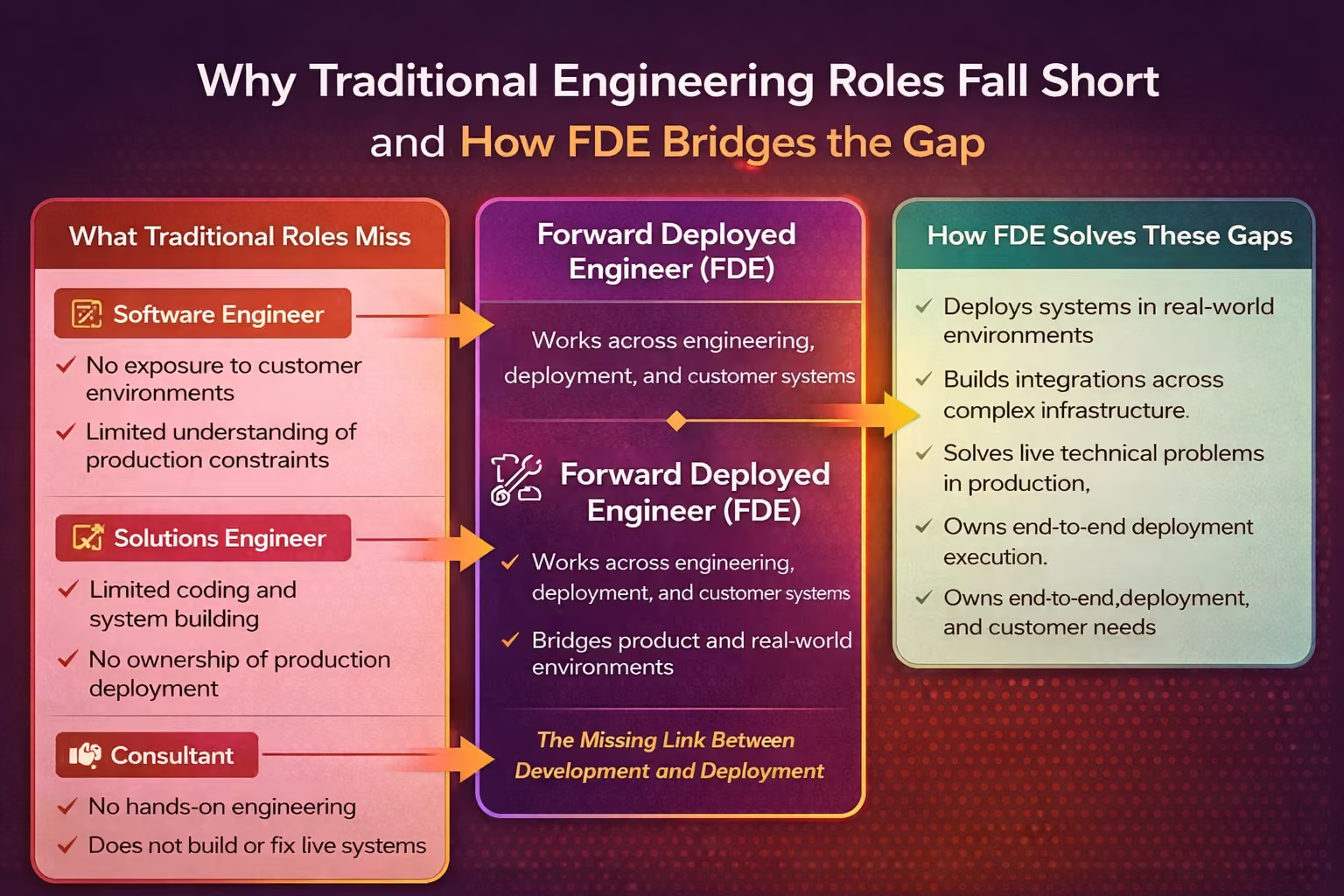
Software engineers are concerned with product creation.
Their duties normally encompass:
Although they are well-versed in the product, they do not spend the larger part of their lives working within customer settings.
Solutions engineers normally assist sales teams.
They are charged with the duty of:
Assisting customers in the comprehension of the requirements of implementation.
Nevertheless, they do not tend to develop deployment systems as well as control integrations of infrastructure.
Implementation projects involve consultants that assist customers but in most cases, their roles are confined to defined project timelines.
They may assist with:
Nevertheless, they tend not to change product structure or to address technical integration issues at a more fundamental level.
Multi-capability is integrated by forward deployed engineers.
They operate as:
Due to this mixed competency, FDEs are becoming a bridge between the product development and the real-world implementation in organizations.
This is a key factor that motivates FDE hiring patterns.
The fast development of artificial intelligence systems is one of the strongest demands of forward deployed engineers today.
AI technology can be highly successful in the strictly controlled setting, but it faces severe issues when applied to enterprises as AI.
Such issues generate high demand for forward deployed engineers.
The datasets with AI models are normally trained on well-crafted data.
Nevertheless, there is unpredictable data in enterprise environments like:
This can greatly decrease model accuracy.
Forward deployed engineers resolve this by:
Performance drift is a well-known problem in AI systems that have been deployed.
Common causes include:
Forward deployed engineers are in charge of these issues by:
AI tools hardly work alone. They have to be linked to existing enterprise systems.
These integrations may involve:
Forward deployed engineers help organizations integrate AI systems with these platforms and maintain stable data flows.
The AI systems should be constantly tuned after deployment.
Customers often require assistance with:
This long term technical support is offered by forward deployed engineers.
The FDE role is adopted after a short period in industries with significant challenges in the deployment of artificial intelligence.
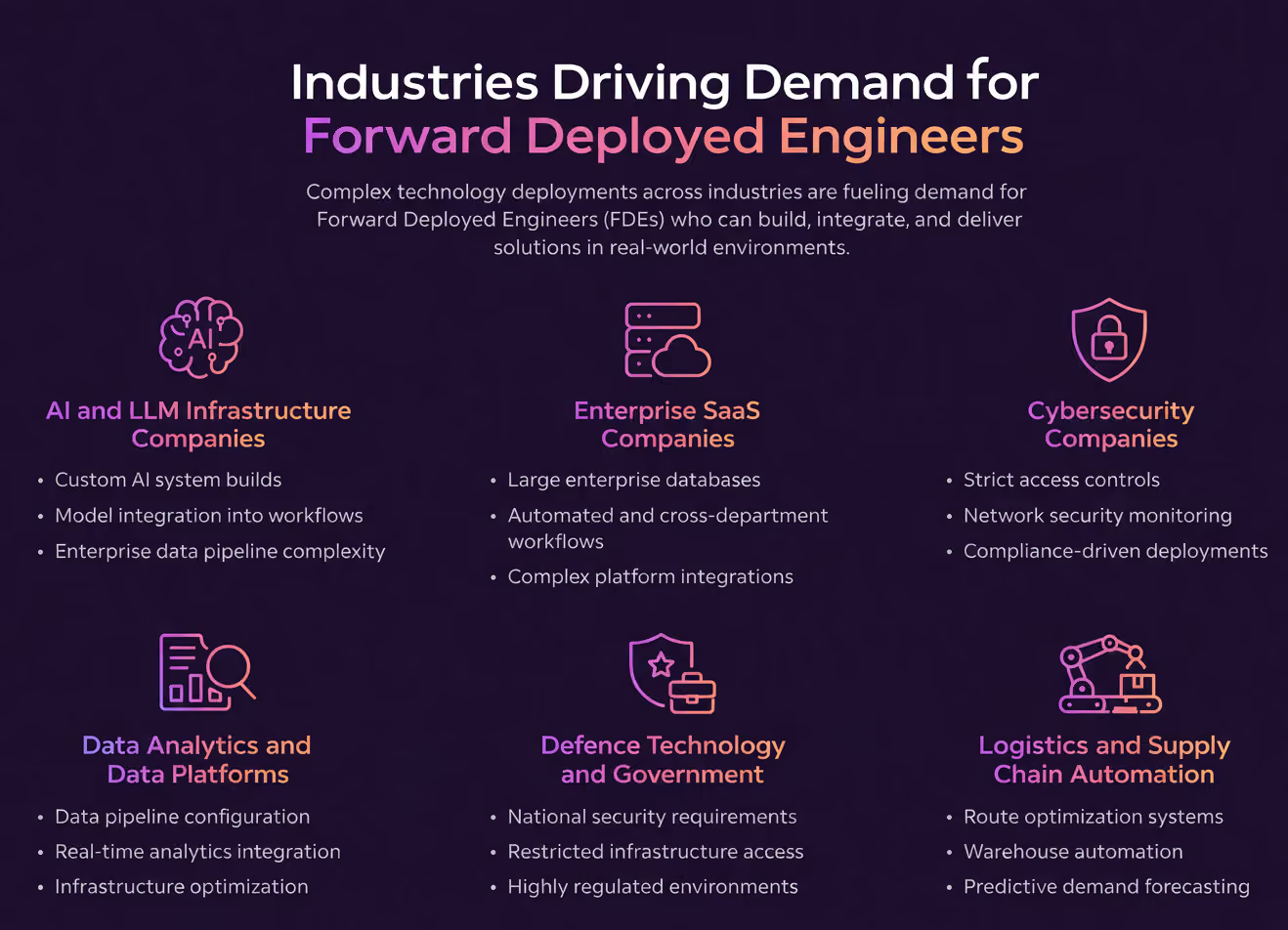
There are quite a number of industries that are contributing to high FDE hiring patterns. The industries are very intensive on complicated technology implementations.
Large AI platforms can be constructed by companies that depend on forward deployed engineers.
Reasons include:
FDEs assist organizations in the implementation of such systems.
Enterprise software platforms are getting more complex.
Deployment often involves:
Forward deployed engineers help to ensure that customers successfully implement these platforms.
Security software needs to be deployed in sensitive infrastructure environments.
Deployment involves:
FDEs assist organizations to set up such systems in a safe manner.
The present-day organizations are bound to big data platforms.
These platforms require:
Forward deployed engineers facilitate deployment in enterprise settings.
The government agencies work under specialized infrastructure systems.
The deployment of technology shall consider:
Forward deployed engineers assist in developing commercial technology to government standards.
The use of AI and automation tools is increasing rapidly within logistics companies.
These systems support:
Forward deployed engineers make sure that these tools are functioning in the actual logistics operations.
There are some strategic benefits of investing in forward deployed engineering teams.
New technological investments demand quick outcomes for customers.
Forward deployed engineers hasten deployment by:
Unsuccessful implementations may hurt the customer's confidence.
FDEs do not allow failures as they:
Forward deployed engineers can give useful feedback to the product teams.
They observe:
This feedback assists product teams to make better versions.
When software is efficient, then customers have more chances to stick to it.
Forward deployed engineers assist companies to accomplish:
Enterprise buyers tend to choose the vendors depending on the implementation support.
Enterprises that offer powerful deployment teams have a benefit since:
A number of technology trends that are long term suggest that the demand of the forward deployed engineering market will keep rising.
Artificial intelligence is an area that many companies are still trying.
With the growing adoption, companies will require experts to handle enterprise AI implementation.
The new enterprise infrastructure has become:
The deployment of these systems needs specialized deployment skills.
Organizations demand shorter implementation cycles.
The extended periods of deployment are not tolerated in the competitive spheres.
Forward deployed engineers assist businesses in providing results in a short period of time.
There is a shortage in the number of engineers who possess the hybrid skills to run forward deployed engineering.
This talent shortage means:
The forward deployed engineer career offers one career opportunity that is gaining attractive features among the technically inclined professionals.
This is an ideal role to engineers who like:
With the reasons behind the emergence of FDE roles becoming apparent in all industries, those pursuing this profession will have more opportunities.
The technology of enterprises is changing at a very high pace, yet one of the most challenging issues that companies struggle with is successful deployment. Software developed in development environments is required to run in highly complex enterprise environments with the legacy infrastructure, unknown data, and rigid compliance criteria.
This fact is the reason why firms are employing forward deployed engineers at a rapid pace.
Forward deployed engineers provide the gap between high power software products and actual operational environment. They are vital to contemporary business because they can be used to overcome complex infrastructures.
With the increased use of artificial intelligence and the more intricate nature of enterprise systems, the demand of forward deployed engineers will only gloss up.
Forward deployed engineering is increasingly one of the most significant jobs in the technology industry to engineers interested in making a difference at the liberalizing nexus of technology, infrastructure and real-world problem solving.
Companies are hiring FDEs because deploying software into complex enterprise environments has become as difficult as building it. Legacy infrastructure, messy production data, and strict compliance requirements mean companies need engineers who can work directly in customer environments, not just in development.
AI and LLM infrastructure companies, enterprise SaaS platforms, cybersecurity firms, data analytics companies, defence technology, and logistics and supply chain automation companies are currently driving the highest FDE demand.
AI models trained on clean data often underperform in real enterprise environments with inconsistent, incomplete, or outdated data. FDEs solve this by building data cleaning pipelines, monitoring model performance, and integrating AI systems with existing enterprise platforms.
Solutions Engineers focus on pre-sales and product demonstrations. Consultants work within defined project timelines. FDEs combine software engineering, infrastructure expertise, and customer collaboration to own actual deployment outcomes and solve deep technical integration problems.
Yes. Enterprise AI adoption is still early, technology stacks are becoming more complex, customer expectations for fast deployment are rising, and there is a limited supply of engineers with the hybrid skills FDE roles require. All of these factors point to sustained demand growth.
FDE is one of the fastest growing roles in tech, with rising compensation due to talent scarcity. It suits engineers who enjoy solving real-world problems, working directly with customers, and bridging the gap between product development and live deployment.
The world is hiring - and this Academy prepares you for it.