Blogs
AI Deployment Engineer vs Forward Deployed Engineer: What's the Difference?
AI Deployment Engineer vs Forward Deployed Engineer: What's the Difference?
By
R&D, FDE Academy
September 2, 2026

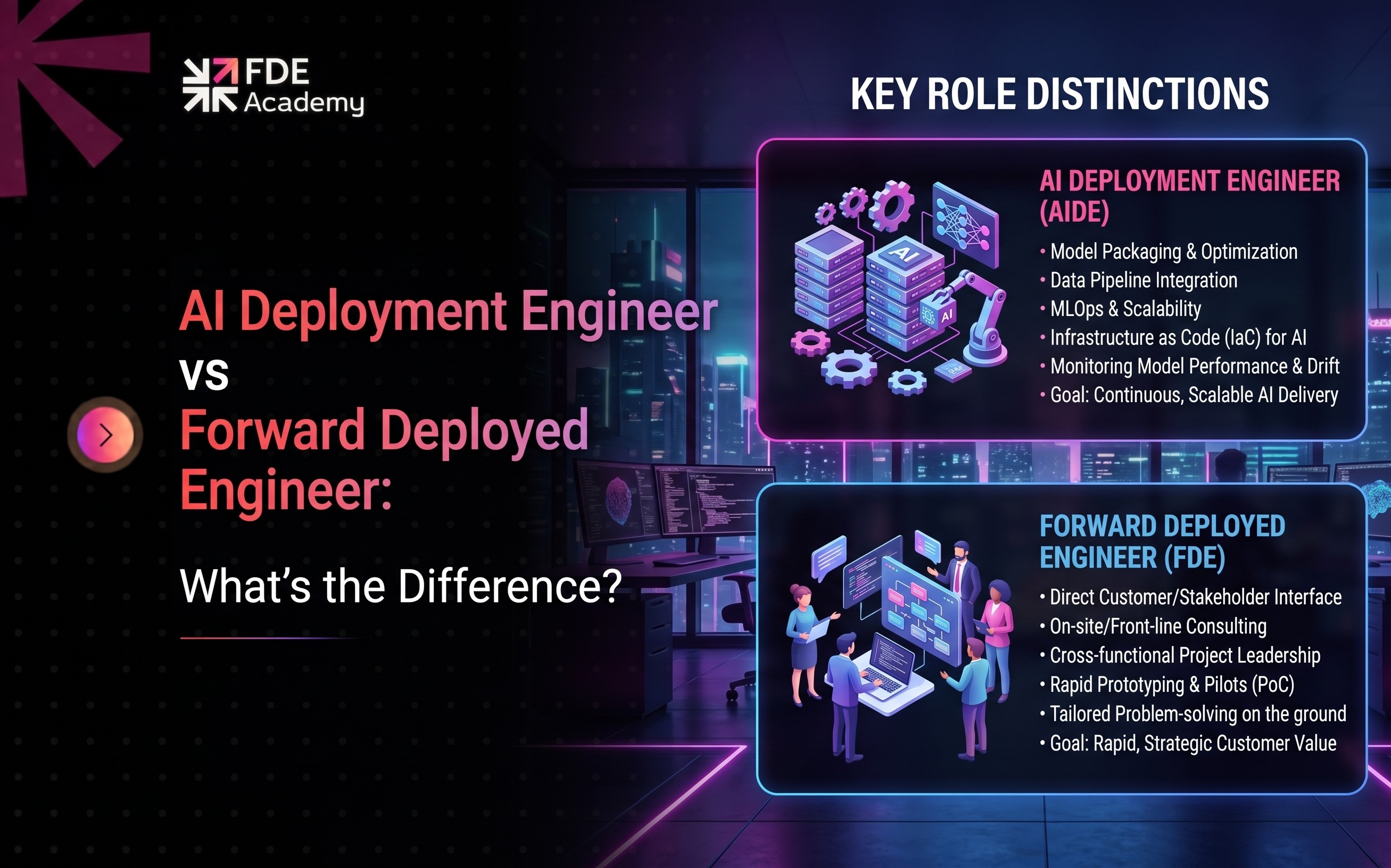
Both roles emerged from the same underlying problem: AI products don't just work out of the box inside a real enterprise, and someone has to sit close to the customer to make them work.
An AI Deployment Engineer is a hybrid role that blends programming, prompt engineering, and model fine-tuning with hands-on testing of AI outputs, and is instrumental in shaping AI models to drive business outcomes like enhanced personalization and workflow optimization.
That description could just as easily appear in an Forward Deployed Engineer job posting which is exactly why the two titles get used almost interchangeably by some companies. In fact, the AI Deployment Engineer role is sometimes referred to directly as a forward-deployed engineer, described as innovative and deeply practical, central to bringing AI products to life in customer-facing environments.
Since neither title is standardized across the industry yet, the honest starting point is: read the actual job description, not the title. That said, there are real, recurring patterns in how companies use each term and this article maps them out.
An AI Deployment Engineer is a customer-facing technical role focused on getting an AI product successfully implemented, onboarded, and adopted inside a client's environment, often blending configuration, light integration work, prompt or model tuning, and ongoing technical relationship management.
The role ensures successful customer implementation and onboarding of AI solutions, collaborating with various teams, managing projects, and optimizing performance once the product is live.
Some companies weigh this role more heavily toward customer success and technical account management than toward hands-on engineering.
OpenAI's own AI Deployment Engineer posting, for instance, describes the team as responsible for ensuring the safe and effective deployment of generative AI applications for developers and enterprises, acting as a trusted advisor and thought partner for customers, and forging relationships with customer leadership to ensure successful deployment and scale language that leans noticeably more toward advisory and relationship work than the "build whatever the product is missing" framing typical of FDE postings.
A Forward Deployed Engineer (FDE) is a customer-embedded software engineer who builds, integrates, and ships production code to solve a specific customer's problem not just configuring an existing product, but extending it.
A forward-deployed engineer is a customer-facing software engineer who turns an ambiguous business problem into a working production system, working alongside the customer to define the problem, design the solution, adapt and integrate the company's product, build any missing software, deploy and debug the system, and feed recurring customer needs back into the core product.
The role traces back to Palantir and has since been widely adopted across AI-first companies. According to Wikipedia, a Forward Deployed Engineer is typically involved throughout the lifecycle of a system requirements analysis, design, implementation, system integration, and deployment combining software development with domain understanding and direct collaboration with end users.
The clearest way to separate the two, when a company does distinguish them: an AI Deployment Engineer is weighted toward making an AI product succeed for the customer onboarding, configuration, tuning, and adoption while a Forward Deployed Engineer is weighted toward building whatever the product is missing to make that same success possible, including real production code the vendor's core product team hasn't shipped yet.
Data collected across 113 FDE job descriptions found that only 21% of other AI roles are expected to interact directly with clients, compared to FDEs where client interaction is a defining, near-universal expectation a useful reminder that both titles sit unusually close to the customer relative to most engineering roles, which is part of why they blur together so easily. The distinction between them is a matter of degree in code ownership and technical depth, not a difference in who talks to customers.
It's worth being direct about this: at many companies, especially smaller AI startups, there is no meaningful difference; the title used is largely a branding choice, not a scope difference.
A Forward Deployment Engineer works with the client's team to build, deploy, and optimize AI systems to tailor implementation to match business requirements, writing code, building integrations, and creating custom solutions that address specific customer needs essentially functioning as a temporary member of the customer's engineering team.
Plenty of "AI Deployment Engineer" postings describe exactly this. The overlap is real, not a naming coincidence. Both roles exist to solve the same underlying problem: AI products that don't work reliably the moment they meet a real customer's data and workflows.
Where companies do draw a real line, it tends to appear at larger, more established AI vendors where a dedicated technical success or deployment team handles rollout and adoption, while a separate, more engineering-heavy FDE team handles the custom build work a rollout might surface. Smaller and earlier-stage companies are far more likely to collapse both functions into one person under either title.
An AI Deployment Engineer typically needs strong product knowledge of the specific AI platform, comfort with prompt engineering and light model tuning, project management skills to run an onboarding process, and the relationship-management ability to act as a trusted advisor to customer leadership.
Postings for this title commonly list experience deploying conversational or generative AI solutions, integrating with CRM and support systems, and strong communication and presentation skills as core requirements.
A Forward Deployed Engineer needs all of that plus genuine software engineering depth the ability to write, test, and ship production code under real deployment constraints. Typical FDE requirements include being comfortable reading and writing REST/JSON APIs, being able to quickly write Python or JavaScript to glue systems together, and a track record of owning a customer-facing build from zero to production. For the full breakdown, see the skills an FDE actually needs.
An AI Deployment Engineer's week centers on the rollout lifecycle: running onboarding calls, configuring the product for a client's specific use case, tuning prompts or model behavior against real usage data, and coordinating between the customer, sales, and the internal product team. Much of the work follows a repeatable onboarding playbook, even when individual customer needs vary.
An FDE's week is less predictable by design. A typical week might include building a first working version of a solution based on customer scoping, getting it into production as fast as possible, listening to real usage data to find edge cases, fixing them, and then sharing results with the customer's team to build momentum toward expansion.
For a fuller picture of the role's rhythm, see what forward deployed engineers do day-to-day. This role sits close to the AI Deployment Engineer role on the spectrum of adjacent customer-facing titles for how FDE also compares to Solutions and Customer Success Engineering more broadly, see how FDEs compare to Solutions Engineers, Sales Engineers, and Customer Success Engineers. It's also worth reading Forward Deployed Engineer vs Implementation Engineer if you're mapping the full landscape of blurry, adjacent titles. The same build-vs-configure distinction that separates FDE from Implementation Engineer largely applies here too.
Compensation data for "AI Deployment Engineer" specifically is thinner than for FDE roles, since the title is newer and less standardized but the postings that exist track closely with technical customer success and solutions engineering bands rather than the top of the software engineering scale.
FDE compensation, by contrast, reflects full engineering ability plus customer ownership, and at frontier AI labs has climbed sharply: mid-level Forward Deployed AI Engineer positions start around $300K total comp in the US market, with senior roles clearing $500K or more at frontier labs, and FDE job postings grew over 800% year-over-year, with 224 open roles tracked across 118 companies as of mid-2026.
See our full Forward Deployed Engineer salary data for a detailed India and global breakdown by experience level. The pattern holds directionally even where exact AI Deployment Engineer numbers are harder to pin down: roles weighted toward configuration and relationship management consistently pay less than roles weighted toward production code ownership.
Both titles are currently posted across an overlapping set of AI-first companies; top companies hiring Forward Deployed Engineers frequently post "AI Deployment Engineer" roles for adjacent, adoption-focused positions in parallel. OpenAI's use of "AI Deployment Engineer" leans clearly toward technical success and enterprise relationship management. Smaller, product-in-motion AI startups of the kind still shaping what their product should even do for a given customer more often use "Forward Deployed Engineer" or "Forward Deployed AI Engineer," because the work genuinely requires building, not just deploying.
If you want deeper code ownership, more engineering ambiguity, and a role where you're genuinely extending the product rather than configuring it, target roles titled Forward Deployed Engineer or Forward Deployed AI Engineer specifically and read the responsibilities section closely, since some AI Deployment Engineer postings describe identical work under a different label. If you're stronger on the relationship-management and product-adoption side, with lighter (though still real) technical involvement, AI Deployment Engineer roles are usually the more accurate fit and are often somewhat more accessible for engineers earlier in their customer-facing career. Either way, our guide on how to become a Forward Deployed Engineer is the right next read once you've decided which side of this line you're aiming for.
In most job postings, "AI Deployment Engineer" and "Forward Deployed Engineer" describe overlapping, sometimes identical work both sitting inside a customer's environment to get an AI product live and working. Where they diverge: a Forward Deployed Engineer typically owns deeper, production-grade code building custom integrations and extensions the product doesn't natively support while an AI Deployment Engineer more often leans toward configuration, onboarding, and technical relationship management, with code work that's usually lighter and more supportive than foundational. The two titles aren't strictly standardized yet, so always read the actual responsibilities in a posting rather than assuming from the title alone.
Not always the same, but often close. Some companies use the titles interchangeably for identical work. Where they differ, AI Deployment Engineer roles typically lean more toward configuration, onboarding, and customer relationship management, while Forward Deployed Engineer roles lean more toward writing new production code to extend the product.
An AI Deployment Engineer typically runs customer onboarding, configures the AI product for a client's specific use case, tunes prompts or model behavior based on real usage, and manages the relationship through go-live and adoption often acting as a technical advisor to customer leadership.
Yes, though usually less than a Forward Deployed Engineer. AI Deployment Engineer roles commonly require light scripting, prompt engineering, and integration configuration, while FDE roles require the ability to independently write and ship production-grade code.
Forward Deployed Engineer roles generally pay more, since the role requires deeper software engineering ability and greater technical ownership. FDE compensation at frontier AI labs has reached mid-six-figure total comp at senior levels, while AI Deployment Engineer roles tend to track closer to technical customer success and solutions engineering pay bands.
Neither title is fully standardized across the industry yet. Some companies choose "AI Deployment Engineer" specifically to signal a role weighted more toward customer success and product adoption, while others use it as a direct synonym for Forward Deployed Engineer. The only reliable way to know is to read the actual responsibilities in the job posting.
Yes, and it's a fairly natural transition since both roles already involve direct customer work. The main gap to close is deeper, independent software engineering ability: the capacity to build and ship production code, not just configure and tune an existing product.
The world is hiring - and this Academy prepares you for it.