Blogs
Forward Deployed Engineer (FDE) : What Is It, Skills and Scope
Forward Deployed Engineer (FDE) : What Is It, Skills and Scope
By
R&D, FDE Academy
September 1, 2026

What if the most important engineer in a company isn’t building the product, but making it work where it truly matters?
Technology platforms today are more powerful and sophisticated than ever before. Yet building advanced software is no longer enough. Businesses must ensure their solutions perform effectively in real customer environments often shaped by operational constraints, regulatory requirements, legacy systems, and complex business conditions.
This growing need has led to the rise of a highly specialized and demanding role: the Forward Deployed Engineer (FDE).
A Forward Deployed Engineer operates at the front line of technology implementation. Rather than remaining distant from end users, FDEs work directly with customers to customize, integrate, and refine technical solutions within live environments. They bridge the gap between product engineering and real-world deployment, ensuring that innovation translates into measurable impact.
The role has gained particular prominence within AI-driven companies, enterprise SaaS providers, data infrastructure firms, and organizations delivering mission-critical systems. In these settings, solutions cannot simply be shipped; they must be adapted, validated, and optimized in context.
An engineer working to deploy, customize, and operationalize complex technical products in real-world settings in close collaboration with their customers is known as a Forward Deployed Engineer (FDE). FDE full form is Forward Deployed Engineer.
Unlike traditional engineers who primarily focus on building products within internal teams, FDEs work closely with customers to understand their unique challenges and requirements. They adapt existing platforms and customize solutions to fit specific use cases, often working within customer infrastructure, workflows, and operational constraints.
Simply stated, a Forward Deployed Engineer:
The Forward Deployed Engineer (FDE) role became widely known through Palantir Technologies. Palantir took a different approach from traditional software companies by placing engineers closer to customers instead of keeping them only within internal product teams. These engineers worked directly with organizations to understand their challenges, customize solutions, and make sure the technology worked in real operating environments.
The reason this model became important is that many enterprise problems cannot be solved with a standard product alone. Companies often have complex workflows, existing systems, security requirements, and unique business processes that require technical customization.
Forward Deployed Engineers filled this gap by acting as a connection point between customers and engineering teams. They help adapt products, solve deployment challenges, and provide feedback that improves the technology itself.
Since then, the FDE model has expanded beyond industries like defense and government technology into AI, enterprise software, cloud platforms, and data companies. As businesses adopt more complex technologies, the need for engineers who can successfully deploy and adapt these solutions continues to grow.
Forward deployed engineering is an operating model in which engineers are not centralized in the internal teams but are put in close proximity to customers. Rather than bringing a product on the scene and leaving it, businesses operating under this model integrate engineers into:
This will result in organizations confirming their assumptions, defining real-world constraints, and hastening the adoption. Forward deployed engineering is specifically useful when:
Time-to-value is critical With the ever-evolving software systems, this model has moved to being optional to necessity in most industries.
Depending on the company, the FDE role and duties vary slightly, but the essence does not change, to make complex technology effective for real users.
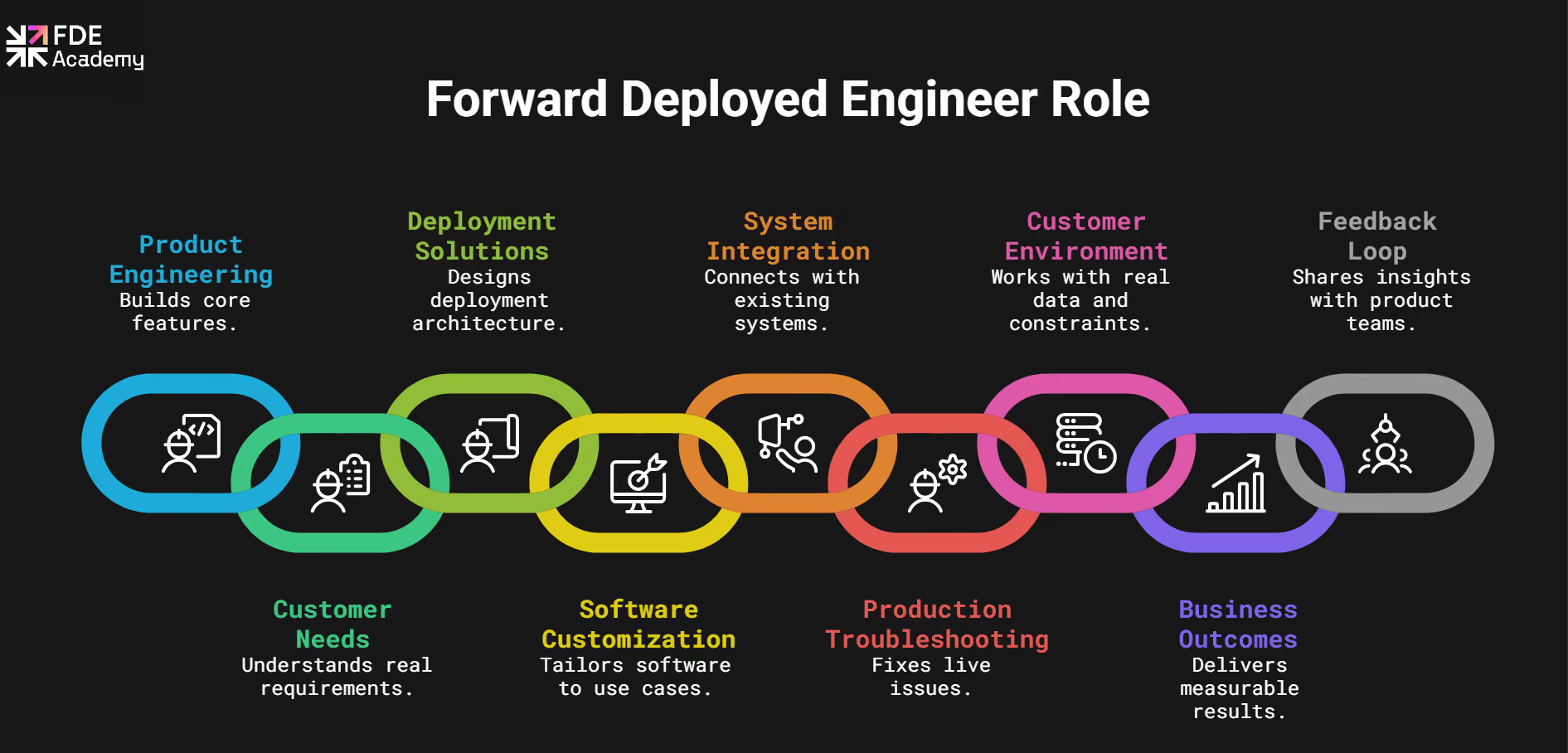
FDEs contribute throughout the lifecycle of numerous organizations, including the initial evaluation and proof-of-concept phases up to the actual deployment and optimization.
The Forward Deployed Engineer role sits between multiple functions, but it remains distinct.
The Forward Deployed Engineer role sits between multiple functions, but it remains distinct. A detailed look at how a Forward Deployed Engineer differs from other engineering roles shows that unlike purely customer-facing roles, FDEs write production-grade code, and unlike internal engineers, they operate under real-world constraints imposed by customer systems and timelines.
Forward Deployed Engineers skills include ability to integrate both good technical skills and be able to join and act in an uncertain customer-driven world.
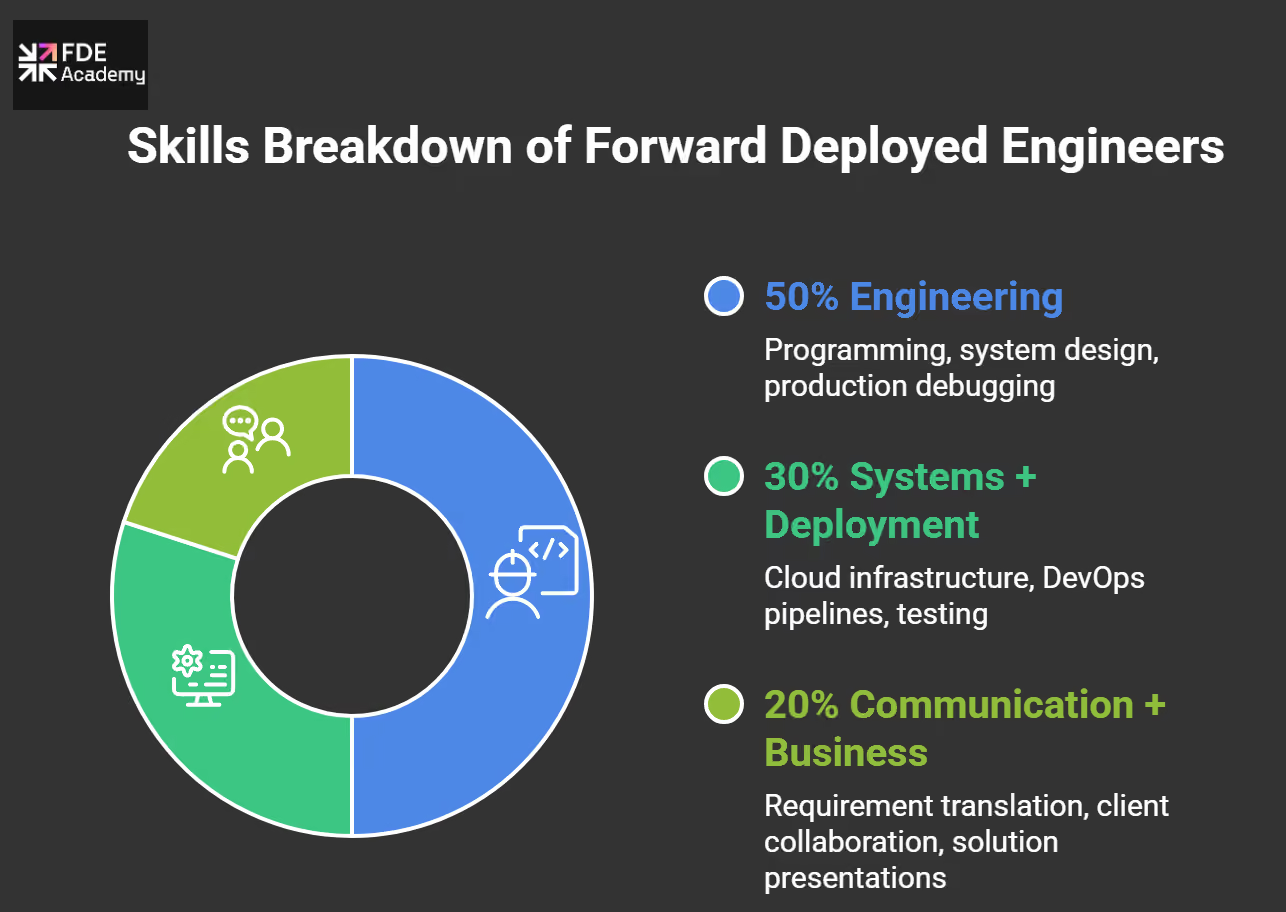
The use of large or complex codebases. Most FDEs work extensively with large and complex codebases, and whether Forward Deployed Engineers actually code is one of the most common questions engineers ask about the role. Beyond core programming, most FDEs also build domain expertise in fields like AI systems, data engineering, security platforms or distributed computing.
These are the non-technical skills that tend to distinguish the good FDEs and the ordinary engineers.
The question of how to become a Forward Deployed Engineer is a common question posed by many professionals particularly as the job becomes more visible.
No formal route has been established but most of the successful FDEs have certain common experiences.
A backend, data engineering, DevOps, and machine learning engineers are also prone to become FDEs on own.
The salary of a forward deployed engineer is usually competitive and in most cases higher than those offered to the traditional engineer at the same level. In the United States, the total annual compensation range for FDE roles generally falls between $110,000 and $180,000, depending on experience, company scale, and location.
Key Salary Influencers
In most technology companies in the world, payment packages might consist of:
The premium is based on the role impact, responsibility and skill requirement.
The industries with complex deployment are mostly the ones where Forward Deployed Engineers are prevalent.
These sectors use FDEs to minimize the risk of deployment and make solutions deliver value rapidly.
Think of an AI platform that aims at optimization of logistics operations. Although the core model can be sound, every customer works with alternative data formats, processes, and limitations.
A Forward Deployed Engineer:
It is this practical engagement that turns a generic platform into a successful solution.
The need for Forward Deployed Engineers is also predicted to rise with the increased specialization of technology and a more complicated deployment environment.
Key drivers include:
Organizations are becoming more aware that the success of products is not only based on innovation, but in real-life settings.
Although it is rewarding, the position is accompanied by challenges.
Common challenges include:
Nevertheless, these difficulties usually lead to a more rapid professional development and expansion of the scope of skills.
Forward deployed engineering suits well those professionals who:
It might not suit those who like internal growth only or tasks which are small in their scope. If you are still weighing up whether this path is right for you, we have answered the most common questions engineers ask about the FDE career, including real questions from Reddit and developer forums, in our detailed guide: Is Forward Deployed Engineer a Good Career?
With the Forward Deployed Engineer role becoming increasingly vital in both AI-related and enterprise technology firms, formal learning initiatives have now started to develop to train professionals to hold this hybrid role. FDE Academy is one such narrow program that is modeled on the realities of deployment-oriented engineering.
The flagship program of the Academy is the PGP in Forward Deployed Engineering and Applied AI Solutions, a 8-month postgraduate program designed around the way AI systems are applied in actual organizations. The curriculum combines a technical path that includes the production-grade AI systems with a consulting-like path focusing on stakeholder alignment, deliver ownership, and operating within real-world constraints.
The learning model focuses on practitioner instruction, applied problem-solving and simulation of real deployment. Moreover, participants obtain a wider Forward Deployed Engineer circle in which to share experience with peers and have an industry outlook. There is also the option of voluntary 3 month certification extension partnership with IIT Roorkee to those who would want to have more academic activity in addition to practice training.
As more companies adopt AI, the demand for Forward Deployed Engineers (FDEs) is growing. Businesses need professionals who can not only build AI solutions but also deploy them, integrate them with existing systems, and solve customer-specific challenges.
This combination of technical expertise and customer-facing problem-solving makes FDEs an important part of modern AI teams. As enterprise AI adoption continues to expand, Forward Deployed Engineering is expected to remain a strong and promising career path for engineers looking to work on real-world AI applications.
A Forward Deployed Engineer (FDE) is a software engineer who works directly with customers to deploy, customize, and optimize complex technical products in real-world environments. Unlike traditional engineers who focus only on internal product development, FDEs bridge the gap between engineering teams and enterprise clients to ensure solutions deliver measurable business impact.
A forward-deployed AI engineer works with customers to implement and adapt AI systems within live operational environments. They integrate AI models with existing infrastructure, refine solutions based on real data, troubleshoot deployment challenges, and ensure AI tools produce reliable and scalable results in production settings.
Forward Deployed Engineer salaries vary by location and experience. In the United States, total annual compensation typically ranges between $110,000 and $180,000, including base salary, bonuses, and equity. Compensation depends on technical specialization, industry, deployment complexity, and customer-facing responsibility.
Yes, forward-deployed engineering is considered a strong career path for professionals who enjoy solving real-world problems and working closely with customers. The role offers high impact, strong compensation, exposure to enterprise systems, and opportunities to grow into leadership, product, or architecture roles.
To become a forward-deployed engineer, you need strong programming fundamentals, system design knowledge, API and integration experience, and familiarity with cloud deployment environments. In addition to technical expertise, communication skills, stakeholder management, and the ability to translate business requirements into technical solutions are essential.
The main difference is customer involvement. Software engineers primarily build and maintain core products internally, while forward deployed engineers work directly with customers to customize, deploy, and optimize those products in real environments. FDEs combine technical depth with business interaction and deployment ownership.
The world is hiring - and this Academy prepares you for it.