Blogs
Benefits of Hiring Forward Deployed Engineers for Enterprise AI
Benefits of Hiring Forward Deployed Engineers for Enterprise AI
By
R&D, FDE Academy
August 5, 2026

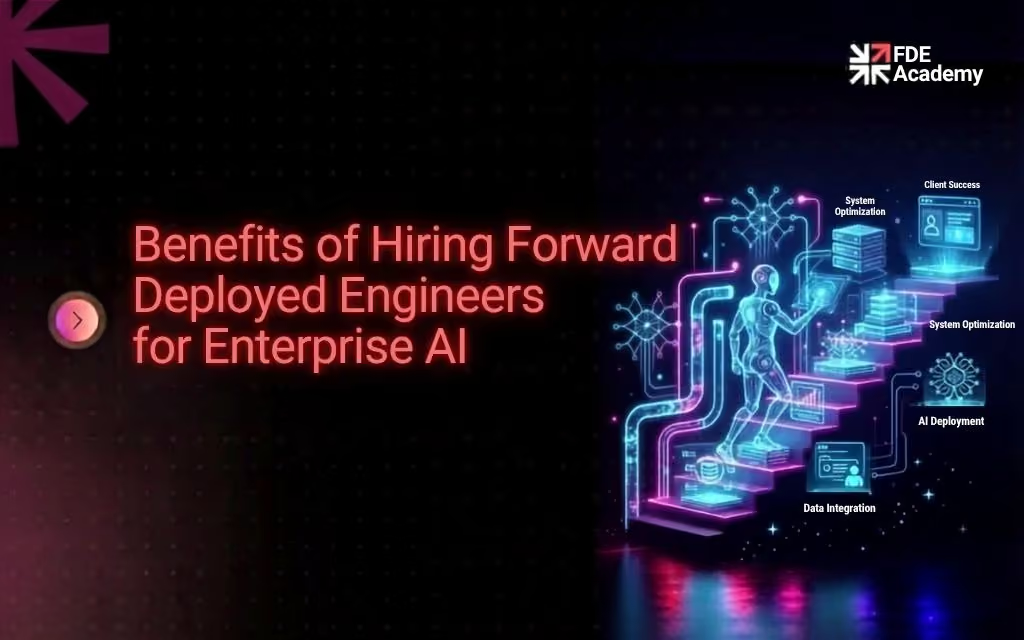
The core benefit of hiring Forward Deployed Engineers for enterprise AI is straightforward: someone owns the gap between a model that works in a demo and a system that actually runs inside your specific business, your data, your legacy systems, your compliance requirements, until it's stable and trusted.
Enterprises that skip this hire routinely watch technically sound AI pilots stall for reasons that have nothing to do with model quality.
This gap is not a minor implementation detail, it's where the majority of enterprise AI investment actually gets won or lost. Industry research consistently shows that most generative AI pilots never reach production, and the pattern holds regardless of how strong the underlying model is: the failure sits in the deployment layer, not the research layer.
This guide covers six concrete benefits enterprises get from this hire specifically, not a generic case for "why AI matters," and how to think about measuring return on it.
A Forward Deployed Engineer compresses the gap between a validated proof of concept and a system your teams actually use daily. Without this role, that gap typically falls to a data science or core engineering team already stretched across other priorities, and enterprise AI pilots frequently stall in that handoff for months.
An FDE owns the deployment as their primary job, not a side project competing with the core roadmap, which directly shortens the timeline from "the model works" to "the business runs on it."
This speed advantage compounds specifically because an FDE isn't starting the deployment work cold. Experienced FDEs carry pattern recognition across prior deployments, common integration approaches, typical data quality issues, standard evaluation frameworks, that let them move through the early stages of a new engagement faster than a team encountering these problems for the first time.
A core engineering team handed a deployment as an unfamiliar side task to learn these patterns from scratch, on top of everything else on their plate; a dedicated FDE has often already solved a version of the same problem for a previous customer.
Most enterprise AI projects don't fail because the underlying model is weak, they fail in the deployment phase: a legacy on-premise data warehouse the model can't connect to cleanly, a compliance requirement nobody scoped for at the start, a data quality issue that only surfaces against real production data.
An FDE is specifically equipped to absorb this risk, running the discovery and integration work that surfaces these problems early, when they're cheap to fix, rather than after a stalled pilot has already cost months of internal credibility.
Consider a common pattern: a financial services firm validates an AI assistant in notebooks, strong accuracy metrics, signed off by the data team. The deployment phase then reveals the system needs to connect to an on-premise
Oracle warehouse with no modern API, under compliance rules nobody flagged during the initial build. Without a dedicated FDE, this discovery happens late, after leadership has already been told the project is on track, turning a manageable scoping problem into a credibility crisis. With an FDE running discovery from day one, this same constraint surfaces in week one, when the plan can still absorb it cleanly.
Enterprise environments are rarely clean. Connecting an AI system to a decades-old ERP, an on-premise database with no modern API, or a patchwork of internal tools built by teams that no longer exist is real, necessary work, and it's a different skill set than building the AI capability itself.
Hiring an FDE means this integration work happens without pulling your core AI or platform team off the roadmap they're actually accountable for, a direct, measurable protection of your existing engineering investment.
This benefit is easy to underestimate until it's missing. Core AI and platform teams are typically measured against product roadmap milestones, features shipped, model improvements delivered, not against how quickly they can untangle one specific customer-facing integration.
Asking that team to absorb deployment work on top of their existing accountability creates a direct tradeoff: either the roadmap slips, or the deployment gets rushed and under-resourced. An FDE removes that tradeoff by making deployment someone's actual job, not a distraction from someone else's.
FDEs bring evaluation design as a core practice, not an afterthought: structured test cases that define what a correct output looks like for your specific data and use case, built and validated before the system reaches your end users.
For AI systems specifically, where outputs are non-deterministic and generic testing frameworks don't apply cleanly, this is one of the highest-value things an enterprise gets from this hire. It's the difference between discovering a failure mode in a controlled evaluation versus discovering it when a customer-facing employee gets a wrong answer in production.
This matters more in regulated or high-stakes enterprise contexts than almost anywhere else in the AI adoption stack. A hallucinated answer in an internal productivity tool is an annoyance; the same failure mode in a customer-facing financial or healthcare application carries real regulatory and reputational risk.
FDEs treat building the evaluation harness as inseparable from building the system itself, which means this risk gets addressed as a structural part of the deployment rather than bolted on after a compliance team raises concerns late in the process.
Enterprise AI initiatives frequently face internal skepticism, from compliance teams, from department heads who've seen prior technology rollouts fail, from executives asking hard questions about real business impact.
An FDE embedded directly with these stakeholders, able to answer a specific technical question about your environment on the spot rather than deferring to "the engineering team will look into it", changes how seriously an initiative gets taken internally. This credibility effect is hard to quantify directly but shows up consistently in faster internal buy-in and smoother rollout politics.
This benefit compounds over the life of a deployment. A stakeholder who gets a confident, technically grounded answer in the first meeting is more likely to champion the initiative internally rather than quietly resist it.
A stakeholder who gets a vague, deferred answer, or worse, an answer that turns out to be wrong once the technical team investigates, becomes a source of internal friction for every subsequent phase of the rollout. The FDE's presence in these conversations is frequently the difference between an initiative that has to fight for internal support and one that gains it naturally.
FDEs sit at the intersection of your AI capability and your actual business operations, which makes them a uniquely valuable source of signal for what to build next.
The integration challenges, data quality issues, and missing features that surface repeatedly across a deployment are exactly the patterns that should shape your broader AI roadmap, and an FDE is positioned to surface that signal directly rather than having it filtered through layers of status reporting.
Our piece on why AI projects fail and how Forward Deployed Engineers fix it covers this failure-to-fix pattern in more depth.
This feedback loop becomes more valuable the more deployments an enterprise runs. The first deployment surfaces problems specific to one team or system.
By the third or fourth, the FDE (or FDE team) has enough cross-deployment pattern recognition to tell you which integration challenges are genuinely one-off versus which ones represent a systemic gap worth solving once, centrally, rather than re-solving for every new department that wants the same AI capability.
This is the mechanism by which a single deployment stops being a one-off cost and starts becoming reusable organizational infrastructure.
Enterprises evaluating this hire should track a small set of concrete metrics rather than relying on a vague sense of "faster AI adoption":
Tracking even two or three of these consistently gives a far clearer picture of return than treating the hire as a cost center evaluated only against headcount.
The most useful comparison isn't FDE cost against a hypothetical scenario where the deployment happens for free, it's FDE cost against the actual cost of a stalled six-month pilot, the internal credibility damage that follows, and the eventual cost of restarting the effort with better-scoped expectations.
The benefits of hiring Forward Deployed Engineers for enterprise AI come down to one consistent pattern: they own the part of AI adoption that most consistently determines whether an investment pays off, not the model itself, but everything required to make it work inside a real, messy, specific business.
Enterprises that treat this as a distinct, dedicated hire rather than an afterthought layered onto an existing team consistently see faster time-to-value and fewer stalled initiatives.
Ownership of the gap between a validated AI model and a production system that actually runs inside your specific business environment, legacy systems, compliance requirements, and real operational data included. This is the single most common point of failure in enterprise AI adoption.
Yes, directly. Most enterprise AI projects fail in the deployment phase, not because the model is weak, but because of integration, data quality, or compliance issues that surface late. FDEs specifically run the discovery work that surfaces these risks early.
An FDE treats deployment as their primary, dedicated responsibility rather than a competing priority layered onto a team already accountable for the core product roadmap. This protects your existing team's velocity while ensuring the deployment gets the focused attention it needs.
Time-to-production, pilot survival rate, production incident rate in the first 90 days, internal adoption rate, and reusable pattern output are concrete, trackable metrics that give a clearer ROI picture than a general sense of "faster AI adoption."
Often, yes. A pilot working well in testing frequently breaks down against real production data, legacy integrations, or compliance requirements that testing environments don't reflect. An FDE's core value is specifically in that transition, not in the initial model-building phase.
The world is hiring - and this Academy prepares you for it.