Blogs
Can a Full Stack Developer Become a FDE?
Can a Full Stack Developer Become a FDE?
By
R&D, FDE Academy
August 4, 2026

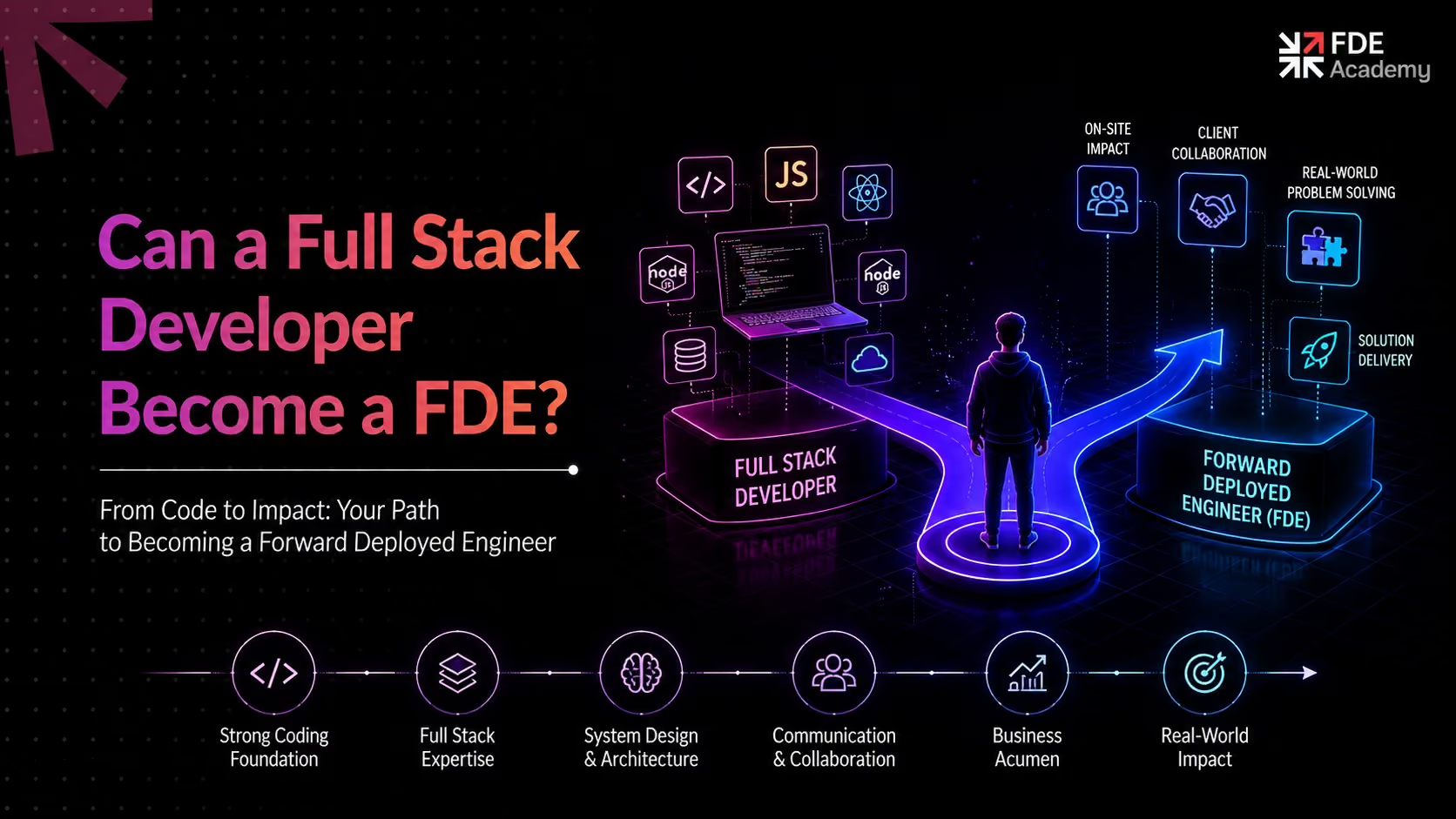
Yes, and full stack developers have one of the shortest paths into the role of any engineering background. The core technical skill, comfort across frontend and backend, API integration, working with whatever the problem requires, is close to identical to what Forward Deployed Engineering demands day to day.
The gap isn't technical depth, it's customer-facing discovery, evaluation design for AI systems, and getting comfortable owning a deployment inside someone else's messy environment.
This guide breaks down exactly what transfers, what's genuinely missing, and a concrete 90-day plan to close that gap if you're a full stack developer considering the move.
Full stack developers are structurally closer to FDE-ready than almost any other engineering background, because the defining trait of both roles is the same: doing whatever the problem in front of you actually requires, rather than staying inside one layer of the stack.
A Forward Deployed Engineer who only knew backend, or only knew frontend, would be limited in exactly the way full stack development is designed to prevent.
What full stack development doesn't teach on its own: customer discovery, production ownership inside an external organization's constraints, and the AI-specific evaluation skills that most 2026-era FDE roles now require. None of these are harder to learn than full stack development itself, they're just different, and worth naming explicitly rather than assuming the technical overlap covers everything.
Not every full stack background transfers at the same speed, though. Where you've worked shapes how much of the gap is already closed:
You're not intimidated by touching a database schema one day and a frontend component the next, exactly the range FDE work demands when a deployment blocker could be anywhere in the stack.
This matters more than it might seem: a backend-only or frontend-only specialist often has to learn an entire adjacent discipline before they can even start closing FDE-specific gaps, while a full stack developer skips that step entirely.
Connecting frontend to backend to third-party services is core full stack work, and it's also a huge share of what FDEs do connecting an AI system to a customer's existing infrastructure. Auth flows, rate limiting, retry logic, all directly transferable.
Full stack developers routinely work in codebases they didn't fully design, tracing a bug from a UI symptom back to a backend cause. This directly maps to FDE work inside a customer's legacy systems, where the system was built by people you'll never meet and documentation is often thin or nonexistent.
Full stack roles, especially at smaller companies or startups, build a bias toward shipping working software quickly rather than waiting for a perfect architecture, a genuinely useful instinct in FDE work where customer timelines are real.
Even full stack developers rarely own infrastructure, deployment pipelines, and monitoring alongside the application code itself. This is closer to a partial gap than a full one, most full stack roles touch at least basic CI/CD and cloud deployment, which shortens the fundamentals runway considerably compared to someone starting from pure frontend or backend specialization.
Full stack developers typically receive requirements from a product manager, already scoped. FDEs have to extract the real requirement themselves from a customer who often doesn't know what they need yet.
This is a distinct, learnable skill, not a natural extension of technical ability. Concretely: instead of a ticket that says "add CSV export to the reports page," an FDE hears "our finance team is spending too much time reconciling data" and has to run the discovery that turns that into a scoped, buildable plan themselves.
If your full stack experience predates heavy AI integration work, you likely haven't built structured evaluation harnesses, test cases that define what "correct" looks like for a non-deterministic system.
This is one of the highest-leverage skills to add, and it's genuinely new territory for most full stack backgrounds. Traditional unit tests assert a fixed expected value; evaluating an LLM output requires graded criteria and judgment calls that most full stack testing experience doesn't prepare you for.
Full stack developers typically own their own team's production environment. FDEs own production inside a customer's environment, their compliance rules, their legacy systems, their timeline pressure.
The technical skill transfers; the ownership context is different and takes deliberate adjustment. Debugging a production incident is a familiar full stack skill; debugging one at 9 PM in a customer's VPC, with their security team watching and their SLA on the line, adds a layer of pressure and constraint that most internal-product work doesn't.
Full stack work has ambiguity, but it's usually bounded by a sprint or a ticket. FDE ambiguity is bigger: an entire customer relationship, an undefined problem, weeks before the shape of the solution is clear. This is more a mindset shift than a skill gap, but it's real and worth naming honestly before making the jump. Our 10 mistakes new Forward Deployed Engineers make covers several failure patterns that trace directly back to underestimating this shift.
Days 1-30: Add AI-specific depth.
Days 31-60: Practice discovery and decomposition.
Days 61-90: Build one deployment-shaped project and document it.
FDE interviewers evaluating a full stack developer candidate are specifically listening for two things beyond baseline coding ability: whether you ask clarifying questions before proposing a technical solution, and whether you can explain a technical tradeoff to a non-technical listener without losing precision.
Full stack candidates who skip straight to architecture without scoping the actual problem first are the most common failure pattern, since it's an easy habit to carry over from PM-scoped work where that step was already done for you. Practicing the explicit habit of clarifying before building is the fastest way to close this specific gap.
A few concrete interview signals worth preparing for directly:
Full stack developers aren't just eligible for FDE roles, they're arguably the best-positioned engineering background to make the jump, since the core instinct, do whatever the problem actually requires, is already built in.
What's missing is specific and learnable: discovery skill, AI evaluation design, and comfort owning production inside someone else's constraints. Close those three gaps deliberately, and the technical foundation you already have does most of the remaining work.
Yes. Full stack developers have one of the shortest technical gaps of any background, since cross-layer comfort and API integration experience map directly onto FDE work. The real gap is customer discovery, AI evaluation design, and production ownership inside a customer's environment, not raw coding ability.
Customer discovery and requirements translation. Full stack developers typically receive pre-scoped requirements from a product manager; FDEs have to extract the real requirement directly from an often-uncertain customer, a distinct, learnable skill rather than a natural extension of coding ability.
Yes, for most 2026-era FDE roles. RAG architecture, evaluation design, and agent orchestration are increasingly baseline expectations. This is genuinely new territory for full stack backgrounds that predate heavy AI integration work, and it's the highest-leverage skill to add first.
Faster than most other backgrounds, often 3 to 6 months of focused effort given the strong technical foundation already in place, compared to 6 to 12 months for less directly overlapping backgrounds. See our full Forward Deployed Engineer skill roadmap for the complete competency list.
Generally, yes, at comparable seniority. Full stack developer salaries are strong but follow standard senior-engineer bands, while FDE compensation at frontier AI labs runs significantly higher, reflecting the added customer-facing and AI-specific skill set. See our Forward Deployed Engineer salary guide for the full breakdown.
The world is hiring - and this Academy prepares you for it.