Blogs
Do Forward Deployed Engineers Code? The Truth About the Most Misunderstood Engineering Role
Do Forward Deployed Engineers Code? The Truth About the Most Misunderstood Engineering Role
By
R&D, FDE Academy
March 9, 2026

Walk into almost any engineering forum and ask a simple question: “Do forward deployed engineers code?” The responses will be wildly divided. Some engineers claim the role is just glorified consulting or technical sales. Others say it is one of the most technically demanding engineering positions in modern software companies.
So which one is true?
The reality is far more nuanced. A forward deployed engineer coding daily is not a myth but the type of coding they do often looks very different from traditional backend or product software engineering. Because of this difference, many developers misunderstand the depth of forward deployed engineer technical work.
This article breaks down the reality behind the role, removes the misconception that it is not “real engineering,” and explains exactly what forward deployed engineers build, the code they write, and how the job differs from traditional software development.
The misunderstanding of the cases of FDE a coding job exists due to the positioning of the role in most companies.
Forward deployed engineers lie at the crossroad of:
Compared to the traditional product engineers that design features to satisfy a large user base, forward deployed engineers collaborate with particular customers to implement advanced technology solutions.
Due to this customer-facing nature, this role is often mistakenly confused with consulting or sales engineering.
However, that premise lacks the essential truth: forward deployed technical work frequently includes creating production level systems with real world constraints.
Rather than authoring product features singly, FDEs frequently develop comprehensive solutions that combine software platforms with an existing infrastructure of a customer.
This needs good coding capacity, systems design capability and good technical knowledge.
The greatest factor that makes people question whether to forward deployed engineers code, is the fact that the job is identical to many other occupational designations that are technical in nature.
The conflation is typically caused by three neighboring positions.
Solutions engineers normally assist customers in configuring products or architecture designs of the existing tools. They can write little code, or prototypes, but they do not generally write production systems.
Consultants examine systems, offer solutions and lead the implementation. They can do technical documentation and architecture design, but they will seldom write much code.
Sales engineers also help in sales by providing demonstrations of products and clarification of technical abilities. They concentrate on product displays as opposed to development of production software.
The reason why forward deployed engineers are confused with either of these roles is that they also deal with customers. Nevertheless, their duties are much more profound, and how a FDE differs from other engineering roles makes this distinction clear across each comparison.
The technical work of a forward deployed engineer in most companies consists of writing complex integration code, infrastructure construction, AI model deployment, and automation system development to execute in production environments.
One of the biggest misconceptions about the role is that Forward Deployed Engineers spend more time in meetings than writing code. In reality, Forward Deployed Engineer coding is focused on solving customer-specific technical problems rather than building features for a shared product.
Depending on the company and deployment stage, a Forward Deployed Engineer may write code for:
Unlike traditional software engineers, FDEs usually write code that is tailored to customer environments. Every deployment comes with different infrastructure, security requirements, and business constraints, so the code is often unique to that implementation rather than reusable across every customer.
The goal isn't just to write clean code it's to build reliable solutions that work in real-world deployments where performance, scalability, and business impact matter most.
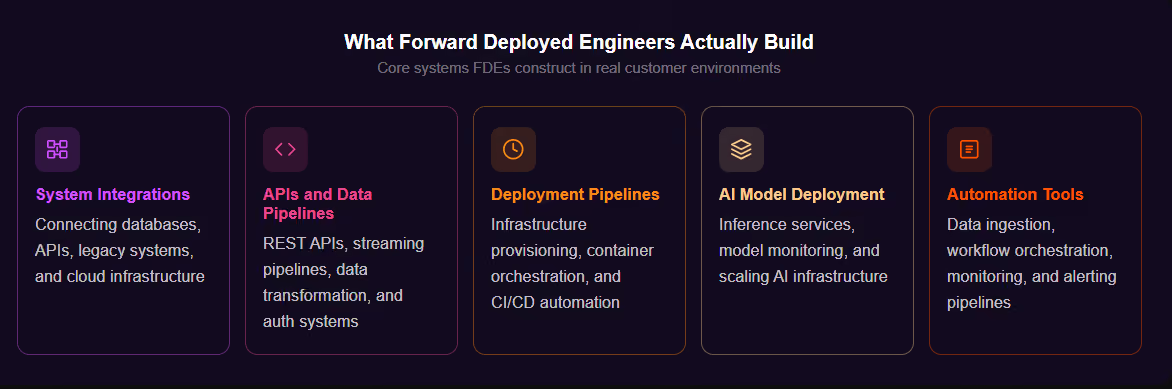
To gain insight into the technical complexity of the position, it is useful to look at what forward deployed engineers construct in practice.
They normally work on linking sophisticated software platforms to customer infrastructure.
The most common systems constructed by the FDEs include:
Companies that use complex platforms (particularly in AI, data infrastructure, or enterprise software) tend to require integrations with dozens of internal systems.
Forward deployed engineers develop integration layers that link:
This can usually involve custom service, service adapters, and middleware development.
APIs designed and implemented by FDEs are often used to enable interaction of customer systems with the core product of a platform.
They could also construct data pipelines that modify, authenticate, and direct data among systems.
This work often involves:
The systems should be secure and dependable since they will be used in the production environment.
Several sophisticated platforms necessitate sophisticated deployment pipelines, in particular, in regulated or enterprise sectors.
Automation pipelines that are constructed by forward deployed engineers include:
These pipelines tend to be combined with such tools as Kubernetes, CI/CD, and cloud infrastructure.
FDEs commonly implement models into practice in companies that deal with machine learning or AI platforms.
This may involve:
The implementation of AI systems is not an easy, plug-and-play procedure, and it is against this reason why companies trust the services of technically strong FDEs.
Numerous deployments of customers demand custom automation.
Forward deployed engineers develop internal tools that enable the automation of processes including:
These are tools that sometimes turn to a major component of the customer operational infrastructure.
To perceive forward deployed engineer coding, one must acknowledge that the code of forward deployed engineer and product engineering code is usually different.
FDEs are not concerned with creating reusable product features, but dealing with complex technical issues in deployment environments.
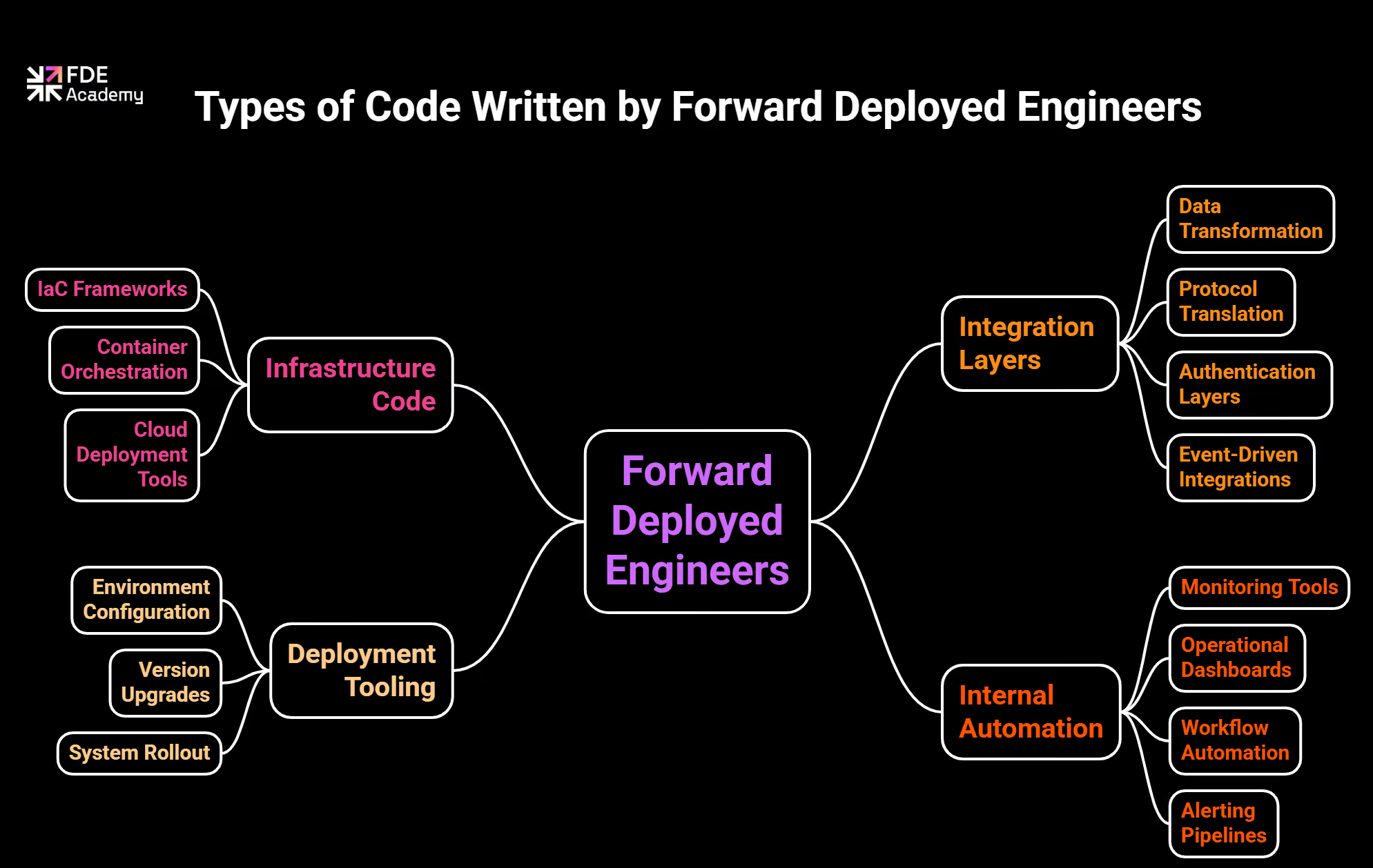
Some general classifications of code are:
FDEs often code infrastructure configuration and provision using tools including:
This code makes systems able to be scaled and to be stable in the production environment.
Integration code relates various systems which may not have been developed to interact.
This may involve:
The development of these integration layers takes a lot of knowledge on distributed systems.
Forward deployed engineers tend to develop custom deployment tools on behalf of the customer.
These tools might automate:
Consistent deployment tooling is essential where the systems have to work in different environments.
FDEs often develop automation scripts and services to minimize manual effort to enhance efficiency.
These might include:
These tools are usually internal but they frequently become vital facts of the deployment environment.
The biggest difference between forward deployed engineering and traditional software engineering lies in the context of the work.
Below is a simplified comparison.
Practically forward deployed engineers can be much nearer to actual operational settings. They should be able to diagnose problems, design solutions and deploy them within real-life conditions within a short time.
This may entail good debugging, knowledge of distributed systems and in-depth infrastructure knowledge.
The technical aspect of the job may be very deep or shallow depending on the firm.
There are organizations that have processes of forward deployed engineering that are so technical, in particular companies that are creating sophisticated infrastructure or AI.
Such examples are companies operating in:
FDEs in such contexts often become hybrid engineers, with the capacities of backend engineering, infrastructure engineering, and systems architecture.
The work frequently involves experience with programming languages (possibly Python, Go, or Java), as well as a solid understanding of distributed systems and cloud environments.
It is necessary to note that not every FDE position is technical.
In other firms, the position name is applied to roles whereby there is more configuration than engineering.
Simpler versions of the role can include:
In such instances, the job will be more similar to solutions engineering or consulting.
This is one of the reasons why the question of do forward deployed engineers code is as common as it is.
The solution to this question lies with the company and the intricacy of the platform, which is being implemented.
So, is FDE a coding job?
The answer is a resounding yes in most of the modern technology companies.
Nevertheless, the coding done by forward deployed engineers is not the same as the type of work that the normal software engineers would carry out in the development of a product.
FDEs may also construct the important systems that enable complex platforms to operate within actual customer contexts rather than developing capabilities of millions of users.
Their work involves:
Such duties involve effective programming skills, technical knowledge and capability to design solutions within the constraints of the real world.
The idea that Forward Deployed Engineers don't code comes from a misunderstanding of the role.
While FDEs work closely with customers, they also spend a significant part of their day building integrations, debugging production issues, and developing solutions for real-world environments. Customer interaction is part of the job—but so is serious engineering.
In the end, a Forward Deployed Engineer isn't just an implementer. They're an engineer who turns complex technical solutions into successful real-world deployments.
Forward deployed engineers typically use languages such as Python, Go, Java, or JavaScript depending on the platform they are deploying. The choice often depends on the systems they are integrating and the infrastructure environment.
Yes. In many companies, forward deployed engineers build and deploy systems that run in real production environments. Their work often includes integrations, deployment pipelines, and infrastructure automation.
Most forward deployed engineers work extensively with cloud platforms such as AWS, Azure, or Google Cloud. They often build infrastructure, deployment pipelines, and integrations within cloud environments.
In companies developing AI platforms, forward deployed engineers frequently deploy machine learning models, build inference services, and integrate AI systems with enterprise data.
In many organizations, forward deployed engineers perform deeper engineering work than solutions engineers. They often build integrations, deployment systems, and automation tools rather than only configuring existing software.
Yes. Engineers who work in forward deployed roles often gain strong system design and deployment experience, which can allow them to transition into product engineering, infrastructure engineering, or architecture roles.
The world is hiring - and this Academy prepares you for it.