Blogs
How a Forward Deployed Engineer Manages Enterprise Scope Creep Without Creating Tech Debt
How a Forward Deployed Engineer Manages Enterprise Scope Creep Without Creating Tech Debt
By
R&D, FDE Academy
July 10, 2026

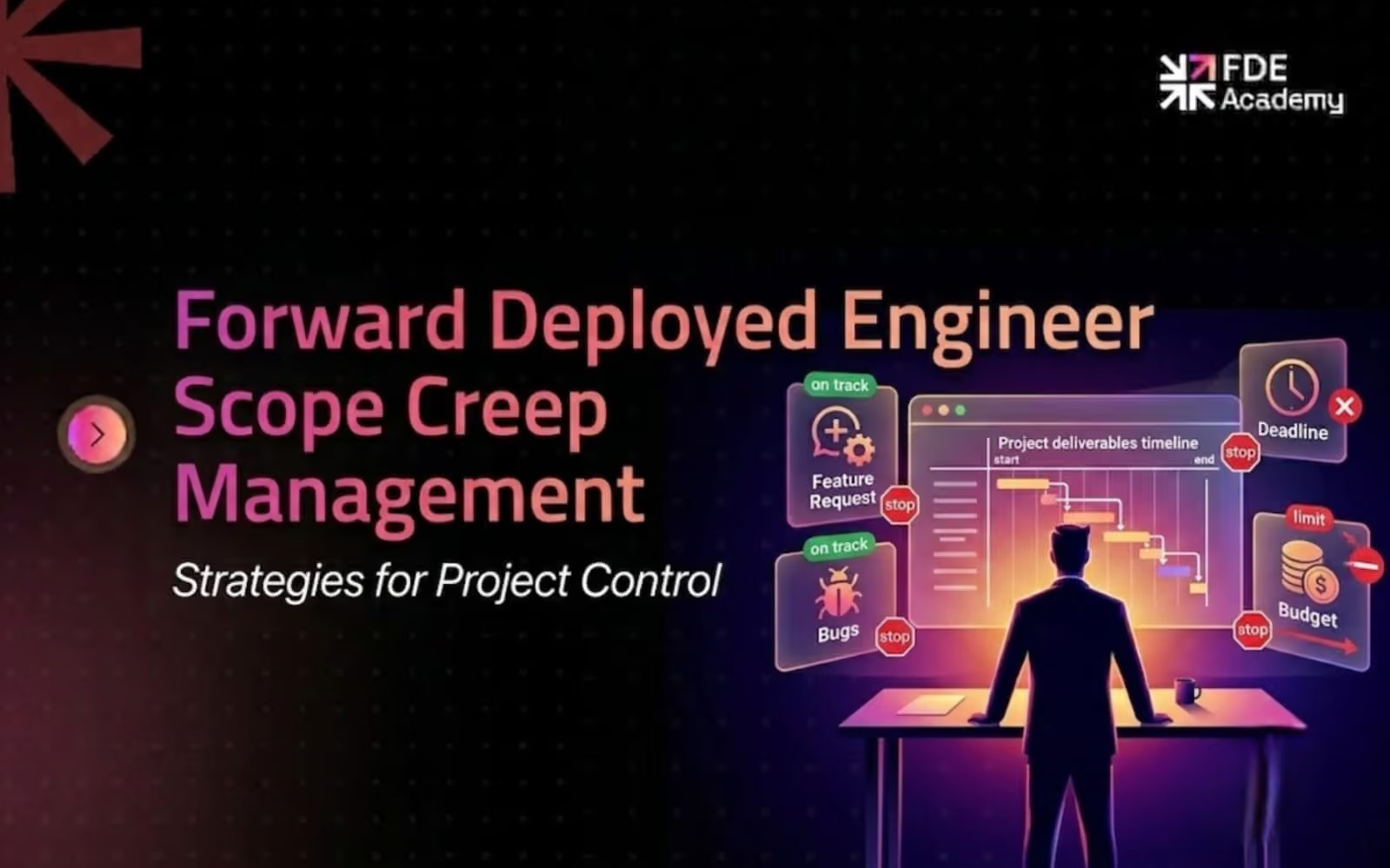
Forward Deployed Engineer Scope Creep Management is not about treating scope creep as the enemy. For a Forward Deployed Engineer, refusing every new request can actually damage customer trust and limit long-term success. The customer relationship an FDE owns depends on staying responsive as business needs evolve.
This means the real challenge of Forward Deployed Engineer Scope Creep Management is not preventing scope from growing, but building an architecture and decision-making process that allows requirements to expand without turning every new request into unmaintainable, undocumented technical debt six months later.
Strong FDEs create modular systems, maintain clear documentation, and establish prioritization frameworks that enable teams to adapt quickly while preserving system quality. The goal is to support changing enterprise requirements without sacrificing maintainability, scalability, or future development speed.
This distinction matters because most advice on scope creep, written for traditional project managers, treats it as purely a negotiation problem: hold the line, push back, protect the timeline. FDEs don't have that luxury in the same way, saying no to an enterprise customer's evolving need is often not a real option if you want to keep the account and the trust that got you the deployment in the first place.
This guide covers five specific techniques experienced FDEs actually use to absorb scope changes without paying for it in unmaintainable code later. If you're preparing for an interview rather than living this day to day, our Forward Deployed Engineer interview questions guide covers how client-simulation rounds test exactly this scenario, a frustrated stakeholder pushing for more scope under pressure.
A product team building a shared feature for thousands of users has room to say "that's not on the roadmap this quarter" without losing the customer entirely, there are many customers, and the roadmap serves all of them collectively.
An FDE embedded with one specific enterprise customer doesn't have that buffer. The customer's new request often comes directly from an executive sponsor, and the FDE is frequently the only technical presence in the room when that request lands.
This creates real pressure to say yes quickly, and saying yes quickly, without a structured response, is exactly how scope creep turns into tech debt. The fix isn't becoming better at saying no, it's building a process that lets yes be safe.
There's also a structural reason this pressure compounds over time rather than staying constant. Early in a deployment, the relationship is new and the FDE has more standing to push back or ask for time to think through an implementation properly.
Deep into a deployment, especially once a customer has come to depend on the system, requests start arriving with an implicit expectation of near-immediate turnaround, since the customer has seen the FDE move fast before and doesn't distinguish between a quick UI tweak and a request that touches core architecture. Recognizing this shift, and deliberately re-establishing the space to think before committing, is itself part of managing scope creep well.
Forward Deployed Engineer Scope Creep Management requires clearly separating scope creep from technical debt, because confusing the two often leads to the wrong solution. Scope creep is primarily a business and communication challenge: requirements expand beyond the original agreement, frequently without corresponding adjustments to timelines, budgets, or resources.
Technical debt, on the other hand, is an engineering consequence created by architectural shortcuts and rushed implementation decisions that make future changes slower, riskier, and more expensive.
Importantly, scope creep does not automatically create technical debt. Effective Forward Deployed Engineer Scope Creep Management recognizes that enterprise requirements naturally evolve over time. A well-managed scope expansion- one that is explicitly acknowledged, properly prioritized, and supported by clean architectural boundaries- can allow a system to grow without sacrificing maintainability.
Technical debt usually emerges when scope expansion is silently absorbed. This happens when teams continuously say yes to new requests without renegotiating timelines, updating system architecture, or documenting intentional trade-offs. Over time, these hidden compromises accumulate into brittle systems that become increasingly difficult to maintain and extend.
For Forward Deployed Engineers, the goal is not to eliminate changing requirements but to create processes and architectures that can accommodate change safely. Clear stakeholder communication, modular system design, and deliberate documentation practices are essential components of successful Forward Deployed Engineer Scope Creep Management, enabling teams to remain responsive to customer needs while avoiding long-term engineering costs.
The single highest-leverage habit is verbally and mentally separating two different commitments that customers frequently bundle into one request. A stakeholder saying "can this also flag transactions over $10,000 for review" is making a business ask.
It is not simultaneously specifying that the flagging logic must be built directly into the existing fraud-detection function you're already maintaining, that's an implementation detail the FDE controls, not the customer.
Strong FDEs learn to say yes to the business need immediately, since that builds trust and keeps the relationship moving, while reserving the implementation decision for a separate, quick internal assessment: does this fit cleanly into the existing architecture, or does it need its own module, its own service, or a scoped extension point.
This single habit prevents the most common failure mode, where an FDE says yes to both at once under pressure and bolts a new requirement directly onto code that wasn't designed to hold it.
Anticipating likely expansion points during initial build is the difference between scope creep that's cheap to absorb and scope creep that requires a rewrite. If you're building a document processing pipeline and you already suspect the customer will eventually want a second document type, building the parsing logic with that seam in mind (even if you don't build the second parser yet) costs relatively little upfront and saves significant rework later.
This requires genuine judgment, over-engineering for expansion that never comes is its own form of wasted effort and complexity. The practical heuristic experienced FDEs use: build seams for expansions the customer has already hinted at or that are common in similar deployments you've seen before, not for every theoretically possible future request.
A discovery conversation that surfaces "we'll probably want this for our EU entity too eventually" is a strong signal worth designing around; a hypothetical you invented yourself usually isn't.
Verbal scope changes in a hallway conversation or a quick Slack message are where silent scope creep does the most damage, because there's no record that a decision was made, no shared understanding of the tradeoff, and no paper trail if the timeline needs to shift as a result.
Strong FDEs convert every meaningful scope change into a brief written summary, even informally, within the same day: here's what was requested, here's what it means for timeline or architecture, here's what's being deprioritized or adjusted as a result.
This isn't bureaucracy for its own sake. It does two things simultaneously: it forces the FDE to actually think through the implementation tradeoff rather than agreeing reflexively in the moment, and it gives the customer stakeholder a clear, low-friction way to understand that more scope means an adjusted timeline or a reprioritization, without it ever feeling like a confrontation.
The format matters less than the habit itself. A three-line email, a comment on a shared project tracker, or even a message in the customer's own Slack channel all work, as long as it exists somewhere both sides can reference later.
The value isn't the documentation as an artifact for its own sake, it's the fact that writing even a short summary forces a moment of actual thought between hearing a request and starting to build, which is precisely the moment where most silent scope creep sneaks past an FDE moving too fast to notice the tradeoff they just made.
Feature flags let an FDE build and ship a new capability behind a toggle, decoupling the engineering work from the customer-facing commitment of exactly when and how it goes live.
This matters specifically for scope creep because it removes the false urgency that often drives bad architectural decisions, a request doesn't have to be fully production-ready and customer-visible the moment it's built, which removes the pressure that leads to skipping tests, skipping documentation, or bolting code on in the fastest possible (and messiest possible) way.
Building the new capability behind a flag, validating it internally or with a small subset of users, and only then exposing it fully gives the FDE room to build it properly even when the original request came in under time pressure, without that pressure directly translating into rushed, undocumented code.
Not every scope change deserves the full architectural treatment, and pretending otherwise is its own mistake. Sometimes the right call is a genuinely quick, slightly hacky implementation, because the customer needs something working by Friday for an executive demo, and the business value of that demo outweighs the cost of some cleanup work later. The skill isn't avoiding debt entirely, it's making that tradeoff consciously and explicitly rather than by default.
The habit that separates deliberate debt from accidental debt: write a single sentence, at the time you make the shortcut, documenting what was skipped and why. "Hardcoded the threshold value instead of making it configurable, customer needs this live by Friday, revisit before the next customer needs a different threshold."
This costs almost nothing to write and makes the difference between debt that gets paid down intentionally later and debt that gets forgotten until it silently breaks something.
A customer mid-deployment for a document processing system asks, three weeks after go-live, whether the system can also handle a second document format from a newly acquired subsidiary.
A weak response says yes immediately and bolts the new format's parsing logic directly into the existing parser function, since that's the fastest path to a working demo. Three months later, adding a third format requires understanding two tangled parsing paths instead of one clean extension point.
A strong response separates the business ask (yes, we can support the new subsidiary's documents) from the implementation decision (this needs its own parser module behind a shared interface, not a branch inside the existing one), writes a two-line summary of the timeline impact this adds.
If the customer needs something live before the clean version is ready, ships a flagged, deliberately-scoped shortcut with a one-line note about what was skipped and why. The business gets the same yes either way. The codebase only survives well in the second scenario.
The instinct to treat scope creep as something to resist misses what the FDE role actually requires: staying responsive to a customer's real, evolving business need while protecting the codebase from the consequences of doing so carelessly.
The five techniques here, separating business asks from implementation commitments, building seams ahead of likely expansion, converting verbal asks into written decisions, using feature flags to remove false urgency, and taking on debt deliberately rather than by accident, aren't about slowing down or saying no more often. They're about making yes sustainable.
An FDE typically can't rely on a shared roadmap to deflect new requests the way a product team can, since they're embedded with one specific customer whose trust and continued business depends on staying responsive. The focus shifts from negotiating scope down to building an architecture and decision process that absorbs scope changes without accumulating unmanaged technical debt.
No. Technical debt comes from silently absorbing scope changes without renegotiating timeline or adjusting architecture, not from scope changing itself. A scope change that's acknowledged explicitly, scoped properly, and built with the right architectural seams can grow a system cleanly.
Architectural seams are natural extension points built into a system in anticipation of likely future requirements, even if those requirements aren't built yet. They let a system absorb an expected type of scope change cheaply, versus requiring a rewrite when the request eventually arrives.
Yes, when the business value of shipping quickly (a customer demo deadline, for example) genuinely outweighs the cost of cleanup work later. The key is making that tradeoff consciously and documenting what was skipped and why, rather than accumulating debt by default without noticing.
Feature flags decouple the engineering work of building a new capability from the customer-facing commitment of when it goes live. This removes false urgency that often drives rushed, undocumented code, since a feature doesn't need to be fully production-polished the moment it's requested.
Traditional project management advice on scope creep focuses on negotiation: holding the line, pushing back, protecting the timeline. This guide focuses on the engineering response specifically, how to say yes safely, given that an FDE often can't simply refuse an enterprise customer's evolving needs the way a product team might.
The world is hiring - and this Academy prepares you for it.