Blogs
The Forward Deployed Engineer Tech Stack: Tools, Languages, and Frameworks
The Forward Deployed Engineer Tech Stack: Tools, Languages, and Frameworks
By
R&D, FDE Academy
April 23, 2026

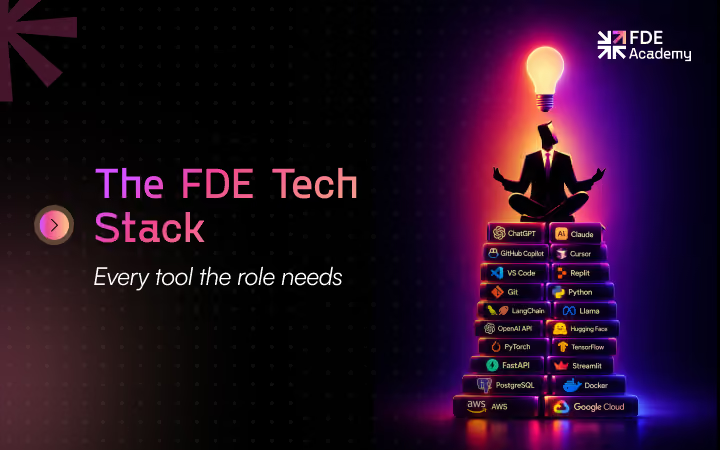
What you'll learn in this guide:
The Forward Deployed Engineer (FDE) tech stack is built for a unique purpose: deploying AI solutions inside complex enterprise environments. Unlike software engineers, who primarily build products for thousands of users, or machine learning engineers, who focus on training and optimizing models, FDEs are responsible for making AI systems work reliably within a customer's existing infrastructure.
This means working with production APIs, enterprise authentication systems, cloud platforms, vector databases, AI orchestration frameworks, and observability tools while solving integration challenges in environments they didn't build themselves.
In this guide, we'll break the Forward Deployed Engineer tech stack into five practical layers, explaining what each technology is used for, why it matters in production, and how frequently it appears in FDE interviews and day-to-day work.
A product software engineer's stack is optimised for building features that work for many users. An ML engineer's stack is optimised for training, evaluating, and serving models. The Forward Deployed Engineer's stack is optimised for a different problem: making complex systems work inside environments you did not design, for clients whose infrastructure you did not build, with constraints that were never fully documented.
This changes what tools matter and how they are used. A tool that is optional for a product engineer, like understanding how OAuth 2.0 works across different identity providers, becomes essential daily knowledge for an FDE. A tool that is core to an ML engineer's workflow, like fine-tuning frameworks or model training infrastructure, is rarely touched by an FDE, whose job is to deploy and operationalise models that already exist.
The FDE stack is also deliberately broad rather than deep. FDEs are described as T-shaped: deep in one or two areas, capable across many others. The stack reflects this. You need to be able to write production-quality Python, work confidently with REST APIs, understand enough cloud infrastructure to debug a deployment failure, and build a RAG pipeline from scratch. Not all at expert level. All at a competent production level.
The language question for FDE roles has a clear answer at the centre and legitimate flexibility at the edges.
Python is the primary language for the vast majority of FDE technical work. It is used for data pipeline scripts, API integration code, AI framework interaction, automation tools, and production utilities. If you are not comfortable writing clean, maintainable, production-quality Python, you are not ready for an FDE role regardless of what else you know.
The standard here is production-quality, not tutorial-quality. FDEs write Python code that runs in a client's live environment, is maintained by the client's team after the engagement ends, and needs to be readable and debuggable by engineers who did not write it. This means type hints, meaningful variable names, error handling, logging, and tests.
Most FDE roles involve building or modifying client-facing integrations and lightweight front-end dashboards. TypeScript is increasingly the standard for this work, particularly at AI-first companies where the FDE stack overlaps with the product stack. It is not a substitute for Python. It is an addition that expands what you can build for a client without pulling in the product engineering team.
SQL is listed as a requirement in nearly every FDE job description. The expectation goes beyond basic queries. FDEs write SQL to explore client data, diagnose data quality issues, and build transformation logic that feeds AI pipelines. Proficiency with joins, window functions, CTEs, and query optimisation for real enterprise databases is the bar.
Some enterprise environments run on Java backends or Go services. FDEs working at companies like Palantir or in financial services or government contexts may need to read, modify, or write code in these languages. This is context-dependent. If the role or company you are targeting operates in these environments, it is worth developing working familiarity. For most FDE roles, Python and TypeScript cover the practical requirement.
Integration is the core technical skill of the Forward Deployed Engineer role. Everything in this layer is must-have territory.
FDEs build and consume REST APIs constantly. On the building side: designing endpoints that client systems can call reliably, handling authentication, rate limiting, and graceful degradation. On the consumption side: connecting to client APIs and third-party services that are often poorly documented, inconsistently implemented, and prone to unexpected failures in production.
The specific patterns that matter most for FDE work are retry logic with exponential backoff, idempotency handling so failed requests can be safely retried, webhook design and reliability, and timeout management across different network conditions.
FDEs work with enterprise authentication systems daily. OAuth 2.0 is the baseline. But real enterprise environments use OAuth 1.0, SAML, OIDC, API keys, mTLS, and combinations of the above across legacy and modern systems. Understanding how these protocols work, how to bridge them when a client system uses one and your platform uses another, and how to handle credential rotation and token management in production are all practical FDE skills.
Not universal, but increasingly common at the companies FDEs work with. Understanding GraphQL alongside REST is becoming a practical requirement rather than a nice-to-have, particularly for FDEs working with modern SaaS platforms and internal developer tooling.
Webhooks appear constantly in FDE integration work. Building reliable webhook receivers that handle retries, validate signatures, process events idempotently, and fail gracefully when the receiving system is temporarily unavailable is a specific and testable skill. FDE interviewers regularly ask about webhook reliability as a system design question.
FDEs are not data engineers. But they work with data systems every day, and the ability to move, transform, and quality-check data in a client's environment is central to making AI deployments actually function.
FDEs build data pipelines that connect a client's existing data sources to the AI system being deployed. These pipelines need to handle dirty data, schema drift, missing values, and upstream changes without breaking silently. The tools vary by client environment, but the underlying skills, designing reliable extraction, transformation, and loading logic in Python, are consistent across contexts.
Apache Airflow appears in many enterprise FDE environments as the orchestration layer. Understanding how to work with existing Airflow DAGs, add new tasks, and debug failures in a managed Airflow environment is practical knowledge for enterprise FDE roles.
Vector databases are now core FDE infrastructure for any deployment involving RAG or semantic search. Pinecone, Weaviate, Qdrant, and pgvector are the most commonly encountered. FDEs need to understand how to index documents, choose appropriate embedding models for a given use case, set similarity thresholds, and debug retrieval quality when the system returns irrelevant results.
This is an area where FDE work is genuinely different from ML engineering. The ML engineer optimises the embedding model. The FDE makes the retrieval pipeline work reliably in the client's actual document environment, with the client's actual data quality, at the client's actual query volumes.
FDEs are responsible for what happens when bad data reaches a production AI system. Building basic data quality checks, schema validation, and anomaly detection on incoming data is practical FDE work. Understanding the difference between a model producing bad outputs because of a model issue versus a data quality issue is a diagnostic skill that FDE interviewers specifically test.
This is the layer that has changed most dramatically in the past 18 months and is now the layer that receives the most weight in FDE hiring.
FDE roles are now focused on generative AI and agentic systems, not traditional machine learning. Companies hiring FDEs are not looking for people who fine-tune BERT. They want engineers who can deploy Claude, GPT-4, or similar models into mission-critical production systems and make them actually work.
Working with LLM APIs from OpenAI, Anthropic, Google, Cohere, and open-source providers via Hugging Face is baseline FDE knowledge. Prompt engineering for production systems goes beyond basic prompting: system prompt design, prompt chaining, context window management, structured output extraction, and handling cases where the model produces malformed or unexpected output gracefully.
Retrieval-Augmented Generation is the most commonly deployed AI pattern in FDE work. An FDE needs to be able to build a complete RAG pipeline from scratch: document ingestion, chunking strategy, embedding, vector store indexing, retrieval with reranking, and context injection into the LLM prompt. Debugging why a RAG system retrieves irrelevant documents, returns incomplete answers, or fails silently on certain query types is a core FDE production skill.
LangChain and LangGraph are the most common agent orchestration frameworks in current FDE deployments. LangGraph in particular has become important for multi-step agent workflows where the agent needs to reason, take actions, and iterate before producing an output. CrewAI and similar frameworks appear in roles involving multi-agent collaboration.
The FDE does not need to be the world's leading expert in these frameworks. The FDE needs to understand them well enough to deploy them reliably, debug failures in a client's environment, and explain what the agent is doing and why to a non-technical stakeholder.
Fine-tuning is less central to FDE work than RAG and agent deployment. Most FDE roles do not require hands-on fine-tuning. However, understanding when fine-tuning is the right approach versus prompt engineering versus RAG, being able to advise a client on which approach fits their use case, and understanding the basic process of fine-tuning an open-source model is useful context for FDEs at AI-first companies.
This is the layer that separates an FDE from an engineer who can only build demos. A demo is a system that works in a controlled environment. A production deployment is a system that works reliably under real conditions, and you know when it stops working.
FDEs in 2026 are expected to instrument AI deployments so that failures are detected, diagnosed, and fixed before the client notices them. The primary tools in this category are LangSmith, Braintrust, and HoneyHive. Each provides tracing of LLM calls, logging of inputs and outputs, latency monitoring, and tools to identify where a pipeline is producing poor results.
Knowing these tools by name and function is now a baseline expectation at AI-first FDE employers. Understanding how to set up tracing on an existing deployment, read trace outputs to diagnose a retrieval failure, and interpret evaluation metrics to tell a client why their AI system is performing below expectations are the practical skills that matter.
Building evals, automated tests that measure whether an AI system is producing correct, safe, and consistent outputs, is one of the skills that most clearly separates strong FDE candidates from weak ones. A demo that works in a controlled setting provides no guarantee about production behaviour. An eval suite that tests the system against representative inputs, edge cases, and adversarial queries provides the evidence that a deployment is actually ready.
This is an area where FDE interview questions have become increasingly sophisticated. The open deployment scenario round often includes a question about how you would design evals for a specific AI system. Engineers who can answer this concretely, with specific metrics, specific test case types, and specific failure modes they are testing for, stand apart from those who hand-wave.
FDEs deploy production systems on cloud infrastructure and need to be able to do so without dedicated DevOps support. The practical skills are: deploying containerised applications using Docker, understanding managed services on at least one major cloud platform, configuring basic networking and security groups, setting up environment variables and secrets management, and reading cloud monitoring dashboards when something behaves unexpectedly.
Deep cloud architecture expertise is not required. The ability to deploy a containerised application, configure its environment, and debug infrastructure failures in a client's cloud account is.
Docker appears in nearly every FDE technical stack. FDEs containerise their deployments to ensure consistent behaviour across the client's development, staging, and production environments. Understanding how to write a Dockerfile, build an image, run containers locally for testing, and debug container failures is practical daily knowledge.
Infrastructure as code via Terraform provides significant practical advantage for FDEs managing multi-environment deployments. It is not universally required but appears frequently in job descriptions for senior FDE roles and enterprise-focused positions. Worth developing familiarity with if you are targeting roles at companies with complex deployment environments.
Not everything in the stack needs to be learned at the same time or to the same depth. The table below separates must-have from good-to-know based on frequency of appearance in FDE job requirements and how often each tool is tested in interviews.
Understanding which tools matter is different from understanding how they are tested. The FDE interview does not ask you to list technologies. It tests whether you can use them to solve real problems under ambiguous conditions.
In the technical round, common questions involve designing an API integration with specific authentication and reliability constraints, debugging a scenario where an AI agent is producing inconsistent results, or designing a monitoring system for a deployed AI pipeline. These questions are answered best when you have actually built and debugged these systems, not when you have memorised what the tools do.
In the deployment scenario round, tools appear as constraints. The client uses an on-premise ERP with no API layer. The client's data has schema drift every Monday morning. The client's security team requires all data to stay within a specific cloud region. How you navigate these constraints using your knowledge of integration patterns, data pipeline design, and cloud infrastructure is what the interviewer is assessing.
The single most important preparation principle: build things with these tools and debug what breaks. Reading documentation builds familiarity. Actually deploying a RAG pipeline, watching it fail when the document ingestion produces bad chunks, and fixing it builds the diagnostic instinct that FDE interviews are designed to test.
Python is the primary language for Forward Deployed Engineers and is non-negotiable. TypeScript is strongly valued for client-facing integrations and dashboards. SQL is a baseline requirement for data exploration and transformation. Java or Go are situationally required depending on the client environment, particularly in enterprise or government contexts.
Forward Deployed Engineers need to understand how to deploy and operationalise AI systems, not how to train them from scratch. The practical knowledge required is RAG architecture, LLM API usage, agent orchestration frameworks like LangChain and LangGraph, and AI evaluation and observability. Traditional ML skills like fine-tuning deep learning models are useful context but are not core FDE requirements in most roles.
The core AI tools for Forward Deployed Engineers are LLM APIs from providers like OpenAI and Anthropic, RAG pipeline components including vector databases like Pinecone and Weaviate, agent orchestration frameworks like LangChain and LangGraph, and AI observability tools like LangSmith and Braintrust. These tools are used to build, deploy, and monitor AI systems in client production environments.
RAG stands for Retrieval-Augmented Generation. It is a pattern for connecting a language model to a specific knowledge base so it can answer questions using a client's own documents and data. Forward Deployed Engineers need to know RAG because it is the most commonly deployed AI pattern in enterprise deployments. Building, debugging, and optimising RAG pipelines in a client's production environment is core FDE daily work.
Yes. Forward Deployed Engineers need practical cloud infrastructure skills: deploying containerised applications, configuring managed services, setting up secrets management, and debugging infrastructure failures. Proficiency with at least one major cloud platform, AWS, GCP, or Azure, is a standard FDE requirement. Deep cloud architecture expertise is not required, but the ability to deploy and debug without dedicated DevOps support is.
A software engineer's stack is optimised for building scalable features for many users in a controlled environment. A Forward Deployed Engineer's stack is optimised for making complex systems work in environments they did not build, for clients whose infrastructure was never designed for the product being deployed. This means more emphasis on API integration patterns, authentication across different systems, AI observability and evaluation, and the ability to debug failures in unfamiliar production environments.
The world is hiring - and this Academy prepares you for it.