Blogs
How Are Forward Deployed Engineers Evaluated? Performance Metrics That Matter
How Are Forward Deployed Engineers Evaluated? Performance Metrics That Matter
By
R&D, FDE Academy
August 6, 2026

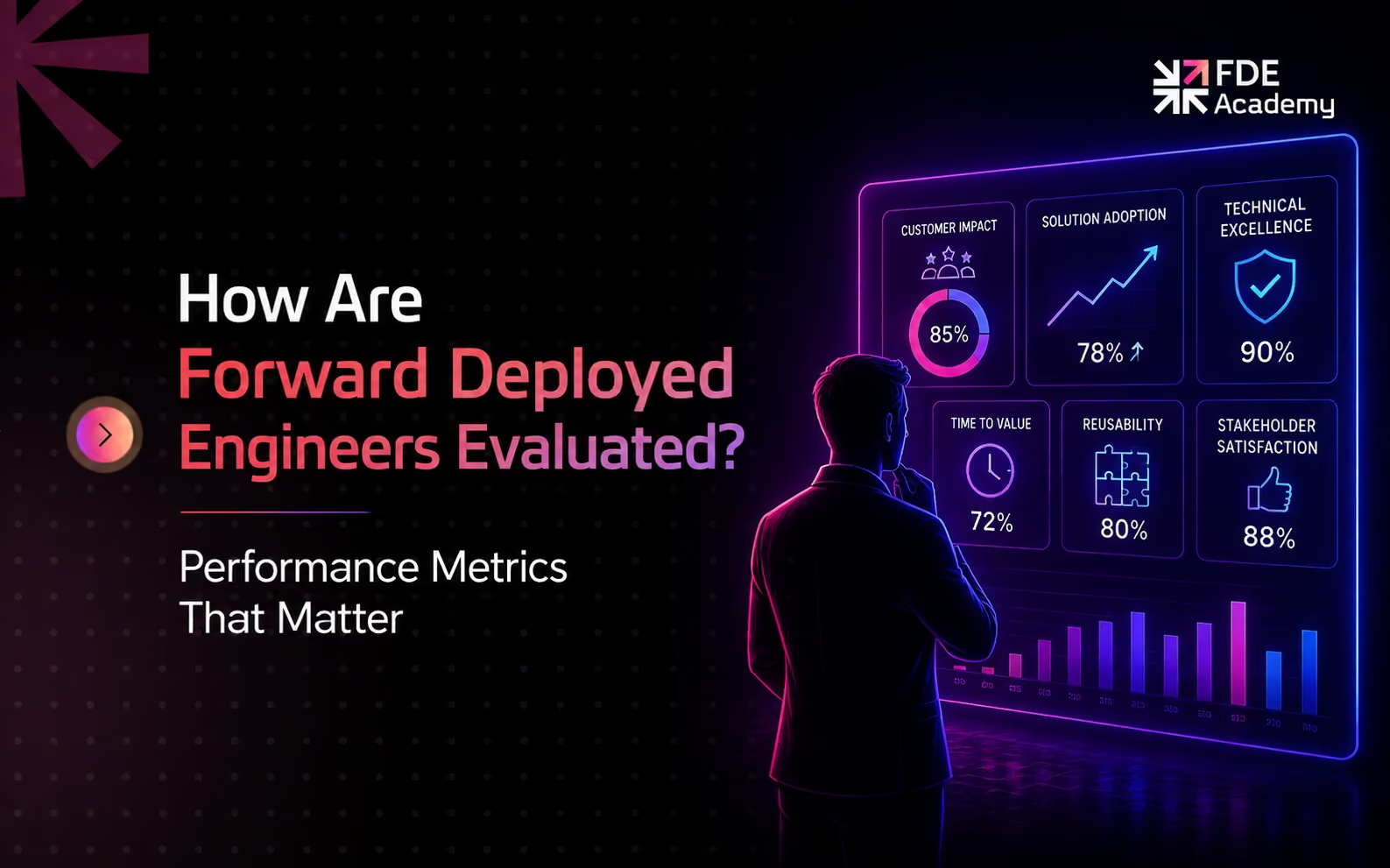
Forward Deployed Engineers are rarely evaluated on lines of code shipped or tickets closed, the standard metrics that work for internal product engineering don't map cleanly onto customer-embedded deployment work.
Instead, strong FDE performance reviews center on four categories: deployment outcomes, technical delivery quality, customer relationship health, and the feedback an engineer contributes back to the broader organization.
This guide breaks down what each category actually measures and why standard engineering metrics fall short for this specific role.
A typical internal product engineer's performance gets measured against velocity, story points completed, features shipped, code review turnaround. These metrics assume a stable, internal-facing context where output volume correlates reasonably well with value delivered.
Forward Deployed Engineer work breaks that assumption immediately: a single, smaller piece of code that unblocks a stalled customer deployment can matter more than a much larger volume of internal feature work, and the actual bottleneck in FDE work is frequent discovery and judgment, not raw coding throughput.
This is also why FDE performance reviews tend to weigh qualitative judgment alongside quantitative output more heavily than a typical engineering review would. A manager evaluating an FDE is asking not just "did they ship it" but "did they scope it correctly, did the customer relationship survive the process, and did anyone else benefit from what they learned."
The most direct, business-facing category: did the deployment actually ship, and did it deliver the outcome the customer needed. Specific measures here typically include time-to-value (how long from engagement start to a working, adopted system), pilot-to-production conversion (did the engagement result in a renewed contract or expanded scope, or did it stall), and post-launch stability (incident frequency and severity in the weeks following go-live).
Our piece on Forward Deployed Engineer vs Professional Services covers how these operational metrics, time-to-value specifically, function as a core performance driver distinguishing FDE work from adjacent roles.
A concrete illustration: two FDEs might both ship a working RAG system for a customer within the same quarter. One customer renews and expands scope within weeks of go-live; the other quietly churns three months later despite the initial deployment technically working.
The first FDE's outcome metric reflects genuine success; the second's reveals that "shipped" and "delivered value" aren't the same thing, and a manager evaluating only on shipping dates would miss this distinction entirely.
Separate from whether something shipped, this category measures how well it was built: code quality and maintainability (can the customer's own team maintain what was delivered after the FDE moves on), evaluation rigor (was a genuine test framework built defining correct versus incorrect outputs, not just a working demo), and system design choices (did the architecture anticipate likely future scope rather than requiring a rebuild for the next reasonable request).
This category exists specifically to catch a failure mode unique to fast-moving deployment work: shipping something that technically works but creates a maintenance burden or fragility the customer discovers only after the FDE has left.
Evaluation rigor specifically has become one of the most heavily weighted sub-measures in this category as AI deployments have matured. A manager reviewing an FDE's work increasingly asks not just whether the system produces good outputs in a demo, but whether a structured evaluation set exists that would catch a regression before a customer does.
An FDE who can point to a documented evaluation harness, with graded test cases and a clear definition of failure, is demonstrating a fundamentally different level of rigor than one who can only point to a handful of examples that happened to work well.
Performance in this area is harder to measure than technical work, but it's often one of the most important factors. Managers pay close attention to whether customers genuinely trust the FDE and involve them in solving new business problems.
They also look at how well the FDE handles changing requirements. A strong FDE knows when to push back, when to adapt, and how to avoid creating unnecessary technical debt while keeping the customer's trust.
Communication is another key factor. The ability to explain complex technical decisions in simple terms helps customers understand trade-offs and builds confidence in the proposed solution.
Managers usually gather this feedback directly from customers during check-ins, renewal discussions, or informal conversations. This helps uncover relationship or communication issues that may not appear in technical performance metrics but can have a major impact on long-term customer success.
Create reusable solutions: Top FDEs don't stop at solving one customer's problem. They build reusable patterns and frameworks that speed up future deployments.
Improve the product: They convert customer feedback into practical product recommendations instead of reporting generic issues.
Share knowledge: Senior FDEs document lessons learned and mentor teammates so the entire engineering team benefits from their experience.
Think beyond one project: The biggest differentiator is long-term impact. FDEs who influence future projects and product direction create more value than those focused only on completing a single deployment.
Several genuinely important signals are difficult to capture in a formal metric and frequently get underweighted as a result. Judgment under ambiguity, the quality of decisions made when a situation genuinely has no clean right answer, is one of the strongest predictors of long-term FDE success but resists easy quantification, which is part of why our First 90 Days guide covers how managers actually watch for it informally during onboarding rather than waiting for a formal review cycle.
Similarly, the cost of a near-miss, a problem an FDE caught and quietly resolved before it became a customer-visible incident, rarely shows up in any metric at all, since the absence of an incident isn't something most tracking systems are built to credit.
The relative weight given to each category shifts meaningfully by company type. AI-native labs (OpenAI, Anthropic) tend to weigh technical delivery quality and evaluation rigor most heavily, given the non-deterministic nature of the systems being deployed.
Enterprise platforms (Palantir, Databricks) often weight customer relationship health and deployment outcomes more heavily, reflecting longer, deeper customer engagements where trust compounds over multiple years. Startups frequently weigh internal contribution disproportionately, since a small FDE team's ability to turn one deployment's learnings into reusable infrastructure has outsized impact on a company still building its playbook from scratch.
This variation is worth taking seriously when evaluating a job offer, not just when already in the role. An engineer who thrives on deep technical rigor and evaluation design may find an enterprise platform's heavier emphasis on relationship management a poor match for their strengths, even if the base compensation and title look identical to a frontier lab's offer.
Asking directly, during the interview process, which of these four categories the team weighs most heavily is a legitimate and useful question, one that signals genuine interest in doing the job well rather than raising any concern about the candidate's preparedness.
Forward Deployed Engineer performance ultimately gets measured across four categories that standard engineering metrics don't capture cleanly: whether the deployment actually delivered value, whether it was built to last, whether the customer relationship stayed healthy through the process, and whether the organization learned something reusable from it.
Engineers who understand this framework early tend to focus their effort more effectively than those optimizing purely for technical output, since technical quality is necessary but genuinely insufficient on its own in this specific role.
Four categories: deployment outcomes (time-to-value, pilot-to-production conversion), technical delivery quality (code maintainability, evaluation rigor), customer relationship health (stakeholder trust, scope management), and internal contribution (reusable patterns, product feedback quality).
Because FDE work doesn't correlate output volume with value the way internal product engineering does. A small piece of code that unblocks a stalled deployment can matter more than a large volume of feature work, and the actual bottleneck is frequent discovery and judgment rather than coding throughput.
Often through direct customer feedback rather than the engineer's self-report: whether the customer's team proactively loops the FDE into new problems, how scope changes were navigated, and renewal or expansion conversations with the account.
Rarely as a formal metric, since it's genuinely difficult to quantify, but it's one of the strongest informal signals managers track, particularly during onboarding and early engagements, even when it doesn't appear on a scorecard.
Yes, significantly. AI-native labs tend to weigh technical delivery quality and evaluation rigor most heavily. Enterprise platforms often weigh customer relationship health more. Startups frequently weigh internal contribution and reusable pattern creation disproportionately.
Ask directly. Because these metrics vary by company and even by manager, the fastest way to align expectations is a direct conversation early on asking what a strong review in this specific role, at this specific company, actually looks like.
The world is hiring - and this Academy prepares you for it.