Blogs
How Do Forward Deployed Engineers Improve AI ROI?
How Do Forward Deployed Engineers Improve AI ROI?
By
R&D, FDE Academy
July 30, 2026

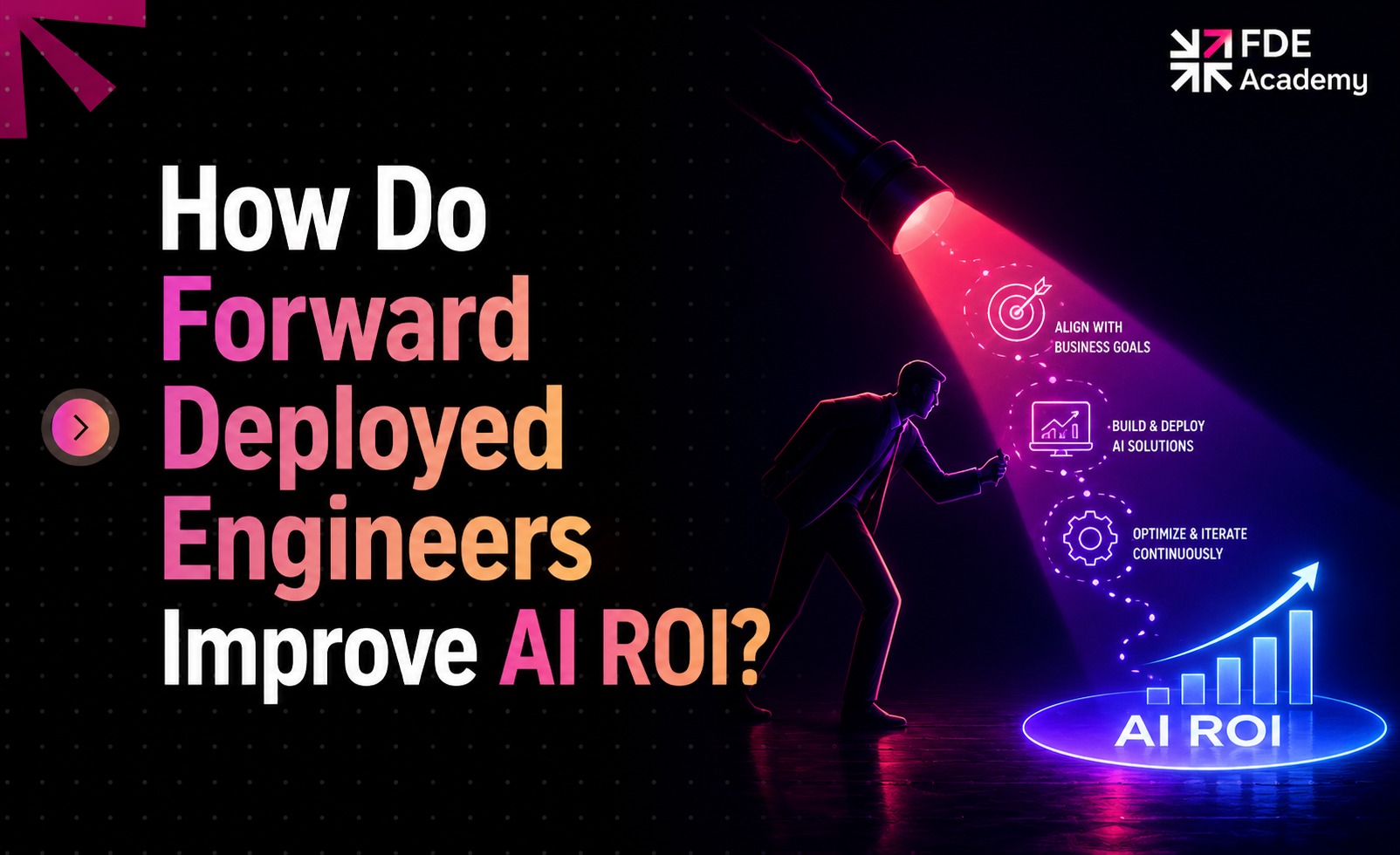
Forward Deployed Engineers (FDEs) improve AI ROI by closing the last-mile deployment gap that causes most enterprise AI projects to fail before they deliver measurable value.
They embed directly inside a customer's environment, own integration from pilot to production, and convert expensive AI investments from stalled pilots into functioning systems that drive revenue, reduce cost, and earn renewal.
This is not a niche role or a premium add-on. It is the missing link between what AI can do in a demo and what it actually delivers in a live business environment.
Most enterprise AI projects do not fail at the model stage. They fail at the deployment stage.
MIT research puts the generative AI project failure rate at 95% when measured against expected ROI. The root cause is rarely a bad model. It is the gap between a capable model and the customer's real workflows, messy data, and legacy systems.
Coastal's 2026 AI Operations Report, which surveyed 800 organisations, found that 73% face data accuracy or availability issues after AI launch, and 60% face ongoing integration difficulties connecting AI to systems like Salesforce, ServiceNow, or their core ERP.
Only 7% of enterprises say their data is fully ready for AI adoption, according to a joint report by Cloudera and Harvard Business Review Analytic Services.
This is the environment FDEs are hired to work in. Not the clean, well-documented environment of a demo. The actual one.
The market is scaling FDE capacity as fast as it can because the alternative is AI investments that never reach ROI.
Understanding how Forward Deployed Engineers improve AI ROI requires understanding what they are not.
A consultant advises and recommends. A solutions engineer demos and configures. An FDE builds, ships, and owns.
The accountability column is what sets the FDE apart. An FDE is not paid to hand over a document or configure a template. They are paid for the outcome: a working system that delivers the business result the client was promised.
To understand the full scope of what a Forward Deployed Engineer is and how the role emerged from Palantir's deployment model, the cornerstone guide covers the complete picture.
Forward Deployed Engineers drive AI ROI through five specific, repeatable mechanisms. Each one addresses a failure mode that kills AI projects before they reach measurable value.
The last-mile gap is the space between a validated AI prototype and a production system running inside a real customer's environment. It is where most AI ROI disappears.
Closing it requires someone who can write production code, navigate an unfamiliar legacy stack, handle enterprise authentication, satisfy security review, and get a working system in front of actual users.
Without an FDE in this role, the gap is typically managed by the client's internal IT team, which is already at capacity. Coastal's 2026 research found that 58% of organisations cite internal team bandwidth as the single most common barrier to running AI, ahead of technology, strategy, and budget combined.
Time to value is the interval between signing an enterprise AI contract and the client seeing measurable business impact. Longer TTV kills renewal, erodes trust, and inflates the cost of each deployment.
FDEs compress TTV by running the iteration cycle fast: Discovery, Prototype, Validate, Ship, Iterate. Rather than a linear handoff from sales to engineering to implementation, an FDE owns the entire path and eliminates the coordination overhead between teams.
Perspective AI's 2026 analysis of 200+ enterprise AI engagements found that the target FDE ROI benchmark for deal velocity is production deployment within 90 days of contract signature. That is the window within which AI investments retain client confidence.
Enterprise AI has to plug into systems the vendor never designed for. The client's ERP, CRM, help desk software, and years of accumulated custom logic all need to integrate with the AI system being deployed.
FDEs handle this integration layer directly. They write the connectors, manage the data transformation pipelines, resolve the edge cases that only appear in production, and fix the authentication problems that surface during security review.
This is a concrete, engineering task. It is not advisory work, and it cannot be delegated to a non-technical team. The AI Forward Deployed Engineering model goes deeper on how FDEs are specifically structured to own this integration layer in production.
The pilot-to-production transition is where most enterprise AI projects die. A pilot proves a concept under controlled conditions. A production system runs under real load, with real users, inside real constraints.
The failure modes at this transition are:
An FDE anticipates all four failure modes and engineers around them before go-live. That is why Perspective AI's ROI scorecard for FDE functions targets a net revenue retention of 130% or higher on accounts where FDEs are deployed.
This is the mechanism most companies undervalue. An FDE embedded in a customer environment sees failure modes, edge cases, and workflow gaps that the product team at headquarters will never encounter.
When that intelligence flows back, it makes the core product better for every future customer. Stripe built an FDE team specifically for this reason: to close the gap between what its Revenue and Financial Automation products could do and what enterprise customers actually needed them to do.
This creates a compounding ROI effect. Each FDE engagement generates product improvements that reduce the cost and failure rate of every subsequent deployment.
Measuring FDE performance on revenue alone is the most common mistake companies make. It rewards short-term deal behaviour and starves the product team of the customer intelligence FDEs exist to generate.
Perspective AI's 2026 analysis of enterprise AI deployments recommends a four-metric scorecard:
The clearest evidence of how Forward Deployed Engineers improve AI ROI is in how the largest AI companies have structured their own deployment organisations.
OpenAI - OpenAI launched its dedicated Deployment Company in May 2026, backed by $4 billion from 19 investment firms. It simultaneously acquired Tomoro, a deployment consultancy staffed with approximately 150 experienced forward-deployed engineers and deployment specialists.
Anthropic - Anthropic structured its enterprise AI strategy around embedded deployment through a partnership with Fidelity Information Services (FIS), announced in May 2026. Applied AI teams and forward-deployed engineers work directly with FIS to co-design a financial crimes AI agent for anti-money laundering investigations.
Google Cloud - Google Cloud has expanded its FDE hiring specifically for generative AI deployments, with job descriptions that explicitly frame the role as embedded builders who move systems from prototype to production by addressing integration, data readiness, and deployment constraints in customer environments.
Palantir - Palantir, which pioneered the FDE model in 2008, continues to run the largest dedicated Forward Deployed Engineering function in enterprise AI. Its deployment methodology is the template that every other company in this list has adapted.
For a granular picture of a day in the life of an FDE, the FDE Academy guide covers the full daily pattern. At a summary level, FDE daily activities that directly translate to ROI include:
Senior FDEs at Palantir earn total compensation ranging from $205,000 to $486,000, with an average of $238,000. FDEs at OpenAI and Anthropic typically earn $350,000 to $550,000 in total compensation, per forward deployed engineer salary data.
Set that against the cost of a failed AI deployment: integration work that gets scrapped, SaaS contracts that don't renew, internal engineering time diverted from the product roadmap, and the opportunity cost of twelve months of AI investment that delivers no measurable return.
The ROI calculation changes completely when you frame it as FDE cost versus failed deployment cost, rather than FDE cost versus alternative hire cost. An FDE who ships one deployment within 90 days and generates 130% NRR on a seven-figure account pays back their cost in the first engagement.
For engineers reading this from a career angle: the FDE role is where engineering skill and business impact converge most directly.
Most engineering roles produce outputs that are measured internally by code quality, test coverage, or feature velocity. FDE work is measured by whether the customer's business problem got solved, on time, in production.
That accountability is demanding. It is also what makes the role compelling for engineers who want to see their work land in the real world and generate verifiable business outcomes.
If you are evaluating this path, how to become a forward deployed engineer maps the specific skills, transition strategies, and career milestones for engineers targeting FDE roles in 2026.
FDE Academy's PGP in Forward Deployed Engineering and Applied AI Solutions is the only structured 8-month program built specifically for this career path, built by practising FDEs and covering the full production-to-customer skill stack. 60 selective seats per cohort. Learn more at fde.academy.
Forward Deployed Engineers improve AI ROI through five core mechanisms: closing the last-mile deployment gap, accelerating time to value, resolving integration failures, converting pilots to production systems, and feeding customer intelligence back to the product.
Most enterprise AI projects (95%, per MIT research) fail at the deployment stage, not the model stage. FDEs exist to own that stage. Companies like OpenAI, Anthropic, Google Cloud, and Palantir have all built dedicated FDE functions because the alternative is AI investment that never reaches measurable business return.
The FDE ROI scorecard targets production deployment within 90 days, NRR of 130%+, and productisation of field learnings. For engineers, this is where engineering skill and business impact converge most directly.
FDEs improve AI ROI by closing the last-mile deployment gap, accelerating time to value, resolving integration failures, converting AI pilots into production systems, and feeding customer intelligence back to the product team.
MIT research puts the enterprise AI project failure rate at 95% when measured against expected ROI. The root causes are last-mile deployment failures: legacy integration complexity, data that is not production-ready, internal team bandwidth constraints, and the absence of clear ownership between demo and live deployment.
Perspective AI's 2026 analysis benchmarks FDE ROI against four metrics: production deployment within 90 days of contract, net revenue retention of 130% or higher, at least one feature shipped to the core product per engagement, and 70% of FDE code in the main product repo by month 12.
OpenAI launched a dedicated Deployment Company in May 2026, backed by $4 billion, and acquired Tomoro with 150 FDEs. Anthropic embedded FDEs with Fidelity Information Services to co-design a production financial crimes AI agent.
Yes, when measured against the cost of a failed AI deployment. Senior FDEs earn $205,000 to $486,000 in total compensation at companies like Palantir. A single successful deployment that generates 130% NRR on a seven-figure enterprise contract recovers that cost in one engagement.
The world is hiring - and this Academy prepares you for it.