Blogs
How to Become a Forward Deployed Engineer: Career Paths, Required Experience and Training Options
How to Become a Forward Deployed Engineer: Career Paths, Required Experience and Training Options
By
R&D, FDE Academy
March 22, 2026

Building a powerful AI product is only the first step. The real challenge begins when that product needs to work inside an enterprise environment filled with legacy systems, complex infrastructure, disconnected data sources, and unique business processes.
This gap between software development and real-world implementation is where the Forward Deployed Engineer (FDE) plays a critical role. FDEs work directly with customers to deploy, integrate, and optimize software solutions, ensuring they deliver measurable business outcomes rather than remaining successful only in controlled development environments. Understanding how to become a Forward Deployed Engineer starts with learning how these engineers combine software development, system integration, AI implementation, and customer-focused problem-solving.
Enterprise software and artificial intelligence are penetrating the real world. Logistics and healthcare are just some of the areas where businesses are implementing sophisticated systems which often need to operate within a very fragile internal environment of the enterprise.
This has caused organizations to require a greater number of engineers who are more than just codewriters. They require experts that have the ability to implement systems, merge technologies and to address issues directly in customer settings.
This trend has generated an increase in demand for the Forward Deployed Engineer.
Forward Deployed engineers work at the nexus of software engineering, infrastructure deployment and customer facing problem solving. They do not work individually on the internal product features; instead, they work hand in hand with the customers in order to deploy, integrate, and optimize intricate software systems in production systems.
The role has received a lot of interest in recent years as businesses that develop more sophisticated technologies - especially AI platforms and enterprise software products - demand engineers that are able to bridge the gap between product creation and its practical use.
As demand for Forward Deployed Engineers continues to grow, many aspiring professionals have similar questions:
There is no typical educational route to becoming a Forward Deployed Engineer, as it is with traditional software roles. The majority of professionals switch towards this role having practical experiences in dealing with production systems, infrastructure and enterprise deployments.
This guide provides an overview of the career routes engineers use to be Forward Deployed Engineers, the general backgrounds engineers typically have to start their careers in the field, and the learning opportunities that may assist in the transition.
The majority of the Forward Deployed Engineers career start in conventional engineering positions. This role is usually developed once engineers have worked with production systems, infrastructure and large scale deployments.
The usual backgrounds used are:
A large number of FDEs start as engineers in back-end or platform roles on a distributed system, API, or enterprise application. These engineers are already conversant with system architecture and software integration.
Deployment pipeline, cloud infrastructure, and system reliability engineers frequently transfer across to FDE roles since they frequently have close access to the production environment and the deployment process.
Data engineers construct pipelines which transport and transform huge datasets. They are good candidates in forward deployed engineering because of their experience of integrating systems and managing enterprise data infrastructure.
Machine learning engineers may transition into Forward Deployed Engineering in AI companies as they transition to the deployment of models into actual customer settings.
Designing scalable services, APIs, and internal platforms, engineers frequently get experience with distributed systems that can be used subsequently in deployment engineering.
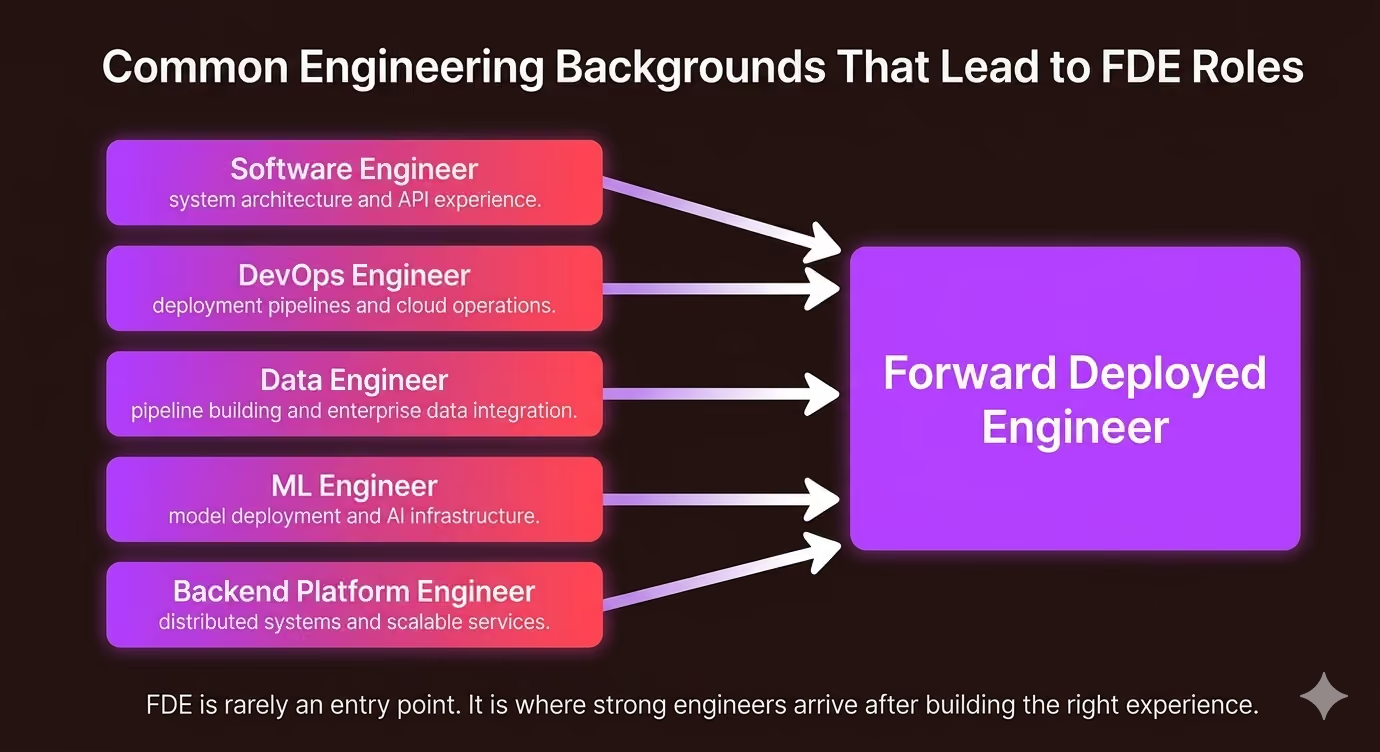
FDE position in most instances is not an immediate entry level career, but a result of several years of work experience post-engineering.
There is no single route to becoming a Forward Deployed Engineer, but most engineers can follow a practical progression from core engineering skills to production deployment and customer-facing work.
To be a Forward Deployed Engineer does not imply any particular certifications but rather the experience of operating in complex systems in the real world.
Some work types naturally equip engineers to do FDE tasks.
Engineers that deploy software to live environments often receive experience in dealing with reliability, performance management, and unforeseen problems. Production deployments educate the engineers on the software behavior beyond the controlled development environments.
Enterprise systems hardly exist in vacuum. Engineers frequently have to integrate the application with existing applications like CRM, data warehouses, ERP systems, or analytics. The engineers that acquire experience with building and maintaining integrations acquire good system level knowledge.
Trouble shooting of complex system behaviour is one of the fundamental duties of a Forward Deployed Engineer. This can include researching cloud infrastructure problems, network latency, or data pipeline problems, or unusual application behavior at scale.
The problem-solving skills that are necessary in FDE roles are developed in engineers who debug distributed systems and infrastructure problems on a regular basis.
Forward Deployed Engineers frequently deal with external customers as opposed to many other internal engineering jobs. This needs the capacity to comprehend various technical environments, adapt deployments to current systems, and effectively communicate with client engineering teams.
Practical experience in customer-facing engineering jobs, implementation teams, or enterprise technical support can be especially helpful.
Enterprise implementation may entail various services, cloud systems, data pipelines, and integrations with the pre-existing business systems. The engineers who are involved in multifaceted deployment projects gain experience of how large systems work in the production process.
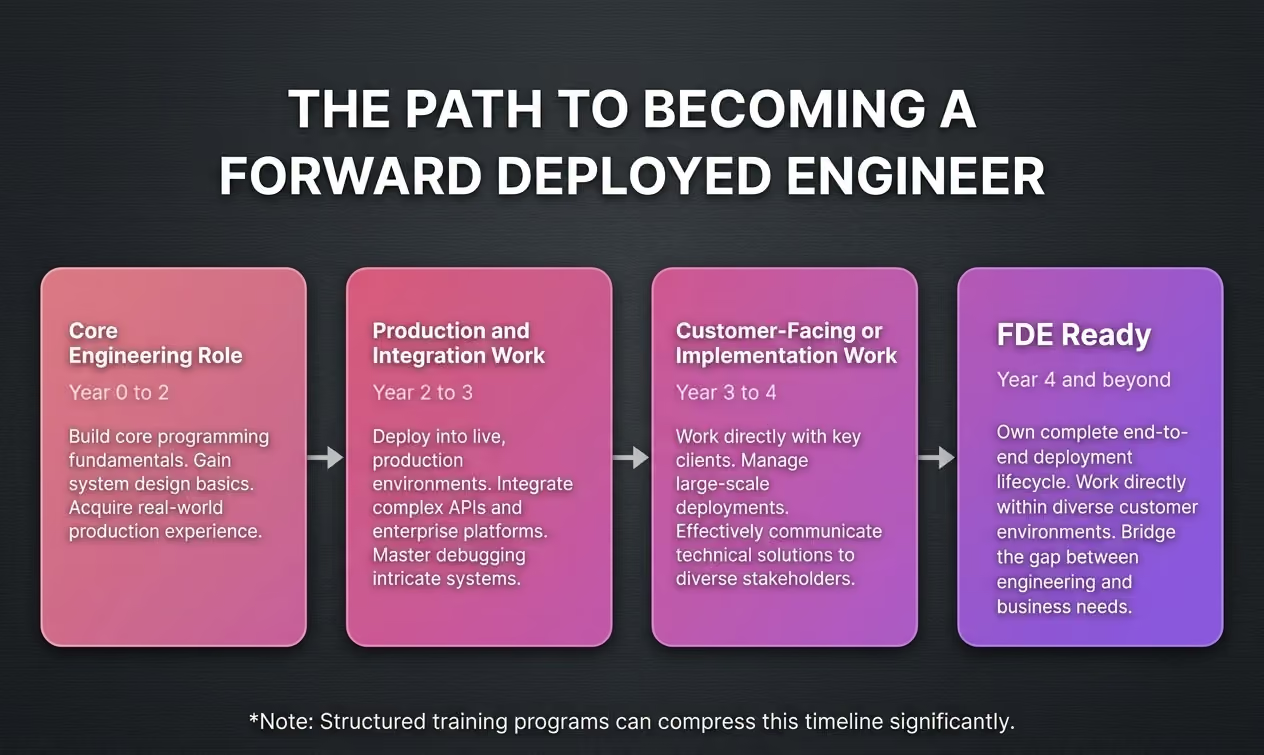
Such experiences accumulate over time to create the deployment experience and system level thinking needed to accomplish Forward Deployed Engineering.
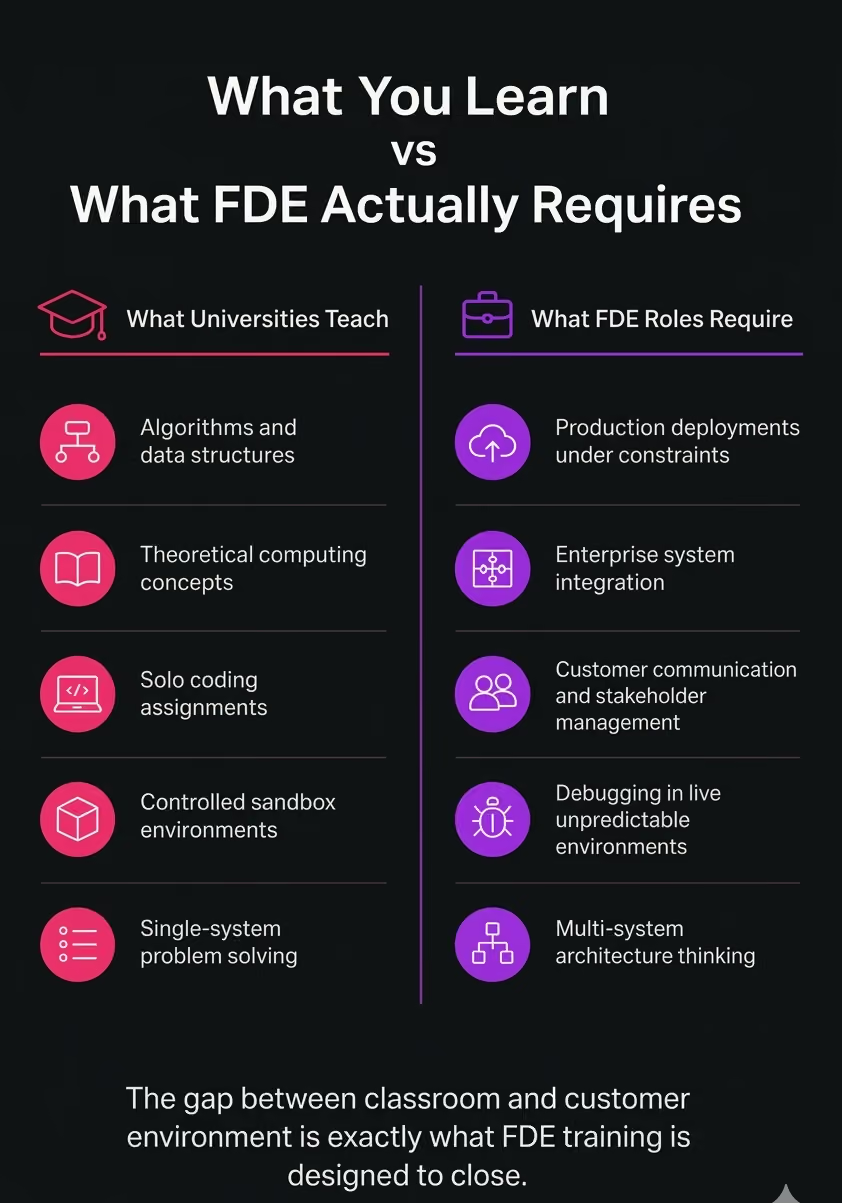
Although Forward Deployed Engineers are in a growing demand, the capabilities that one needs to fulfill the job are seldom acquired in the normal educational channels.
This career is hard to prepare in normal engineering training due to several reasons.
Algorithms, data structures, and theoretical basis of computing are highlighted in most computer science programs. Although these subjects are also necessary, they are not usually about the deployment of systems in the real world, integrating the infrastructure, and debugging the production.
In big technology firms, engineers usually work on developing particular product components instead of implementing systems into the external environment. This will restrict the exposure to the kind of integrational challenges FDEs face.
Technology environments such as enterprise environments are usually characterized by legacy systems, elaborate data pipelines, security layers, and bespoke integrations. These difficulties are faced by many engineers but it takes them several years of work experience before they encounter them.
System integration and deployment engineering are seldom taught but are acquired by experience over a period of time. These skills are normally acquired by the engineers as they undertake big deployment projects.
Due to these gaps, several engineers that are interested in Forward Deployed engineers seek planned methods of developing deployment and integration experience.
Though there is no direct road into Forward Deployed Engineering, some engineers do make the effort to target a position or project that allows them to achieve the necessary experience more quickly.
In a startup environment, engineers are usually expected to do a variety of tasks at their first stages, such as the development of the product, maintaining the infrastructure, and deploying customers. Such an environment exposes them to real life implementation issues.
The ability to work on deployment pipes, cloud infrastructure, and system reliability is developed by engineers who play a significant role in creating many of the operational skills necessary in the FDE roles.
Firms utilizing enterprise software also tend to have technical implementation groups which are tasked with modifying products to customer settings. The engineers involved in such projects get real-life experience of enterprise deployments.
Other engineers acquire the requisite experience by constructing tools that tie various software systems, automate deployments, or in data pipelines.
Such experiences are useful in enabling engineers to gain system-level thinking and deployment experience, which are the core of Forward Deployed Engineering jobs.
Since Forward Deployed Engineering integrates several areas of skills such as software engineering, deployment of infrastructure, system integration, and customer collaboration, some engineers prefer structured learning programs to hasten the process of learning.
A forward deployed engineering course or forward deployed engineering program can be devoted to practical situations including:
The programs usually replicate real world engineering scenarios, which are similar to work that Forward Deployed Engineers perform when they are deployed to work.
Structured training, instead of being entirely based on theory, may tend to lean towards practical projects, system architecture construction and simulations of real deployment.
These formal learning pathways can serve to bridge the divide between classroom training and the on the job training in the field of forward deployed engineers that are needed to occupy these positions.
To learn about the work of a Forward Deployed Engineer, we may take a real-life situation of a deployment of an AI system.
The scenario is the implementation of an AI Model in a Logistics Company.
A logistics company is interested in using the AI model that will forecast shipment delays and the best routes to deliver.
During this implementation, a Forward Deployed Engineer can have a number of tasks.
Engineers are regularly required to connect applications with CRM platforms, data warehouses, ERP systems, and analytics tools. Building and maintaining these integrations develops strong system-level thinking that directly maps to FDE work.
The engineer creates APIs, which enable the internal logistics software to communicate with predictions made by the AI model.
To handle massive amounts of logistics data and real-time predictions, the system should be implemented with scalable cloud infrastructure.
Once deployed, the engineer monitors the performance of the systems, determines the possible problems as well as guarantees that the model will run successfully within the current company infrastructure.
Such projects are indicators of the practice-oriented, deployment-oriented work that Forward Deployed Engineers do at production locations.
Even though coordinated programs may aid in speeding up the learning process, several engineers are Forward Deployed Engineers by other career tracks.
The alternative directions are possible and include:
Enterprise software deployers find experience integrating products into highly complex customer environments.
DevOps engineers develop deployment pipelines and operate infrastructure, which is similar to most FDE tasks.
Cloud platform, networking and distributed infrastructure engineers tend to have an excellent understanding of systems at the system level.
Startup engineers are often involved in product development and deployments with customers, which is a good experience in FDE jobs.
These secondary paths show that there are several career paths that may lead to Forward Deployed Engineering, based on the kind of engineering experience an individual has had.
The engineers who have an interest in Forward Deployed Engineering can prepare the position by building a few essential competencies.
Being familiar with the workings of distributed systems APIs, data pipelines, cloud infrastructure, and service architecture is vital to deployment-oriented jobs.
Engaging in deployment of production also assists engineers to comprehend the operational difficulties and reliability of the system.
The FDEs regularly troubleshoot various systems. It is very useful to develop effective infrastructure, network, and software-layer debugging.
During the deployments, Forward Deployed Engineers usually liaise with the client teams. In such cases, communication and technical explanation skills come into play.
Forward Deployed Engineering is becoming an essential position in the work of current technology firms especially those that implement enterprise software and AI systems.
There is no standard academic route to becoming an FDE as is the case with most engineering professions. Rather, engineers learn the necessary experience over time through practical exposure to system deployments, integrations and production systems.
These are often launched into software engineering, DevOps, data engineering, and machine learning. Engineers who have an exposure to the real world deployment issues acquire the skills necessary in the system level of Forward Deployed Engineering over time.
Engineers who seek to hasten their move can have recourse to forward deployed engineer training programs, forward deployed engineering course or even course specific deployment oriented learning paths as some of the ways to offer them a structured exposure to real-life situations.
With the ever-growing complexity of enterprise systems and the ongoing growth of AI technologies into the real-world setting, the number of engineers capable of closing this divide between software products and the real-world systems is likely to expand drastically.
A computer science degree is not a strict requirement for becoming a Forward Deployed Engineer. Most FDEs come from practical engineering backgrounds in software development, DevOps, data engineering, or infrastructure. What matters more is hands-on experience with production systems, integrations, and enterprise deployments.
Most Forward Deployed Engineers have between two and five years of prior engineering experience before moving into the role. The role requires comfort with production systems, debugging complex infrastructure, and working directly with customers, which typically takes time to develop through hands-on work.
It is uncommon but not impossible. Some companies with structured graduate programs or training tracks do hire entry-level engineers into FDE adjacent roles. However, most FDE positions expect prior experience with deployment, system integration, or enterprise infrastructure.
The fastest path typically involves combining practical experience in deployment-oriented roles with structured training. Working in startups, joining DevOps or implementation teams, and completing a purpose-built FDE training program can significantly shorten the transition timeline compared to waiting for the experience to accumulate organically.
Traditional certifications do not cover Forward Deployed Engineering directly. However, structured programs like the PGP in Forward Deployed Engineering at FDE Academy are designed specifically around deployment-oriented engineering, real-world simulation, and applied AI systems, which directly maps to what FDE hiring teams look for.
Backend engineering, DevOps, data engineering, and machine learning engineering are the most common backgrounds for FDE transitions. Each provides a different but complementary set of skills. Backend engineers bring systems knowledge, DevOps engineers bring deployment experience, data engineers bring pipeline expertise, and ML engineers bring AI deployment familiarity.
The world is hiring - and this Academy prepares you for it.