Blogs
How Fresh Graduates Can Break Into Forward Deployed Engineering
How Fresh Graduates Can Break Into Forward Deployed Engineering
By
R&D, FDE Academy
June 19, 2026

Key fact: The gap between a fresh graduate and FDE role is not years. It is the right combination of technical depth, deployment thinking, and client-facing confidence. That combination can be built in months with the right preparation.
The Forward Deployed Engineer role is exploding. FDE job postings grew more than 800 percent in 2025. Companies across AI, SaaS, and enterprise software are building FDE teams from scratch.
And yet almost every job description asks for three to five years of experience.
For a fresh graduate or early-career engineer in India looking at this role, that gap can feel discouraging. The role sounds exactly like what you want to do. The requirements seem to close the door before you even knock.
This article is about that gap. What it actually means, whether it can be closed, and precisely how to close it faster than you think.
The honest answer is that the path exists. Most graduates who want it are just preparing the wrong way, and spending time on the wrong things.
Before talking about how to break in, it is worth understanding why the experience requirement exists at all. It is not arbitrary.
A Forward Deployed Engineer works inside a client's production environment. Real systems, real data, real deadlines, real accountability. When something breaks at midnight, there is no senior engineer to escalate to. When a client's CTO asks a question you cannot answer confidently, you cannot say you are still learning. The role demands the ability to operate effectively under pressure in unfamiliar environments without a safety net.
That capability typically develops through professional experience: debugging systems you did not build, owning production incidents, navigating client relationships with competing priorities. These are things a classroom or personal project can approximate but cannot fully replicate.
However, experience is a proxy for capability, not the thing itself.
What FDE hiring teams are actually looking for is evidence that you can do specific things: reason through ambiguous problems, build and deploy systems that work in the real world, communicate technical decisions clearly, and take ownership of outcomes. If a fresh graduate can demonstrate those things convincingly, the years on the resume matter less.
That is what the rest of this article covers.
When a fresh graduate or early-career engineer applies for a Forward Deployed Engineer role, the hiring team is asking a specific question: does this person have the instincts the role requires, even without the professional history to prove it?
There are four things that answer that question positively.
The FDE interview process across most companies tests how you approach an ambiguous problem, not how quickly you can solve it. You will be given a large, open-ended scenario and asked to work through it. The failure mode for fresh graduates is waiting to be told how to structure the problem, or jumping to a solution before understanding what the real problem actually is.
This instinct can be developed deliberately. It is a skill, not a trait. Engineers who have practised talking through ambiguous problems out loud, who have learned to ask the right clarifying questions before proposing anything, and who have built the habit of naming assumptions before treating them as facts, develop this faster than those who have not.
Most graduates underinvest in this completely. They practise algorithms. They do not practise decomposition.
The most differentiating thing a fresh graduate can show is a project that was deployed and used by real people. Not a demo. Not a polished GitHub repository. A system that ran in production, had actual users, broke in an unexpected way at some point, and had to be fixed.
Deployment experience teaches you things that cannot be learned any other way. How systems behave when data is dirty. How users interact with a product versus how you imagined they would. What breaks under real load that worked perfectly in development. Fresh graduates who have this experience, even from a modest project, stand apart from those who have not.
If you are in your final year, the most valuable thing you can do right now is build and deploy something real. It does not need to be impressive in scope. It needs to be live, used, and maintained.
Forward Deployed Engineering is fundamentally about connecting systems. Most graduate projects are self-contained. They do not connect to external APIs, handle authentication across different systems, or deal with the messiness of real-world data coming from a source you do not control.
A fresh graduate who has built at least one project that pulls real data from an external API, handles authentication, and deals gracefully with failures shows a fundamentally different level of readiness than one who has not. It is a specific gap to fill, and it is fillable in weeks with a focused project.
The client simulation dimension of FDE work is the one most graduates prepare the least for. Explaining a technical failure to a non-technical stakeholder. Holding firm on a technical constraint under client pressure. De-escalating a tense situation without making promises you cannot keep.
Graduates who have done any customer-facing work, even informally, a part-time role, a freelance project, a university club where they presented technical work to non-technical audiences, have a foundation here. Those who have worked entirely in isolation need to practice this specifically before an FDE interview.
Most engineering portfolios are built to get software engineering jobs. That means they show technology competence through completed projects. An FDE portfolio shows something different: deployment thinking through real-world problem solving.
Here is what matters and what does not.
The portfolio question is about quality over quantity. One strong deployed project with a case study is more effective than eight polished demos.
Building a portfolio that meets this standard from scratch is one of the things FDE Academy structures explicitly. The programme includes guided deployment projects designed to produce the kind of real-world evidence that FDE hiring teams look for, rather than leaving graduates to figure out what to build on their own.
There are two realistic routes for a fresh graduate who wants to break into a Forward Deployed Engineer role. Being clear about which one applies to your current situation saves significant time.
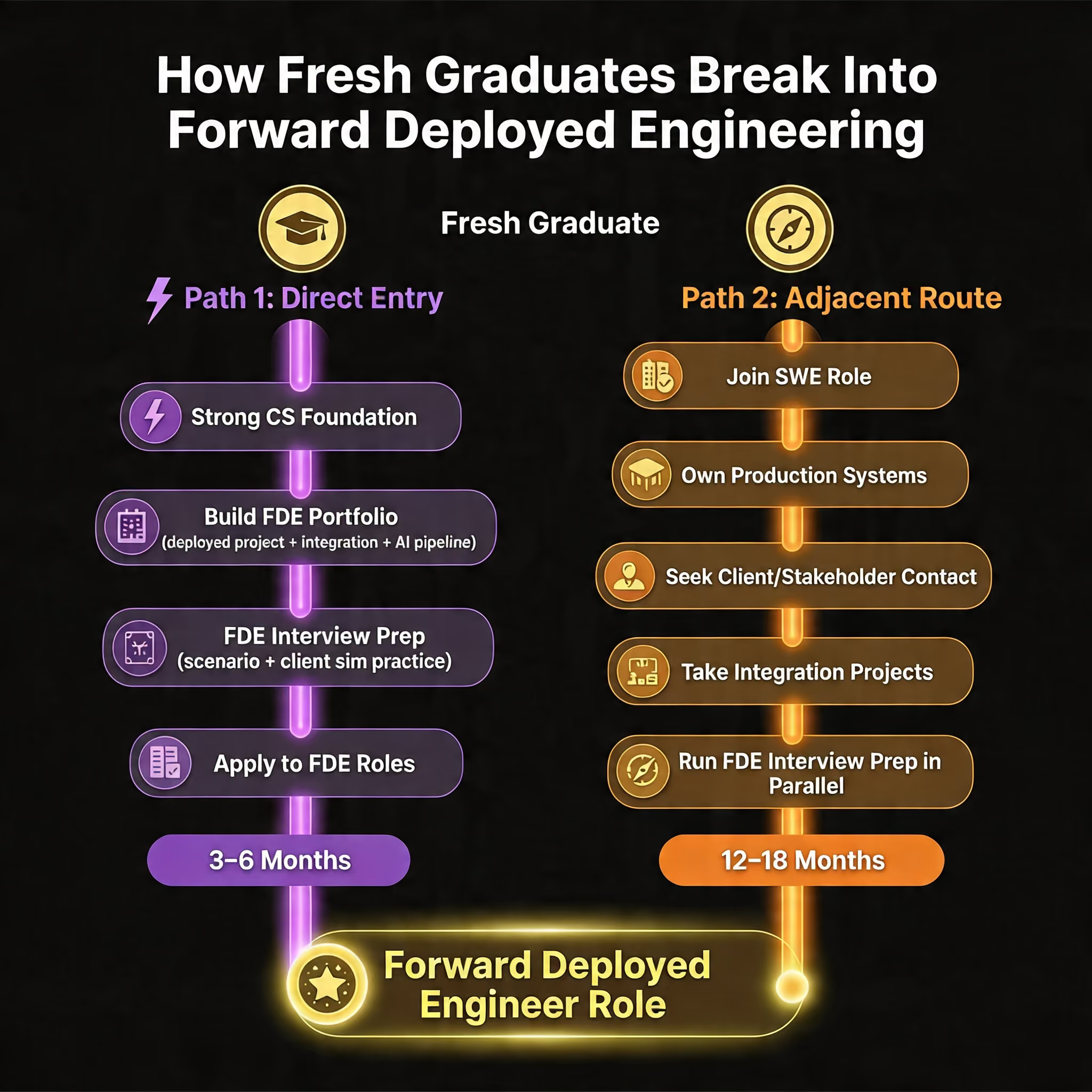
This path is possible but narrow. It requires a specific combination: strong academic foundation in computer science or engineering, at least one deployed project with real users, demonstrated integration and AI systems knowledge, and the ability to handle FDE-style interview formats, specifically the open deployment scenario problem.
The graduates who successfully take this path directly are typically those who have done one or more of the following during their degree:
The fourth point is worth expanding. The gap between a capable fresh graduate and one who can compete for an FDE role is largely a preparation gap, not a talent gap. Most graduates who want this role have the underlying aptitude. What they lack is the specific deployment experience, the FDE interview format preparation, and the portfolio that signals FDE-readiness rather than SWE-readiness.
This is precisely the gap that FDE Academy is designed to close. The programme is built around the specific skills FDE employers test: production deployment, integration engineering, client communication under pressure, and the open scenario interview format. Graduates who complete structured preparation of this kind move from the standard SWE candidate pool into the FDE-ready candidate pool, which is significantly smaller and significantly more competitive for roles.
For graduates who cannot land a direct FDE role immediately, the faster-than-expected path is to join a software engineering role with deliberate intent to build specific FDE-relevant experiences, then make the transition within 12 to 18 months.
The key word is deliberate. This path fails when graduates join a standard SWE role and wait for FDE experience to happen organically. It works when you are actively engineering your own experience toward a specific goal.
The three experiences that matter most to build in that window:
Seek on-call responsibility for a real system. Be the person accountable when something breaks at 2am. This is most accessible at smaller companies and startups where on-call is not shared across a large team. One year of genuine production ownership teaches you more about deployment thinking than three years of ticket-based feature work.
Actively seek opportunities to interact directly with the people your work affects. Internal tooling projects where you gather requirements directly from users. Technical support escalations where you diagnose and communicate. Presentations to non-technical stakeholders. Any of these develops the client instinct that FDE work demands.
Volunteer for the integration projects nobody else wants. The API work connecting your company's system to a third-party service. The data pipeline pulling from a messy external source. The authentication layer bridging two systems with different security models. These projects are unglamorous and difficult to scope. They are exactly what FDE-relevant experience looks like.
After 12 to 18 months of building these three experiences deliberately, alongside the portfolio work you do in parallel, your profile changes materially. You are no longer competing as a fresh graduate. You are competing as an engineer with directly relevant early-career FDE experience.
There is one dimension of FDE readiness that fresh graduates underestimate more consistently than any other: the client-facing communication requirement.
Most engineering education focuses entirely on technical problem solving. The assumption is that communication will develop naturally over time. For standard software engineering roles, this is broadly true. For FDE roles, it is not.
A Forward Deployed Engineer is the technical authority in the room with a client. Not a support resource. Not someone who escalates to a senior engineer. The authority. That means explaining why an AI model is producing inconsistent results to a CFO who does not know what an embedding is. It means holding firm on a technical constraint under commercial pressure. It means staying composed and useful when a client system fails in front of an executive audience.
This is a learnable skill. But it requires practice with real humans in pressure situations, not solo preparation. The engineers who develop it fastest are those who find structured environments to practice the specific scenarios FDE roles produce: the escalation call, the scope negotiation, the technical explanation to a non-technical audience.
The client simulation round is the round that eliminates the most technically strong FDE candidates. Not because they lack technical ability. Because they have never practised communicating technical decisions under real pressure.
The FDE Academy programme includes structured client simulation practice specifically because this is the gap that costs graduates the most in interviews. Practising this in isolation does not develop the skill. The scenario work needs to involve real pressure, real time constraints, and real feedback on what worked and what did not.
The framing mistake most graduates make is presenting themselves as engineers who want to try something customer-facing. The correct framing is that you are an engineer whose work has already involved the challenges FDE roles are built around, just in an earlier-career context.
Specific changes to resume and application language:
The self-teaching path into FDE is possible but slow. It works by accumulating the right experiences over time, making mistakes in professional contexts, and gradually developing the combination of technical depth and client communication that the role demands.
Structured training compresses this timeline by making the development deliberate rather than accidental.
The difference is specific. When you know exactly what FDE hiring teams test, you can build portfolio projects that demonstrate those specific things rather than building projects that seem impressive in general. When you understand the open deployment scenario interview format, you can practise it dozens of times before your first real interview rather than encountering it for the first time under pressure. When you have done client simulation practice with real feedback, you walk into the client round with a framework rather than improvising.
This is not about shortcuts. The forward deployed engineer skills still need to be developed. Structured training accelerates the development because it is targeted rather than general.
For fresh graduates and early-career engineers in India who want to move into Forward Deployed Engineering, the question is not whether to prepare. It is whether to prepare with a general plan you build yourself or a structured path designed specifically for this transition.
FDE Academy exists specifically for this. The programme is built around production deployment projects, integration engineering, FDE interview format preparation, and client-facing communication skills. It is designed for engineers who are serious about entering the FDE role with the preparation it actually requires, not the preparation that gets people into general SWE roles.
Yes, with the right preparation. Most FDE job descriptions ask for 3 to 5 years of experience, but companies also hire exceptional early-career engineers who demonstrate deployment thinking, real project evidence, and the communication skills the role demands. The path is narrower than for experienced engineers and requires specific preparation, not just a strong academic record.
They look for problem decomposition instinct, evidence of real deployed projects used by actual users, integration experience connecting different systems, and the ability to communicate technical decisions to non-technical stakeholders. A strong academic record matters but is not sufficient on its own. The evidence that you have done real deployment work, even from personal or university projects, is what differentiates FDE-ready graduates from general SWE candidates.
With structured preparation focused specifically on FDE skills, a fresh graduate can become competitive for early-career FDE roles in 3 to 6 months. Without structured preparation, the timeline extends significantly because graduates build general engineering experience rather than the specific deployment, integration, and client-facing skills that FDE hiring tests for. The gap is a preparation gap more than an experience gap.
Build a project that is actually deployed and used by real people, connects to at least one external system through an API, has experienced a real failure in production, and has documentation written for someone who did not build it. An AI pipeline that answers queries from a real document set, deployed and running reliably, is particularly relevant to the current FDE hiring market. Pair it with a written case study of what broke and how you fixed it.
Join a software engineering role with deliberate intent to build three specific experiences: production ownership with on-call responsibility, direct customer or stakeholder contact, and integration work connecting your company's systems to external services. After 12 to 18 months of building these deliberately alongside FDE interview preparation, you are competitive for FDE roles as an early-career engineer rather than a fresh graduate.
Yes. Structured training compresses the preparation timeline by making it targeted rather than accidental. When you know exactly what FDE hiring teams test, you build the right portfolio projects. When you practise the open deployment scenario format dozens of times before your first real interview, you walk in with a framework rather than improvising. For fresh graduates without professional FDE experience, structured preparation is what moves them from the general SWE candidate pool into the FDE-ready pool.
The world is hiring - and this Academy prepares you for it.