Blogs
What Makes a Successful Forward Deployed Engineer
What Makes a Successful Forward Deployed Engineer
By
R&D, FDE Academy
August 10, 2026

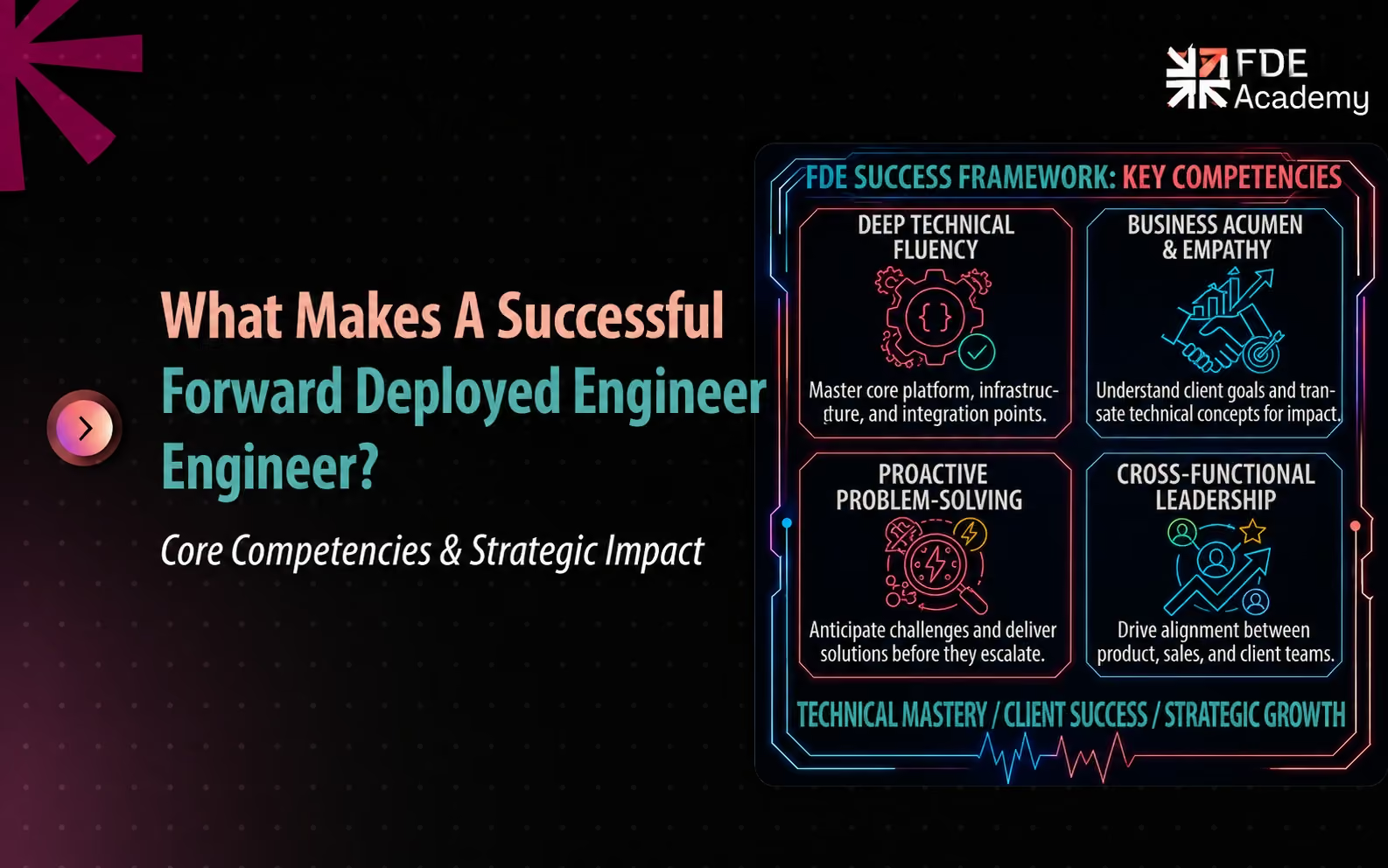
Technical skill gets an engineer hired as a Forward Deployed Engineer. It's a set of underlying traits, not additional skills, that determines who actually succeeds once they're in the role.
This guide covers six specific traits that consistently show up in successful FDEs, dispositional qualities that shape how someone approaches ambiguity, ownership, and customer relationships, distinct from the technical skill checklist most career guides already cover.
Two candidates can pass the same technical interview loop with comparable scores and go on to have completely different trajectories once they're actually embedded with a customer.
The difference usually isn't a skill either candidate lacked, it's how they respond to the specific conditions FDE work creates repeatedly: genuine ambiguity, being wrong in front of a customer, needing to care about a business problem outside their technical comfort zone.
These are traits more than skills, harder to teach directly, but recognizable and, to a real degree, developable with deliberate attention.
Successful FDEs are noticeably curious about how the customer's business actually works, not just the technical problem in front of them. This shows up as unprompted questions about a customer's industry, their competitive pressures, why a specific workflow exists the way it does, curiosity that goes beyond what's strictly necessary to scope the immediate technical task.
Engineers without this trait can still do competent discovery, but they miss the deeper context that often reveals the real problem behind the stated one, the kind of insight that separates an adequate deployment from one that genuinely transforms how a customer operates.
A concrete signal of this trait in action: two FDEs are asked to build a document-search tool for a legal team. One builds exactly what was requested, competently, and moves on.
The other, curious about why lawyers were manually searching in the first place, discovers the real bottleneck is inconsistent document naming conventions across departments, a problem no one had explicitly asked to fix, and ends up delivering something that solves a bigger issue than the original request. Both technically completed the assignment. Only one demonstrated the curiosity that turns a competent deployment into a genuinely valuable one.
FDE work rarely arrives with a clean specification. Successful FDEs are noticeably comfortable operating without one, treating an unclear starting point as the normal condition of the job rather than a problem someone else should have solved before handing it to them.
This isn't the same as being comfortable with chaos or disorganization, strong FDEs still bring structure to ambiguous situations, but they generate that structure themselves rather than needing it provided in advance.
Engineers who need requirements fully specified before they can start working tend to struggle significantly with this role, regardless of how strong their technical execution is once a clear spec exists.
This trait is often what separates candidates in decomposition-style interviews more than raw technical ability does. Given the same ambiguous prompt, one candidate visibly relaxes into the problem, treating the lack of a clean spec as an invitation to ask good questions and propose structure.
Another candidate visibly tenses, repeatedly asking for clarification that isn't going to arrive, waiting for the interviewer to define the problem more precisely before committing to any direction.
Interviewers watching for this trait aren't grading whether clarifying questions get asked, nearly every strong candidate asks some, they're watching whether the candidate can move forward productively once it's clear the ambiguity isn't going away.
The same engineer needs to debug a production issue with a customer's technical team in the morning and explain a scope tradeoff to a non-technical executive in the afternoon, often on the same day, sometimes in the same meeting, the kind of switching our day in the life of a Forward Deployed Engineer guide covers concretely.
Successful FDEs genuinely enjoy this range rather than merely tolerating it, they don't experience a conversation with a skeptical business stakeholder as a distraction from the "real" engineering work, they experience it as part of the actual job. This trait is closely related to, but distinct from, communication skill.
Some technically excellent communicators still strongly prefer staying in technical contexts, and that preference tends to create real friction in a role that requires moving fluidly between both worlds constantly.
Successful FDEs default to treating a problem as theirs to solve, even when it technically sits outside their assigned scope, rather than waiting for explicit permission or a formal handoff.
This shows up in small, consistent ways: flagging a related issue nobody asked about, staying engaged with a production system after the formal engagement technically ended, taking responsibility for a mistake without immediately explaining the mitigating circumstances.
This trait is what makes the habits of successful Forward Deployed Engineers, discovery discipline, evaluation-first thinking, staying close to production, actually stick over time. The habits are learnable behaviors; ownership mentality is the underlying disposition that makes practicing them consistently feel natural rather than like a checklist to remember.
The clearest test of this trait shows up during a production incident that isn't technically your fault. An engineer without a genuine ownership mentality tends to spend real energy establishing that the failure originated elsewhere, in a system someone else built, a requirement someone else missed, before turning attention to actually fixing it.
An engineer with this trait moves to resolving the issue first and worries about attribution, if it matters at all, afterward. Customers notice this difference immediately, and it shapes trust in the relationship far more than any single technical decision does.
FDE work touches frontend, backend, infrastructure, data, and increasingly AI-specific systems, often within the same engagement. Successful FDEs tend to genuinely enjoy this breadth rather than experiencing it as a distraction from a preferred specialization.
An engineer who's happiest going deep on one specific technical layer, and who experiences being pulled into an unfamiliar part of the stack as an unwelcome interruption, tends to find sustained FDE work more draining than engineers who find that same variety energizing. Neither disposition is better in the abstract, but the fit with this specific role differs meaningfully.
Discovery assumptions get corrected constantly in FDE work, a customer clarifies that an assumed requirement was actually wrong, an evaluation reveals a technical approach doesn't hold up against real data, a stakeholder points out a gap in a proposed plan.
Successful FDEs treat this as the normal texture of the job rather than a personal setback, recalibrating quickly and visibly rather than becoming defensive or quietly resentful.
This trait matters more than it might seem: engineers who experience being corrected as a threat to their credibility tend to either argue past the point of usefulness or become quietly less willing to propose ideas at all, both of which erode the trust the role depends on.
This trait is closely tied to how someone was rewarded earlier in their career. Engineers who came up in environments that heavily rewarded being right, competitive academic settings, highly individual-contributor cultures where mistakes were costly to a personal reputation, sometimes carry that conditioning into FDE work in a way that actively works against them.
The role rewards the opposite instinct: proposing an idea confidently, updating it visibly and without defensiveness the moment better information arrives, and treating that update as evidence of good judgment rather than a failure to have gotten it right the first time.
Traits and habits aren't the same thing, and the distinction matters practically. A trait like ambiguity tolerance is a disposition, present or underdeveloped in a given engineer before they ever start the job.
A habit like building the evaluation set before calling a build finished is a specific, repeatable behavior that can be practiced deliberately regardless of natural disposition.
The traits in this guide make certain habits easier to sustain consistently, someone with genuine ownership mentality will find it more natural to stay engaged through production stabilization than someone forcing the behavior without the underlying disposition, but the habits themselves remain learnable and worth building deliberately either way.
Our habits of successful Forward Deployed Engineers guide covers the specific, practiced behaviors this piece's traits tend to produce naturally.
This has a practical implication for how to read both pieces together. If you're evaluating whether FDE work fits you at all, start with the traits, since they're the harder, slower thing to change and the more honest signal of underlying fit.
If you've already decided the role fits and want to perform well in it, the habits are where deliberate practice pays off fastest, since they're concrete, teachable behaviors rather than dispositions you either have or need to slowly cultivate.
There's no single dominant trait, but ambiguity tolerance and ownership mentality show up most consistently across successful FDEs, since so much of the role's difficulty comes from operating without a clear specification and needing to treat problems as yours to solve without waiting for explicit permission.
They're more developable than fixed personality traits typically are, closer to disposition shaped by repeated practice than immutable character. An engineer who deliberately practices operating without full specifications, or deliberately seeks out cross-functional communication opportunities, can genuinely build these traits over time, even if they don't come naturally at first.
Traits are underlying dispositions, comfort with ambiguity, curiosity about business context, that shape how naturally someone approaches the role. Habits are specific, repeatable behaviors, like building an evaluation set before calling work done, that can be practiced deliberately regardless of natural disposition.
No, both matter, technical skill is necessary but genuinely insufficient on its own. These traits determine how well technical skill translates into successful outcomes in the specific, ambiguous, customer-facing conditions FDE work creates repeatedly.
Engineers who need requirements fully specified before starting, who strongly prefer staying in purely technical contexts, or who experience being corrected as a threat to their credibility tend to find sustained FDE work more draining than engineers with the traits described here, regardless of technical strength.
The world is hiring - and this Academy prepares you for it.