Blogs
Forward Deployed Engineer vs Sales Engineer: Which Career Is Right for You?
Forward Deployed Engineer vs Sales Engineer: Which Career Is Right for You?
By
R&D, FDE Academy
September 28, 2026

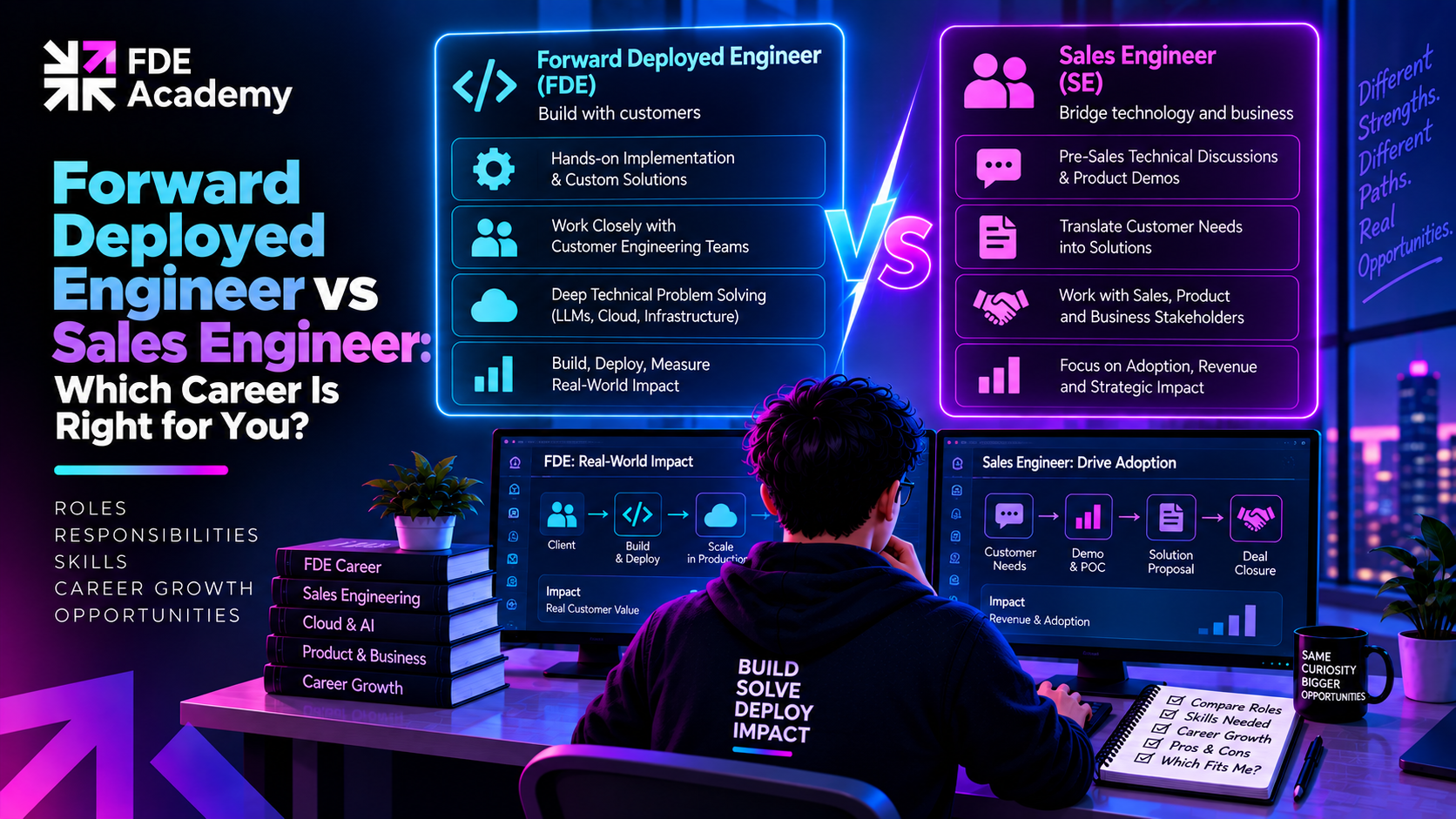
A Sales Engineer's job ends when the deal closes. A Forward Deployed Engineer's job starts when the deal closes. That single distinction explains almost every other difference between the two roles what you build, who you talk to, how success is measured, and what skills actually matter day to day.
For a broader look at how FDE compares against a wider set of customer-facing technical roles, including Solutions Engineer and Customer Success Engineer alongside Sales Engineer, see our companion guide, Forward Deployed Engineer vs Solutions Engineer, Sales Engineer, and Customer Success Engineer. This article goes deeper specifically on the FDE-vs-Sales-Engineer decision, since it's the comparison candidates ask about most.
A Sales Engineer (sometimes called a Solutions Consultant or Pre-Sales Engineer) is the technical half of a sales team. Their job is to translate a product's technical capabilities into a compelling, credible case for a specific prospect running live product demos, building tailored proofs of concept, answering deep technical questions on sales calls, and responding to RFPs and security questionnaires.
The work is cyclical and deadline-driven, tied to the sales pipeline: a demo has to be ready before a specific call, a POC has to prove value before a specific decision date. Success is measured in deals influenced, win rates, and sales cycle velocity commercial outcomes, not engineering ones.
A Forward Deployed Engineer picks up where the Sales Engineer's job ends. Once a deal closes, the FDE is the one who builds the actual production integration connecting the platform to the client's real systems, writing real code against real data and real constraints, and staying accountable for whether the deployed system actually delivers the outcome the client bought.
This work follows the FDE Work Cycle understanding the business reality, defining the right problem, designing the approach, building within real constraints, deploying to production, and owning outcomes afterward. Success is measured in whether the system works, adopts, and keeps delivering value months after deployment not in a single closed deal.
Note that Sales Engineer compensation typically includes a meaningful variable/commission component tied to deals influenced, while FDE compensation is usually more base-salary weighted a real structural difference worth factoring into any direct comparison, not just the headline range.
Rather than asking "which role is better," ask these four questions honestly:
Do you want your day tied to a sales calendar, or a delivery roadmap? Sales Engineering runs on deal timelines set by prospects and account executives. FDE work runs on delivery milestones set by an implementation plan. If the energy of a closing sales cycle appeals to you, that's a real signal toward Sales Engineering. If you'd rather own a build from start to production, that points toward FDE.
Do you want to write production code regularly, or build convincing demos? Sales Engineers write code, but it's usually demo-grade built to show a capability convincingly, not built to survive months of real production traffic and edge cases. FDEs write code that has to actually hold up in a client's live environment. If deep, sustained coding is what you want from your day-to-day, FDE is the stronger fit.
Do you want to be measured on deals won or systems delivered? This is the clearest signal of all. If closing deals and directly influencing revenue is motivating to you, Sales Engineering aligns your incentives with that. If you'd rather be accountable for whether something actually works after it ships, FDE aligns better.
How do you feel about ambiguity in the problem itself, not just the solution? Sales Engineers usually work from a known, if evolving, sales narrative. FDEs regularly walk into a client's messy operational reality and have to figure out what the actual problem even is before building anything a skill our guide on the technical skills an FDE actually needs covers in depth. If that kind of ambiguity energizes rather than drains you, that's a strong FDE signal.
If you're still unsure after running through these, our self-assessment guide, 7 Signs You Would Be Good at Forward Deployed Engineering, is a useful next gut-check specifically for the FDE side.
Yes, and it happens in both directions, though the more common path is Sales Engineer → FDE, because the coding and delivery skills required for FDE work are a genuine step up in depth, while the customer communication skills built in Sales Engineering transfer directly and are a real asset in FDE work presenting designs to clients, managing expectations, and communicating technical tradeoffs in plain language are things strong Sales Engineers are often already good at.
The reverse move, FDE → Sales Engineer, happens too, usually from engineers who discover they enjoy the customer-facing and narrative-building side of the work more than the deep production-delivery grind, and want to move earlier in the customer relationship rather than later.
Neither transition requires starting over it's closer to a lateral shift in what part of the customer lifecycle you sit in, provided the underlying technical credibility and communication skills are there either way.
TL;DR: Sales Engineers work before the sale, using technical credibility to support the pitch demos, proofs of concept, answering technical questions in sales calls. Forward Deployed Engineers work after the sale, building and shipping the actual production system inside the client's environment. If you want to stay close to revenue conversations and enjoy the sprint of a sales cycle, Sales Engineering fits. If you want to write real production code and own whether the thing you built actually works, FDE fits. Neither is "more technical" by definition they're technical in different directions.
A Sales Engineer works before a deal closes, using technical expertise to support the sales process through demos and proofs of concept. A Forward Deployed Engineer works after the deal closes, building and owning the actual production system inside the client's environment.
Base ranges broadly overlap (roughly 120K–190K), but Sales Engineer compensation typically includes a larger variable/commission component tied to deals influenced, while FDE compensation tends to be more base-salary weighted. Total comp can favor either role depending on individual performance and company structure.
Not automatically "more technical," but technical in a different direction. Sales Engineers need enough technical depth to build convincing demos and answer sales-context technical questions. FDEs need production-grade coding ability to build systems that hold up under real operational constraints.
Yes, and it's a common transition. The customer communication and expectation-management skills built in Sales Engineering transfer well, though moving into FDE work typically requires building up production-level coding and systems-delivery skills that pre-sales demo work doesn't fully develop.
Sales Engineering keeps you closer to revenue conversations day to day, since your work is directly tied to influencing whether specific deals close. FDE work is further from the sale itself, focused instead on whether the delivered system succeeds after the deal is done.
Forward Deployed Engineering typically involves more open-ended ambiguity, since FDEs often have to define the real problem inside a messy client environment before building anything. Sales Engineers usually work from a clearer, if evolving, sales narrative and technical requirement set.
The world is hiring - and this Academy prepares you for it.