Blogs
What Is the FDE Work Cycle? The 6 Steps, Explained
What Is the FDE Work Cycle? The 6 Steps, Explained
By
R&D, FDE Academy
September 25, 2026

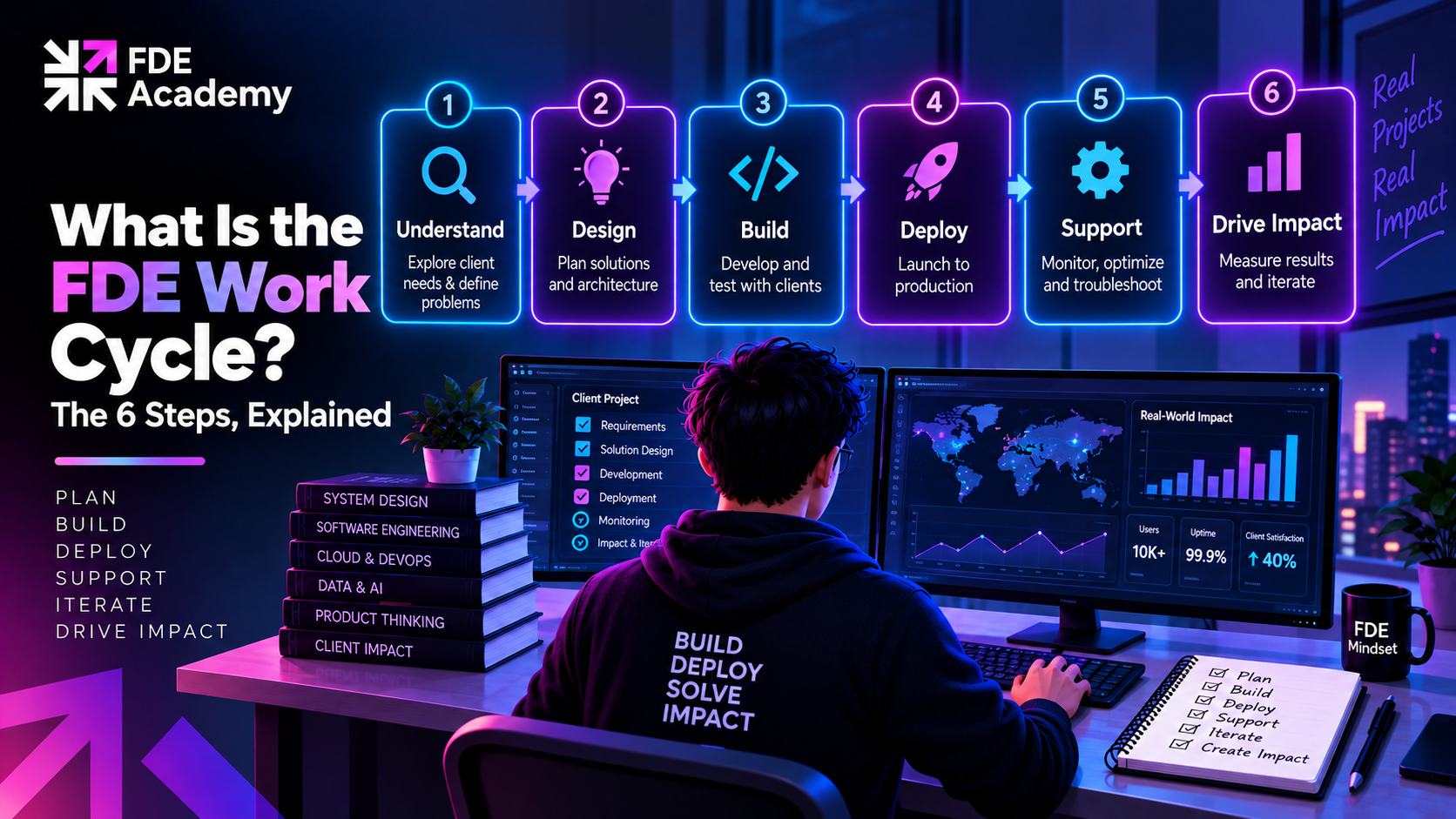
Most descriptions of how FDEs work borrow language from traditional software delivery sprints, milestones, a linear path from kickoff to launch. That framing misses something specific about FDE work: it's genuinely cyclical, not linear. The same six steps repeat across every new problem an FDE takes on, even within a single, ongoing customer engagement, because step six owning outcomes and improving routinely surfaces the next problem worth solving, which restarts the cycle from step one.
This is worth distinguishing clearly from a related but different resource: our guide to the FDE project lifecycle from discovery to deployment maps the phased timeline of a single project from first contact through go-live. This article explains the six-step operating cycle itself the repeatable rhythm that runs inside and across those project phases, whether it's your first week on an engagement or your fifth iteration on the same system. For the underlying role definition both articles build on, see our guide to Forward Deployed Engineer.
The cycle doesn't start with a technical question it starts by understanding how the business actually operates, not just the stated requirement. This is a deliberate, disciplined first step, not a courtesy conversation before the "real work" begins. A stated requirement from a business stakeholder is almost never the full picture; it's a compressed, often imprecise summary of a much messier operational reality involving people, workarounds, and constraints that don't show up in a one-line request.
Skipping this step is one of the most common reasons AI projects fail before they even start building against the stated requirement rather than the underlying reality produces a technically correct system that solves the wrong problem. Our analysis of why enterprise AI adoption fails covers this exact failure pattern in more depth.
Once the business reality is genuinely understood, the next step is to translate business pain into a clear, solvable problem worth using AI for now. This step is where a huge amount of an FDE's real value gets created, and it's also the step most often skipped or rushed by teams eager to start building.
"Worth using AI for now" is a precise phrase worth sitting with not every business pain point is actually an AI problem, and not every AI-solvable problem is worth solving immediately given competing priorities and available data. Defining the right problem means saying no to the wrong one, even when it's the problem the loudest stakeholder originally asked about.
With the right problem defined, step three decides what AI should do, what data it will use, and how success will be measured before any serious build work begins. This is a design step, not an implementation step, and treating it as one is a common mistake among engineers moving into FDE work from a purely build-first background.
Defining success measurement at this stage, rather than after deployment, matters enormously. A system built without a clear definition of success is nearly impossible to evaluate honestly later you end up retrofitting a metric to whatever the system happens to produce, rather than holding the system accountable to what actually mattered when the problem was defined.
This is the step most people picture when they think of "FDE work," but it only makes sense in the context of the three steps before it. Step four means developing solutions that fit existing data, systems, security, and infrastructure not a clean, greenfield build, but one constrained by everything already true about the customer's environment.
This is precisely where deep technical skill becomes non-negotiable. Our breakdown of the skills an FDE actually needs covers the specific competencies this step draws on production coding ability, data pipeline literacy, and integration skill against systems that were never designed with this build in mind.
Step five is the step that separates FDE work most sharply from a lot of adjacent AI and data science work: shipping working AI into live environments where real users depend on it. A model that performs well in a notebook or a sandboxed demo hasn't cleared this step deployment means the system is live, carrying real operational weight, not just technically complete.
This step is also where the earlier steps get tested against reality. A problem poorly defined in step two, or a design that ignored a real constraint in step three, tends to surface painfully and visibly right here, which is exactly why skipping or rushing the earlier steps so often shows up as a deployment crisis rather than a planning footnote.
The cycle's final step is also what makes it a cycle rather than a line: monitor performance, fix failures, and continuously improve based on real usage. An FDE doesn't hand off a deployed system and move on ownership continues past launch, tracking whether the system is actually delivering the value it was built for, under real, messy usage patterns that no design phase can fully anticipate.
This step routinely generates the next problem worth solving a pattern in real usage data that reveals a new business reality worth understanding, which restarts the cycle at step one. This is the mechanism behind why FDE engagements tend to expand and deepen over time rather than close out cleanly after one deliverable.
The six steps aren't strictly sequential in daily practice an FDE often works on multiple steps across different problems within the same week, since a mature engagement typically has several threads running at different points in the cycle simultaneously. For a concrete look at how this actually plays out hour by hour, our guide on what forward deployed engineers do day-to-day shows the cycle in practice rather than in the abstract.
The cycle's defining feature is that it never lets the technical work drift away from the business reason it exists. Every step either grounds the work in business reality (steps 1, 2, 6) or translates that reality into technical execution (steps 3, 4, 5), alternating deliberately rather than treating "figure out the business problem" and "build the AI system" as two disconnected phases handled by two different people.
This is also precisely why FDE training has to teach both halves together rather than sequentially. Our guide to the FDE Academy Method covers how the program's dual-track curriculum technical and consulting skills running in parallel is built specifically to prepare engineers for this alternating rhythm, not just the technical build steps in isolation. Readers who want the full program structure behind this training can review FDE Academy's curriculum directly, and those ready to pursue the role can start with our guide on how to become a Forward Deployed Engineer.
TL;DR: The FDE Work Cycle is a six-step operating rhythm understand the business reality, define the right problem, design the AI approach, build within real constraints, deploy into production, and own outcomes and improve that bridges business needs and AI execution. It's not a one-time project plan; it's the recurring cycle a Forward Deployed Engineer runs on every engagement, closing the loop from vague business pain to a working, monitored AI system in production.
The six steps are: understand the business reality, define the right problem, design the AI approach, build within real constraints, deploy into production, and own outcomes and improve. Together they bridge business needs and AI execution in a repeating cycle rather than a one-time linear plan.
Not quite. A typical software development lifecycle usually starts from an already-defined requirement and focuses on build and release. The FDE work cycle starts earlier with understanding the actual business reality before any requirement is finalized and explicitly loops back to step one after deployment, rather than ending at launch.
The work cycle is the repeatable, six-step operating rhythm an FDE runs on every problem, potentially several times within a single engagement. The project lifecycle describes the broader, phased timeline of a single project from first contact through go-live. The work cycle operates inside and across the phases of that broader lifecycle.
Because a stated business requirement is rarely the full picture of what's actually happening operationally. Skipping straight to a technical solution based only on the stated requirement is one of the most common reasons AI projects end up solving the wrong problem.
Not usually. Step six, owning outcomes and improving, routinely surfaces new problems worth solving based on real usage patterns, which restarts the cycle from step one. This is why FDE engagements tend to expand and deepen over time rather than close cleanly after a single deliverable.
In daily practice, not always an FDE often has multiple problems moving through different steps of the cycle simultaneously within the same engagement. The six steps describe the logical progression each individual problem moves through, not a strict weekly schedule.
The world is hiring - and this Academy prepares you for it.