Blogs
What Technical Skills Does an FDE Need? A Proficiency Checklist
What Technical Skills Does an FDE Need? A Proficiency Checklist
By
R&D, FDE Academy
September 23, 2026

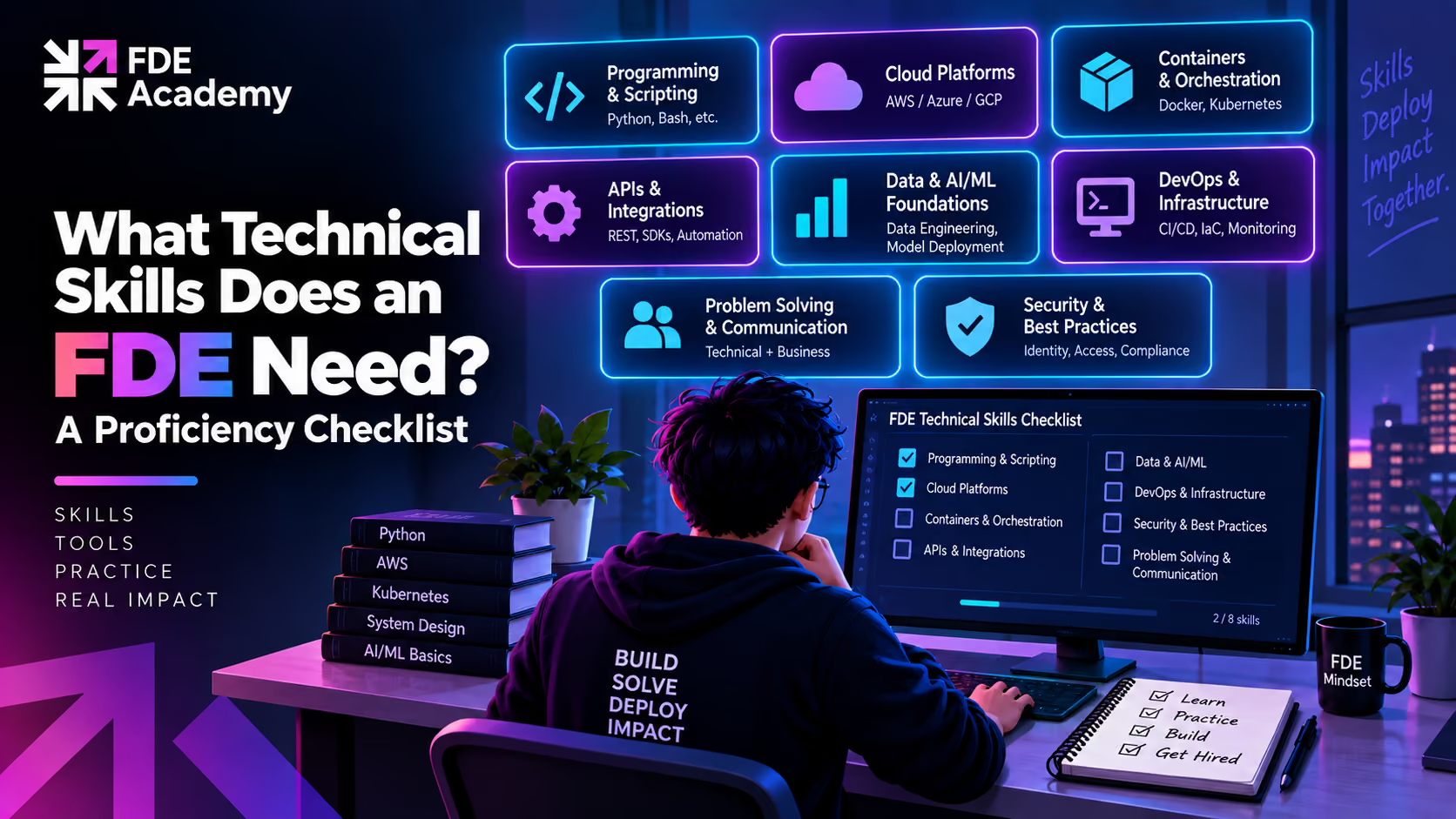
Most content answering "what technical skills does an FDE need" stops at naming the categories coding, data, cloud, AI frameworks without specifying how good is good enough. That's the wrong level of detail for someone trying to self-assess honestly. Our broader guide to the skills an FDE actually needs covers the full picture, technical and non-technical together; this article goes one layer deeper specifically on the technical side, with the proficiency bar for each competency rather than just the competency name.
It's also worth distinguishing this from the hard eligibility gate. Our guide to Forward Deployed Engineer eligibility covers the pass/fail requirements production experience, degree expectations, the non-negotiables while this article goes deep specifically on the technical-skill dimension of that eligibility bar, with real benchmarks rather than a yes/no checkbox.
Knowing that Python matters isn't useful without knowing what "knowing Python" actually needs to mean for this role. Deep technical skill in coding specifically means Python and TypeScript for most current FDE roles, with the bar set at production-quality, not tutorial-quality output.
The concrete fluency test: working proficiency in at least one production language means being able to read an unfamiliar codebase, identify the relevant entry points, and ship a working patch inside a single workday not rewrite the system from scratch, and not just recognize the syntax. If you can complete a LeetCode problem but can't navigate someone else's messy, undocumented repository and make a safe, working change within a day, you haven't cleared this bar yet, regardless of how many languages you list on a resume. Our guide on best programming languages to learn for an FDE role covers which specific languages to prioritize and in what order; this section is about the depth bar, not the selection.
Data skills are a named, distinct category SQL and Spark specifically sitting alongside coding and systems as one of three core deep technical pillars most sources agree on. The proficiency bar here isn't "can write a SELECT query." It's the ability to explore an unfamiliar, messy customer dataset independently: joins, window functions, and enough data-pipeline literacy to diagnose whether a data quality issue is going to block a deployment before it becomes a production incident.
This matters because FDE engagements routinely start with a customer's data in a state nobody has fully mapped yet. If your SQL experience comes entirely from clean, well-documented internal databases, that's a real gap worth closing before you're tested on someone else's undocumented production data under time pressure.
The third core pillar is systems cloud platforms (AWS or GCP most commonly), Docker, and Kubernetes specifically named as the baseline infrastructure competencies expected of a technically credible FDE candidate. The proficiency bar here is deployment fluency, not just conceptual familiarity: can you actually get a service running reliably in a customer's cloud environment, debug it when it fails, and reason about scaling and cost trade-offs not just describe what Kubernetes does in an interview.
For the fuller picture of how these systems components fit together with the language and data layers into one coherent stack, our guide to the Forward Deployed Engineer tech stack is the right companion resource.
This is the fastest-moving part of the technical bar, and the part most likely to be outdated in older FDE skill guides. For AI-focused FDE roles specifically, the bar has shifted to agentic orchestration frameworks like LangGraph and CrewAI, evaluation frameworks, and AI observability and guardrails, layered on top of foundational RAG and fine-tuning fundamentals.
The proficiency bar here is meaningfully deeper than "has used ChatGPT's API." It means being able to design a multi-step agentic workflow with real tool-calling and failure handling, not just prompt a single model call and, critically, being able to evaluate whether that system is actually working reliably before a customer trusts it with a real task, rather than shipping it and hoping. Our guide on how AI agent orchestration works for Forward Deployed Engineers covers this specific competency in depth, since it's become one of the most heavily weighted technical dimensions in 2026 FDE hiring specifically.
A distinct, named technical competency separate from general coding ability: FDEs must be able to write clean code, build integrations, fix edge cases, and navigate APIs or data pipelines. This is worth calling out separately because integration work has its own specific failure modes authentication quirks, rate limits, inconsistent API documentation, legacy systems that don't behave the way their docs claim that pure algorithmic coding practice doesn't prepare you for.
The proficiency bar: can you take an unfamiliar, imperfectly documented third-party or legacy API and build a working, reasonably resilient integration against it without extensive hand-holding, including handling the edge cases that only show up once real data starts flowing through it.
It's worth being direct about why this checklist sets a higher bar than a typical mid-level engineering role. FDE interviews are described as being designed to break candidates deliberately, testing for technical skill, problem-solving, and genuine grit rather than book knowledge alone the expectation is a builder who can ship, not just someone who can discuss concepts fluently.
This connects to a broader point worth internalizing before you self-assess against this checklist: technical depth is the foundation of the FDE role specifically because client environments rarely provide perfectly defined requirements, and engineers are expected to design, deploy, and optimize production-grade systems inside that ambiguity, not just execute a well-specified ticket. If you're still unsure how central hands-on technical work actually is to daily FDE life, our direct answer on whether Forward Deployed Engineers actually code settles that question plainly.
Go through each category above honestly, using the specific proficiency bar described, not the category name alone. For languages: can you ship a working patch in an unfamiliar codebase within a day? For data: can you independently diagnose a data-quality issue in a messy, undocumented dataset? For systems: can you actually deploy, debug, and reason about cost and scale in a real cloud environment, not just describe the concepts? For AI-specific skills: can you design and evaluate a multi-step agentic workflow, not just call a single model API? For integration: can you build a working connection against an unfamiliar, imperfectly documented API and handle its edge cases?
If you can answer yes to most of these with a specific, concrete example not a course you completed, but something you actually shipped you're technically close to the real FDE bar. If several categories come up short, that's genuinely useful information: it tells you exactly where to focus rather than leaving you with a vague sense that you need to "get better at AI" broadly.
Once you know which specific categories need work, the Forward Deployed Engineer roadmap provides the sequenced path for closing those gaps in a sensible order rather than randomly. And our complete guide on how to become a Forward Deployed Engineer ties the technical checklist here together with the non-technical, customer-facing side of the role this article deliberately didn't cover.
The core technical categories are: production-level programming language fluency (commonly Python and TypeScript), data skills (SQL and pipeline literacy), systems and infrastructure (cloud platforms, Docker, Kubernetes), AI-specific skills (agentic orchestration, RAG, evaluation frameworks), and integration/API fluency.
It means being able to read an unfamiliar codebase, identify the relevant entry points, and ship a working, production-quality patch within a single workday not completing tutorials or solving isolated algorithm problems in a familiar environment.
Not typically research-level depth. The bar is applied and production-focused: designing and evaluating agentic workflows, RAG systems, and reliable AI deployments, rather than developing new machine learning algorithms or techniques from first principles.
The bar has shifted meaningfully toward agentic orchestration frameworks like LangGraph and CrewAI, evaluation and observability tooling, and guardrails, layered on top of the RAG and fine-tuning fundamentals that were the primary technical bar in earlier years.
Yes, it's necessary and treated as a distinct, core pillar alongside coding and data skills. FDEs are expected to actually deploy and debug systems in a real cloud environment, not just write application code that someone else deploys.
Run the self-assessment in this article honestly against each category, using concrete examples of things you've actually shipped rather than courses completed. Categories where you can't produce a specific real example are the ones to prioritize closing before applying.
The world is hiring - and this Academy prepares you for it.