Blogs
Forward Deployed Engineer Job: Resume, Portfolio & Interview Guide
Forward Deployed Engineer Job: Resume, Portfolio & Interview Guide
By
R&D, FDE Academy
March 16, 2026


Want to land a Forward Deployed Engineer job but unsure what companies are really looking for?
Obtaining a forward deployed engineer position is quite different compared to obtaining a conventional software engineering position. Most applicants believe that to perform well in a job, one should have good coding and algorithm practice. Actually, companies hiring Forward Deployed Engineers look for a specific combination of technical skills and real-world deployment capability.
A Forward Deployed Engineer is an engineer who collaborates with customers to implement intricate software to a live setting. Due to this, employers do not only check on the ability to code. They usually seek after engineers who will be able to:
This guide explains how to get a forward deployed engineer job, including how to build a strong forward deployed engineer resume, create an impressive forward deployed engineer portfolio, and prepare strategically for common forward deployed engineer interview questions through effective FDE interview prep.
At the end, you will be left with a clear and practical roadmap of how to shine in a competitive FDE hiring process.
It is also crucial to know what the hiring managers actually look at before constructing a forward deployed engineer resume or before attending interviews.
FDEs are at the boundary between engineering, deployment and customer problem solving in contrast to the traditional engineering jobs.
The companies normally assess the candidates on three dimensions.
The FDEs have a role of ensuring that software developed in the environments is moved to actual customer systems. Recruiters are seeking candidates who realize:
This attitude is core to the forward deployed engineer career path.
FDEs continue to require good technical abilities. Most roles require:
These abilities tend to intersect with the essential forward deployed engineer abilities, but are to be used in actual deployment settings in addition to hypothetical issues.
In contrast to the conventional engineers who operate within the company, Forward Deployed Engineers are frequently engaged in direct work with the clients. When hiring teams look at candidates, they would desire those who can:
With this hiring lens in mind, the rest of the preparation process becomes easier to understand.
The forward deployed engineer resume you are using needs to show that you can make the transition between engineering and the actual deployment.
Most of the candidates commit the error of providing a generic software engineering resume. This does not more often than not bring out the attributes that companies want of FDE candidates.
Although you may not have been called Forward Deployed Engineer in your previous job, you might have experience that relates.
Instead of emphasising on coding activities, emphasise:
As an illustration, assuming you were doing API integrations or infrastructure deployment, such experiences are quite applicable to FDE job requirements.
Forward Deployed Engineers are considered according to the effect that they produce on actual systems.
The resume must bring out:
Do not just enumerate programming tools and programming languages. Employers would like to know how your work has enhanced a real system.
In most resumes, so descriptive phrases as:
There is no deployment thinking or system level impact that is exhibited by these statements.
A good forward deployed engineer resume will typically have:
Brief account of the deployment experience and technical strengths.
Languages, frameworks, cloud technologies, and deployment technologies.
Integration work, infrastructure implementations or system implementations.
Practical projects Revealing integration or deployment capabilities.
Applicable educational experience.
Weak example:
Developed backend features using Python and Node.js.
Stronger example:
Designed and deployed an API integration layer connecting five enterprise data sources, reducing manual data synchronisation time by 80 percent across 20 client accounts.
The second example demonstrates integration work, actual system impact and context of deployment.
This is a very powerful strategy to enhance a forward deployed engineer resume.
A forward deployed engineer portfolio is one of the strongest ways to demonstrate readiness for the role.
Contrary to the customary developer portfolios, FDE portfolios have to demonstrate actual system deployment thought.
GitHub repositories are the only source of many software engineers. Nevertheless, recruiting teams in FDE positions desire:
This is why a well-structured forward deployed engineer portfolio often includes more than just code.
A good portfolio must reflect your way of dealing with complicated deployment issues.
Examples include:
For example:
Linking analytics applications and tools.
Describe a project that was developed and deployed.
Include:
This is practical engineering thinking.
Forward Deployed Engineers frequently develop tools to assist customers in inter-relating with systems.
Examples include:
These demonstrate practical value creation.
Transparent documentation is very vital in FDE functions. Your portfolio is to contain:
Effective documentation is an indication of effective communication.
Although GitHub repositories are helpful, they are to be supplemented by:
Hiring teams are interested in how you reason to resolve deployment issues, not just how you code.
Even scholarly work can make good portfolio items.
For example:
Rather than describing a machine learning model as a research project, describe it as a deployment situation.
Explain:
This approach strengthens your forward deployed engineer portfolio and shows readiness for real-world engineering challenges.
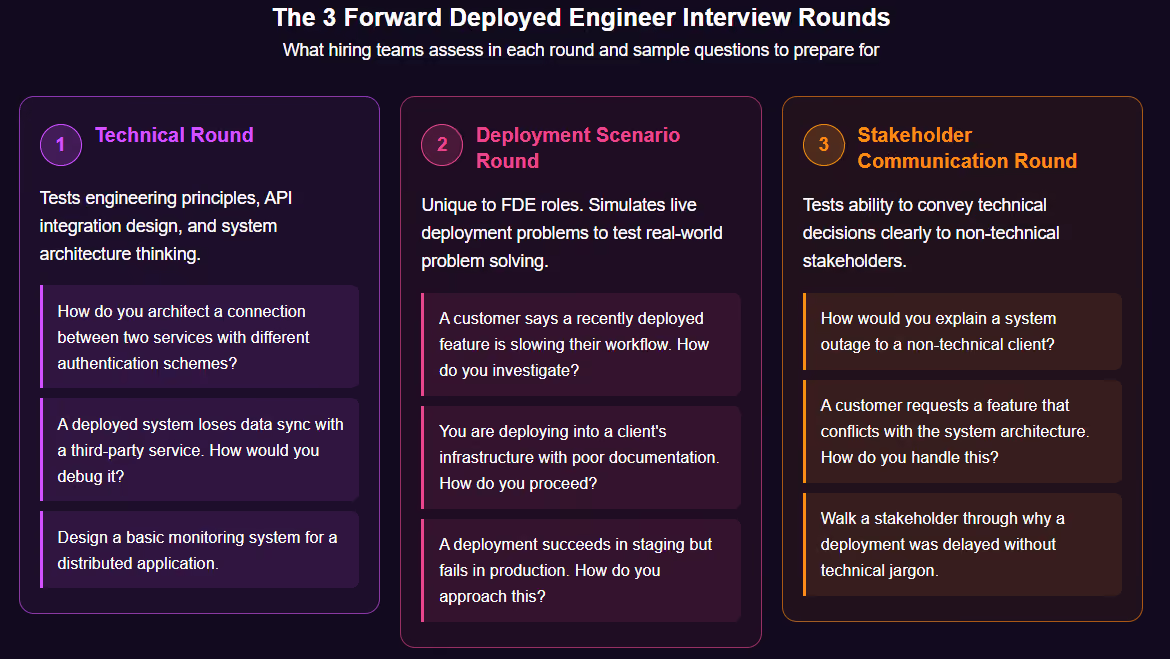
The forward deployed engineer job interview tends to assess three broad areas.
These interview formats are important to understand in order to effectively prepare a FDE interview.
This round tests engineering principles and high-level thinking.
Other than interviewing candidates on algorithm puzzles, they are usually tested on:
The possible questions to be used during the technical interview of FDE role include system interactions and real-world constraints.
Example questions include:
1. How do you architect a connection between two services with authentication schemes?
This tests system design and integration thought.
2. A deployed system loses data synchronization with a third-party service. How would you debug it?
This question is an assessment of debugging strategy during production.
3. Design a basic monitoring system of a distributed application.
This evaluates architecture thought and reliability engineering expertise.
It is a round peculiar to FDE roles.
The interviewers simulate actual deployment whereby the candidate has to work through a live problem.
Examples of forward deployed engineer interview questions would be:
4. A customer complains that a recently implemented feature is slowing down their work process. How would you proceed to investigate?
A good answer shows organized problemshooting and interaction with stakeholders.
5. You are implementing software in the infrastructure of a client with poor documentation. How do you proceed?
This tests flexibility and methodical investigation.
6. A deployment is successful in staging and fails in production. How do you approach the issue?
This is a test of real-world debugging logic.
Forward Deployed Engineers need to convey technical decisions in an effective manner.
The interviewers determine the ability of the candidates to present the technical engineering concepts to the non-technical stakeholders.
Typical questions include:
7. What is the best way to describe a system outage to a non-technical client?
This assesses the comprehension and compassion in communication.
8. A customer orders a feature that is incompatible with the system architecture. What would you do about the discussion?
This challenges negotiation as well as management of expectations.
Good candidates show that they can be able to balance between technical integrity and customers needs.
It is necessary to know how the hiring process works, nevertheless, success is also influenced by adhering to a systematic preparation plan.
The steps that are typically taken in a practical roadmap of how to get a forward deployed engineer job would include the following steps.
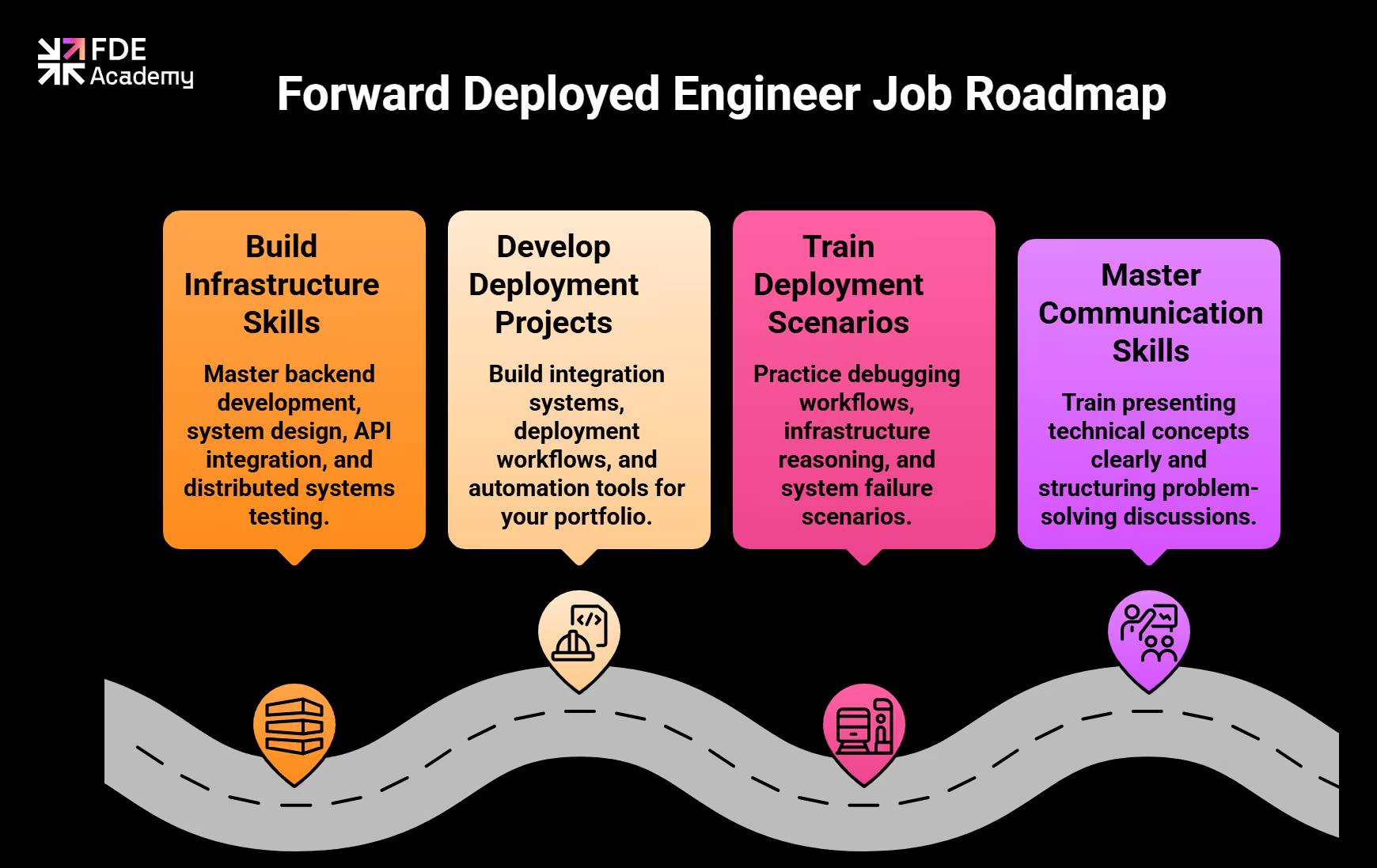
Step 1: Build Infrastructure Technology.
The candidates should develop effective engineering fundamentals which include:
These skills are the basis of a forward deployed engineer career path.
Step 2: Develop Real Deployment Projects.
Pragmatic projects are needed to show preparedness. Candidates are supposed to be look for:
These projects strengthen the forward deployed engineer portfolio.
Step 3: Train Deployment Scenarios.
A high number of candidates do not pass FDE interviews due to their preparation of algorithm questions.
Preparation instead should include:
This enhances preparations towards actual forward deployed engineer interview questions.
Step 4: Master Communication Skills.
Since FDEs are dealing closely with the customers, effective communication is very critical.
The applicants are to train presenting technical concepts in an effective way and organizing the problem-solving discussions.
An independent preparation towards a job of a forward deployed engineer may prove difficult as the job demands a combination of both technical and deployment skills.
Such programs like FDE Academy are created to educate engineers to work in this hybrid job.
The program is dedicated to the precise skills that companies want at the time of hiring.
The benefits that participants generally receive are:
The real proof points that the graduates have by the end of the program are the practical work on deployment and the practice of communicating which are very useful during the interview.
A preparation strategy that exceeds the conventional software engineering interview preparation is the way to landing a forward deployed engineer job.
The hiring teams are seeking engineers that are able to:
Building a strong forward deployed engineer resume, creating a practical forward deployed engineer portfolio, and preparing for realistic deployment scenarios are all essential steps.
Engineers with proper preparation strategy can enter this proliferating field and develop a satisfying forward deployed engineer career path with problem solving in the real world and technical depth.
An FDE resume emphasises deployment experience, system integration work, and customer-facing technical projects rather than feature development. Instead of listing technologies and coding tasks, it highlights real-world impact such as systems integrated, deployments completed, and measurable improvements to customer environments.
No, prior FDE experience is not required. Most successful candidates come from software engineering, DevOps, or data engineering backgrounds. What matters is demonstrating deployment thinking, integration experience, and the ability to work in real customer environments.
Focus on projects that demonstrate integration and deployment thinking. Build tools that connect multiple APIs, create deployment case studies from personal or academic projects, and document your architecture decisions clearly. Even a well-framed university project can show FDE readiness if presented in deployment terms.
FDE interviews typically include a deployment scenario round that standard software engineering interviews do not have. While coding ability is tested, interviewers place equal weight on how you debug production issues, handle ambiguous customer environments, and communicate technical decisions to non-technical stakeholders.
Common questions cover system design for integration scenarios, debugging production failures, handling customer complaints about deployed features, and explaining technical decisions to non-technical clients. Preparation should focus on these deployment and communication scenarios rather than algorithm-heavy coding problems.
Preparation time varies depending on your current experience level. Engineers with strong backend or DevOps backgrounds may need two to three months of focused preparation to build a relevant portfolio and practice deployment scenarios. Engineers transitioning from less deployment-oriented roles may benefit from a structured program that compresses this timeline significantly.
The world is hiring - and this Academy prepares you for it.