Blogs
Google Forward Deployed Engineer Interview Questions
Google Forward Deployed Engineer Interview Questions
By
R&D, FDE Academy
September 14, 2026

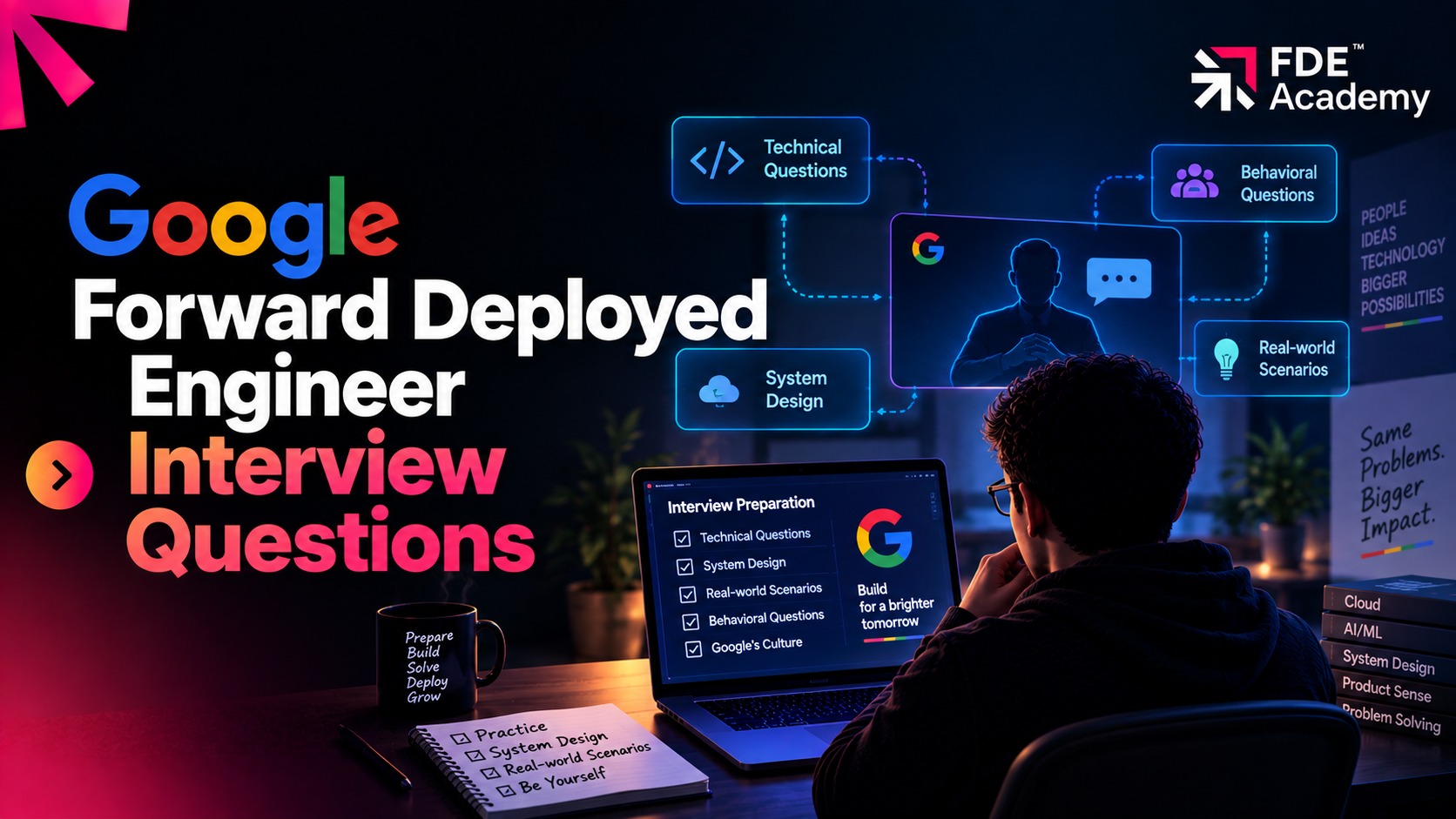
Unlike some companies that use "Forward Deployed Engineer" loosely or interchangeably with other titles, Google runs a real, named FDE track. Within Google Cloud's Applied AI team, the Forward-Deployed Engineer sits at the intersection of cutting-edge research and real-world implementation, and a closely related Forward-Deployed Engineer track at Google DeepMind positions the engineer as the primary technical interface between DeepMind's research breakthroughs and Google Cloud's enterprise customers, ensuring sophisticated AI models are performant, reliable, and integrated into mission-critical production environments.
Before you prepare, it's worth confirming you're looking at the right role: Google also has a long-standing Customer Engineer title inside Google Cloud, which is a different, adjacent function.
Our comparison of Google Customer Engineer vs Forward Deployed Engineer walks through exactly how the two differ if you're not certain which one you're interviewing for. For the foundational definition this article builds on, see our guide to Forward Deployed Engineer as a role generally.
Google rolled out its FDE loop as a newer 2026 interview format compressed into fewer named rounds, with a potentially shortened process of as few as two interviews over two days for some candidates though the total number of rounds still tracks roughly with a standard Google onsite, so candidates should confirm their exact loop with their recruiter.
Recruiter Screen: A 30–45 minute call covering background, motivation, and role fit, with time built in for the candidate's own questions. This stage is largely about confirming mutual fit and making sure the candidate understands the role's customer-facing, high-travel nature before investing further time.
Coding / DSA Round: A standard data structures and algorithms evaluation, similar in format to Google's broader software engineering loops. One candidate's account describes a DSA round with a maximum of three questions, noting that even without deep prior DSA experience, staying focused on explaining reasoning and thought process mattered as much as reaching a perfect answer a useful reminder that Google's FDE loop still rewards clear technical communication, not just a correct final result.
System Design Session. The Google FDE system design round evaluates how candidates architect intelligent systems that combine machine learning and agent components at scale designing a system end to end, reasoning about data flow, model integration, orchestration, and trade-offs, with interviewers specifically looking for familiarity with retrieval-augmented generation, vector databases, and production-grade AI deployment. This is where the role's AI-specific focus shows up most clearly, and it's worth practicing machine learning system design specifically rather than relying on generic distributed-systems design prep alone.
"Googleyness" / Behavioral Round. This round evaluates how candidates work, handle ambiguity, and align with Google's values, built around past experiences that demonstrate ownership, navigating failure, or driving impact across teams carrying extra weight for a customer-facing role where FDEs operate inside client organizations. One candidate described this round as being less about textbook answers and more about how a person thinks, handles ambiguity, works with others, and responds when things don't go perfectly closer to a character and working-style evaluation than a scripted behavioral checklist.
"Design an agentic system that [handles a specific enterprise workflow]." Recent candidates report system design questions like "Designing an Agentic System" and "Building AI Systems Knowledge" appearing frequently in the Google FDE loop. Interviewers are grading whether you can reason about orchestration, tool calling, and failure handling in a multi-step agentic workflow, not whether you land on one specific "correct" architecture. Our guide on how AI agent orchestration works for Forward Deployed Engineers is directly relevant preparation for this round.
A vague, under-specified customer scenario. This pattern shows up across nearly every FDE loop, not just Google's. The defining FDE round presents a scary, under-specified brief, and interviewers watch how a candidate turns it into a clear plan not whether they reach a single "correct" answer, since the core skill being tested is translating between a customer's vague needs and a shippable system. Expect Google's version of this to lean toward enterprise AI deployment scenarios specifically, given the role's placement inside Applied AI.
A behavioral prompt about a time you drove impact under ambiguity. This maps directly to the Googleyness round described above, and carries extra weight precisely because FDEs operate inside client organizations, where the ability to navigate ambiguity and stakeholder dynamics is as load-bearing as raw technical skill.
Technical communication and observability follow-ups. A recurring tip from candidates who've been through the loop: in every system design discussion, proactively mention how you'd monitor, trace, and debug the system in production, rather than treating monitoring as an afterthought interviewers appear to reward candidates who build observability into the design from the start rather than bolting it on when asked.
Google's process is broadly consistent with the shape of FDE interviews across the industry, even though the exact stages and names vary by company. The 2026 forward deployed engineer interview process typically runs three to six weeks from first recruiter call to offer and includes five distinct stages, with the overall shape holding consistent across Palantir, OpenAI, Google, ElevenLabs, Rippling, and C3 AI, even though the exact loop composition differs OpenAI's process, for instance, runs faster at three to five weeks and explicitly weights case studies, customer empathy, and business judgment at roughly half the total evaluation.
Google's version distinguishes itself with its heavier emphasis on agentic AI system design specifically, reflecting the Applied AI team's placement between DeepMind research and enterprise deployment. For our broader guide on the FDE interview pattern across companies, see general Forward Deployed Engineer interview questions.
Reported compensation for Forward-Deployed Engineer roles at Google ranges from roughly $174K base to $301K total per year, varying by level, team, and location. This sits within the broader band reported across frontier AI companies for FDE-titled roles, though exact positioning depends heavily on level and whether total compensation includes equity. For a fuller cross-company view of how Google's numbers stack up, see our Forward Deployed Engineer salary data.
Start with the coding fundamentals, since the DSA round is a real bar even in a customer-facing role; don't assume the role's relationship-heavy reputation means the technical bar is lower. Layer machine learning system design practice on top specifically, with a focus on retrieval-augmented generation, vector databases, and agentic orchestration patterns, since these come up repeatedly in Google's system design round.
Structure behavioral answers with the STAR method, but make sure the "Action" section highlights the technical complexity of the work rather than staying purely narrative and be ready to explicitly address comfort with the high-travel, non-technical-stakeholder-facing nature of the role, since Google's Googleyness round is specifically probing for fit with that demand. A strong, well-organized portfolio matters here too our Forward Deployed Engineer resume and portfolio guide covers how to present prior deployment work credibly.
Finally, review common reasons candidates fail Forward Deployed Engineer interviews before your loop several of the most common failure patterns (under-preparing for the ambiguity round, treating the coding round as an afterthought, failing to build observability into system design answers) show up directly in what Google's interviewers are reported to reward. If you're earlier in your FDE journey and want the full preparation path before targeting Google specifically, our guide on how to become a Forward Deployed Engineer is the right starting point.
Google’s Forward Deployed Engineer (FDE) role combines software engineering, AI system design, and customer-facing problem solving. The interview typically covers coding/DSA, AI-focused system design, behavioral/Googleyness, and ambiguous customer scenarios. Prepare for agentic AI, RAG, vector databases, system architecture, observability, and technical communication, while also practicing STAR-based behavioral answers. The key difference from a Google Customer Engineer is that FDEs are more deeply involved in building and deploying technical solutions for enterprise customers.
Yes. Google runs a real, named Forward Deployed Engineer track within Google Cloud's Applied AI team, along with a closely related track at Google DeepMind, positioning the role as the technical bridge between AI research and enterprise deployment.
The Google FDE loop typically includes a recruiter screen, a data structures and algorithms coding round, a system design session focused on agentic AI architecture, and a "Googleyness" behavioral round that carries extra weight given the role's customer-facing nature.
The system design round evaluates how candidates architect intelligent systems combining machine learning and agent components at scale, with interviewers specifically looking for familiarity with retrieval-augmented generation, vector databases, and production-grade AI deployment patterns.
Googleyness is Google's behavioral interview format, evaluating how a candidate works, handles ambiguity, and aligns with company values through past-experience questions about ownership, navigating failure, and driving cross-team impact. It carries extra weight for FDE candidates given the role's customer-embedded nature.
Reported compensation for Google Forward Deployed Engineer roles ranges from roughly $174K base to $301K total per year, varying by level, team, and location.
The world is hiring - and this Academy prepares you for it.