Blogs
How Forward Deployed Engineers Improve Customer Retention
How Forward Deployed Engineers Improve Customer Retention
By
R&D, FDE Academy
August 8, 2026

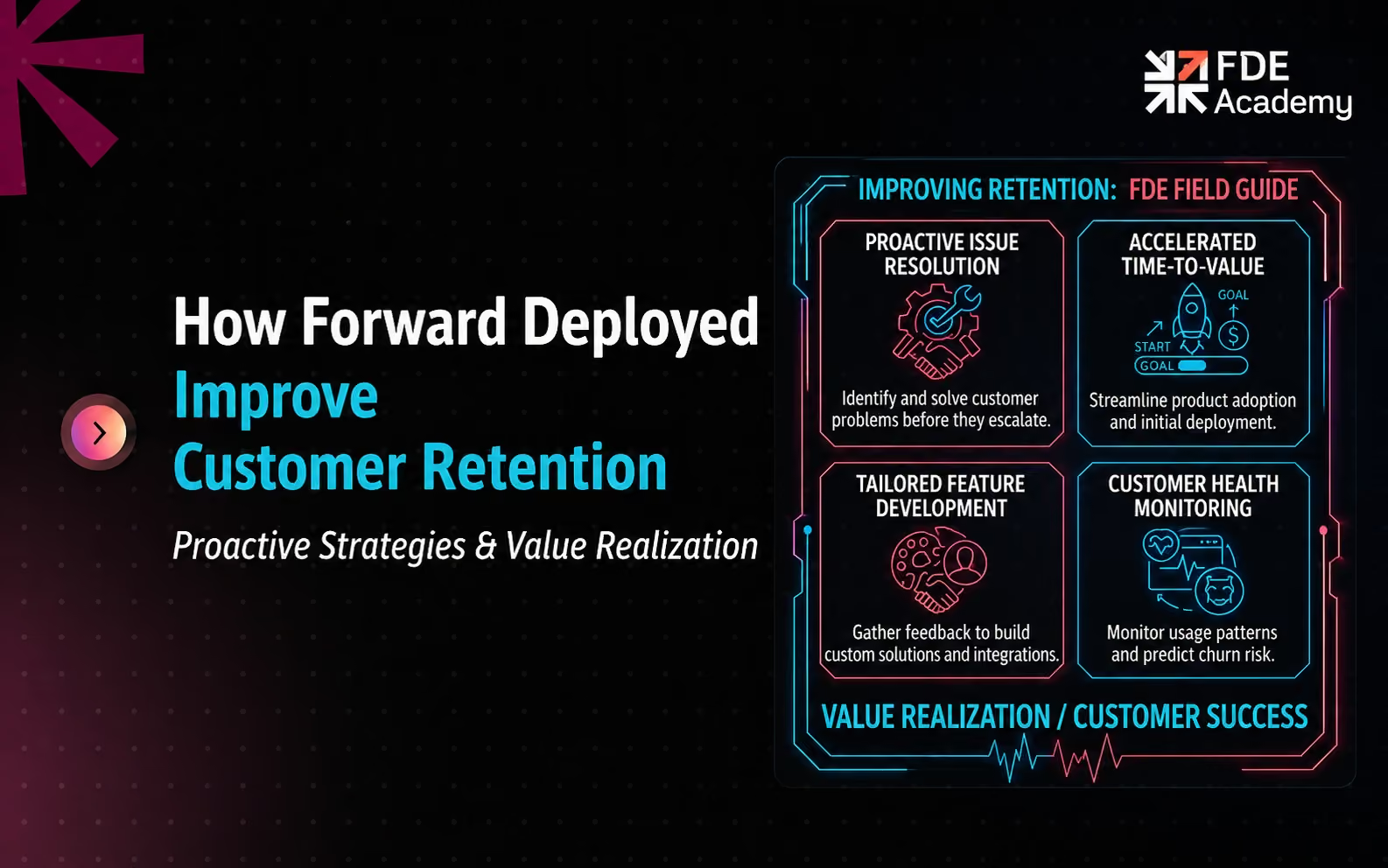
Forward Deployed Engineers improve customer retention through a specific, traceable chain of mechanisms, not vague "better service." Faster time-to-value shrinks the window where a customer might churn before ever seeing results. Problems get caught and fixed before they become the specific frustration that ends a renewal conversation. Embedded relationships raise the real cost of switching to a competitor.
And the feedback loop back to the product makes the system genuinely stickier over time, not just well-supported. This guide walks through each mechanism specifically, rather than treating retention as a vague byproduct of "good deployment work."
Retention deserves this level of specificity because it's the metric most directly tied to whether an AI investment was worth making at all.
A deployment that ships on time but churns within a year has still, in a real sense, failed, and understanding exactly which levers move retention is what lets a company invest in this hire deliberately, rather than hoping engagement quality translates into renewal by default.
Retention is a lagging, aggregate metric, it reflects the sum of everything that happened across a customer relationship, which makes it easy to discuss in the abstract and hard to trace back to a specific cause.
Forward Deployed Engineers sit close enough to the actual customer relationship that their impact on retention is unusually traceable compared to most engineering roles: you can point to the specific deployment milestone that built trust, the specific incident that got caught before it became a churn reason, the specific integration that made switching costly.
Our piece on how Forward Deployed Engineers improve AI ROI covers retention as one of several metrics in a broader ROI picture; this guide goes deeper specifically into why retention moves, not just that it does.
Every enterprise AI purchase has a vulnerable window between signing and seeing real value, and the longer that window stays open, the more opportunities exist for internal champions to lose confidence, budget conversations to sour, or a competing priority to displace the initiative entirely.
An FDE compresses this window directly, owning deployment as a dedicated, primary responsibility rather than a side task competing with a core team's roadmap. Shorter time-to-value means fewer months where a customer relationship is vulnerable to exactly this kind of quiet erosion before it ever reaches a renewal conversation.
Consider the alternative: a deployment that takes six months instead of six weeks gives an internal champion six months of budget scrutiny, leadership turnover risk, and competing initiative pressure to survive before they can point to a concrete result.
Every additional month without visible value is another month the champion has to defend the investment on faith rather than evidence, and internal champions who run out of patience before value arrives are one of the most common, and most preventable, causes of quiet early churn.
Most churn doesn't happen because of one dramatic failure, it happens because a string of smaller frustrations accumulates until a renewal conversation becomes a conversation about whether it's worth continuing.
FDEs, through disciplined evaluation practice and staying engaged through production stabilization, catch a meaningful share of these smaller frustrations before a customer ever experiences them: an edge case an evaluation harness flags before a user hits it, an integration issue caught in monitoring before it causes a visible outage.
Our habits of successful FDE pieces cover the specific practices, evaluation-first thinking, staying close to production after go-live, that make this mechanism actually work rather than being aspirational.
The distinction that matters here is proactive versus reactive discovery. A support ticket system discovers problems reactively, after a customer has already been frustrated enough to report one.
An FDE's evaluation harness and production monitoring discover the same category of problems proactively, often before a single end user notices. The renewal conversation a customer has after a deployment where they never needed to file a frustrated support ticket looks fundamentally different from one where they've accumulated a list of unresolved annoyances, even if the underlying system quality was comparable in both cases.
A customer whose only touchpoint with a vendor is a support ticket queue has a genuinely low switching cost, replacing an impersonal support relationship with another impersonal support relationship is easy.
A customer with an FDE embedded directly in their environment, who understands their specific data, their specific integration quirks, their specific internal politics, has accumulated something much harder to replace: institutional knowledge that would take a new vendor months to rebuild from scratch.
This isn't a manipulative lock-in tactic, it's a natural consequence of genuinely deep, specific work, but it functions as a real retention mechanism regardless of intent.
This mechanism compounds specifically because the knowledge involved is rarely fully documented anywhere formal.
An FDE who's spent months embedded with a customer carries context, which internal stakeholder actually makes the final call, which data source is technically correct but organizationally distrusted, which integration workaround exists because of a legacy constraint nobody wants to revisit, that a competing vendor starting fresh would need to rediscover from scratch, often the hard way.
That accumulated, informal context is precisely what makes switching costly in a way that's difficult to price out in a simple vendor comparison spreadsheet.
FDEs sit at the intersection of a specific customer's real usage and the broader product roadmap, which means the patterns they surface, repeatedly, across a deployment tend to shape what the product becomes next.
A product that evolves based on direct field signal from embedded engineers becomes progressively better fitted to exactly the customers it's already serving, a compounding advantage that's difficult for a competitor without the same embedded feedback loop to replicate quickly.
Retention improves not just because the current deployment works well, but because the product itself is on a trajectory shaped by the customers already using it.
This creates a specific, virtuous asymmetry over time. A vendor without embedded engineers learns about customer needs secondhand, through support tickets, sales calls, or periodic surveys, all filtered and delayed.
A vendor with FDEs learns directly, from engineers who've spent months inside the actual problem, and that signal reaches the product roadmap faster and with more fidelity.
Customers on that vendor's platform benefit disproportionately from improvements shaped by exactly their kind of use case, which makes staying increasingly rational compared to switching to a competitor building against a generic, less-informed picture of the same market.
By the time a renewal conversation actually happens, the mechanisms above have already done most of the work, the conversation itself tends to reflect accumulated trust rather than create it fresh.
A customer with a strong FDE relationship typically enters renewal discussions already having expanded scope organically (a sign the relationship compounds rather than plateaus), having a specific internal champion who can speak concretely to delivered value rather than a vague sense of satisfaction, and having a technical relationship deep enough that switching would mean losing real, accumulated institutional knowledge, not just a vendor name on an invoice.
Contrast this with a renewal conversation where none of these mechanisms were in play: time-to-value dragged on, the customer discovered problems reactively rather than having them caught proactively, the relationship stayed transactional rather than embedded, and the product hasn't visibly evolved based on this specific customer's experience.
That renewal conversation starts from a fundamentally weaker position, one where the vendor has to actively make the case for continuing rather than the case largely having made itself over the preceding months.
Forward Deployed Engineers (FDEs) can improve customer retention by helping customers achieve value faster, preventing technical problems before they become churn reasons, building deep technical relationships, and feeding real customer insights back into the product roadmap.
Their impact on retention goes beyond customer support. FDEs work directly inside the customer's technical environment, helping with deployments, integrations, production issues, and ongoing optimization. This creates stronger customer trust and makes the product increasingly aligned with the customer's needs.
Bottom line: FDEs improve retention by reducing the time to value, proactively solving problems, building institutional knowledge, and continuously improving the product based on real customer usage
Yes, through specific, traceable mechanisms: faster time-to-value, problems caught before they become churn reasons, embedded relationships that raise switching costs, and product feedback loops that make the system progressively stickier, not through generic "better service."
Customer Success typically manages relationship health and renewal conversations from outside the technical system. FDEs directly build and own the technical system itself, catching issues at the source and creating deep, specific institutional knowledge, mechanisms a relationship-focused CS role can't replicate on its own.
Organic scope expansion during an active engagement, a customer asking for more before a formal renewal conversation even starts is a strong signal the relationship has already built the trust that makes renewal close to a formality.
Yes. Our piece on how Forward Deployed Engineers improve AI ROI covers NRR as one of the concrete metrics FDE deployment is benchmarked against, alongside production deployment speed and other ROI indicators.
It's possible but harder. The mechanisms described here depend specifically on dedicated ownership, deep embedded relationships, and a functioning feedback loop, all of which are difficult to replicate with a team splitting attention across many customers or a purely reactive support model.
Both, inseparably. The relationship depth that raises switching costs is built through real technical work, integrations, fixes, deployments, not through relationship management alone. Removing the technical substance would collapse the mechanism entirely.
The world is hiring - and this Academy prepares you for it.