Blogs
Python Skills You Need for a Forward Deployed Engineer Interview
Python Skills You Need for a Forward Deployed Engineer Interview
By
R&D FDE academy
September 18, 2026

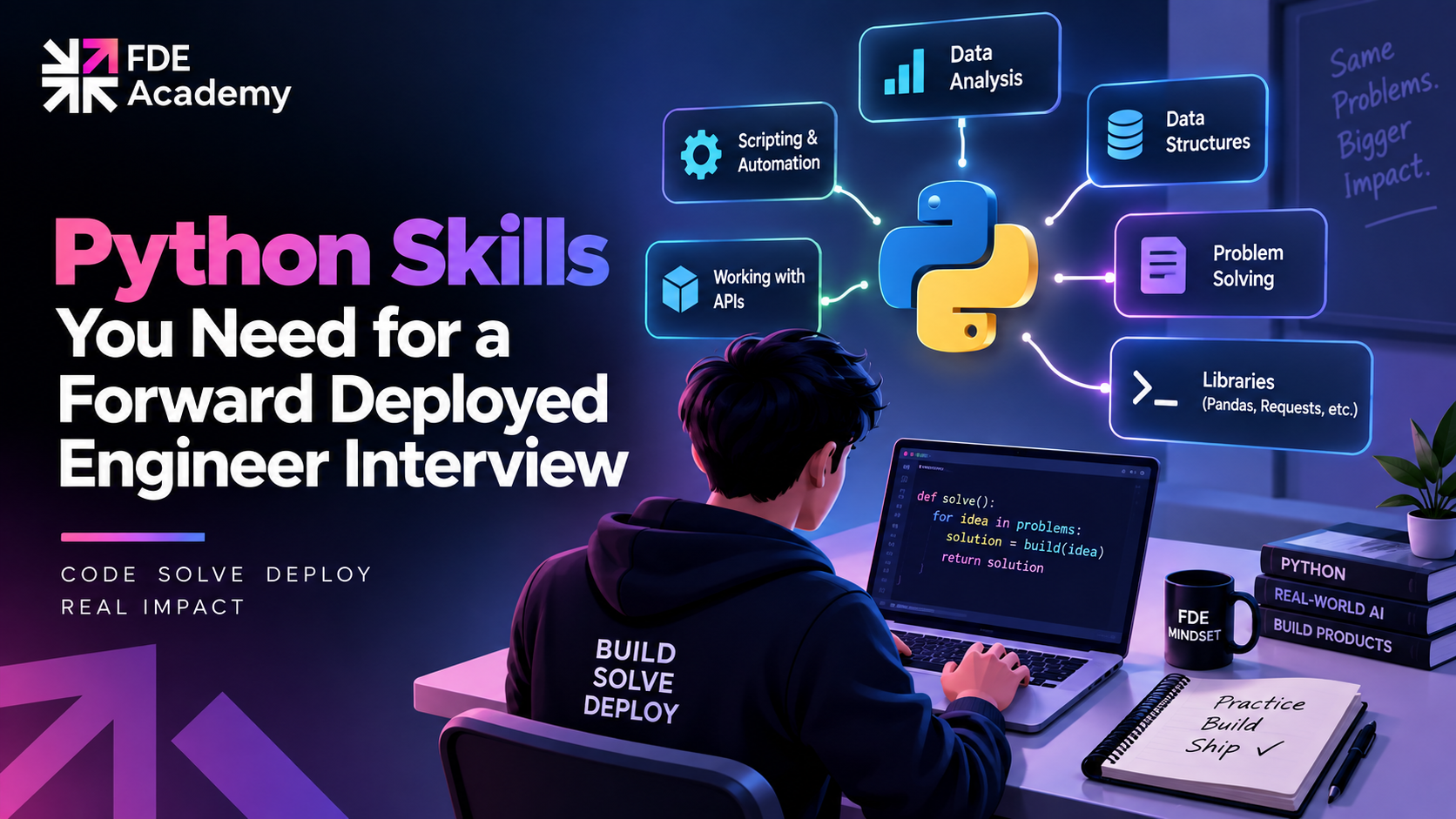
Most engineers preparing for an FDE interview default to LeetCode, and that instinct is largely misplaced. Most Forward Deployed Engineer interviews include a technical round with some coding, but not LeetCode-style algorithm-focused coding the emphasis is on integration design, systems thinking, and production-quality code under real-world constraints. Spending your prep time drilling algorithmic puzzles is a real misalignment with what FDE interviewers are actually testing.
For the full picture of every round in the loop, not just the Python-specific one, see our guide to general Forward Deployed Engineer interview questions. This article goes deep specifically on the Python skills tested within that loop, since Python remains the dominant language for FDE work our broader guide on best programming languages to learn for an FDE role covers why Python sits at the top of that priority list for the role generally, beyond just interview prep.
Format varies by company, but a consistent pattern shows up across most FDE loops. A typical technical round runs around 60 minutes in a shared editor (CodePair, CoderPad, or a take-home), and what's tested is practical engineering, not algorithm trivia. This is exactly where most engineers over-prepare on the wrong thing and under-prepare on the actual format.
Some companies run this as a collaborative, pair-programming-style round working alongside an interviewer to diagnose and fix a bug in an unfamiliar codebase or small module, where the focus is less on trick puzzles and more on how you navigate ambiguity, write tests, and communicate while iterating. Others run a more standalone timed coding assessment. Either way, the underlying skill being tested is the same: can you write Python that holds up against real, messy conditions, not just pass a set of predefined test cases.
Across multiple independent sources analyzing real FDE interview loops, a consistent set of practical Python exercise types keeps appearing. Useful prep exercises include a rate limiter, a CSV parser with edge cases, a streaming consumer with backpressure, retry/backoff logic, and a small RAG pipeline five patterns that map directly onto what real FDE work actually requires day to day, not abstract computer science puzzles.
Parsing messy, real-world data. Expect to parse a messy CSV or JSON file and extract structured data while handling edge cases missing fields, inconsistent formatting, unexpected types. This mirrors the actual first step of most FDE engagements: making sense of a customer's real, imperfect data before building anything on top of it.
Rate limiting and backoff logic. Building a rate limiter or implementing retry-with-backoff logic tests whether you understand how to build resilient integrations against external systems that fail, throttle, or behave unpredictably a near-daily concern in real customer-environment integration work.
Streaming data with backpressure. A streaming consumer with backpressure handling tests whether you can reason about data flow under load, not just process a static, well-behaved input list.
Multi-dimensional logic problems. Some companies go further, asking you to write Python functions that account for several dimensions at once one documented example involved a file-system permissions challenge that factored in both hierarchy and the timestamps of permission changes, testing whether you can hold multiple interacting constraints in your head simultaneously rather than solving a single isolated rule.
A small RAG pipeline. Given how central retrieval-augmented generation has become to modern FDE work, being able to sketch or implement a basic RAG pipeline chunking, embedding, retrieval, and passing context to a model is now a realistic interview expectation, not just a nice-to-have.
A recurring, distinct round in many FDE loops focuses specifically on debugging rather than writing new code from scratch and it's a skill many candidates underprepare for relative to how often it shows up. When walking through a debugging exercise, interviewers want to see a clear loop: reproduce the issue, minimize it to the smallest failing case, form a hypothesis, instrument or log to test that hypothesis, fix it, and then write a regression test to confirm it stays fixed.
Practical tools matter here as much as the reasoning itself fluency with pytest for tests, pdb for breakpoints, structured logging, and constructing small, deterministic inputs to isolate a failure all signal real production experience rather than textbook debugging knowledge. Asking clarifying questions about expected behavior, edge cases, and interfaces before changing code rather than immediately diving in and thrashing is itself part of what's being evaluated.
One detail that shows up consistently across FDE interview accounts: silence is one of the most common ways candidates lose points in these rounds. Practicing narrating your code out loud while you write it is a specific, trainable skill not just a communication nicety, but a direct proxy for what the job actually requires: explaining a technical trade-off to a non-technical stakeholder in real time, not after the fact.
This connects directly to why coding is present but secondary to systems reasoning in these rounds. An interviewer would generally rather see a candidate reason clearly through a suboptimal solution out loud than silently produce a technically perfect one with no visible thought process the former is a much closer proxy to real FDE work than the latter.
It's worth knowing that Python rarely gets tested in complete isolation SQL fluency often shows up in the same loop or an adjacent round, particularly given how much FDE work involves querying and transforming a customer's existing data before any Python integration work even begins. Problems that hinge on stating your assumptions explicitly while working with imperfect data under time pressure a pattern common to both Python and SQL rounds in FDE loops show up frequently at companies like Palantir and Scale AI specifically, since the mix of technical fluency and judgment under ambiguity is difficult to fake through memorized preparation alone.
If you've interviewed for standard software engineering roles before, it's worth resetting a few expectations. A standard SWE loop weights algorithmic problem-solving heavily and often abstracts away real-world messiness in favor of clean, well-specified problems. FDE loops invert that: the "hard part" isn't the algorithm, it's handling the mess missing data, ambiguous requirements, systems that don't quite talk to each other cleanly, and a stakeholder in the room who isn't technical.
This is consistent with the deeper reason do Forward Deployed Engineers actually code has a nuanced answer: yes, extensively, but the code exists in service of solving a specific, messy customer problem, not as a standalone technical exercise and the interview is deliberately designed to test for exactly that orientation. For the fuller skill picture beyond just Python, our guide to the skills an FDE actually needs covers the non-coding dimensions that round out what's actually being evaluated across the full loop.
Structure your prep around the real pattern set rather than generic algorithm practice. Work through the five practical exercise types directly a rate limiter, a CSV/JSON parser with edge cases, a streaming consumer with backpressure, retry/backoff logic, and a small RAG pipeline since these map far more closely to what's actually tested than a standard DSA problem set would.
Practice your debugging loop deliberately and out loud: reproduce, minimize, hypothesize, instrument, fix, regression test using pytest and pdb as your actual tools, not just describing the process abstractly. And practice narrating your reasoning the entire time you code, since silence is consistently flagged as one of the most common, avoidable failure points in these rounds.
It's also worth reviewing common reasons candidates fail Forward Deployed Engineer interviews before your loop, since over-indexing on LeetCode-style prep at the expense of practical, narrated, messy-data problem-solving is one of the most frequently cited, avoidable mistakes. If you're preparing for a specific company's loop, our guide on Google Forward Deployed Engineer interview questions walks through how one major company's version of this round is actually structured. And since Python performance in the coding round is only one piece of the evaluation, make sure your resume and portfolio can back up the ownership claims you'll be asked to defend in a separate, project-deep-dive round.
TL;DR: The FDE Python round isn't a LeetCode round in disguise. Interviewers are testing practical engineering under real-world constraints parsing messy CSV/JSON data, building rate limiters and retry logic, handling streaming data with backpressure, and debugging an unfamiliar codebase not algorithmic optimization. Coding is present but secondary to systems reasoning: can you design something that works reliably against messy, real data, and can you narrate your thinking clearly while you build it.
No. Most FDE Python rounds emphasize practical, realistic engineering problems parsing messy data, building resilient integrations, debugging over algorithmic optimization puzzles. Coding ability is tested, but it's secondary to systems reasoning and handling real-world constraints.
Common patterns include parsing messy CSV or JSON data with edge cases, building a rate limiter, implementing retry-with-backoff logic, handling a streaming data consumer with backpressure, and sketching or implementing a small RAG pipeline.
Yes, in most cases. SQL fluency frequently appears in the same loop or an adjacent round, since FDE work regularly involves querying and transforming a customer's existing data before any Python integration work begins.
Very important. Silence is one of the most commonly cited reasons candidates underperform in FDE coding rounds. Narrating your reasoning as you work is treated as a direct proxy for the real job, which requires explaining technical trade-offs to non-technical stakeholders in real time.
Practice a structured debugging loop: reproduce the issue, minimize it to the smallest failing case, form a hypothesis, use logging or a debugger like pdb to test it, fix the issue, and write a regression test. Familiarity with pytest and structured logging is expected, not just an ability to eventually find the bug.
No, not primarily. Spending most of your preparation time on LeetCode is commonly cited as a significant misalignment with what FDE interviewers actually test. Practical, messy-data problem types and clear narration under ambiguity are a better use of preparation time.
The world is hiring - and this Academy prepares you for it.